
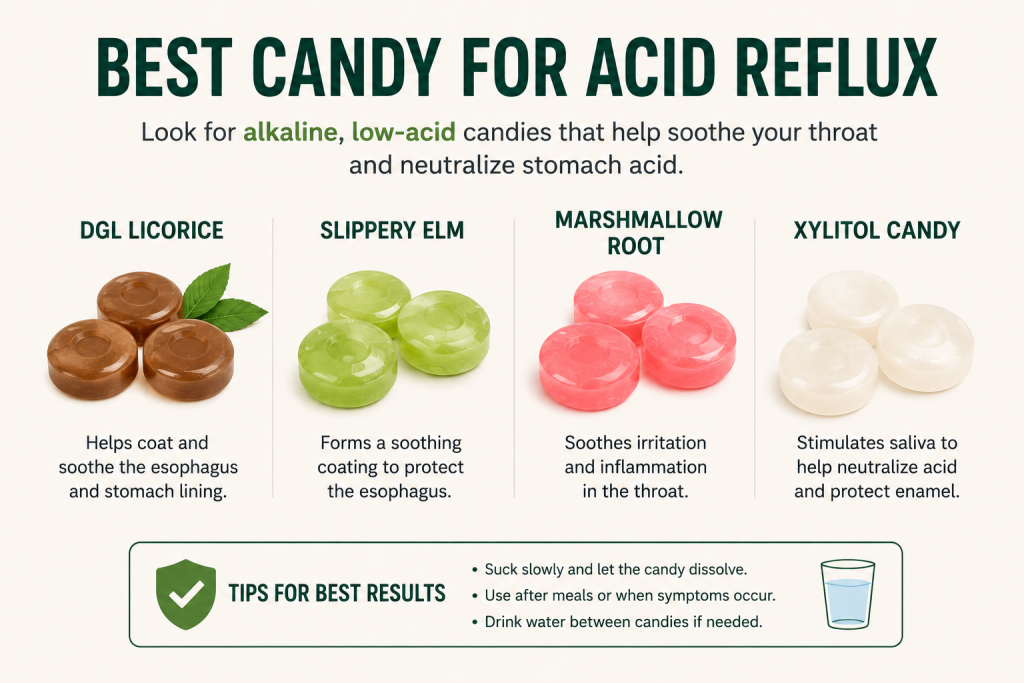
Let’s be honest from the start: no candy is good for acid reflux. Candy is essentially concentrated sugar, and research now shows that reducing simple sugar intake measurably improves acid exposure time and reflux episodes. But “no candy ever” is not a realistic position for most people, and the real question is which types cause the least damage — and which you should avoid entirely.
The difference between candy types matters enormously. A small amount of plain hard candy made with sugar and no citric acid, mint, or chocolate is a completely different proposition to a handful of sour gummy worms, which can measure as acidic as pH 1.8 — more acidic than vinegar — and directly reactivate pepsin in the throat. One is an excess sugar problem; the other is an active LPR injury mechanism operating in a single handful.
This guide works through the worst offenders first (with the mechanisms explained), then the options that are least likely to cause problems in small amounts, and practical guidance for managing the sweet craving without triggering a flare.
Key Takeaways
- A randomised controlled trial found that reducing simple sugar intake by around 62g per day significantly reduced oesophageal acid exposure time, total reflux episodes, heartburn, and regurgitation — making high-sugar candy a meaningful dietary concern, not just an indirect one.
- Chocolate, peppermint, and sour/citrus-flavoured candy are the three worst candy categories for acid reflux — each with a distinct and documented mechanism: LES relaxation, direct pepsin reactivation, and mucosal irritation respectively.
- Sour candy is especially dangerous for LPR (silent reflux) because it combines high sugar with citric, malic, or tartaric acid at pH values as low as 1.8 — directly creating the acidic environment that reactivates dormant pepsin in the throat.
- Plain candy without citric acid, chocolate, or mint — such as plain marshmallows, plain candy corn, or plain hard candy in non-citrus flavours — is the least triggering option in small amounts.
- Sugar-free candy is not automatically safer — many sugar-free products replace sugar with acidic flavourings, citric acid coatings, or sweeteners that can cause bloating and gas, which increases reflux pressure.
- Portion size and timing both matter as much as the candy type — even the safest option causes problems in large quantities or eaten close to bed.
What Makes Most Candy Bad for Acid Reflux?
To understand which candy is safer, you first need to understand the specific mechanisms by which candy triggers reflux. There are four main pathways, and different types of candy activate different ones.
Simple sugar load: The most direct mechanism. A Vanderbilt University randomised controlled trial — the first of its kind specifically examining dietary carbohydrate type and GERD — found that reducing simple sugar intake by an average of 62 grams per day (roughly equivalent to a moderate-sized chocolate bar or bag of sweets) significantly reduced oesophageal acid exposure time and the total number of reflux episodes measured by 24-hour pH monitoring. The proposed mechanism involves simple sugars affecting gastric motility and fermentation patterns in the lower oesophageal region. All candy contributes to this load.
Lower oesophageal sphincter (LES) relaxation: Certain candy ingredients directly relax the LES — the valve between the stomach and oesophagus that prevents reflux. Chocolate is the most extensively studied: its methylxanthines (theobromine and caffeine) and the serotonin released from intestinal cells in response to cocoa both cause measurable decreases in LES pressure. Peppermint oil — including the amount in a peppermint candy — relaxes LES smooth muscle through calcium channel effects. Both have peer-reviewed evidence behind them.
Fat content: Fat delays gastric emptying and directly stimulates transient LES relaxations via small intestinal receptors. Chocolates, caramels, toffees, and cream-filled candies all have significant fat content that compounds their reflux risk beyond their sugar load alone.
Acidity (for LPR in particular): This is the most dangerous mechanism and the one most people don’t think about when they reach for sweets. Many fruit-flavoured, sour, and gummy candies contain citric acid, malic acid, tartaric acid, or combinations of these — at pH values well below the pH 4 threshold that activates pepsin, and sometimes below pH 2. For anyone with LPR, eating acidic candy effectively reactivates dormant pepsin in throat and laryngeal tissue. The pH threshold matters: anything below pH 5 creates a risk of pepsin reactivation, and sour candy sits far below that. This is why citric acid in candy is such a specific concern for LPR patients, as explored in the dedicated citric acid and acid reflux guide.
The Worst Candy for Acid Reflux and LPR
Chocolate Candy
Chocolate deserves its reputation as a reflux trigger — it’s one of the most extensively documented dietary causes of LES relaxation. Chocolate causes intestinal cells to release large amounts of serotonin, which relaxes the LES directly. Studies measuring LES pressure before and after chocolate ingestion found that mean basal LES pressure dropped from 14.6 mmHg to 7.9 mmHg — essentially halving the pressure holding that valve closed. On top of this, methylxanthines (theobromine and caffeine) provide a second LES-relaxing mechanism.
Dark chocolate is the worst offender because it contains the highest concentration of cocoa — and therefore the highest methylxanthine and serotonin-triggering compound content. Milk chocolate is somewhat better (more milk, less cocoa), and white chocolate contains no cocoa at all — making it the only chocolate-like candy that avoids the cocoa-driven LES relaxation mechanism (though it still contains fat and sugar).
The full mechanism and what to do if you can’t give chocolate up entirely is covered in the chocolate and acid reflux guide.
Peppermint and Spearmint Candy
Peppermint candy, candy canes, mint humbugs, and any mint-flavoured sweet all contain menthol — the active compound that relaxes the LES through smooth muscle effects. Peppermint oil reduces LES pressure by blocking calcium channels in smooth muscle, creating the same physiological setup as chocolate: a loosened valve allowing stomach contents to reflux upward more easily.
A study of spearmint specifically found that while flavouring doses had no measurable effect on LES pressure, higher doses caused symptoms through direct mucosal irritation. And menthol infusion into the oesophagus significantly reduced upper oesophageal sphincter pressure — which is the valve protecting the throat in LPR. This matters particularly for LPR patients, where both sphincters (upper and lower) are relevant to pepsin reaching the larynx.
The folk belief that peppermint “settles the stomach” and might help reflux is the opposite of true for acid reflux patients — exactly the relaxing effect that helps IBS-related intestinal spasm is the mechanism that worsens reflux. This is covered thoroughly in the article on peppermint and acid reflux.
Sour Candy
This is the single worst category of candy for LPR specifically, and arguably the most underappreciated candy danger for reflux sufferers in general.
Sour candy — Sour Patch Kids, sour gummy worms, sour belts, lemon sherbets, warheads — achieves its sour taste through organic acids: typically citric acid, malic acid, tartaric acid, or combinations of these. The pH of sour candy ranges from approximately pH 1.8 to pH 3.5 depending on the product. To put that in context: lemon juice sits at pH 2–2.5. Many sour candies are as acidic as undiluted lemon juice.
For LPR patients, this matters enormously. Pepsin deposited in throat tissue from previous reflux events remains stable and dormant at neutral pH — but is reactivated by any acidic exposure below around pH 6. Eating pH 2 candy delivers precisely the acid environment that wakes up that dormant pepsin and restarts the inflammatory cycle in the throat, even without a new reflux event. This is the same reason LPR guidelines recommend avoiding all foods and drinks below pH 4–5: it’s not just about stopping new reflux, it’s about not reactivating what’s already sitting in the tissue.
Citrus-Flavoured Gummies and Hard Candy
This category catches many people off guard. Gummies that aren’t sour-coated still typically contain citric acid as part of their formulation — for flavour enhancement, preservation, and as a pH modifier to help pectin or gelatin set correctly. Most commercial gummies are manufactured at pH 1.9–4.0. Even “non-sour” fruit gummies contain citric acid, just without the additional acid-sand coating that makes sour varieties so extreme.
Citrus-flavoured hard candy — lemon drops, orange sweets, lime-flavoured boiled sweets — similarly contain citric acid as their primary flavour compound. Check the ingredients: if citric acid appears in the label, the product is acidic enough to reactivate pepsin in the throat.
Caramels, Toffees, and Cream-Filled Chocolates
High fat content is the problem here. Fat delays gastric emptying and stimulates transient LES relaxations through receptors in the small intestine — the mechanism is well-established in reflux pathophysiology. Caramels and toffees don’t have the acute pepsin-reactivating problem of sour candy or the serotonin mechanism of chocolate, but their fat content compounds the gastric pressure effects of their sugar load and creates conditions favourable for post-meal reflux.
They’re also particularly problematic when eaten close to bed, since the delayed gastric emptying effect means stomach contents — and the acid from digesting that fatty candy — are still present at higher volumes when you lie down.
Candy That’s Least Likely to Trigger Reflux
None of the following are recommended as part of a reflux management diet — the simple sugar load is a problem regardless. But if you’re going to have a small amount of something sweet, these categories are the least likely to provoke a significant response:
Plain Marshmallows
Marshmallows are made primarily from sugar, gelatin, and air. They contain no fat, no citric acid, no mint, and no chocolate. They’re among the least triggering confections for reflux because they don’t activate any of the four main candy-reflux mechanisms beyond the basic sugar load. They’re not alkaline or protective — they’re just neutral in terms of trigger ingredients. Keep portions small and don’t eat them close to bedtime.
Candy Corn
Candy corn is essentially a sugar confection — sugar, corn syrup, honey, and wax, with no fat, citric acid, mint, or chocolate. The same logic applies as to marshmallows: no specific trigger beyond the sugar content. In small amounts, eaten earlier in the day, it’s one of the more neutral candy options for reflux.
Plain Jelly Beans (Selected Flavours)
Plain jelly beans — particularly vanilla, coconut, or berry flavours without citric acid in the formulation — can be reasonably tolerated in small amounts. Check the ingredients label carefully: many jelly bean brands include citric acid in fruit-flavoured varieties. Look for flavours without “citric acid” in the ingredient list. Buttered popcorn and coconut flavours tend to be safer choices.
Plain Hard Candy (Non-Citrus, Non-Mint Flavours)
Plain boiled sweets or hard candy in vanilla, butterscotch, or caramel flavours — without citric acid, mint, or chocolate — represent the most accessible “safe” candy option for most people. Dissolve slowly in the mouth, keep portions to one or two pieces, and avoid them within two to three hours of bed.
Look specifically for the absence of: citric acid, malic acid, tartaric acid, peppermint oil, spearmint oil, menthol, and chocolate. If those aren’t in the ingredients, you’re looking at a pure sugar and flavour product whose main reflux risk is the overall sugar load.
Liquorice (Genuine Anise Liquorice)
Real black liquorice — made with liquorice root extract and anise — has a long history as a digestive aid. DGL (deglycyrrhizinated liquorice) in particular has some clinical evidence as a mucosal protectant, though the clinical picture is mixed. Plain anise liquorice without citric acid or sour coating is a reasonably neutral option. Be aware, however, that “red liquorice” (like Twizzlers) contains no actual liquorice root — it’s a fruit-flavoured chewy candy with citric acid and is not the same thing at all.
What About Sugar-Free Candy?
Sugar-free is not automatically reflux-safe, and in some cases it creates different problems.
The acidity issue remains: many sugar-free fruit-flavoured candies still contain citric acid for flavouring, at the same pH as their sugared equivalents. Removing sugar doesn’t remove the citric acid that reactivates pepsin.
Sugar alcohols — xylitol, sorbitol, maltitol, and erythritol — which are the most common sugar replacements in sugar-free candy, can cause significant gas, bloating, and loose stools in many people, particularly in larger quantities. Gas and bloating directly increase intra-gastric pressure, which worsens reflux by making transient LES relaxations more likely to be symptomatic. So sugar-free candy can produce a different but still meaningful reflux-worsening effect through this pathway.
Sugar-free peppermint candy still contains menthol. Sugar-free chocolate still contains methylxanthines and fat. The “sugar-free” label removes one variable while leaving the category-specific triggers intact.
The best-case scenario for sugar-free candy is a plain, non-citrus, non-mint, non-chocolate variety sweetened with a sugar alcohol — which avoids most triggers while potentially introducing the gas-bloating pressure problem. If you do well with sugar alcohols (some people do, some don’t), this can be a reasonable option in small amounts.
The LPR Angle: Why Candy Is Particularly Complicated for Silent Reflux
For anyone managing LPR specifically, the candy landscape is harder than for standard GERD, and the reason comes back to pepsin reactivation.
Standard GERD management focuses primarily on reducing acid production and preventing reflux events. For this purpose, the main candy concern is the simple sugar load and specific LES-relaxing triggers (chocolate, mint). A small amount of plain candy eaten at the right time and in the right context causes a manageable additional acid load.
LPR requires an additional layer of thinking. Pepsin that has already reached the throat from previous reflux events sits dormant in laryngeal tissue, waiting for an acidic environment to reactivate it. The threshold for reactivation is roughly pH 6.5 — pepsin is active at this pH level and below. Most citrus-flavoured candy, all sour candy, and many gummies sit at pH values several units below this threshold. Eating them doesn’t just add more reflux risk — it actively reignites injury from pepsin that’s already there.
This is why the LPR food framework is stricter about dietary pH than the standard GERD framework. It’s not that LPR sufferers produce more acid — it’s that the injury mechanism (pepsin in the throat) can be triggered by acidic food or drink even without a new reflux event. For full detail on this, the LPR symptoms guide explains the pepsin mechanism and why diet management is so specific to the condition.
Practical Tips for Managing Sweet Cravings With Reflux
Eat it earlier in the day. If you’re going to have any candy, the middle of the afternoon is better than after dinner. You need at least two to three hours of upright time before lying down regardless of what you eat, but earlier gives more time for gastric emptying before sleep — when reflux risk is highest.
Check every label for citric acid. “Fruit-flavoured” and “citric acid” are nearly synonymous in the confectionery industry. If a candy has any fruit flavour at all — lemon, orange, strawberry, berry — assume it contains citric acid unless the label specifically confirms otherwise. Citric acid should be your first ingredient check for LPR.
Keep portions genuinely small. The safe candy options above are only safe in small amounts. Two marshmallows or three jelly beans is a different proposition from a large bag. The simple sugar load compounds with quantity, and so does the gastric pressure effect.
Don’t eat candy on an empty stomach. Candy eaten with or just after a meal is somewhat buffered by the food in the stomach. Candy eaten on an empty stomach delivers a direct sugar hit to an undiluted gastric environment, which can worsen symptoms more than the same amount eaten with a meal.
Consider alternatives that satisfy sweetness without the risks. A ripe banana satisfies a sweet craving with a pH of around 5.0–5.6 and no fat, no citric acid, and no LES-relaxing compounds. A small amount of manuka honey — the subject of its own dedicated guide on manuka honey and acid reflux — can satisfy sweetness with the added benefit of some antibacterial and potentially mucosal-soothing properties.
Rinse your mouth with water after eating any candy. This is particularly relevant for LPR — clearing residual sugars and any acid from the oral cavity reduces the ongoing acidity in the throat environment after eating. It’s a simple habit that reduces the window of pepsin reactivation risk.
For a broader view of which foods to prioritise and which to avoid in LPR management, the LPR foods to avoid guide covers the full dietary picture with mechanisms explained for each category.
Frequently Asked Questions
What candy can I eat with acid reflux?
In small amounts, the least triggering options are plain marshmallows, candy corn, plain hard candy in non-citrus and non-mint flavours (butterscotch, vanilla), and plain jelly beans in flavours without citric acid. None of these are good for reflux — the sugar load is always a concern — but they don’t activate the major reflux mechanisms of chocolate (LES relaxation), peppermint (LES relaxation), or sour/citrus candy (pepsin reactivation from low pH).
Why is sour candy so bad for acid reflux?
Sour candy achieves its sharpness through citric, malic, tartaric, or fumaric acid at pH values often between 1.8 and 3.5 — more acidic than vinegar and similar to lemon juice. For LPR sufferers specifically, these acids directly reactivate dormant pepsin already present in throat tissue from previous reflux events, reigniting the inflammatory injury cycle without needing a new reflux event to occur. Even for standard GERD, the acid load compounds the sugar-driven reflux effect.
Is sugar-free candy better for acid reflux?
Not necessarily. Sugar-free candy still contains citric acid if it’s fruit-flavoured. Sugar-free peppermint candy still contains menthol. Sugar-free chocolate still contains fat and methylxanthines. Additionally, sugar alcohols (the most common sweeteners in sugar-free candy) cause gas and bloating in many people, which increases intra-gastric pressure and worsens reflux. Plain, non-citrus, non-mint sugar-free candy with a tolerated sweetener is the best option, but it’s not automatically safe.
Is chocolate candy the worst for acid reflux?
Chocolate is among the worst for GERD specifically because it demonstrably lowers LES pressure through both serotonin release and methylxanthines — directly causing more reflux events. For LPR, sour candy may be even worse because of the direct pepsin reactivation from low pH, which doesn’t require the LES to relax at all. The answer depends on whether your primary concern is GERD (heartburn, oesophageal acid exposure) or LPR (throat damage from pepsin).
Can candy cause a reflux flare?
Yes — and the type of candy determines the severity and mechanism of the flare. Chocolate candy can trigger a flare within minutes of eating through LES pressure reduction. Sour or citrus candy can trigger LPR throat symptoms by reactivating existing pepsin. Large quantities of any candy contribute to the simple sugar load documented to worsen acid exposure time. Eating candy close to bed is particularly problematic because gastric emptying is slower at night and reflux events are more damaging when lying down.
What is the best candy for LPR (silent reflux)?
The threshold for LPR is stricter than for GERD because of the pepsin reactivation issue. For LPR, the primary requirement is that the candy contains no citric acid or other added food acids (no sour or fruit flavour that requires acidic pH), no chocolate, and no peppermint or mint. Plain marshmallows and plain vanilla or butterscotch hard candy without citric acid are the least problematic options. Even these should be kept to small amounts and eaten well before bed, as the sugar load still matters.
Conclusion
The honest answer to “best candy for acid reflux” is that the question is really about minimising harm rather than finding a genuinely safe option. All candy contributes to the simple sugar load that research now links to worsened acid exposure and reflux episodes. The best you can do is avoid the categories with specific additional mechanisms — chocolate, peppermint, sour candy, and citrus-flavoured products — and keep any remaining options to small amounts eaten at the right time of day.
For LPR sufferers, the bar is higher. The citric acid in fruit-flavoured and sour candy reactivates pepsin in throat tissue and should be avoided during any active management phase — not occasionally, but consistently, because the injury mechanism operates from a single exposure. Plain, non-acidic candy in very small quantities, eaten hours before bed, is the outer limit of what’s manageable during LPR treatment.
If sweet cravings are a significant challenge in your reflux management, building a broader picture of what you can eat — not just what to avoid — helps enormously. The LPR foods to eat guide covers the full range of reflux-friendly foods, and the Wipeout Diet Plan provides the full structured framework — including how to approach foods like these in phases as healing progresses. The Wipeout Food Reference Guide gives you the pH values and reflux potential of foods and drinks at a glance — so you know exactly where any given candy or sweet sits before you eat it, rather than finding out afterwards.
Research Sources
[__Gu et al., American Journal of Gastroenterology, 2022__] — First randomised controlled diet intervention trial examining both amount and type of dietary carbohydrate on symptomatic GERD in 98 veterans; reducing simple sugar intake by an average of 62g/day significantly reduced oesophageal acid exposure time and total reflux episodes measured by 24-hour pH monitoring; all carbohydrate modification groups showed subjective improvement in heartburn and regurgitation; established a direct evidence-based link between dietary simple sugar reduction and GERD improvement.
[__Wright & Castell, Digestive Diseases and Sciences, 1975__] — Study of 9 normal subjects demonstrating that chocolate ingestion reduced mean basal LES pressure from 14.6 mmHg to 7.9 mmHg (p < 0.01) — essentially halving the sphincter pressure that prevents reflux; established the physiological mechanism by which chocolate causes gastro-oesophageal reflux; antacid administration alongside chocolate did not attenuate the LES pressure reduction.
[__Tang et al., Nutrients, 2021__] — Cross-sectional study of free sugar consumption and LPR risk in Chinese adolescents; found significant positive associations between free sugar consumption and LPR prevalence, with proposed mechanisms similar to those established for GERD; noted that LPR mucosal damage is primarily driven by pepsin and bile salts rather than acid alone, establishing why dietary acid control is particularly important for LPR beyond simple sugar reduction.
[__Holloway et al., Gut, 1997__] — Study of 12 healthy volunteers and 11 reflux oesophagitis patients demonstrating that duodenal fat infusion significantly increased transient LES relaxations and oesophageal acid exposure compared to saline; established that fat stimulates LES relaxation via small intestinal receptors — the mechanism by which chocolate, caramel, and cream-filled candies with high fat content worsen reflux beyond their sugar load.
[__Bulat et al., Alimentary Pharmacology and Therapeutics, 1999__] — Controlled study showing that spearmint at flavouring doses has no measurable effect on LES pressure or objective acid reflux in healthy volunteers; however, high doses caused symptoms through direct mucosal irritation; relevant because it distinguishes the dose-dependent nature of mint’s effect and confirms that even spearmint at higher doses causes reflux-like symptoms through mucosal irritation, supporting avoidance in reflux management.
[__Farkas et al., Journal of Clinical Medicine, 2024__] — High resolution manometry study of menthol’s effect on oesophageal motility in healthy volunteers and GERD patients; found that menthol significantly reduced upper oesophageal sphincter pressure in patients with ineffective oesophageal motility, adding to the evidence that peppermint-containing products (including peppermint candy) affect the sphincter mechanisms that protect against LPR — both the LES at the lower end and the UES at the upper end relevant to throat reflux.

David Gray
12 years living with LPR · Consultant & researcher
I've lived with LPR for twelve years — the misdiagnoses, the PPI courses that did nothing, the slow work of figuring out what actually helps. Wipeout Reflux is where I translate the research into plain terms for people stuck in the same place. Every claim here is sourced to peer-reviewed work, and I consult one-to-one with LPR sufferers.