
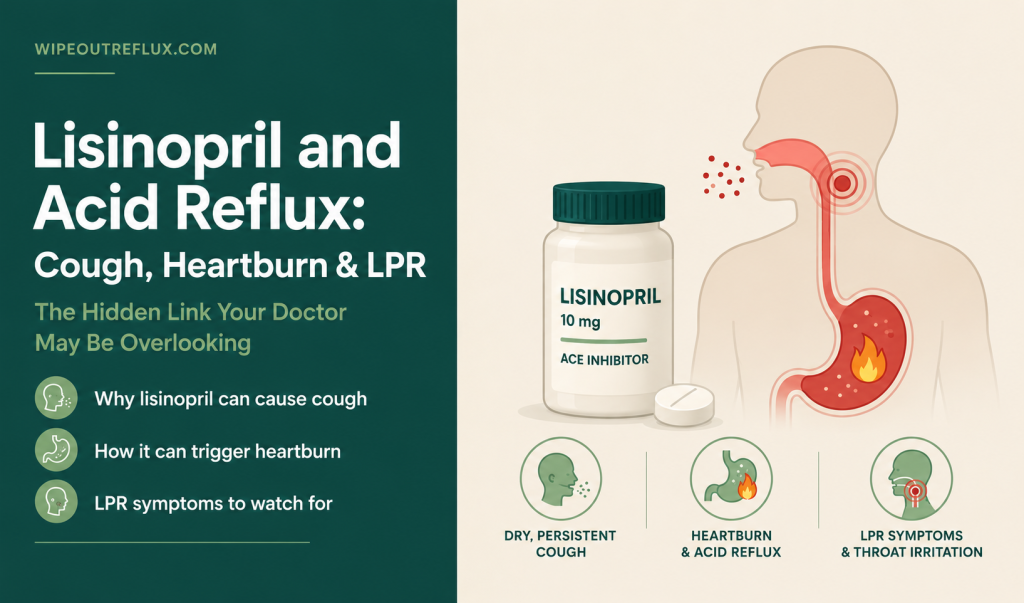
Lisinopril isn’t a classic cause of acid reflux, but there are two real connections worth understanding. First, it can occasionally trigger indigestion or heartburn as a less-common side effect — though nausea is the more typical gut complaint. Second, and this is the one that matters most on a reflux site, lisinopril causes a dry, nagging cough and throat irritation in a meaningful minority of people, and that cough is very easily mistaken for silent reflux (LPR).
So if you’re on lisinopril and chasing a “reflux cough” or constant throat clearing, the drug itself could be the real culprit — or at least part of it.
One thing up front: never stop or change a blood pressure medication on your own. Lisinopril is protecting your heart, kidneys and blood pressure. The aim of this article is to help you have a more informed conversation with your doctor, not to talk you out of your prescription.
Key Takeaways
- Lisinopril is an ACE inhibitor used for high blood pressure and heart protection — it is not a major direct cause of acid reflux.
- Heartburn and indigestion are recognised but relatively uncommon side effects; nausea and diarrhoea are the more typical gut complaints.
- The bigger reflux-site issue is the ACE inhibitor cough — a dry, persistent cough that affects roughly 5–35% of users and is often misread as silent reflux (LPR).
- This cough is caused by a build-up of bradykinin and substance P, which sensitise the nerves in your airway and throat.
- The cough can start anywhere from hours to months after beginning the drug, so it’s easy not to connect it to lisinopril at all.
- Switching to an ARB (such as losartan) usually resolves the cough, because ARBs don’t cause the same bradykinin build-up — but that’s your doctor’s call.
- Sudden facial, lip, tongue or throat swelling, or severe stomach pain, can signal angioedema — treat that as an emergency.
Does Lisinopril Cause Acid Reflux or Heartburn?
Let’s deal with the direct question first, because it’s the one most people are typing into Google.
Lisinopril can cause heartburn or indigestion, but it sits in the “less common, frequency-not-reported” category rather than being a headline side effect. The gut symptoms that show up more often are nausea and diarrhoea [NHS, Side Effects of Lisinopril]. So if your main problem is classic burning behind the breastbone, lisinopril is unlikely to be the whole story — it’s worth looking at the usual reflux triggers (diet, late meals, weight, alcohol) alongside the medication.
Unlike some other blood pressure drugs, lisinopril isn’t known for strongly relaxing the lower oesophageal sphincter (the valve that’s supposed to keep stomach contents down). Calcium channel blockers like amlodipine are more associated with that mechanism. So as reflux-provoking blood pressure medications go, an ACE inhibitor like lisinopril is a relatively middle-of-the-road choice rather than a worst offender.
The takeaway: if you started lisinopril and your heartburn got noticeably worse at the same time, mention it to your prescriber — but the more interesting connection for most people is the cough, which I’ll get to now.
The Bigger Connection: Lisinopril Cough vs Silent Reflux (LPR)
This is the part that almost no general blood-pressure article explains properly, and it’s exactly where a reflux site can help.
A dry, persistent cough is a well-described class effect of ACE inhibitors, reported in somewhere between 5% and 35% of people who take them [Dicpinigaitis, Chest, 2006]. Here’s the mechanism, because it explains why this cough feels so much like reflux.
Lisinopril works by blocking the angiotensin-converting enzyme. But that same enzyme also breaks down two inflammatory messengers: bradykinin and substance P. Block the enzyme, and those two start to accumulate in your airway and throat — where they sensitise the sensory nerves and lower the threshold for the cough reflex. In other words, your throat becomes twitchy and over-reactive, and a tickle that you’d normally ignore turns into a nagging cough or a constant urge to clear your throat.
If that sounds familiar, it should — because nerve sensitisation in the throat is also central to silent reflux. In LPR, the enzyme pepsin lodges in the throat tissue and is reactivated by anything acidic, driving inflammation and an irritable, hypersensitive larynx [Johnston et al., The Laryngoscope, 2007]. Two completely different triggers — a drug and a digestive enzyme — converge on the same end result: an over-sensitive throat that coughs and clears at the slightest provocation.
That overlap is why so many people get stuck. They develop a chronic dry cough or persistent throat clearing, assume it’s reflux, and start working through the LPR symptom checklist — while the actual driver is sitting in their pill organiser. The classic trap is described in the clinical guidelines themselves: in anyone with a chronic cough, an ACE inhibitor should be considered a possible cause regardless of when the cough started relative to beginning the drug, because the onset can lag by weeks or months [Dicpinigaitis, Chest, 2006]. If your cough began six months into treatment, it’s natural to assume the two are unrelated — but they may not be.
How to Tell Lisinopril Cough From Reflux Cough
You can’t diagnose this yourself with certainty — and I’ll be honest, the two genuinely overlap. But there are some useful clues that can shape the conversation with your doctor.
| Feature | Lisinopril (ACE) cough | Reflux / LPR cough |
|---|---|---|
| Character | Dry, tickly, non-productive | Dry, often with throat clearing |
| Timing | Any time of day; not meal-related | Often worse after meals or lying down |
| Onset | Hours to months after starting or raising the dose | Builds alongside reflux symptoms |
| Other clues | Usually no other reflux symptoms | Globus, hoarseness, post-nasal drip, sour taste |
| What settles it | Stopping lisinopril (days to ~4 weeks) | Controlling reflux and pepsin |
The single most telling clue is the company the cough keeps. A pure ACE cough tends to travel alone — just the tickle and the cough. A reflux cough usually brings friends: a lump-in-the-throat (globus) sensation, hoarseness, post-nasal drip, or that maddening urge behind it all that drives constant throat clearing. If you have a clutch of those alongside the cough, reflux is more likely in the mix. If it’s genuinely just a dry tickle and nothing else, the drug climbs up the suspect list.
There’s also a clean real-world test that your doctor can run: a medication review. If lisinopril is the cause, the cough reliably eases once it’s stopped or swapped — usually within one to four weeks, occasionally longer. This is also why, if you’ve been on reflux medication that isn’t working, it’s worth asking whether you’re treating the right problem in the first place.
What to Do If You Think Lisinopril Is Behind Your Symptoms
The plan here is simple and safe: gather information, then talk to your prescriber. Do not stop lisinopril on your own — coming off a blood pressure drug abruptly can let your blood pressure rebound, which carries its own risks.
What’s actually useful to bring to the appointment:
- A timeline. When did the cough or throat symptoms start, and roughly when did you begin lisinopril or move to a higher dose?
- The symptom picture. Is it a lone dry cough, or is it wrapped up with hoarseness, globus and post-nasal drip?
- What you’ve already tried. If low-acid eating and reflux measures haven’t touched it, that’s a meaningful data point.
If lisinopril does turn out to be the driver, the usual move is a switch to an angiotensin receptor blocker (ARB) such as losartan or candesartan. ARBs lower blood pressure through a related pathway but don’t cause the bradykinin build-up, so the cough typically clears. That decision — and the choice of replacement — belongs with your doctor.
One genuine red flag to know. Lisinopril can rarely cause angioedema — sudden swelling of the face, lips, tongue or throat, or severe stomach pain from swelling in the gut. That isn’t a reflux symptom and it isn’t something to wait out: it needs urgent medical attention.
Can You Take Reflux Medication With Lisinopril?
In most cases, yes — the common reflux treatments don’t have a major clash with lisinopril, but the detail matters and your pharmacist is the right person to confirm for your exact situation.
A raft alginate like Gaviscon Advance works physically in the stomach rather than systemically, so it’s generally an easy companion. Antacids and PPIs are also widely used alongside ACE inhibitors. The main practical tip is spacing: antacids can interfere with the absorption of various tablets, so it’s sensible to take them a couple of hours apart from other medicines. None of this replaces sorting out why your throat is irritated in the first place — if the cause is the drug, no amount of reflux medication will fully fix it.
Frequently Asked Questions
Can lisinopril cause acid reflux?
Indirectly and uncommonly. Heartburn and indigestion are recognised but lower-frequency side effects, with nausea being the more typical gut complaint. Lisinopril is not a strong direct cause of reflux compared with some other blood pressure drugs.
How long does the lisinopril cough last after stopping?
Usually it settles within one to four weeks of stopping or switching the drug, though in a minority of people it can linger for up to about three months.
Is the lisinopril cough the same as a reflux cough?
No, but they feel very similar because both involve an over-sensitised throat. The ACE cough is typically a lone dry tickle; a reflux cough more often comes with hoarseness, globus or post-nasal drip and worsens after meals or lying down.
Will cough medicine help a lisinopril cough?
Generally not. Standard cough medicines don’t usually help an ACE inhibitor cough — the only reliable fix is stopping or switching the drug, which is a decision for your doctor.
Should I stop taking lisinopril if I have reflux symptoms?
Not on your own. Talk to your prescriber, who can review the timeline, decide whether lisinopril is contributing, and switch you to an alternative if appropriate. Stopping a blood pressure medication abruptly can be risky.
Conclusion
The honest answer to “lisinopril and acid reflux” is that the direct heartburn link is real but modest — and the connection that actually trips people up is the cough. Because lisinopril sensitises the nerves in your throat in much the same way that pepsin does in silent reflux, an ACE inhibitor cough can look exactly like LPR, send you down the reflux rabbit hole, and resist every dietary change you throw at it. The fix, if the drug is the cause, isn’t a stricter reflux diet — it’s a conversation with your doctor about switching medication.
That said, plenty of people are dealing with genuine silent reflux on top of, or instead of, a medication cough — and for them the dietary and lifestyle side is where the real progress happens. If you want to know which foods and drinks are safe and what their pH values are, the Wipeout Food Reference Guide is the quick everyday companion for that. And if you want the full mechanism-first system for calming an irritated, pepsin-sensitised throat — the structured diet and lifestyle plan rather than a lookup — that’s exactly what the Wipeout Diet Plan is built around. Rule out the medication first; then, if reflux is still in the picture, you’ll know your throat is reacting to acid and pepsin rather than to a side effect — and that’s a problem you can actually fix.
Research Sources
- Dicpinigaitis, Chest, 2006 — ACCP evidence-based review establishing ACE inhibitor cough as a class effect (reported in 5–35% of users), driven by bradykinin and substance P, and advising that ACE inhibitors be considered a possible cause of any chronic cough regardless of timing.
- Johnston et al., The Laryngoscope, 2007 — Showed that pepsin is dormant at the throat’s neutral pH and reactivated by acid, the mechanism behind the sensitised, hyper-reactive throat seen in silent reflux (LPR).
- NHS, Side Effects of Lisinopril — Authoritative patient-facing summary of lisinopril’s side effects, including cough, nausea and indigestion, and guidance that the cough may take up to a month to settle after stopping.

David Gray
12 years living with LPR · Consultant & researcher
I've lived with LPR for twelve years — the misdiagnoses, the PPI courses that did nothing, the slow work of figuring out what actually helps. Wipeout Reflux is where I translate the research into plain terms for people stuck in the same place. Every claim here is sourced to peer-reviewed work, and I consult one-to-one with LPR sufferers.