
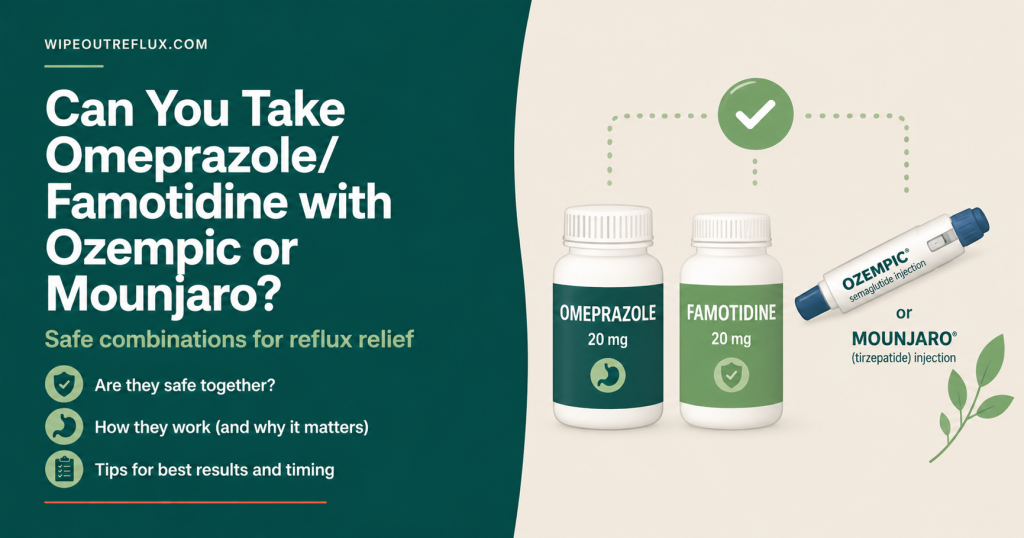
Yes — in almost all cases you can take omeprazole (Prilosec) or famotidine (Pepcid) alongside Ozempic or Mounjaro. There’s no known drug interaction between these acid-reflux medications and the GLP-1 drugs, they work through completely different mechanisms, and doctors prescribe them together all the time to manage the reflux and heartburn that GLP-1s can cause.
The one thing worth understanding is direction. The theoretical concern with GLP-1s is that they slow gastric emptying, which could change how your body absorbs pills you swallow. But this rarely matters in practice, and it matters even less for omeprazole and famotidine specifically — neither is the kind of drug where small timing shifts cause problems. And since Ozempic and Mounjaro are injected, your reflux medication can’t affect them at all.
Below I’ll walk through the actual pharmacology, the handful of medications that do deserve extra care (omeprazole and famotidine aren’t among them), which acid medication tends to work best for GLP-1 reflux, and how to use them together sensibly. As always, this is general information — run your specific medication list past your prescriber or pharmacist.
Key Takeaways
- There’s no known interaction between omeprazole or famotidine and semaglutide (Ozempic) or tirzepatide (Mounjaro). They’re commonly taken together.
- They work in completely different ways. GLP-1s act on gut hormone receptors; omeprazole blocks acid pumps; famotidine blocks histamine receptors. No chemical clash.
- The GLP-1 can’t be affected by your reflux medication, because Ozempic and Mounjaro are injected, not swallowed.
- Slowed gastric emptying is the only theoretical concern, and it applies to the reflux drug, not the GLP-1 — but omeprazole and famotidine aren’t sensitive to it in a way that matters.
- Ozempic showed no clinically relevant absorption effect on the oral medications it was tested against, so no dose changes are needed.
- A few medications DO need care with GLP-1s — notably warfarin, and oral contraceptives with Mounjaro — but reflux medications are not on that list.
- Omeprazole and famotidine are the actual tools used to manage GLP-1 heartburn, so combining them isn’t just allowed — it’s often the plan.
- Weight loss may let you reduce reflux medication over time, but never stop a PPI abruptly — taper with your prescriber to avoid rebound acid.
The Short Answer: Yes, and It’s Common
If you’ve started a GLP-1 and developed heartburn or reflux, reaching for omeprazole or famotidine is a completely normal, widely-used approach. These drugs are the front-line treatments for reflux, and there’s no reason a GLP-1 changes that. In fact, many people are prescribed both together precisely to smooth out the reflux that can crop up in the early weeks of GLP-1 treatment.
If you want the background on why these drugs trigger reflux in the first place, I’ve covered it in detail for Ozempic and for Mounjaro. Here, I’m focusing on the combination question.
Do Omeprazole or Famotidine Interact With Ozempic or Mounjaro?
No known interaction — and the reason is mechanistic. GLP-1 drugs like semaglutide and tirzepatide work on gut hormone receptors to curb appetite and slow digestion. Omeprazole is a proton pump inhibitor (PPI) that shuts down acid production at the source. Famotidine is an H2 blocker that dials down acid by blocking histamine receptors on stomach cells. Three different targets, no chemical overlap.
The manufacturers studied this. For semaglutide, the prescribing information notes that while it delays gastric emptying and could in theory affect oral drug absorption, no clinically relevant drug interactions were observed across the medications tested — including metformin, an oral contraceptive, warfarin, digoxin and atorvastatin — and no dose adjustments are required [Ozempic (Semaglutide) Prescribing Information, Novo Nordisk]. Omeprazole and famotidine aren’t flagged anywhere in that picture.
There’s also a one-way street here that’s easy to miss. The only absorption concern with GLP-1s runs from the injection to the pills you swallow — never the reverse. Because Ozempic and Mounjaro are injected under the skin, omeprazole and famotidine have no way to influence how they’re absorbed or how well they work.
Could the GLP-1 Change How Well Your Reflux Medication Works?
This is the more reasonable version of the question, and the answer is: theoretically a little, practically no.
Because GLP-1s slow gastric emptying, a pill can sit in your stomach a bit longer before it’s absorbed. For omeprazole — a delayed-release capsule — that could nudge the timing of absorption slightly. But omeprazole and famotidine aren’t drugs where timing precision matters. They’re not narrow-therapeutic-index medications, and they don’t rely on hitting a sharp threshold concentration to work. A modest shift in how fast they’re absorbed doesn’t meaningfully change their effect on your acid.
Contrast that with something like warfarin, where absorption changes genuinely matter — which is exactly why it gets singled out and reflux medications don’t. If your reflux medication doesn’t seem to be helping, the cause is far more likely to be the type of reflux you have than any interaction, and my guide on what to do when your acid reflux medication isn’t working digs into that.
The Interactions That Do Deserve Care
To be precise rather than just reassuring, here are the GLP-1 absorption concerns that are real — none of which involve omeprazole or famotidine:
- Warfarin and similar blood thinners. Both semaglutide and tirzepatide labels advise monitoring narrow-therapeutic-index drugs like warfarin, with more frequent INR checks when starting or changing dose [Ozempic (Semaglutide) Prescribing Information, Novo Nordisk].
- Oral contraceptives with Mounjaro. Tirzepatide reduces the absorption of birth control pills — roughly a 20% drop after the first dose — so the label advises switching to a non-oral method or adding a barrier method for 4 weeks after starting and after each dose increase. (Notably, semaglutide does not carry this warning.) [Mounjaro (Tirzepatide) Prescribing Information, Eli Lilly].
- The effect is biggest at the start. Tirzepatide’s impact on gastric emptying is largest after the first dose — it cut peak paracetamol/acetaminophen levels by about half in one measurement — and diminishes with later doses. That’s useful context, but again, it doesn’t change the picture for reflux drugs.
The takeaway: GLP-1 absorption effects are real for a specific short list of medications, and reflux drugs simply aren’t on it.
A Quick Note If You’re on Oral Semaglutide (Rybelsus)
This article is about the injectables, but if you happen to take oral semaglutide (Rybelsus), there’s a wrinkle. Studies of oral semaglutide with omeprazole found only a slight, non-clinically-relevant change in semaglutide exposure — so the combination is still fine. The bigger issue with Rybelsus is its own strict routine: it has to be taken on an empty stomach with a small sip of plain water, waiting 30 minutes before anything else. If you take omeprazole or famotidine as well, keep that Rybelsus window clean and take your reflux medication afterward. Your pharmacist can help you sequence them.
Omeprazole or Famotidine — Which Is Better for GLP-1 Reflux?
Since both are fair game, the practical question becomes which to use. Neither is universally “better” — they suit different situations:
- Omeprazole (a PPI) is the more powerful acid suppressor and the usual first choice for frequent or more troublesome heartburn. It takes a day or two to reach full effect and is taken regularly rather than on demand.
- Famotidine (an H2 blocker) works faster and is handy for on-demand relief or nighttime symptoms, though its acid suppression is milder and can fade with daily use. I compare it directly to an alginate in my Pepcid vs Gaviscon guide, and cover other options in alternatives to famotidine.
One important caveat from my own eight years with silent reflux: if your GLP-1 symptoms are throat-based — hoarseness, throat clearing, a lump sensation — you may have silent reflux (LPR) rather than classic heartburn, and PPIs like omeprazole often underperform for it because so much LPR reflux is only weakly acidic. In that case, an alginate such as Gaviscon Advance, which physically blocks pepsin and not just acid, frequently does more — I explain why in my Gaviscon Advance guide and in how to neutralize pepsin in the throat. And the good news is you can layer an alginate on top of omeprazole or famotidine and the GLP-1 without any conflict. Which route fits you is a conversation for your prescriber.
How to Take Them Together
There’s no mandatory spacing between your GLP-1 injection and your reflux medication — the injection is weekly and the two don’t compete. A few sensible habits still help:
- Take omeprazole as directed, usually 30–60 minutes before your first meal, so it’s active when acid production ramps up.
- Famotidine can be taken before a known trigger meal or at bedtime for nighttime symptoms.
- Keep a simple symptom log through dose increases, since that’s when GLP-1 reflux tends to peak before settling.
- Tell your prescriber and pharmacist about everything you take, including supplements — not because of the reflux drugs, but so they can watch the medications that genuinely need it.
Can You Eventually Come Off Your Reflux Medication?
Here’s the encouraging long-game. Excess weight is one of the biggest drivers of reflux, and the weight loss GLP-1s produce is a genuinely effective way to reduce it. Plenty of people find their reflux eases as the weight comes off, and some are able to step down or eventually stop their PPI — always with their prescriber’s guidance.
The one rule: don’t stop a PPI like omeprazole abruptly. Doing so can cause a surge of rebound acid that feels worse than the original problem, which fools people into thinking they can’t live without it. A gradual taper avoids that trap — I walk through exactly how in my guide to getting off PPIs and acid rebound.
Frequently Asked Questions
Is it safe to take omeprazole with Ozempic?
Generally, yes. There’s no known interaction between omeprazole and semaglutide, they work through different mechanisms, and they’re commonly prescribed together to manage GLP-1-related reflux. Confirm with your prescriber or pharmacist based on your full medication list.
Can I take famotidine (Pepcid) with Mounjaro?
Yes. Famotidine and tirzepatide have no known interaction and are frequently used together. Famotidine can be handy for on-demand or nighttime relief, while Mounjaro is your weekly injection — the two don’t compete.
Do I need to space out my reflux medication and my GLP-1?
No mandatory spacing is needed with the injectables, since your GLP-1 is injected weekly and doesn’t compete with a swallowed pill. Just take omeprazole or famotidine as directed for reflux — typically omeprazole before your first meal. (Oral semaglutide/Rybelsus is the exception, with its own empty-stomach timing rules.)
Does omeprazole make Ozempic or Mounjaro less effective?
No. Because Ozempic and Mounjaro are injected rather than swallowed, an oral reflux medication can’t affect how they’re absorbed or how well they work.
Which is better for GLP-1 heartburn — omeprazole or famotidine?
It depends. Omeprazole (a PPI) is stronger and better for frequent heartburn; famotidine (an H2 blocker) acts faster and suits on-demand or nighttime use. If your symptoms are throat-based silent reflux, an alginate may outperform both. Your prescriber can help you choose.
Can I take Tums or other antacids with Ozempic or Mounjaro too?
Yes. Antacids like Tums (calcium carbonate) have no significant interaction with GLP-1 drugs and can be used for quick, short-term relief. They’re fine to combine with a PPI or H2 blocker as well, though it’s worth mentioning your full routine to your pharmacist.
Will I need to stay on reflux medication the whole time I’m on a GLP-1?
Not necessarily. GLP-1 reflux often peaks early and eases as your body adapts, and the weight loss itself can reduce reflux over time — so some people step down or stop their reflux medication later, with their prescriber’s guidance. Never stop a PPI abruptly, though, to avoid rebound acid.
Conclusion
So, can you take omeprazole or famotidine with Ozempic or Mounjaro? For the vast majority of people, yes — comfortably. There’s no known interaction, the drugs target completely different parts of your physiology, and because the GLP-1 is injected, your reflux medication can’t interfere with it. The only genuine absorption concerns with GLP-1s involve a short list of specific medications like warfarin and, for Mounjaro, oral contraceptives — and reflux drugs simply aren’t on that list. If anything, omeprazole and famotidine are the very tools used to manage GLP-1 reflux in the first place. Just loop in your prescriber or pharmacist with your full medication list, and never stop a PPI abruptly.
The bigger opportunity is to treat the reflux at its root rather than only masking the acid, so you can eventually lean less on medication as the weight comes off. That’s exactly what the Wipeout Diet Plan is designed to do — a structured, in-depth approach to calming reflux and silent reflux through the food and lifestyle changes that genuinely work, and a natural fit for the smaller appetite a GLP-1 gives you. And because so much of managing reflux comes down to knowing which foods and drinks are reflux-friendly and where they sit on the pH scale, the Wipeout Food Reference Guide is the essential companion to keep on hand while you build better habits. Together they give you the deeper plan and the quick daily reference to get your reflux under control — ideally to the point where your GLP-1 and a lighter touch of medication are all you need.
Research Sources
- Ozempic (Semaglutide) Prescribing Information, Novo Nordisk — Semaglutide delays gastric emptying but showed no clinically relevant drug interactions with the oral medications tested (metformin, oral contraceptive, warfarin, digoxin, atorvastatin), requiring no dose adjustments; more frequent INR monitoring is advised when starting in patients on warfarin.
- Mounjaro (Tirzepatide) Prescribing Information, Eli Lilly — Tirzepatide delays gastric emptying (greatest after the first dose, diminishing thereafter); caution is advised for narrow-therapeutic-index drugs like warfarin, and oral contraceptive users should switch to or add a non-oral method for 4 weeks after starting and after each dose increase.

David Gray
12 years living with LPR · Consultant & researcher
I've lived with LPR for twelve years — the misdiagnoses, the PPI courses that did nothing, the slow work of figuring out what actually helps. Wipeout Reflux is where I translate the research into plain terms for people stuck in the same place. Every claim here is sourced to peer-reviewed work, and I consult one-to-one with LPR sufferers.