
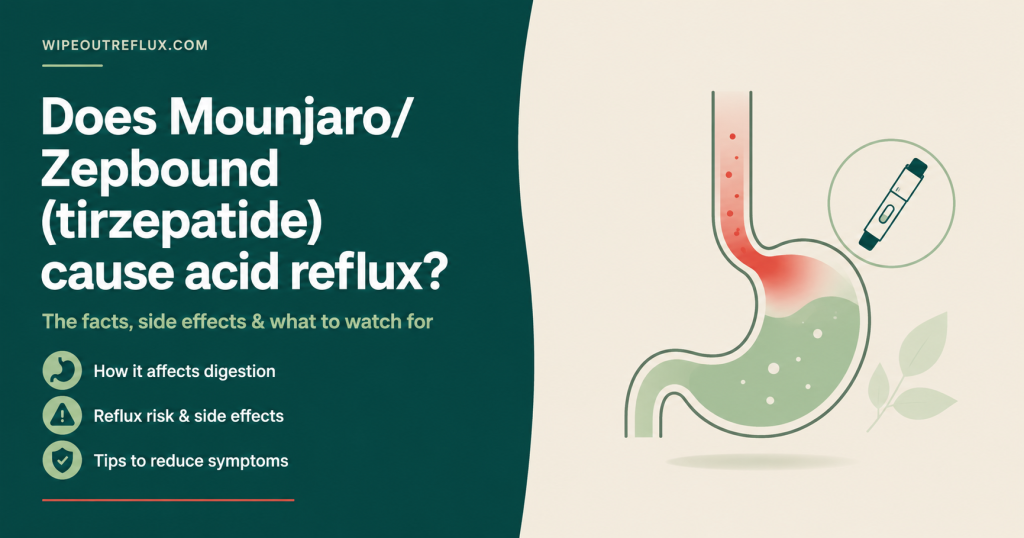
Yes — tirzepatide, the active drug in Mounjaro and Zepbound, can cause acid reflux, and it’s now listed as a recognized side effect. But the real picture is more interesting than the usual explanation of “a GLP-1 slows your stomach down, so you reflux.”
In the weight-loss trials, gastroesophageal reflux disease (GERD) showed up in roughly 4–5% of people on Zepbound versus about 2% on placebo, and indigestion (dyspepsia) in around 9–10%. So it’s real, but it’s not the most common side effect by a long way — nausea, diarrhea and constipation are all far more frequent.
What I find fascinating, having managed silent reflux myself for over eight years, is that when researchers actually measured what happens inside the esophagus on a GLP-1 drug, the results were surprisingly mixed. Below I’ll walk through why tirzepatide can trigger reflux, what the trials really found, why the mechanism is less clear-cut than most articles claim, and exactly what tends to help.
Key Takeaways
- Acid reflux is a recognized side effect of tirzepatide. GERD is listed in the current Zepbound prescribing information, and dyspepsia (indigestion) is listed for both Mounjaro and Zepbound.
- It’s relatively uncommon. In the weight-loss trials, GERD affected about 4–5% of people versus 2% on placebo — far less common than nausea (25–29%) or diarrhea (19–23%).
- The leading mechanism is delayed gastric emptying. Food sits in the stomach longer, which can raise pressure and give acid more chance to escape upward.
- The mechanism isn’t as simple as it sounds. Studies that directly measured reflux episodes and lower esophageal sphincter (LES) function found no significant change on GLP-1 therapy, and gastric acid output may even drop slightly.
- Symptoms cluster around starting and dose increases. The stomach-slowing effect is strongest after the first dose and fades over time, so reflux often eases as your body adapts.
- Mounjaro and Zepbound contain the same drug. Any difference in reported reflux comes down to labeling and trial populations, not a different molecule.
- Most cases are manageable with meal timing, portion size, not lying down after eating, and simple over-the-counter options — rarely a reason to stop.
- Weight loss itself improves reflux. There’s a genuine tension here: the drug may aggravate reflux short-term while the weight it removes is one of the most effective long-term reflux interventions there is.
Why Tirzepatide Can Trigger Acid Reflux
To understand the reflux link, you need to understand what tirzepatide actually does to your gut. It’s a dual GIP and GLP-1 receptor agonist, and one of its core effects is slowing gastric emptying — the rate at which food leaves your stomach and passes into the small intestine. That slowdown is part of why it works so well: food lingers, you feel full for longer, and you eat less.
The trade-off is that a fuller stomach for a longer time can mean more pressure pushing up against the lower esophageal sphincter — the ring of muscle that’s supposed to keep stomach contents where they belong. When that pressure rises, acid (and in some cases pepsin) has more opportunity to travel back up into the esophagus or throat. If you already live with reflux or silent reflux, this is the part that tends to matter most.
This is the same basic mechanism people describe with semaglutide, which is why I’ve written separately about whether Ozempic causes heartburn, reflux and LPR — the story rhymes across the whole GLP-1 class.
What the Clinical Trials Actually Found
Here’s where it pays to look at the real numbers rather than the scary headlines.
Across the large diabetes trials (SURPASS-1 to -5, over 6,000 people), the dominant gastrointestinal side effects were nausea (12–24%), diarrhea (12–22%) and vomiting (2–13%). They were generally transient and mild to moderate, and they clustered around dose escalation before settling down [Patel et al., Diabetes, Obesity and Metabolism, 2024].
In the current Zepbound prescribing information, from the pooled weight-loss trials, gastroesophageal reflux disease occurred in about 4–5% of patients across the dose range, compared with roughly 2% on placebo. Dyspepsia — that classic upper-tummy indigestion feeling — came in higher, at around 9–10% versus 4% on placebo [Zepbound (Tirzepatide) Prescribing Information, Eli Lilly, 2026].
The pattern held in the obesity trials too: gastrointestinal complaints were the most common adverse events overall, but they were mostly mild to moderate and eased over time rather than getting steadily worse [Rubino et al., Diabetes, Obesity and Metabolism, 2025]. So reflux is on the list — it’s just not the headline act.
The Mechanism Is More Nuanced Than “Slow Stomach = Reflux”
This is the part almost every other article skips, and it’s the part I think is most useful.
If delayed gastric emptying reliably caused reflux, you’d expect studies that put a pH probe and a pressure sensor in the esophagus to light up. They mostly didn’t. In one carefully controlled study comparing two GLP-1 drugs, gastric emptying was clearly slowed — yet the number of reflux episodes, the overall acid exposure, and lower esophageal sphincter function did not change significantly. Gastric acid secretion actually appeared to drop slightly [Quast et al., Diabetes Care, 2020].
That doesn’t mean reflux on tirzepatide is imaginary — people clearly experience it, and the label reflects that. But it suggests the trigger may be more individual than universal. A few things probably explain the gap:
- Pre-existing anatomy matters. If you already have a weak LES or a hiatal hernia, the extra stomach pressure has an easier route upward.
- Bloating and fullness get read as reflux. The heavy, over-full, burpy feeling that tirzepatide can cause overlaps with reflux symptoms, and the two can be hard to tell apart.
- Confounders muddy the data. Many people on these drugs also carry excess weight and sometimes diabetes, both of which independently raise reflux risk.
If you’re trying to work out whether what you’re feeling is classic heartburn or the more throat-based silent version, my guide on GERD vs LPR is a good place to get oriented, and the roundup of LPR symptoms can help you spot the sneakier throat-clearing, hoarseness and lump-in-throat presentations.
Is Reflux Worse on Mounjaro or Zepbound?
Short answer: they’re the same drug. Mounjaro is tirzepatide licensed for type 2 diabetes; Zepbound is tirzepatide licensed for weight management and obstructive sleep apnea. There is no pharmacological reason one would cause more reflux than the other at the same dose.
Any difference you see in the paperwork comes from how each product’s trials were run and reported. GERD is specifically named in the Zepbound label, while the diabetes-focused reporting leaned more on dyspepsia. If you switch between brands or doses, expect your gut’s response to track the dose and the titration speed far more than the brand name on the pen.
When Reflux Tends to Show Up — and Settle
Timing is one of the most reassuring parts of this whole topic. Tirzepatide’s effect on gastric emptying is largest after the very first dose and diminishes with continued use. Your gut essentially adapts. That’s exactly why the trials saw most nausea, vomiting and related symptoms during the dose-escalation phase, with new events tapering off over the following weeks.
In practice, reflux and indigestion are most likely to flare:
- In the first few weeks after starting
- In the days after each dose increase
- After larger or fattier meals, which slow emptying further
- When you eat late and then lie down
For a lot of people, riding out the adjustment window — ideally with a slow, patient titration guided by your prescriber — is enough for symptoms to fade on their own.
How to Manage Acid Reflux on Tirzepatide
Because the main driver is a stomach that’s emptying slowly, the most effective strategies are the ones that reduce how much sits in there and for how long. This is where the mechanism-first thinking pays off.
Eat smaller, and stop earlier
Large meals are the enemy here. A big volume of food on top of already-delayed emptying is the perfect setup for pressure-driven reflux. Smaller portions, eaten more slowly, give your stomach less to push against. You’ll likely find your appetite is smaller anyway — work with that, don’t override it.
Go easier on fat and known triggers
Fatty and fried foods slow gastric emptying independently, effectively stacking on top of tirzepatide’s effect. The same goes for the usual reflux aggravators. My list of LPR foods to avoid is a practical starting point for trimming the worst offenders without overhauling your whole diet.
Don’t lie down on a full stomach
Gravity is free medicine. Leave at least three hours between your last meal and bed, and if nighttime symptoms are an issue, raising the head of your bed helps. I’ve covered the specifics in managing acid reflux at night and the best sleeping position for silent reflux.
Use simple over-the-counter support when needed
For breakthrough symptoms, an alginate like Gaviscon Advance forms a physical raft on top of the stomach contents, which is a nice mechanical match for a pressure problem — I explain how and why in my Gaviscon Advance guide. If you’re getting throat symptoms rather than chest burning, it’s worth reading about how to neutralize pepsin in the throat too. Chewing sugar-free gum after meals can also increase saliva and help clear acid — more on that in my piece on chewing gum and acid reflux.
Talk to your prescriber about pace and add-ons
If symptoms are persistent, your doctor may keep you at a lower dose for longer before escalating, or discuss whether a short course of acid-suppressing medication makes sense. Don’t start or stop prescription reflux medication on your own, and if you’re already on a proton pump inhibitor, be aware of how stopping can cause a rebound — something I cover in getting off PPIs and acid rebound.
When Reflux on Tirzepatide Needs Medical Attention
Most reflux and indigestion on tirzepatide is a nuisance rather than a red flag. But you should contact your doctor promptly if you experience severe or persistent upper abdominal pain (especially radiating to the back), ongoing vomiting, difficulty swallowing, signs of dehydration, or symptoms that keep worsening rather than settling. These can point to more serious gastrointestinal issues that need proper assessment rather than self-management.
Frequently Asked Questions
Does Mounjaro cause acid reflux in everyone?
No. In the trials, GERD affected only around 4–5% of people, and many users never notice reflux at all. Whether you’re affected depends heavily on your own anatomy, your baseline reflux tendency, your dose, and how quickly you titrate up.
How long does acid reflux from tirzepatide last?
For most people, it’s worst in the first few weeks and after each dose increase, then eases as the body adapts — because the stomach-slowing effect is strongest early and fades with continued use. If it’s still bad after a couple of months, that’s worth raising with your prescriber.
Can I take antacids or omeprazole with Mounjaro?
Antacids and alginates like Gaviscon are generally used for symptom relief, and many people take acid-suppressing medication alongside tirzepatide. Because tirzepatide delays gastric emptying and can affect how some oral medications are absorbed, don’t start prescription options without checking with your doctor or pharmacist first.
Should I stop tirzepatide if I get acid reflux?
Rarely necessary. Reflux is usually manageable with meal timing, smaller portions and simple over-the-counter support, and it often settles on its own. Any decision to pause, lower or stop the medication should be made with your prescriber, not solo.
Does a lower dose reduce reflux?
Often, yes. Gastrointestinal side effects are dose-related and tied to titration speed, so staying at a lower dose for longer, or escalating more gradually, is a common way to improve tolerability. Your prescriber can tailor the schedule.
Is reflux worse on Mounjaro or Zepbound?
Neither — they’re the same molecule, tirzepatide. Differences in reported reflux come from how each product’s trials were labeled and which patients were studied, not from the drug itself. Dose and titration speed matter far more than the brand.
Can tirzepatide actually improve reflux over time?
It can, indirectly. Excess weight is one of the strongest drivers of reflux, and the weight loss tirzepatide produces is a genuinely effective long-term reflux intervention. So while the drug may aggravate symptoms in the early weeks, the weight it removes can leave many people with less reflux down the line.
Conclusion
So, does Mounjaro or Zepbound cause acid reflux? Yes, it can — it’s a recognized side effect, driven mainly by delayed gastric emptying and the extra stomach pressure that comes with it. But the honest, evidence-based version of the story is more balanced than the headlines suggest. Reflux affects a minority of users, it’s usually mild and clustered around starting and dose increases, and the studies that directly measured the esophagus found the effect on reflux and sphincter function was far less clear-cut than the “slow stomach” theory implies. On top of that, the weight loss itself pulls in the opposite direction, easing reflux for many people over time.
If you’re dealing with reflux on tirzepatide, the fixes are the same fundamentals that help any reflux: smaller meals, going easy on fat and triggers, not lying down on a full stomach, and giving your body time to adapt. Those principles are exactly what the Wipeout Diet Plan is built around — a structured, in-depth approach to calming reflux and silent reflux through the food and lifestyle changes that actually move the needle, which pairs particularly well with the appetite reduction these medications give you. If you want a quicker, everyday reference for which foods and drinks are reflux-friendly and where they sit on the pH scale, the Wipeout Food Reference Guide is the essential companion to keep on hand while you’re building better habits. Between the two, you’ll have both the deeper roadmap and the quick lookup you need to keep symptoms in check while your treatment does its job.
Research Sources
- Patel et al., Diabetes, Obesity and Metabolism, 2024 — Across SURPASS-1 to -5 (N=6,263), nausea, diarrhea and vomiting were the most common gastrointestinal side effects of tirzepatide; they were transient and mostly mild to moderate.
- Zepbound (Tirzepatide) Prescribing Information, Eli Lilly, 2026 — Gastroesophageal reflux disease occurred in roughly 4–5% and dyspepsia in about 9–10% of Zepbound-treated patients, and the drug’s delay of gastric emptying is greatest after the first dose and diminishes over time.
- Rubino et al., Diabetes, Obesity and Metabolism, 2025 — In the SURMOUNT-1 to -4 obesity trials, gastrointestinal events were the most common adverse effects but were mostly mild to moderate and eased over time.
- Quast et al., Diabetes Care, 2020 — Despite clearly delayed gastric emptying on GLP-1 therapy, the number of reflux episodes and lower esophageal sphincter function did not change significantly, and gastric acid secretion appeared slightly reduced.

David Gray
12 years living with LPR · Consultant & researcher
I've lived with LPR for twelve years — the misdiagnoses, the PPI courses that did nothing, the slow work of figuring out what actually helps. Wipeout Reflux is where I translate the research into plain terms for people stuck in the same place. Every claim here is sourced to peer-reviewed work, and I consult one-to-one with LPR sufferers.