
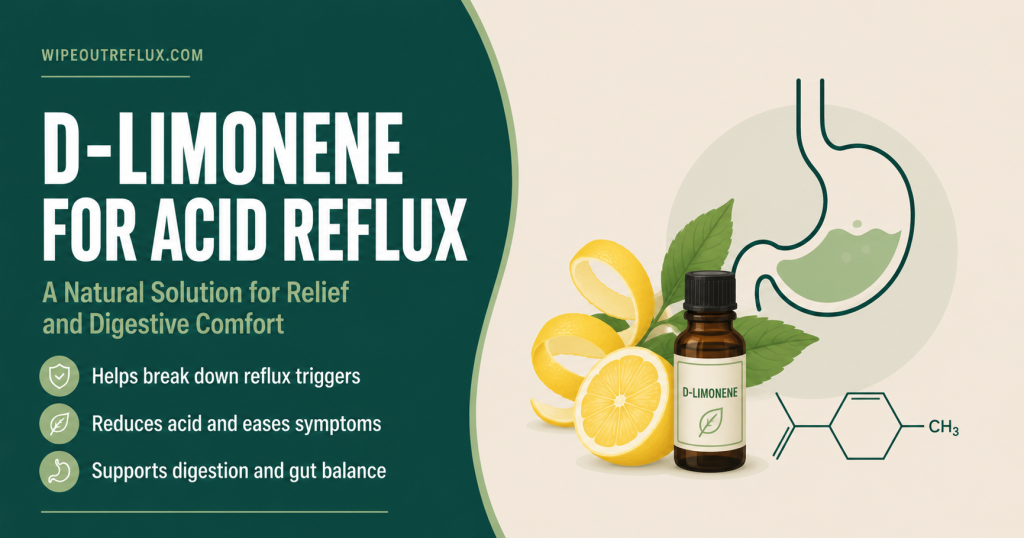
D-limonene is one of the more surprising reflux remedies you will come across — mostly because it comes from citrus peel, the very thing reflux sufferers are usually told to avoid. Having managed LPR myself for over eight years, I was curious whether there was anything real behind it, or whether it was just clever supplement marketing.
The honest short answer: d-limonene is a citrus-peel oil that, unlike antacids and PPIs, is thought to ease heartburn without lowering your stomach acid. The proposed mechanisms — coating the oesophagus, supporting normal digestion, and boosting the stomach’s own protective mucus — are plausible and backed by animal studies. But the human evidence is genuinely thin: essentially one small pilot study and a safety review, with no proper controlled trial. So I rate it as an interesting option worth knowing about, not a proven treatment.
Here is how it is supposed to work, what the research really shows, and how people take it.
Key Takeaways
- D-limonene is a monoterpene found in the oil of citrus peel (not the acidic juice).
- Its main selling point is that it may relieve heartburn without reducing stomach acid — unlike antacids and PPIs.
- Proposed mechanisms: floating on stomach contents to coat and protect the oesophagus, supporting normal peristalsis, and boosting gastric mucus.
- Animal studies show real gastroprotective and ulcer-healing effects via increased mucus and antioxidant activity.
- Human evidence is very limited — a small, uncontrolled pilot and a clinical review, with no randomised trial.
- It is generally recognised as safe (GRAS) with low toxicity; the main side effect is citrusy burping.
- There is almost no direct evidence for LPR specifically, so temper expectations if silent reflux is your main issue.
What Is D-Limonene?
D-limonene is a monocyclic monoterpene — a natural oil — that makes up the bulk of the essential oil in orange, lemon and other citrus peels. It is what gives citrus its bright smell, and it is used widely as a food flavouring and even as a natural cleaning solvent. For supplements, it is usually extracted from orange peel and sold as 1,000 mg softgels.
Here is the important distinction: the d-limonene oil from the peel is not acidic like citrus juice. That matters, because it is the acidity of orange and lemon juice that tends to trigger reflux symptoms — not the aromatic peel oil. I will come back to that paradox shortly, because it trips a lot of people up.
How D-Limonene Might Work for Reflux
I always want the mechanism before the marketing, and d-limonene is interesting precisely because it doesn’t work like the usual reflux treatments.
1. It doesn’t reduce stomach acid
This is the headline claim and the whole appeal. In a clinical review, d-limonene is described as supporting normal peristalsis and having a gastric acid–neutralising effect, and it has been used for heartburn and GERD on that basis [Sun, Alternative Medicine Review, 2007]. Crucially, it is thought to help manage symptoms without altering stomach acid levels [Natural Products in the Management of GERD (review), 2025]. For anyone wary of long-term acid suppression, or looking at options while coming off PPIs and dealing with acid rebound, that is an appealing angle.
2. It may coat and protect the oesophagus
Because it is an oil, d-limonene floats on top of stomach contents. The leading idea is that during minor reflux or belching it coats the oesophageal lining, laying down a protective film that shields the tissue from acid [From Citrus to Clinic (limonene review), International Journal of Nanomedicine, 2025]. It is a similar “physical protection” idea to a raft barrier like Gaviscon Advance, just via an oil rather than a gel.
3. It boosts the stomach’s protective mucus
The strongest experimental evidence is from animal ulcer models. In rats, limonene provided near-complete protection against gastric ulcers, and it did so by increasing gastric mucus and preserving mucosal defences (including protective proteins like HSP-70), rather than by cutting acid [Rozza et al., Chemico-Biological Interactions, 2011]. It has also shown genuine healing effects on established ulcers, boosting cell proliferation and repair of the lining [Rozza et al., Chemico-Biological Interactions, 2013]. That is animal data, not proof for humans, but it is a consistent, plausible mechanism.
But Isn’t Citrus Bad for Reflux?
This is the question everyone asks, and it is a fair one. If oranges and lemons set off my reflux, how can a citrus extract help?
The answer is that the trigger in citrus fruit is its acidity — citric and ascorbic acid in the juice and flesh. D-limonene comes from the peel oil, which is aromatic rather than acidic, so it does not carry the same acid load that makes orange juice a common reflux trigger. So the two are not the same thing at all. That said, a small number of people do find the citrus oil itself doesn’t agree with them, so it is worth testing your own response carefully. If you want to understand the acidity side of citrus more broadly, my acidity of fruits chart is a useful reference.
What the Research Actually Shows
Here I have to be straight with you, because the enthusiasm online runs well ahead of the data.
The human evidence. The most-cited human data comes from a small pilot in which 19 people with long-standing heartburn or GERD took 1,000 mg of d-limonene daily or every other day; a proportion reported meaningful symptom relief that built up over about two weeks [From Citrus to Clinic (limonene review), International Journal of Nanomedicine, 2025]. These were essentially studies conducted under a US patent, and they showed encouraging remission rates — but they were small and uncontrolled, and reviewers are clear that proper clinical trials are still needed [Natural Products in the Management of GERD (review), 2025].
The animal evidence. This is actually the more solid part: multiple rat studies show limonene protects the stomach lining and helps heal ulcers by increasing mucus, calming inflammation and reducing oxidative stress [Rozza et al., 2011; Rozza et al., 2013].
What’s missing. There is no randomised, placebo-controlled trial of d-limonene for GERD, and the main human support remains largely anecdotal. So the fair summary is: a genuinely interesting, non-acid-suppressing mechanism with good animal data and a promising but tiny human signal — and a real evidence gap. I would rather tell you that plainly than oversell it.
Does D-Limonene Help LPR (Silent Reflux)?
Honestly? There is almost no direct evidence here. The proposed benefits — oesophageal coating and heartburn relief — are framed around classic acid reflux and GERD, not the throat-and-voice-box picture of LPR. If anything, the citrusy belching that d-limonene is known for is worth a second thought for silent reflux, since the goal in LPR is usually to reduce upward movement of stomach contents, not encourage it.
So while I am not ruling it out, I would set expectations low for LPR specifically and lean far more heavily on the fundamentals in my complete guide to LPR and my broader roundup of natural remedies for LPR. D-limonene is a reasonable experiment for heartburn-dominant reflux; it is a long shot for pure silent reflux.
How to Take D-Limonene for Reflux
Dose. The typical supplement is a 1,000 mg (1 g) softgel. In the pilot data, people took 1,000 mg either daily or every other day, with benefits emerging gradually over roughly two weeks rather than immediately. A common real-world approach is 1,000 mg every other day for a couple of weeks, then as needed.
Timing. Take it with food and a full glass of water. Because it is an oil in a softgel, taking it with a meal tends to reduce the citrusy repeating that some people notice.
Give it time. Unlike an antacid, d-limonene is not an instant fix — the pilot data suggested the effect accumulates over days to a couple of weeks. If you are trialling it, give it a fair run before deciding, and ideally change only one thing at a time so you can tell whether it is actually helping. If your reflux is worse overnight, it is worth pairing any approach with the wider tactics in my guide to managing acid reflux at night.
And if you have reached for d-limonene because standard treatment isn’t cutting it, it is worth reading why reflux medication sometimes doesn’t work — often the issue is that the real drivers haven’t been addressed.
Safety and Side Effects
D-limonene has a reassuring safety profile. It is listed as generally recognised as safe (GRAS) as a flavouring, has low toxicity, and has been used in humans at supplement doses for up to a year without significant problems [Sun, Alternative Medicine Review, 2007]. A note on the old rat kidney-tumour finding: that effect is specific to male rats through a mechanism that does not apply to humans, and d-limonene is not considered a carcinogenic or nephrotoxic risk to people.
Practical points:
- Citrusy burping / aftertaste. The most common complaint. Taking it with food helps.
- Mild digestive upset. Occasional, usually minor.
- Pregnancy and breastfeeding. Safety data at supplement doses is lacking, so avoid unless advised by your doctor.
- Medications. If you take prescription drugs, check with your pharmacist first, as with any new supplement.
None of this is medical advice — it is general information from someone who has lived with reflux for a long time, not a clinician.
Frequently Asked Questions
Does d-limonene help acid reflux?
It may ease heartburn without reducing stomach acid, via oesophageal coating and better mucosal protection. A small human pilot and solid animal data are encouraging, but there is no controlled trial, so treat it as a promising experiment rather than a proven treatment.
How does d-limonene work if it doesn’t lower stomach acid?
The proposed mechanisms are physical and protective rather than acid-suppressing: floating on stomach contents to coat the oesophagus, supporting normal peristalsis, and increasing the stomach’s protective mucus. This is why fans like it as an alternative to antacids and PPIs.
Isn’t citrus bad for reflux — so why would a citrus extract help?
The reflux trigger in citrus is the acidity of the juice, not the aromatic peel oil. D-limonene comes from the peel oil, which isn’t acidic, so it doesn’t carry the same acid load as orange or lemon juice.
How much d-limonene should I take, and when?
The usual form is a 1,000 mg softgel, taken daily or every other day with food and water. Benefits tend to build over about two weeks rather than working instantly.
Is d-limonene good for silent reflux (LPR)?
There is almost no direct evidence for LPR. The proposed benefits are aimed at heartburn and GERD, and the citrusy belching it can cause is worth considering in silent reflux. Set expectations low for LPR specifically.
Is d-limonene safe?
Yes, for most people. It is GRAS, has low toxicity, and has been used safely at supplement doses for up to a year. The main side effect is citrusy burping. Avoid in pregnancy and breastfeeding without medical advice.
How long does d-limonene take to work for reflux?
It is not an instant antacid — in the available data, relief tended to build gradually over one to two weeks of regular use.
Conclusion
After more than eight years managing LPR, my honest take on d-limonene is that it is one of the more intriguing reflux supplements — largely because it tackles the problem from a different direction. Instead of switching off stomach acid, it seems to work by coating and protecting, supporting normal digestion, and strengthening the stomach’s own mucus defences. The animal evidence for that is genuinely solid, and the mechanism is appealing for anyone who would rather not suppress acid indefinitely.
What holds me back from recommending it wholeheartedly is the lack of proper human trials. The clinical support is a single small pilot and a safety review — interesting, but a long way from proof, and thinner still for LPR. So I would treat it as a reasonable experiment for heartburn-dominant reflux, tested carefully and one variable at a time, rather than a cornerstone of your plan.
Because whatever supplement you try, the biggest, most reliable gains come from reducing reflux at its source through what and when you eat. That is the part that changed things for me. If you want a structured way to do that, my Wipeout Diet Plan is the in-depth, step-by-step programme I built from everything that worked for me — it goes far beyond a food list into the full approach for calming reflux and LPR. And if you simply want a fast, reliable reference for which foods and drinks are safe, along with their pH values, the Wipeout Food Reference Guide is the essential companion to keep on your phone while shopping and cooking. Use something like d-limonene as an experiment if you wish, but build a genuinely reflux-friendly diet around it — that is what gives your throat and oesophagus the best chance to settle. For more on building that diet, see my guide to the LPR diet.
Research Sources
- Sun J. Alternative Medicine Review, 2007. Clinical review noting d-limonene is generally recognised as safe, has low toxicity across single and repeated dosing for up to a year, and has been used for heartburn and GERD owing to its gastric acid–neutralising effect and support of normal peristalsis.
- Natural Products in the Management of Gastroesophageal Reflux Disease (review), 2025. Describes d-limonene as a citrus-peel monoterpene with potential to manage GERD symptoms without altering gastric acid levels, notes two patent studies showing symptom remission, and highlights its gastroprotective, mucus-enhancing effects.
- From Citrus to Clinic: Limonene’s Journey. International Journal of Nanomedicine, 2025. Reviews the small pilot in 19 patients with persistent heartburn/GERD given 1,000 mg d-limonene, and the proposed mechanism of protecting the stomach wall and mucosal lining against acid.
- Rozza AL, et al. Chemico-Biological Interactions, 2011. Found limonene provided near-complete gastroprotection in rats, acting through increased gastric mucus and protective proteins (HSP-70, VIP) rather than acid suppression.
- Rozza AL, et al. Chemico-Biological Interactions, 2013. Showed d-limonene actively healed established gastric ulcers in rats, increasing cell proliferation and repair of the mucosal lining.

David Gray
12 years living with LPR · Consultant & researcher
I've lived with LPR for twelve years — the misdiagnoses, the PPI courses that did nothing, the slow work of figuring out what actually helps. Wipeout Reflux is where I translate the research into plain terms for people stuck in the same place. Every claim here is sourced to peer-reviewed work, and I consult one-to-one with LPR sufferers.