
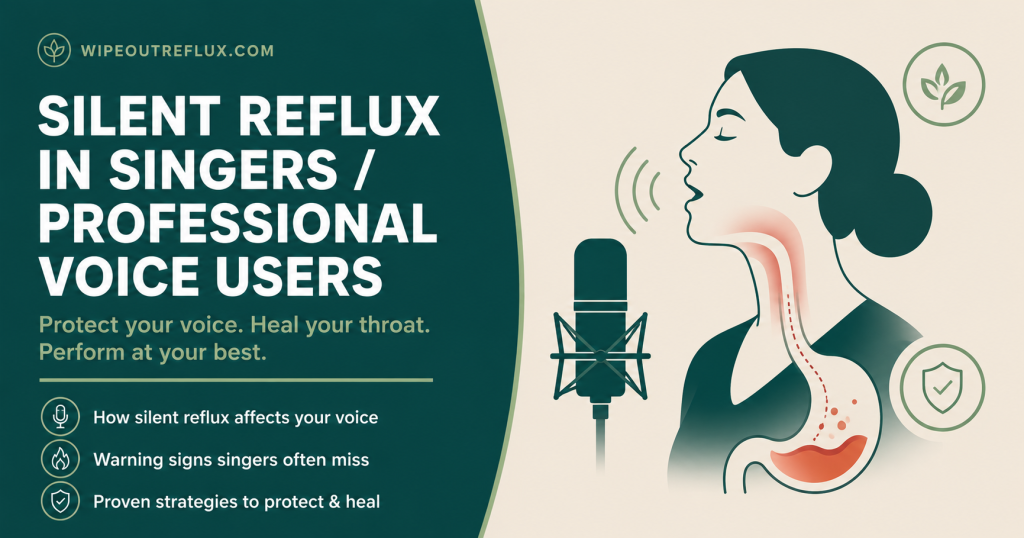
If your voice feels tired before you’ve done anything to tire it, if your top notes have quietly gone missing, or if you’re clearing your throat constantly on stage – silent reflux may be the culprit, even if you’ve never had heartburn in your life.
Silent reflux, properly called laryngopharyngeal reflux (LPR), is remarkably common in singers and professional voice users, and it’s often missed precisely because it’s silent. In one study of vocal opera students, nearly 97% tested positive for reflux reaching the throat – yet only half of them had any symptoms they’d have described as reflux [Loor et al., Medicine and Pharmacy Reports, 2020].
Here’s why this matters so much for anyone who relies on their voice: LPR doesn’t just cause a bit of throat irritation. It damages the delicate lining of the vocal folds themselves – the very tissue your sound depends on. As someone who’s spent years dealing with the throat side of reflux, I want to walk you through exactly why voice users are so vulnerable, what to watch for, and what actually helps.
Key Takeaways
- Silent reflux (LPR) is common in singers and professional voice users, with reflux symptoms reported in roughly 25–65% of singers across studies.
- It’s often truly silent – many affected voice users have no heartburn at all, so it goes undiagnosed for years.
- The act of singing itself can drive reflux, by repeatedly raising intra-abdominal pressure and working against the natural anti-reflux barrier.
- LPR damages the vocal fold lining directly, causing microscopic changes that impair the voice.
- Early signs are often singer-specific: loss of upper range, vocal fatigue, a longer warm-up, and morning hoarseness – not classic heartburn.
- Pepsin, a stomach enzyme carried up in reflux, is the key aggressor and stays active on throat tissue even without acid.
- Diet, meal timing around performances, and protecting the throat are the most practical levers for voice users.
Why Singers and Voice Users Are at Higher Risk
Being a professional voice user is, mechanically, a reflux risk factor. When you sing – especially with proper support – you make rapid changes in subglottal pressure using your diaphragm, and this produces an abrupt, prolonged increase in intra-abdominal pressure. Repeated over years of training and performing, this works against the natural barrier that keeps stomach contents down, and the occurrence of reflux rises [Loor et al., Medicine and Pharmacy Reports, 2020]. In effect, the same breath support that powers your voice can also push stomach contents in the wrong direction.
Layer on the lifestyle that often comes with performance – late meals after evening shows, eating close to bedtime, higher stress, sometimes alcohol or caffeine to wind down – and you have a near-perfect setup for reflux. The systematic review evidence backs this up: reflux symptoms have been found in 25% to 65% of singers, with clinically significant scores in a substantial minority [Lechien & Briganti, Journal of Voice, 2024].
The Silent Problem
The reason this flies under the radar is that LPR frequently produces no heartburn. Unlike classic acid reflux (GERD), which irritates the lower oesophagus, silent reflux travels higher and hits the throat and larynx – and the throat responds with hoarseness and irritation rather than a burning chest. If you’re unclear on the distinction, I’ve broken down the difference between GERD and LPR in detail. For a voice user, the practical danger is that you can be doing real damage to your instrument while feeling perfectly fine in your stomach.
How Silent Reflux Damages the Singing Voice
This is the part that should get every voice user’s attention. LPR isn’t a nuisance that stops at the throat – it reaches the vibratory margin of the vocal folds, the precise edge that vibrates to create sound. Clinical and experimental studies have shown that LPR produces significant changes in this tissue, including epithelial cell damage, microtraumas, changes to Reinke’s space, inflammatory infiltrates, mucosal drying and thickening of the epithelium [Lechien et al., European Annals of Otorhinolaryngology, 2019].
Every one of those changes matters for singing. The vocal folds need to be supple, well-hydrated and precisely shaped to vibrate cleanly across your range. When the lining is inflamed, dried out or thickened, you lose exactly the qualities you rely on – smooth vibration, flexibility, and the fine control needed for soft, high or sustained singing.
Pepsin: The Real Aggressor
The main villain in silent reflux isn’t acid alone – it’s pepsin, a digestive enzyme that hitches a ride in the reflux and can stay active on your throat and vocal fold tissue long after the acid itself is gone. This is why LPR can keep damaging the voice even between obvious reflux episodes, and why simply suppressing acid doesn’t always fix the problem. Understanding and dealing with this enzyme is central to recovery, which is why I’ve written specifically about how to neutralise pepsin in the throat.
The Symptoms Singers Notice First
Here’s something important: the standard reflux questionnaires often miss the symptoms singers care about most. A voice user will typically notice performance changes long before they’d ever call it “reflux”. The early warning signs tend to be:
- Loss of upper range – the top of your voice becomes effortful or simply disappears.
- Vocal fatigue – your voice tires quickly and takes longer to recover after singing.
- A longer, harder warm-up – you need much more time to get the voice working, especially in the morning.
- Morning hoarseness – a rough or thick voice on waking, since reflux tends to pool overnight when you’re lying flat.
- Difficulty phonating softly – quiet, controlled singing becomes unreliable.
- Excess throat mucus and clearing – a constant need to clear the throat, which itself traumatises the folds. I’ve covered how to stop constant throat clearing from reflux separately.
- A lump-in-throat sensation – the globus sensation that makes swallowing feel odd even when nothing’s there.
If several of these sound familiar, it’s worth reading through the full range of LPR symptoms to see how many fit. Notably, amateur singers carry a real burden here too – research shows they report higher levels of voice and vocal-tract discomfort than non-singers, which is why clinicians are now advised to ask specifically about singing when assessing voice complaints [Robotti et al., Journal of Voice, 2023].
It’s Not Just Singers
While the research focuses heavily on singers, the same risks apply to anyone whose living depends on their voice. Teachers, actors, broadcasters, voice-over artists, lawyers, clergy, call-centre staff, fitness instructors and public speakers all place sustained demand on the larynx, and all can develop silent reflux that quietly erodes vocal stamina and clarity. If your voice is your tool, this applies to you.
Getting Diagnosed Without Damaging Your Voice
Many singers are understandably nervous about invasive testing near their larynx. The good news is that diagnosis often starts with simple, non-invasive tools. A clinician will usually use the Reflux Symptom Index questionnaire and a look at the larynx for the characteristic signs of irritation. Beyond that, a non-invasive salivary Peptest can detect pepsin in your saliva – and crucially, samples can be collected around your singing tasks to catch reflux when it’s actually happening. Just bear in mind that the standard questionnaires weren’t designed for singers, so genuine voice symptoms like lost range or fatigue can be present even when your reflux score looks borderline. Trust the pattern, not just the number.
Managing Silent Reflux as a Professional Voice User
The encouraging news is that LPR responds well to a consistent, mechanism-focused approach. Here’s where to put your energy.
- Diet is the biggest lever. Reducing the acid and pepsin load reaching your throat does more than anything else. This is the foundation everything else builds on.
- Time your meals around performances. Avoid eating in the two to three hours before you sing or before bed – a full stomach plus singing pressure is the worst combination.
- Protect the throat after eating. An alginate raft such as Gaviscon Advance forms a physical barrier that helps stop reflux reaching the larynx, particularly useful after a necessary late meal.
- Fix your sleep position. Elevating the head of the bed and not sleeping flat reduces overnight reflux and morning hoarseness – see the best sleeping position for silent reflux.
- Stay hydrated. Good hydration supports the mucus and saliva that protect and clear the vocal folds.
- Break the throat-clearing habit. Swallowing or a gentle sip of water is far kinder to your folds than a forceful clear.
Conclusion
If your voice is your livelihood – or even just your passion – silent reflux deserves to be on your radar. It’s common among singers and professional voice users, it frequently arrives with no heartburn to warn you, and it goes to work on the exact tissue you depend on to make sound. The loss of range, the stubborn fatigue, the endless throat clearing, the voice that just won’t warm up: these are so often reflux in disguise, mislabelled as poor technique or simply “getting older”.
The good news is that this is a manageable problem, and the earlier you catch it the better your voice will fare. The upstream fix is calming the reflux itself – lowering the acid and, critically, the pepsin reaching your larynx – and diet is by far the most powerful tool you have. Pair that with sensible meal timing around performances, throat protection, and good vocal hygiene, and you give your instrument the stable, healthy environment it needs to perform.
If you want to tackle the reflux properly, my Wipeout Diet Plan is the complete, step-by-step system I built for calming reflux and LPR at the source – it’s the most thorough resource I have for getting throat and voice symptoms under control. And if you’d like a simpler place to start, the Wipeout Food Reference Guide is an essential companion that lays out exactly which foods and drinks are safe for acid reflux and LPR, along with their pH values, so you always know what’s reflux-friendly at a glance. Between the deep strategy and the quick daily reference, you’ll have what you need to protect your voice for the long haul.
Frequently Asked Questions
Can silent reflux ruin your singing voice?
Left unmanaged, LPR can cause real, lasting changes to the vocal fold lining – inflammation, drying and thickening – that impair the voice. The reassuring flip side is that when the reflux is properly controlled, many of these effects can improve, so it’s well worth addressing early.
Why do I have no heartburn but my voice is suffering?
That’s the hallmark of silent reflux. LPR travels higher than classic acid reflux and irritates the throat and larynx rather than the lower oesophagus, so it produces hoarseness and vocal fatigue instead of a burning chest. No heartburn absolutely does not mean no reflux.
Does singing make reflux worse?
It can. Singing repeatedly raises intra-abdominal pressure through diaphragmatic support, which works against the barrier that keeps stomach contents down. That’s a key reason professional voice users are at higher risk than the general population.
What are the first signs of reflux in singers?
Usually performance changes rather than stomach symptoms: loss of upper range, vocal fatigue, needing a much longer warm-up, morning hoarseness, excess throat mucus, and a lump-in-throat sensation. These often appear before anyone suspects reflux.
Should I stop singing if I have silent reflux?
Not necessarily – most voice users can keep performing while they manage the reflux. The priority is controlling the reflux and protecting the folds, ideally with guidance from an ENT or a laryngologist and a singing teacher who understands vocal health.
How is silent reflux diagnosed in singers?
Typically through the Reflux Symptom Index, a laryngeal examination, and often a non-invasive salivary pepsin (Peptest), which singers can do around their singing tasks. Invasive pH testing is available but many singers prefer to start with non-invasive options.
What should I eat and avoid as a singer with reflux?
Favour lower-acid, reflux-friendly foods and steer clear of common triggers like alcohol, caffeine, fatty or fried foods, and anything eaten late at night. A structured, pH-aware approach takes the guesswork out of which foods are safe.
Research Sources
- [Lechien & Briganti, Journal of Voice, 2024] – A systematic review of 18 studies covering 2288 singers, finding reflux symptoms in 25% to 65% of singers and clinically significant reflux scores in a substantial minority.
- [Lechien et al., European Annals of Otorhinolaryngology, 2019] – Reviews how LPR produces macroscopic and microscopic changes in the vocal fold lining, including epithelial damage, microtraumas, inflammation, drying and thickening.
- [Loor et al., Medicine and Pharmacy Reports, 2020] – A case-control study in which 96.7% of vocal opera students tested positive for reflux via salivary pepsin versus 30% of controls, though only half reported symptoms – and describes how singing raises intra-abdominal pressure.
- [Robotti et al., Journal of Voice, 2023] – A study of 392 amateur choir singers showing higher levels of voice and vocal-tract discomfort than non-singers, prompting the advice to ask about singing when assessing voice complaints.

David Gray
12 years living with LPR · Consultant & researcher
I've lived with LPR for twelve years — the misdiagnoses, the PPI courses that did nothing, the slow work of figuring out what actually helps. Wipeout Reflux is where I translate the research into plain terms for people stuck in the same place. Every claim here is sourced to peer-reviewed work, and I consult one-to-one with LPR sufferers.