
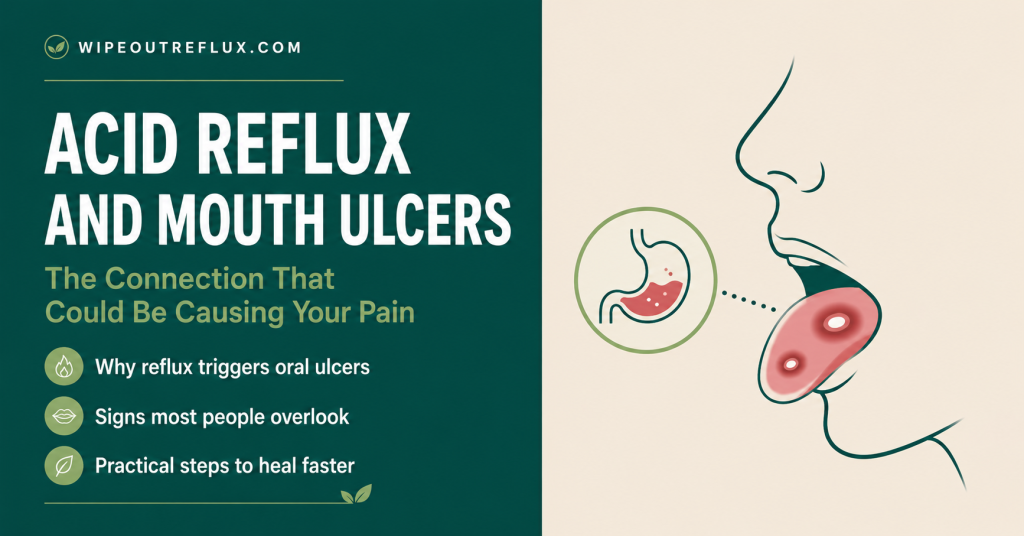
Yes, acid reflux can contribute to mouth ulcers — though it’s rarely the only cause. When stomach acid and pepsin travel high enough to reach the mouth, they can irritate the delicate oral lining and tip the balance toward ulcers, especially in people prone to them. Reflux also lowers and acidifies your saliva, removing some of the protection that normally keeps oral tissue healthy.
There’s also an indirect route worth knowing about: the medications used to suppress acid long-term can, in some people, lower nutrient levels linked to recurrent mouth ulcers. So the relationship has a few moving parts.
If you keep getting sore, painful ulcers and you also have heartburn or silent reflux (LPR), the two may well be connected. Below I’ll explain exactly how, and what actually helps.
Key Takeaways
- Acid reflux can contribute to mouth ulcers, but ulcers are usually multifactorial — reflux is one piece of the puzzle.
- Genetic evidence supports a causal link between GERD and mouth ulcers, alongside other oral problems.
- Reflux reduces saliva and makes it more acidic, weakening the mouth’s natural defences.
- Pepsin carried up with reflux can irritate oral and throat tissue directly.
- Long-term acid-suppressing medication may lower vitamin B12 in some people — and low B12, iron, or folate is linked to recurrent ulcers.
- Calming reflux at the source — primarily through diet — addresses the root rather than just the sore.
- Any ulcer that doesn’t heal within about three weeks should be checked by a doctor or dentist.
Can Acid Reflux Really Cause Mouth Ulcers?
This is the question I get asked most, so let me answer it properly. The honest version is: reflux is a genuine contributing factor, but mouth ulcers almost always have more than one cause. Stress, minor trauma (like biting your cheek), certain foods, nutritional gaps, and individual susceptibility all play a role too. Reflux sits within that mix rather than acting alone.
What’s changed in recent years is the strength of the evidence. Using a genetic approach called Mendelian randomization — which helps separate true cause from mere correlation — researchers found that GERD has a causal effect on mouth ulcers, along with loose teeth and periodontitis (Jiang et al., Frontiers in Genetics, 2023). That’s a meaningful step up from older studies that could only show the two tend to occur together.
So if you have reflux and recurring ulcers, you’re not connecting dots that aren’t there. The link is real — it’s just one of several factors, which is actually good news, because it means there are several levers you can pull.
How Reflux Reaches and Damages the Mouth
To understand the connection, it helps to follow the acid upward. In most people, reflux is thought of as a chest problem. But in silent reflux (LPR), the refluxate travels past the upper oesophagus and into the throat and mouth — often without classic heartburn. That’s why so many LPR symptoms show up above the chest. If this pattern is new to you, my overview of silent reflux symptoms is a useful starting point.
Once acidic material reaches the mouth, two things happen. First, the acid itself can irritate the soft oral lining. Second — and this is the part most people miss — reflux brings up pepsin, a stomach enzyme that can stay bound to throat and mouth tissue and become reactivated whenever the environment turns acidic again. That lingering, reactivatable irritant is a big reason LPR causes so much tissue trouble, and I explain it in detail in my guide to neutralizing pepsin in the throat.
Reflux is also recognised more broadly as a driver of oral manifestations — from dental erosion to mucosal changes and oral burning sensations (Ranjitkar et al., Journal of Gastroenterology and Hepatology, 2012). Mouth ulcers are one symptom within that wider picture of reflux affecting the mouth.
The Saliva Factor: Why Reflux Leaves Your Mouth Less Protected
Saliva is your mouth’s built-in defence system. It’s slightly alkaline, rich in bicarbonate, and it constantly buffers acid, washes away irritants, and supports healing of the oral lining. When saliva is plentiful and healthy, your mouth shrugs off a lot of minor insults.
Reflux undermines this. People with GERD have been found to produce less saliva overall, with a more acidic salivary pH and lower buffering capacity than people without reflux (Bechir et al., International Journal of Environmental Research and Public Health, 2022). In plain terms: the mouth’s protective fluid becomes weaker and more acidic at exactly the time it’s being asked to deal with more acid. That weakened defence makes ulcers easier to develop and slower to heal. If a dry mouth is part of your experience, it’s closely related to this — I cover it separately in my article on acid reflux and saliva changes.
The Hidden Medication Link
Here’s a connection that surprises a lot of people, so I want to handle it carefully and honestly.
Recurrent mouth ulcers are linked to low levels of certain nutrients — particularly vitamin B12, iron, and folate. Patients with recurrent aphthous stomatitis (the medical name for ordinary recurring canker sores) are more likely to have lower dietary intakes of vitamin B12 and folate than people without them (Kozlak et al., Journal of Oral Pathology & Medicine, 2010).
Now the reflux angle: long-term acid-suppressing medication can affect vitamin B12. Because stomach acid is needed to release B12 from food, suppressing it for years has been associated with an increased risk of B12 deficiency. In a large study, two or more years of proton pump inhibitor use was linked to higher rates of B12 deficiency (Lam et al., JAMA, 2013).
I want to be balanced here: the evidence on this is genuinely mixed, and not everyone on these medications develops a deficiency. But it’s a plausible, under-appreciated route by which long-term reflux treatment could indirectly feed into recurring ulcers in susceptible people. If you’ve been on acid-suppressing medication for a long time and you’re getting frequent ulcers, it’s worth asking your doctor to check your B12, iron, and folate. It’s a simple blood test. For the bigger picture on reducing reliance on these drugs safely, see my guide to getting off PPIs and managing acid rebound — and never stop a prescribed medication without medical advice.
Is It a Reflux Ulcer, a Canker Sore, or Something Else?
Mouth ulcers from different causes can look similar, so it’s worth knowing the landscape:
- Aphthous ulcers (canker sores) — small, round, painful ulcers with a pale centre and red border, usually on the soft, non-keratinised parts of the mouth. These are the ones most often linked to nutritional and reflux factors.
- Trauma ulcers — from biting, sharp teeth, braces, or dentures. These usually sit exactly where the trauma occurred.
- Acid-related irritation — diffuse soreness, burning, or raw patches rather than a single neat ulcer, often alongside other reflux symptoms. This can overlap with a burning sensation; if that’s prominent, my piece on burning mouth syndrome may resonate.
One non-negotiable safety point: any ulcer that hasn’t healed within about three weeks needs to be checked by a doctor or dentist. Persistent, non-healing mouth ulcers can occasionally signal something more serious, including oral cancer, and they should never be left to “wait and see” indefinitely. Reflux is a common, benign explanation — but it shouldn’t be assumed for an ulcer that won’t heal.
How to Heal and Prevent Reflux-Related Mouth Ulcers
Because the problem has several roots, the most effective approach works on more than one front. Here’s how I’d think about it.
Calm the reflux itself
This is the foundation. As long as acid and pepsin keep reaching your mouth, you’ll keep re-irritating the tissue and weakening its defences. Reducing reflux — primarily through what you eat and drink — gives the oral lining a genuine chance to recover. This matters even more for LPR, where throat and mouth tissue takes longer to settle, as I discuss in how long reflux throat irritation takes to heal.
Protect and support your saliva
Stay well hydrated with frequent small sips of water, and consider sugar-free gum to stimulate saliva flow (skip mint if it triggers your reflux). More saliva means better buffering and faster healing of the oral lining.
Check your nutrient levels
If ulcers are recurrent, ask for a blood test covering vitamin B12, ferritin (iron stores), and folate — particularly if you’ve been on long-term acid-suppressing medication. Correcting a genuine deficiency can meaningfully reduce how often ulcers appear.
Ease symptoms while tissue heals
Avoid acidic, spicy, salty, or rough foods that sting open ulcers. Warm salt-water rinses can soothe, and pharmacy ulcer gels provide a protective barrier. These don’t fix the underlying cause, but they make the healing window far more comfortable.
Address the upstream drivers
Stress and poor sleep both worsen reflux and are independently linked to ulcer flare-ups, so they’re worth tackling too. For the complete framework that pulls diet, lifestyle, and mechanism together, my complete guide to LPR is the best single resource on the site.
Frequently Asked Questions
Can acid reflux cause mouth ulcers?
It can contribute to them. Reflux can carry acid and pepsin into the mouth, irritate the lining, and weaken saliva’s protective effect. Genetic evidence supports a causal link between GERD and mouth ulcers, though ulcers usually have more than one cause.
Why do I keep getting mouth ulcers with silent reflux?
With LPR, reflux reaches the throat and mouth more readily, often without heartburn. Combined with reduced, more acidic saliva and possible nutrient gaps, this creates conditions where ulcers form more easily and heal more slowly.
Can my reflux medication cause mouth ulcers?
Not directly, but long-term acid-suppressing medication may lower vitamin B12 in some people, and low B12, iron, or folate is linked to recurrent ulcers. If you’ve taken these drugs for years and get frequent ulcers, ask your doctor to check your levels.
How do I get rid of mouth ulcers caused by acid reflux?
Treat the reflux at its source (mainly through diet), support saliva with hydration and sugar-free gum, check for nutrient deficiencies, and use soothing measures like salt-water rinses or ulcer gels while the tissue heals.
How long should a mouth ulcer last?
Most ordinary mouth ulcers heal within one to two weeks. Any ulcer that hasn’t healed within about three weeks should be assessed by a doctor or dentist, as persistent non-healing ulcers occasionally indicate something more serious.
Are mouth ulcers a sign of GERD?
They can be one of several oral signs of reflux, alongside dental erosion, bad breath, a burning sensation, and dry mouth. On their own, ulcers aren’t proof of GERD — but if they come with other reflux symptoms, the two may be connected.
Conclusion
Mouth ulcers and acid reflux are connected in more ways than most people realise. Reflux can carry acid and pepsin up into the mouth, it weakens the saliva that normally protects your oral lining, and the medications used to suppress acid long-term can, in some people, nudge down the very nutrients that keep recurring ulcers at bay. None of these factors usually acts alone — but together they explain why so many reflux sufferers also struggle with sore, recurring ulcers.
The encouraging part is that because the problem has several roots, you have several ways to improve it. Support your saliva, check your nutrient levels, soothe the tissue while it heals — and, most importantly, address the reflux itself. As long as acid keeps reaching your mouth, you’ll be fighting the symptom instead of the cause. For the vast majority of people, calming reflux starts with diet, which is exactly why I built the Wipeout Diet Plan around it — it’s the in-depth, step-by-step system for settling reflux through food and lifestyle, going far deeper than any single article can.
For quick, everyday decisions about which foods and drinks are reflux-friendly and where they sit on the pH scale, keep the Wipeout Food Reference Guide close at hand — it’s the essential companion for shopping and meal planning. Use the guide for fast, in-the-moment choices, and the Wipeout Diet Plan when you’re ready to tackle the root of the problem. And remember: if an ulcer won’t heal within three weeks, get it checked — reflux is a common explanation, but it’s never one to assume blindly.
References
- A Mendelian randomization analysis found a causal effect of GERD on mouth ulcers, loose teeth, and periodontitis (Jiang et al., Frontiers in Genetics, 2023).
- Reflux is recognised as a cause of oral manifestations including dental erosion, mucosal changes, and oral burning (Ranjitkar et al., Journal of Gastroenterology and Hepatology, 2012).
- People with GERD produced less saliva, with a more acidic salivary pH and lower buffering capacity than controls (Bechir et al., International Journal of Environmental Research and Public Health, 2022).
- Patients with recurrent aphthous stomatitis were more likely to have lower dietary intakes of vitamin B12 and folate (Kozlak et al., Journal of Oral Pathology & Medicine, 2010).
- Two or more years of proton pump inhibitor use was associated with an increased risk of vitamin B12 deficiency (Lam et al., JAMA, 2013).

David Gray
12 years living with LPR · Consultant & researcher
I've lived with LPR for twelve years — the misdiagnoses, the PPI courses that did nothing, the slow work of figuring out what actually helps. Wipeout Reflux is where I translate the research into plain terms for people stuck in the same place. Every claim here is sourced to peer-reviewed work, and I consult one-to-one with LPR sufferers.