
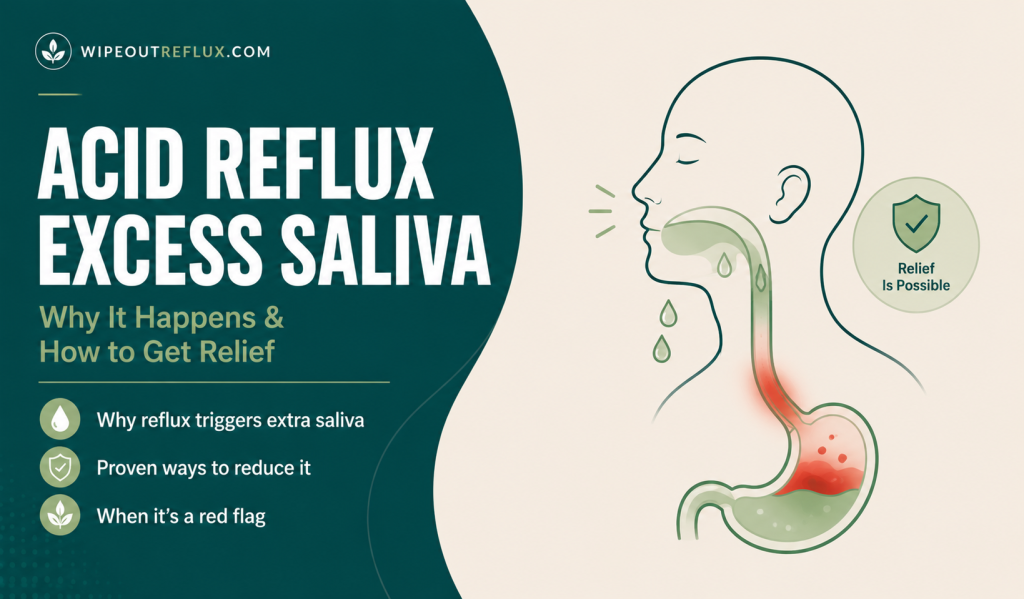
If acid reflux is causing your mouth to fill with saliva — a sudden watery surge that leaves a sour or acidic taste — you are experiencing what clinicians call water brash. It is one of the more unsettling reflux symptoms because it tends to catch people off guard, especially at night or shortly after eating, and it raises the immediate question of whether something is seriously wrong.
The short answer is that water brash is your body doing something intelligent. When acid enters the esophagus, your nervous system triggers a reflex that floods the area with bicarbonate-rich saliva to neutralise the acid and wash it back down. The problem is that when reflux is chronic, this reflex fires repeatedly — and the constant sensation of excess saliva, the sour taste, and the unsettled feeling that comes with it become a significant quality of life issue. This article explains exactly what is happening, how it differs from other reflux symptoms, and what you can actually do to reduce it.
Key Takeaways
- Excess saliva from acid reflux — known medically as water brash — is caused by the esophagosalivary reflex, a protective neural response triggered when acid enters the esophagus.
- The reflex is a defence mechanism: your salivary glands produce alkaline, bicarbonate-rich saliva specifically to neutralise acid and speed up esophageal clearance.
- In clinical experiments, esophageal acid perfusion increased salivary flow nearly fourfold in patients with reflux esophagitis.
- Water brash is different from regurgitation — it is excess saliva production, not stomach contents rising into the mouth.
- LPR (silent reflux) causes a different saliva-related symptom: thick, sticky mucus in the throat, produced by the laryngeal lining to protect against pepsin, not the watery surge of water brash.
- Excess saliva at night is particularly relevant — saliva production naturally drops during sleep, making nighttime water brash an indicator of significant nocturnal reflux.
- Chronic exposure of oral tissues to refluxed acid and pepsin carried in saliva is associated with dental enamel erosion in over half of GERD patients.
- Dietary changes, meal timing adjustments, and Gaviscon Advance are the most effective strategies for reducing water brash frequency and severity.
What Is Water Brash? (Excess Saliva from Acid Reflux Explained)
Water brash — also called acid brash, pyrosis idiopathica, or simply reflux-associated hypersalivation — is the sensation of your mouth suddenly filling with a large volume of watery, slightly sour or acidic fluid. Unlike regurgitation, where partially digested food or stomach contents physically travel up into the throat and mouth, water brash involves your salivary glands producing excessive saliva in direct response to the presence of acid in your esophagus.
The amount can be striking. Some people describe it as two teaspoons or more of fluid appearing in the mouth within seconds, with a distinctly sour or bitter edge to the taste. It can happen during the day after meals, but many people first notice it at night — waking with a mouth full of acidic saliva and a vague feeling of nausea or discomfort.
Water brash is not universal in reflux. Not everyone with GERD experiences it, even if their acid exposure is significant. Why some people develop a pronounced esophagosalivary reflex and others do not remains an active area of research, but it is more common in people with more severe or prolonged esophageal acid exposure.
Why Does Acid Reflux Cause Excess Saliva? The Esophagosalivary Reflex
Understanding what is happening mechanistically makes water brash considerably less alarming. Saliva is not just water — it is a sophisticated protective fluid containing bicarbonate (which neutralises acid), mucins (which coat and protect mucosal surfaces), epidermal growth factor (which promotes tissue repair), and digestive enzymes. Your body produces between 0.5 and 1.5 litres of it per day, and its bicarbonate content is one of your esophagus’s primary defences against acid damage.
When stomach acid enters the esophagus, sensory receptors in the esophageal wall send signals via the vagus nerve to the salivary glands, triggering a rapid increase in saliva production. This is the esophagosalivary reflex, and it exists specifically to protect you. Research confirming this reflex as a true neural response (rather than coincidental salivation) showed that when the esophagus or salivary glands were individually anaesthetised in volunteers, the reflex was abolished — confirming the neurological pathway between them [Ahmed et al., European Journal of Gastroenterology & Hepatology, 2005].
In patients with reflux esophagitis who underwent controlled acid perfusion of the esophagus, saliva flow increased nearly fourfold compared to baseline by the time the acid exposure required stopping — demonstrating just how actively the salivary system responds to esophageal acid [Helm et al., Gastroenterology, 1987].
The salivary response is particularly important in the upper esophagus — the region closest to the throat, which is where LPR damage tends to concentrate. Studies of the upper esophageal acid response have shown a threefold increase in salivary bicarbonate secretion, suggesting an even more pronounced protective response when acid reaches the upper tract [Helm et al., Digestive Diseases and Sciences, 2014].
This means that water brash, while deeply uncomfortable, is your body working correctly. The problem is not the saliva — it is the acid that keeps triggering it.
Water Brash vs Regurgitation: What’s the Difference?
These two symptoms are frequently confused, and the distinction matters because they have slightly different implications and management approaches.
Regurgitation is the passive movement of stomach contents — acid, bile, and partially digested food — back up into the esophagus and sometimes into the throat or mouth. It has a stronger, more overtly sour or bilious taste, often carries food particles, and tends to feel like material coming up from the stomach. It is a more common GERD symptom than water brash.
Water brash is excess saliva production. The fluid is produced by your salivary glands, not sourced from your stomach. It is watery rather than viscous, and while it may carry a mild sour or acidic edge (from mixing with the acid it is responding to), it does not contain food material. It appears suddenly and in large volume.
Both can occur together — a reflux episode can trigger regurgitation that then activates the esophagosalivary reflex, resulting in a mouth full of both stomach contents and excess saliva simultaneously. This is the full water brash presentation and is what most people describe when they say they “fill up with acidic saliva” after meals or at night.
Excess Saliva, LPR and Silent Reflux
The relationship between saliva and LPR (silent reflux) is somewhat different from the classic water brash picture, and understanding this distinction is important if your symptoms are predominantly in the throat rather than the chest.
In LPR, refluxate reaches the larynx and pharynx — areas that have virtually no defence against acid and pepsin. When the laryngeal and pharyngeal lining is irritated, the mucous glands in those tissues respond by producing a thick, sticky mucus to coat and protect themselves. This is not the watery surge of water brash — it is a thicker, more persistent mucous blanket that creates the characteristic postnasal drip sensation, the feeling of something stuck in the throat, and the urge to constantly clear the throat.
So if you have LPR, you may have one or both of the following:
- Watery water brash — the esophagosalivary reflex responding to acid in the lower or upper esophagus, producing a sudden flood of thin, slightly sour saliva
- Thick throat mucus — the laryngeal and pharyngeal tissues producing a protective mucous coating in response to pepsin irritation of the throat lining
Many people with LPR experience both, which creates a confusing picture of intermittent watery surges and chronic mucous burden. If your LPR symptoms are centred around throat mucus rather than the watery water brash described above, read my article on stopping throat clearing from reflux for a deeper look at that specific mechanism.
Importantly, pepsin carried in saliva can cause damage independently of its acid content — which is why LPR symptoms often persist even when acid suppression appears adequate.
When Does Excess Saliva from Reflux Happen?
After meals: The most common timing. Eating increases stomach acid production and distension, and lying back or sitting in certain positions after eating allows reflux to occur more easily. The esophagosalivary reflex then fires in response, producing excess saliva during the post-meal period. This is why many people notice a sudden mouth-fill of saliva 20–60 minutes after eating, particularly after larger or fattier meals.
At night: Nocturnal water brash is particularly significant. During sleep, saliva production drops substantially, swallowing frequency drops, and voluntary esophageal clearance mechanisms are largely absent. When reflux does occur at night — especially in people who eat within two to three hours of lying down, or who sleep flat — it stays in contact with the esophageal lining for longer. When the esophagosalivary reflex does fire, it can wake you with a sudden rush of saliva. This is a sign of meaningful nocturnal reflux. My article on acid reflux at night covers the management of nocturnal symptoms in more detail.
In the morning: Some people notice excess saliva on waking, which may reflect overnight reflux events or the transition from sleep to waking (when saliva production resumes and mixes with acid that accumulated during the night). Morning hoarseness, throat clearing, and excess saliva on waking are all common LPR presentations.
During stress: Anxiety and stress both increase gastric acid production and can lower the threshold of the esophagosalivary reflex. People often notice water brash is worse during periods of high stress, which is consistent with the nervous system’s dual role in both driving reflux and regulating salivary responses.
Is Excess Saliva from Reflux Damaging Your Teeth?
This is a question worth taking seriously. While the saliva itself is protective to the teeth (it is alkaline and contains minerals that help remineralise enamel), the acid it is responding to — and in some cases, the pepsin it carries — can cause meaningful dental damage over time.
A large meta-analysis of 28 studies involving over 4,300 people found that the pooled prevalence of dental erosion was 51.5% in GERD patients, compared to 21.4% in healthy controls — more than double the background rate [Yanushevich et al., Dentistry Journal, 2022]. A more recent case-control study confirmed that salivary pepsin levels were significantly elevated in GERD patients compared to healthy subjects, and that dental erosion was significantly more common in the GERD group — 80% of GERD patients showed dental erosion risk versus 31% of healthy controls [Rajab & Zaidan, Cureus, 2023].
The damage is particularly associated with nocturnal reflux, when saliva production is reduced and the acid stays in contact with teeth and oral tissues for longer without the normal buffering protection of wakeful salivation.
Practical dental protective measures if you have chronic water brash or reflux:
- Do not brush your teeth immediately after a reflux episode or bout of water brash — the acid temporarily softens enamel and brushing immediately causes more abrasion. Wait at least 30 minutes.
- Rinse with water or a bicarbonate mouthwash after episodes to neutralise the acid in your mouth without mechanical damage.
- Mention your reflux to your dentist — they can monitor for erosion patterns and suggest protective fluoride treatments.
- Elevating the head of the bed reduces nocturnal acid exposure and with it the overnight acid contact time with teeth.
How to Reduce Excess Saliva from Acid Reflux
The key insight here is that water brash is a symptom, not a condition in its own right. Treating the reflux treats the water brash. The esophagosalivary reflex stops firing excessively when the acid stops reaching the esophagus repeatedly. With that framing, here is what actually works:
Dietary changes: Reducing or eliminating the foods and drinks that most strongly trigger reflux — alcohol, caffeine, carbonated drinks, high-fat foods, chocolate, and large meals — directly reduces the frequency of acid episodes and with them the frequency of water brash. Eating smaller portions more frequently, and avoiding eating within two to three hours of lying down, makes a significant difference. For a comprehensive reference on which specific foods and drinks are safe versus problematic, the Wipeout Essential Reflux Food List is the resource I recommend for daily use.
Gaviscon Advance: The UK alginate formulation forms a physical raft over stomach contents after meals and at bedtime, physically preventing refluxate from reaching the esophagus and triggering the salivary reflex. Because it works mechanically rather than chemically, it is effective against all types of reflux — acid, weakly acidic, and non-acid — and can be particularly useful for reducing post-meal and nocturnal water brash. My dedicated Gaviscon Advance guide covers the correct formulation and dosing.
Chewing sugar-free gum after meals: This is one of the more interesting management options, because it turns the salivary mechanism to your advantage. When you chew gum, you dramatically increase saliva production and swallowing frequency, both of which improve esophageal acid clearance. In a controlled study, doubling salivary flow by chewing a gum base reduced acid clearance time from 6.9 minutes to 2.3 minutes — a threefold improvement [Schönfeld et al., Digestion, 1997]. The key is using non-mint, sugar-free gum — peppermint and spearmint relax the lower esophageal sphincter and can worsen reflux, and sugar feeds the oral bacteria that drive decay. My article on chewing gum and acid reflux covers the best options in detail.
Meal timing and positioning: Remaining upright for at least two hours after eating, not lying flat at night (elevate the head of the bed 15–20cm using bed risers or a wedge pillow, not just extra pillows), and eating your last meal earlier in the evening are among the most effective behavioural changes for reducing nocturnal and post-meal water brash.
Alkaline water: Drinking water with a pH of 8 or above between meals helps raise the baseline pH of the esophagus and throat, reducing the conditions under which pepsin can cause damage and potentially reducing the threshold at which the esophagosalivary reflex fires. It is not a substitute for addressing the reflux itself, but it is a useful supportive measure.
Frequently Asked Questions
Why does my mouth fill with saliva when I have heartburn?
This is the esophagosalivary reflex in action. When acid enters your esophagus, sensory nerve receptors in the esophageal wall send signals via the vagus nerve to your salivary glands, triggering a rapid increase in saliva production. The saliva is bicarbonate-rich and alkaline — it is your body’s natural attempt to neutralise the acid and wash it back down into the stomach. The timing is almost immediate: in clinical studies, saliva flow began increasing within one to five minutes of esophageal acid perfusion, and the reflex has been confirmed as a true neural pathway rather than coincidental salivation.
Is water brash a sign of serious reflux?
Not necessarily serious in the life-threatening sense, but it is a sign of significant esophageal acid exposure. The esophagosalivary reflex tends to be more pronounced in people with reflux esophagitis (inflammation of the esophageal lining) than in those with mild or infrequent reflux. If you are regularly experiencing water brash — particularly at night — that frequency and severity of acid exposure warrants proper management rather than simply tolerating it. Chronic esophageal acid contact carries risks including esophagitis, strictures, and over years, a small increased risk of Barrett’s esophagus.
Can LPR cause excess saliva?
Yes, in two different ways. LPR can trigger the esophagosalivary reflex if acid and pepsin are irritating the esophageal wall as they travel upward, producing watery water brash. It also causes the laryngeal and pharyngeal tissues to produce thick protective mucus in response to pepsin irritation — a different saliva-adjacent symptom that feels like post-nasal drip or a constant need to clear the throat. Many people with LPR experience both the watery surge and the chronic mucous burden, which creates a confusing but identifiable symptom pattern.
Why do I get excess saliva at night from acid reflux?
Nocturnal water brash is a common presentation and usually indicates meaningful nighttime reflux. During sleep, saliva production drops significantly, swallowing becomes infrequent, and your body’s voluntary esophageal clearance mechanisms are largely off. When acid does reflux in this context, it sits in contact with the esophageal lining for longer — which is a stronger stimulus for the esophagosalivary reflex. When that reflex fires during sleep, the sudden surge of saliva can wake you. The most effective approach for nighttime water brash is eating earlier, elevating the head of your bed properly, and taking Gaviscon Advance at bedtime.
Does excess saliva from reflux damage teeth?
The saliva itself is protective, but the acid it is responding to — and any pepsin it carries in solution — can damage enamel over time. Studies show dental erosion is roughly 2.5 times more common in GERD patients than in healthy controls. The risk is highest with nocturnal reflux, when reduced salivary flow and infrequent swallowing mean acid stays in prolonged contact with teeth. Never brush your teeth immediately after a reflux episode — rinse with water or a bicarbonate mouthwash instead and wait at least 30 minutes before brushing.
Can anxiety cause excess saliva with reflux?
Yes, through multiple overlapping mechanisms. Anxiety activates the vagus nerve and increases gastric acid production, making reflux events more frequent. It can also lower the sensitivity threshold of the esophagosalivary reflex, meaning it fires more readily at lower levels of acid exposure. Additionally, the anxiety that naturally follows an unexpected mouth-fill of acidic saliva can create a cycle where awareness of the symptom triggers more anxiety, which worsens both the reflux and the salivary response. My article on LPR and anxiety explores this bidirectional relationship in more detail.
Will treating my reflux stop the excess saliva?
Yes — this is the most important thing to understand about water brash. It is a symptom of the reflux, not a separate condition. When the reflux is controlled, the esophagosalivary reflex stops firing excessively and the water brash resolves. The appropriate approach is not to treat the saliva production itself but to reduce the acid reaching the esophagus through dietary changes, meal timing, Gaviscon Advance, and where appropriate, acid-modifying medication. Treating the cause treats the symptom.
Conclusion
Excess saliva from acid reflux — water brash — is uncomfortable and disorienting, but it is your body doing something mechanistically intelligent. The esophagosalivary reflex exists to protect your esophageal lining, and the bicarbonate-rich saliva it produces genuinely does help neutralise acid and speed up clearance. The problem is that chronic reflux means chronic reflex activation, and over time the repeated exposure to acid and pepsin carried in that saliva causes real damage — to your esophageal lining, your throat, and your teeth.
The path out of water brash is the same as the path out of reflux itself: address the dietary and lifestyle factors that allow acid to repeatedly reach the esophagus, reduce the volume and acidity of what is being refluxed, and use appropriate mechanical protection like Gaviscon Advance to prevent refluxate reaching the esophagus in the first place. The Wipeout Diet Plan covers the full framework for doing this systematically — not just treating the symptom but addressing the reflux patterns that drive water brash in the first place. For a practical daily guide on which foods are safe and which trigger reflux, the Wipeout Essential Reflux Food List is the companion resource most people find immediately useful alongside any dietary changes.
Research & References
Esophageal acid perfusion in patients with reflux esophagitis increased saliva flow nearly fourfold; saliva flow increased concurrently with the onset of heartburn, confirming that water brash — when clinically evident — is a direct expression of the esophagosalivary reflex responding to acid contact. [Helm et al., Gastroenterology, 1987]
Esophageal acidification was shown to increase salivary secretion via a confirmed neural reflex mechanism — when either the lower esophagus or the salivary glands were individually anaesthetised, the salivary response to esophageal acid was abolished, establishing the esophagosalivary reflex as a true neurological pathway. [Ahmed et al., European Journal of Gastroenterology & Hepatology, 2005]
Exposure of the upper esophageal mucosa to acid and pepsin produced a threefold increase in salivary bicarbonate secretion compared to saline controls, suggesting an especially pronounced protective salivary response when acid reaches the upper esophagus — the region most relevant to LPR. [Helm et al., Digestive Diseases and Sciences, 2014]
In 10 healthy volunteers, doubling salivary flow by chewing a gum base reduced esophageal acid clearance time from 6.9 minutes to 2.3 minutes — a threefold improvement — confirming saliva’s central role in esophageal acid clearance and the potential of stimulated salivation as a non-pharmacological management strategy. [Schönfeld et al., Digestion, 1997]
A meta-analysis of 28 studies involving 4,379 individuals found that the pooled prevalence of dental erosion was 51.5% in GERD patients versus 21.4% in healthy controls, confirming that chronic reflux is associated with more than double the background rate of dental enamel damage. [Yanushevich et al., Dentistry Journal, 2022]
In a case-control study of 40 GERD patients and 35 healthy subjects, salivary pepsin levels were significantly elevated in GERD patients, and dental erosion risk was present in 80% of GERD patients versus 31% of healthy controls, confirming the association between salivary pepsin exposure and enamel damage. [Rajab & Zaidan, Cureus, 2023]

David Gray
12 years living with LPR · Consultant & researcher
I've lived with LPR for twelve years — the misdiagnoses, the PPI courses that did nothing, the slow work of figuring out what actually helps. Wipeout Reflux is where I translate the research into plain terms for people stuck in the same place. Every claim here is sourced to peer-reviewed work, and I consult one-to-one with LPR sufferers.