
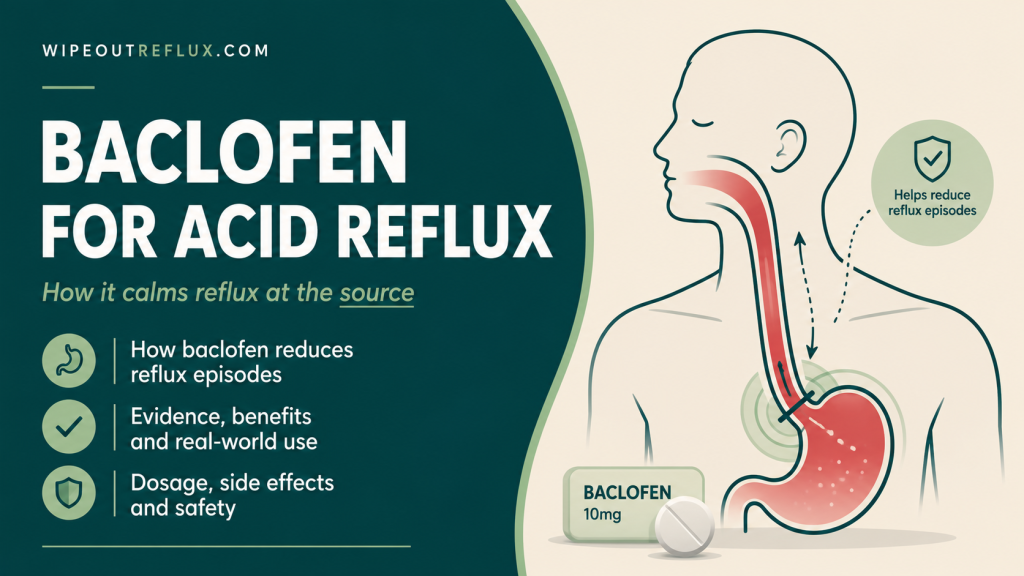
Baclofen is not a reflux drug by design. It started life as a muscle relaxant for conditions like spasticity, and it is still mainly known for that. But it has a second trick that makes it genuinely interesting for stubborn reflux: it works upstream of acid entirely, reducing the reflux events themselves rather than just neutralising what comes up.
That mechanism is why baclofen keeps appearing in the research on refractory GERD and LPR. Unlike a PPI, which only makes the refluxate less acidic, baclofen can cut down all reflux episodes — acid, non-acid, and bile-containing alike. For people whose reflux keeps breaking through despite acid suppression, that is a compelling idea on paper.
Here is the honest catch, and it is a big one: baclofen’s side effects — drowsiness, dizziness, fatigue — are the main reason it never became a routine reflux treatment. It is used off-label, under specialist guidance, usually as a last resort. I have managed my own LPR for over eight years, so let me walk through how it actually works, what the studies show, and why the side-effect profile matters so much.
Key Takeaways
- Baclofen is a GABA-B agonist repurposed off-label for reflux. It is not an acid blocker.
- It works by reducing TLESRs — the transient lower oesophageal sphincter relaxations that cause most reflux episodes.
- Its big advantage is cutting non-acid reflux. Because it reduces reflux events regardless of their pH, it targets a problem PPIs cannot touch.
- The evidence is real but modest. It reliably reduces reflux episodes and TLESRs, and helps refractory symptoms, but is less impressive for acid reflux specifically.
- Side effects are the limiting factor. Drowsiness, dizziness, and fatigue are common and dose-dependent, which is why it is not a first-line option.
- It should not be stopped abruptly. Baclofen needs to be tapered under medical guidance.
- It is a refractory-case adjunct, not a replacement for diet, meal timing, and the fundamentals.
What Is Baclofen?
Baclofen is a derivative of GABA (gamma-aminobutyric acid), one of the brain’s main inhibitory, “calm-down” neurotransmitters. It acts as a GABA-B receptor agonist, which is a technical way of saying it damps down certain nerve signals. Its long-standing licensed use is for muscle spasticity in conditions like multiple sclerosis and spinal cord injury.
Its use in reflux is entirely off-label. No regulator has approved it specifically for GERD or LPR — doctors prescribe it based on the research and their clinical judgement, usually when standard treatments have not worked. That off-label status is worth keeping in mind throughout: this is a specialist tool, not a mainstream reflux medicine.
How Baclofen Works for Reflux
To understand baclofen, you first need to understand what actually causes most reflux — and it is not simply “too much acid.”
The real culprit: transient LES relaxations
The lower oesophageal sphincter (LES) is the muscular valve that should stay shut between your stomach and oesophagus. Most reflux episodes do not happen because that valve is permanently weak. They happen during transient lower oesophageal sphincter relaxations (TLESRs) — brief, involuntary openings of the valve that are not triggered by swallowing. They are set off by a reflex response to your stomach stretching after a meal, and they are the single biggest mechanism behind reflux in both healthy people and reflux sufferers.
This is the pivotal point: if you can reduce how often those relaxations happen, you reduce reflux at its source. If you want the deeper picture of how this valve misbehaves in silent reflux, I cover it in my guide to the stomach sphincter and LPR.
Baclofen calms those relaxations
Baclofen acts on the nerve reflex that triggers TLESRs, reducing how frequently they occur. It also modestly raises resting LES pressure. In a study of healthy volunteers, the GABA-B agonist baclofen inhibited reflux primarily by reducing these transient relaxations, with a smaller contribution from increased sphincter tone [Lidums et al., Gastroenterology, 2000]. Fewer relaxations means fewer chances for anything to escape upward.
The acid-and-non-acid advantage
Here is what sets baclofen apart from every acid-suppressing drug. A PPI reduces how acidic your stomach contents are, but it does nothing to stop the physical act of reflux — the refluxate just becomes less acidic. Baclofen reduces the reflux events themselves, so it cuts both acid and non-acid reflux.
In a study using combined impedance and pH monitoring, baclofen significantly reduced postprandial acid reflux, non-acid reflux, and their associated symptoms compared with placebo [Vela et al., Alimentary Pharmacology and Therapeutics, 2003]. That non-acid piece is the crux of why baclofen matters for the hard cases.
Why This Matters for LPR and Refractory Reflux
If you have LPR or reflux that will not settle on a PPI, this mechanism should catch your attention. A large share of silent reflux involves reflux that is only weakly acidic, non-acidic, or gaseous — and PPIs, which only work on acid, leave that untouched. It is one of the main reasons people find their acid reflux medication is not working as well as they hoped.
Baclofen sidesteps that problem by reducing the reflux events regardless of their pH. It can also help when bile is part of the picture, since bile-containing reflux is another thing acid blockers cannot address — something I explain in my breakdown of bile reflux vs acid reflux. And because it can dampen nocturnal reflux, it is sometimes considered for people whose worst symptoms hit overnight, alongside the usual advice for acid reflux at night.
What the Evidence Says
Let me lay out the research honestly, because the picture is genuinely mixed — real benefits, real limitations.
For general GERD
A meta-analysis of nine randomised controlled trials covering 283 patients and healthy subjects found that baclofen produced a short-term decrease in the number of reflux episodes, the length of those episodes, and the incidence of transient LES relaxations — and it was generally well tolerated over the short term [Li et al., Gastroenterology Research and Practice, 2014]. So the core mechanism holds up in pooled data.
For refractory GERD
This is where the nuance bites. A 2025 meta-analysis of 10 studies covering 362 patients with refractory GERD found that adding baclofen to PPI therapy improved symptom scores, reduced non-acidic reflux episodes, and improved DeMeester scores — but it did not effectively reduce acid reflux, and longer-term use came with an increased rate of side effects [Dong et al., Journal of Clinical Gastroenterology, 2025]. In other words: it helps symptoms and the non-acid component, but it is not a magic bullet, and the side effects add up.
For LPR
Direct LPR evidence is limited. In a prospective open-label study of 32 patients with LPR symptoms that persisted despite PPIs, adding baclofen (10 mg three times daily) to a PPI plus lifestyle changes produced a meaningful symptom response — a greater than 50% improvement in the Reflux Symptom Index — in 53% of patients over three months [Lee et al., Clinical Otolaryngology, 2019]. Encouraging, but this was a small, uncontrolled study — a signal worth following, not proof.
If your dominant symptom is a nagging need to clear your throat, it is also worth reading how to stop constant throat clearing from reflux, since that often responds to the same broader strategy.
The Side-Effect Problem
Now the part that decides whether baclofen is usable for a given person — and the reason it is not a routine reflux drug.
Because baclofen acts on GABA-B receptors in the brain and spinal cord, not just the gut, it produces central nervous system effects: drowsiness, dizziness, fatigue and weakness, sedation, confusion, and nausea. A systematic review noted these effects are dose-dependent, and that the biggest predictors of trouble are daily doses above 60 mg, significant kidney impairment, and taking other sedating medicines at the same time [Arabpour et al., Frontiers in Medicine, 2023].
For a lot of people, that drowsiness is simply not worth it for a reflux drug, especially if they need to drive or concentrate. There is also an important safety rule: baclofen should not be stopped suddenly. Abrupt withdrawal can cause problems, so it needs to be tapered down gradually under a doctor’s guidance. This is not a medicine to start or stop on your own.
Dosing and How It Is Used
Any dosing is entirely your prescriber’s decision, but the general pattern in the research is a low starting dose — often 5 to 10 mg, taken two to four times a day — with gradual, cautious titration. The “start low and go slow” approach exists precisely to manage the drowsiness.
Because of the side-effect profile and the off-label status, baclofen is realistically reserved for people whose reflux has failed to respond to standard care and who are being managed by a specialist. It is not something to request casually, and it is never a substitute for the groundwork.
Where Baclofen Realistically Fits
Here is how I would frame it. Baclofen is one of the few reflux tools that attacks the event rather than the acid, which gives it a genuine niche: refractory reflux, non-acid or bile reflux, and stubborn LPR that has not responded to acid suppression. That is a real and valuable role.
But it is an adjunct for difficult cases, layered on top of everything else under medical supervision — not a cure, and not a first move. And if you are on a PPI, do not stop it abruptly to switch strategies without a plan, because rebound can set you back; my guide on getting off PPIs and acid rebound explains why.
The foundation, as always, is diet and habit — the things you can safely sustain for years, which a drug like baclofen never should be. That is exactly what my Wipeout Diet Plan is built around: reducing reflux frequency at the source so your throat has a low-irritation environment to heal.
Conclusion
Baclofen is one of the more mechanistically interesting reflux drugs, precisely because it does something PPIs cannot: it reduces the reflux events themselves, acid and non-acid alike, by calming the transient sphincter relaxations that cause most reflux in the first place. For refractory GERD, non-acid or bile reflux, and stubborn LPR, that gives it a genuine, if narrow, role.
The honest limits are just as important. The evidence, while real, is modest and short-term; it is better at helping symptoms and non-acid reflux than at reducing acid reflux specifically; and its central nervous system side effects — the drowsiness and dizziness — are the reason it stays a specialist, off-label, last-resort option rather than a mainstream one. It also has to be tapered carefully rather than stopped on a whim.
My honest take after years of living with this: baclofen is a tool for the hard cases, to be used under a doctor’s care when the fundamentals plus standard treatment have not been enough — never as a shortcut around them. The lasting improvement, in my experience, comes from changing what you eat and how you eat far more than from any single medication. That is what my Wipeout Diet Plan is designed to deliver, in the depth this condition actually requires, and the Wipeout Food Reference Guide is the essential companion that shows exactly which foods and drinks are reflux-friendly and their pH values, so you can build safe choices in from the start. Get the foundation right first, and let any medication be the boost on top — never the whole plan.
Frequently Asked Questions
Does baclofen help acid reflux?
It can, by reducing the transient sphincter relaxations that cause most reflux. It reliably cuts the number of reflux episodes, though the research suggests it is actually better at reducing non-acid reflux and symptoms than at lowering acid reflux specifically.
How is baclofen different from a PPI?
A PPI reduces how much acid your stomach makes, so the refluxate is less acidic. Baclofen reduces the reflux events themselves, regardless of pH — so it can cut acid, non-acid, and bile reflux. They work on completely different parts of the problem.
Is baclofen good for LPR and silent reflux?
There is early, limited evidence it can help refractory LPR as an add-on to a PPI, with one small study showing about half of patients improving. Its ability to reduce non-acid reflux makes it mechanistically appealing for LPR, but the evidence is not strong enough to make it routine.
What are the main side effects of baclofen?
The common ones are drowsiness, dizziness, fatigue, and sometimes nausea or confusion, because it acts on the central nervous system. These are dose-dependent and are the main reason it is not a first-line reflux treatment.
Can I stop taking baclofen suddenly?
No. Baclofen should not be stopped abruptly, as withdrawal can cause problems. It needs to be tapered down gradually under your doctor’s guidance.
Is baclofen approved for acid reflux?
No. Baclofen is not approved specifically for GERD or LPR anywhere — it is used off-label for reflux based on the research, usually by a specialist and typically only when standard treatments have failed.
When is baclofen used for reflux?
It is generally reserved for refractory reflux — cases that persist despite proper acid suppression — and particularly where non-acid or bile reflux is suspected. It is an adjunct for difficult cases, not a starting treatment.
Research Sources
- [Lidums et al., Gastroenterology, 2000] — In healthy volunteers, the GABA-B agonist baclofen inhibited postprandial reflux mainly by reducing transient lower oesophageal sphincter relaxations, with a smaller effect from increased sphincter tone.
- [Vela et al., Alimentary Pharmacology and Therapeutics, 2003] — Using combined impedance-pH monitoring, baclofen significantly reduced both acid and non-acid postprandial reflux episodes and their associated symptoms versus placebo.
- [Li et al., Gastroenterology Research and Practice, 2014] — A meta-analysis of nine randomised trials (283 subjects) found baclofen produced a short-term reduction in reflux episode number and length and in TLESR incidence, and was generally well tolerated.
- [Dong et al., Journal of Clinical Gastroenterology, 2025] — A meta-analysis of 10 studies (362 refractory-GERD patients) found add-on baclofen improved symptoms, reduced non-acidic reflux, and improved DeMeester scores, but did not reduce acid reflux and increased side effects with longer use.
- [Arabpour et al., Frontiers in Medicine, 2023] — A systematic review of baclofen for GERD detailing its dose-dependent central nervous system side effects and the main predictors of adverse effects, including high daily doses and renal impairment.
- [Lee et al., Clinical Otolaryngology, 2019] — In a prospective open-label study of 32 refractory-LPR patients, adding baclofen to a PPI and lifestyle changes gave a meaningful symptom response in 53% over three months.

David Gray
12 years living with LPR · Consultant & researcher
I've lived with LPR for twelve years — the misdiagnoses, the PPI courses that did nothing, the slow work of figuring out what actually helps. Wipeout Reflux is where I translate the research into plain terms for people stuck in the same place. Every claim here is sourced to peer-reviewed work, and I consult one-to-one with LPR sufferers.