
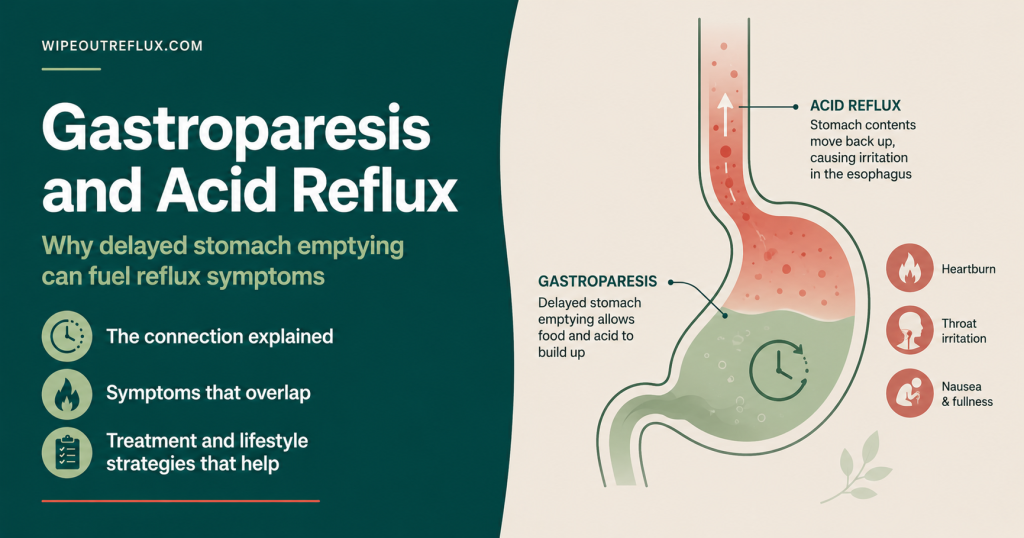
Gastroparesis and acid reflux are closely tangled, and if you have one, it’s worth understanding the other. Gastroparesis means your stomach empties too slowly — food lingers for hours longer than it should — and that retention can push acid and stomach contents back up, producing heartburn, regurgitation and, often, throat symptoms.
But here’s the honest twist most articles skip: the connection is real yet more complicated than “slow stomach equals reflux.” When researchers measure reflux directly, gastroparesis doesn’t always show more of it — and, crucially, gastroparesis symptoms often don’t improve with acid-suppressing drugs the way ordinary reflux does. That single fact is one of the most useful clues in this whole topic, because a “reflux” that won’t respond to a PPI may not really be reflux at all.
Having lived with silent reflux for over eight years, I’ve learned how much these overlapping conditions get confused. So this guide explains how gastroparesis and acid reflux relate, how to tell them apart, what causes gastroparesis (including the GLP-1 question everyone’s asking), and what actually helps — with the clear caveat that gastroparesis is a serious condition that needs a proper diagnosis and a real care team.
Key Takeaways
- Gastroparesis is delayed stomach emptying without a physical blockage, marked by early fullness, nausea, bloating, and sometimes vomiting of undigested food.
- It can drive acid reflux by leaving food in the stomach longer, raising gastric pressure and volume, and increasing the amount available to reflux upward.
- The link is real but not simple. Direct reflux measurements are mixed, and gastroparesis symptoms characteristically don’t respond to acid-suppressing medication.
- “Reflux” that ignores PPIs is a red flag that should prompt your doctor to consider gastroparesis rather than just increasing acid suppression.
- Diabetes is the leading known cause, alongside idiopathic (often post-viral) cases, prior surgery, and certain medications including opioids, anticholinergics, and GLP-1 drugs.
- The GLP-1 slowdown is usually different from true gastroparesis — it’s largest early, tends to diminish over time, and is generally reversible on stopping.
- Diagnosis needs a gastric emptying test, not a reflux test — the two conditions are confirmed in completely different ways.
- The gastroparesis diet differs from standard reflux advice — small, low-fat, low-fiber meals — so the usual “eat more fiber” guidance can backfire.
What Is Gastroparesis?
Gastroparesis literally means “stomach paralysis.” More precisely, it’s objectively delayed emptying of the stomach in the absence of any mechanical obstruction blocking the exit. The muscular contractions that should grind food down and push it into the small intestine become weak or poorly coordinated, so food sits and stagnates.
The cardinal symptoms are early satiety (feeling full after just a few bites), postprandial fullness that drags on for hours, nausea, bloating, upper abdominal discomfort, and in more significant cases vomiting — sometimes of food eaten hours earlier and still undigested [Camilleri et al., American Journal of Gastroenterology, 2022]. It’s also under-recognized, so plenty of people carry it for a long time before it’s named.
How Gastroparesis and Acid Reflux Are Connected
The mechanistic story is intuitive. When your stomach empties slowly, food and fluid pile up. That prolonged retention raises the pressure gradient across the valve between your stomach and esophagus, increases the total volume sitting in your stomach, and therefore increases the volume available to reflux back up. Prolonged retention of food can also stimulate more gastric acid secretion. Put together, a slow stomach becomes a stomach primed to reflux [Fass et al., Gastroenterology & Hepatology, 2009].
This is why gastroparesis and reflux so often travel together, particularly in people with diabetes, who are at elevated risk of both. Delayed emptying has been found in a substantial share of people with reflux disease, and the two conditions can feed each other — gastroparesis can even blunt the effect of antireflux treatment by disrupting how regularly medications are released and absorbed.
But the Link Is More Complex Than It Looks
Here’s where being precise matters. Despite that tidy mechanism, studies that directly measure reflux — using esophageal pH and impedance monitoring — haven’t consistently found that people with gastroparesis have more reflux episodes than those without. And the most telling clinical observation is that gastroparesis symptoms frequently fail to respond to acid suppression, the very treatment that reliably calms ordinary GERD.
That mismatch is genuinely useful. If your heartburn, regurgitation or fullness isn’t easing on a proton pump inhibitor despite a solid trial, the problem may not be acid at all — it may be a motility problem masquerading as reflux. That’s exactly the scenario I explore in my guide on what to do when your acid reflux medication isn’t working. The lesson: don’t just keep escalating acid suppression — ask whether something else is going on.
Gastroparesis vs Acid Reflux: Telling Them Apart
The two share a lot of surface features — nausea, bloating, heartburn, regurgitation, an unpleasant fullness — which is why they’re so easily confused. But the emphasis differs:
- Points toward gastroparesis: feeling full after only a few bites, fullness that lasts for hours, persistent nausea, vomiting of undigested food, and symptoms that don’t budge with acid-reducing medication.
- Points toward reflux (GERD): a burning sensation behind the breastbone, sour acid regurgitation, symptoms worse when lying down or bending over, and clear relief from acid suppression.
Of course, you can have both at once — and frequently people do. If you’re trying to work out whether your throat-based symptoms are classic reflux or the quieter silent version, my breakdown of GERD vs LPR will help orient you.
The Silent Reflux (LPR) Angle
This is the piece that matters most on this site, and it’s often overlooked. When a slow-emptying stomach pushes contents upward, that refluxate doesn’t always stop at the esophagus. It can travel higher, reaching the throat and voice box — the territory of laryngopharyngeal reflux, or silent reflux.
The throat is far more vulnerable than the esophagus, and refluxate carries pepsin, an enzyme that clings to delicate laryngeal tissue and does damage even when the reflux isn’t strongly acidic. So gastroparesis can quietly produce throat clearing, hoarseness, a lump sensation and chronic cough with no chest burning at all — the tell-tale LPR symptoms that get misread as allergies for months. It also explains why acid-only treatment underwhelms: if pepsin and volume are the problem, suppressing acid alone leaves the throat exposed. My guide on how to neutralize pepsin in the throat digs into this.
What Causes Gastroparesis?
Gastroparesis has several recognized causes:
- Diabetes — the single most common known cause, driven by nerve damage affecting the stomach, and typically emerging years into the disease alongside other diabetic nerve complications. Poor blood-sugar control worsens it.
- Idiopathic — a large share have no identifiable cause; many of these follow a viral illness.
- Post-surgical — operations affecting the vagus nerve or the stomach itself.
- Medications — opioids/narcotics are a big and often unrecognized culprit, along with anticholinergics, tricyclic antidepressants, and calcium channel blockers [Fass et al., Gastroenterology & Hepatology, 2009]. GLP-1 drugs belong in this medication conversation too — see below.
The GLP-1 Connection
Because GLP-1 drugs like Ozempic, Wegovy, Mounjaro and Zepbound slow gastric emptying by design, they’ve raised understandable questions about gastroparesis. It’s an important distinction to get right.
The slowdown these drugs cause is a real, expected pharmacological effect — and it can produce gastroparesis-like symptoms, especially early on. But it differs from established gastroparesis in key ways: the effect is largest after the first dose and tends to diminish with continued use as the body adapts, and it’s generally reversible once the drug is stopped, rather than reflecting permanent nerve damage. That said, these drugs can certainly aggravate reflux in the early weeks, which I cover in detail for Ozempic and Mounjaro, and the throat-symptom side in my piece on GLP-1 drugs and silent reflux. If you’re on a GLP-1 and develop severe or persistent vomiting, don’t just push through — that warrants a proper medical review.
How Gastroparesis Is Diagnosed
This is critical: gastroparesis and reflux are confirmed by completely different tests. Reflux is assessed with esophageal pH monitoring and endoscopy. Gastroparesis requires a gastric emptying study — most commonly scintigraphy, where you eat a meal containing a small tracer and imaging tracks how quickly your stomach empties over at least four hours. A wireless motility capsule or breath test can also be used [Camilleri et al., American Journal of Gastroenterology, 2022].
The practical takeaway: if you have stubborn upper-GI symptoms that don’t fit neatly into reflux — or that don’t respond to reflux treatment — a gastric emptying study is the test that settles the question. You can’t diagnose gastroparesis with a reflux workup alone.
How to Manage Gastroparesis and Its Reflux
Management aims at three things at once: emptying the stomach more effectively, easing symptoms, and — in diabetics — controlling blood sugar. This needs a doctor and ideally a dietitian; what follows is the general shape of it, not a substitute for personalized care.
Diet: small, low-fat, and low-fiber
This is where gastroparesis advice diverges from typical reflux advice, so read carefully. The mainstay is small, frequent meals that are low in fat and low in fiber, ideally of smaller particle size — softer, well-cooked, blended or mashed textures empty more easily [Camilleri et al., American Journal of Gastroenterology, 2022]. Fat and fiber both slow gastric emptying, and indigestible fiber can even clump into a mass (a bezoar) in a sluggish stomach. That’s why the standard “just eat more fiber” wellness advice can actually make gastroparesis worse. Liquid calories are often tolerated better than solids when symptoms flare.
Meal mechanics and posture
Eat slowly, chew thoroughly, and stay upright during and after meals — gentle movement like a short walk can help, while slumping or lying down works against you. Keeping the head of your bed raised is especially worthwhile given the reflux overlap, as I explain in the best sleeping position for silent reflux.
Glycemic control if you have diabetes
High blood sugar itself slows gastric emptying, so tight glucose control is part of the treatment, not separate from it. It’s a genuine two-way street worth prioritizing with your care team.
Medications: prokinetics, and why acid suppression alone falls short
Because the core problem is motility, the targeted medications are prokinetics that stimulate stomach emptying — metoclopramide is the first-line and only FDA-approved option, used at the lowest effective dose, with domperidone, erythromycin and 5-HT4 agonists as further options depending on availability and circumstances, plus antiemetics for nausea [Camilleri et al., American Journal of Gastroenterology, 2022]. Acid-suppressing drugs like PPIs still have a role for any genuine acid reflux component, but they don’t fix the emptying problem — which is exactly why relying on them alone so often disappoints here.
Managing the reflux and LPR component
For the reflux side, especially if it’s reaching your throat, an alginate such as Gaviscon Advance is a smart addition because it forms a physical raft that blocks pepsin and volume mechanically, not just acid — I explain the approach in my Gaviscon Advance guide. Trimming the worst reflux triggers helps too, though always within the gastroparesis-friendly, low-fat framework; my list of LPR foods to avoid is a useful cross-reference.
When to See a Doctor
Gastroparesis isn’t something to self-diagnose or self-treat. See a doctor if you have persistent nausea or vomiting, vomiting of undigested food, ongoing early fullness, unintended weight loss, signs of dehydration, or reflux-type symptoms that won’t respond to treatment. Get urgent care for severe, unrelenting vomiting or an inability to keep fluids down. A proper diagnosis — including a gastric emptying study when indicated — is what unlocks the right treatment.
Frequently Asked Questions
Does gastroparesis cause acid reflux?
It can. By leaving food in the stomach longer, gastroparesis raises gastric pressure and volume, giving stomach contents more opportunity to reflux upward. That said, the direct evidence is mixed, and gastroparesis symptoms don’t always behave like ordinary acid reflux.
Why isn’t my reflux responding to omeprazole?
One important possibility is that it isn’t really acid-driven reflux. Gastroparesis symptoms characteristically don’t improve with acid suppression, so “reflux” that ignores a proper PPI trial should prompt your doctor to consider a gastric emptying study rather than simply increasing the dose.
How can I tell gastroparesis and GERD apart?
Early fullness, prolonged nausea and vomiting of undigested food lean toward gastroparesis; burning chest pain and sour regurgitation that eases with acid suppression lean toward GERD. They overlap and often coexist, so proper testing — a gastric emptying study versus pH monitoring — is how they’re distinguished.
Can gastroparesis cause silent reflux (LPR)?
Yes. Retained stomach contents pushed upward can reach the throat and voice box, where pepsin irritates delicate tissue — producing throat clearing, hoarseness, a lump sensation and cough without heartburn. Acid-only treatment tends to underperform in this situation.
Do GLP-1 drugs cause gastroparesis?
They slow gastric emptying by design and can cause gastroparesis-like symptoms, but this differs from established gastroparesis: the effect is biggest early, tends to lessen over time, and is generally reversible on stopping. Persistent severe vomiting still warrants medical review.
Is the gastroparesis diet the same as a reflux diet?
Not entirely. Both favor smaller, low-fat meals, but gastroparesis specifically calls for low-fiber, smaller-particle foods, whereas general reflux and wellness advice often pushes more fiber. In gastroparesis, high fiber can slow emptying further and even form a bezoar, so the usual advice can backfire.
Can gastroparesis be cured?
It’s usually managed rather than cured, though some cases — particularly post-viral ones — improve over time, and medication- or blood-sugar-related cases can improve when the underlying cause is addressed. The goal is symptom control and better emptying through diet, prokinetics and treating the cause.
Conclusion
Gastroparesis and acid reflux are genuinely linked — a slow-emptying stomach raises pressure and volume in ways that favor reflux, and the two conditions frequently overlap, especially in diabetes. But the smartest thing you can take from this is the nuance: the connection isn’t as automatic as it sounds, and gastroparesis symptoms tend not to respond to acid suppression. If your reflux has been stubborn against medication, that’s a signal worth acting on — a conversation with your doctor about a gastric emptying study, not just a stronger PPI. And because retention can send pepsin-laden contents toward the throat, gastroparesis is a real and under-recognized driver of silent reflux.
Managing it well means treating the motility problem and the reflux together: a small, low-fat, low-fiber eating pattern, upright meal habits, glycemic control where relevant, prokinetics under medical guidance, and pepsin-aware reflux protection. If you want a structured, in-depth way to calm the reflux and silent-reflux side of the picture while you work with your care team on the gastroparesis itself, the Wipeout Diet Plan is the roadmap I built around exactly these food-and-lifestyle fundamentals. And since so much of this comes down to knowing which foods and drinks are reflux-friendly and where they sit on the pH scale — while keeping things gentle on a sluggish stomach — the Wipeout Food Reference Guide is the essential companion to keep on hand. Together they take the guesswork out of eating for a calmer throat and esophagus, so you can focus your energy on the bigger diagnosis with your doctor.
Research Sources
- Camilleri et al., American Journal of Gastroenterology, 2022 — The ACG Clinical Guideline on gastroparesis defines the condition and its cardinal symptoms, establishes the scintigraphic gastric emptying study as the standard diagnostic test, and recommends a small-particle, low-fat, low-fiber diet alongside prokinetics such as metoclopramide (first-line) and glycemic control in diabetic patients.
- Fass et al., Gastroenterology & Hepatology, 2009 — This review explains the multifactorial link between gastroparesis and GERD: delayed emptying prolongs gastric retention, raising the gastroesophageal pressure gradient, gastric volume and refluxate volume, and can increase acid secretion, while also complicating reflux treatment; recognized causes include diabetes, surgery, and medications.

David Gray
12 years living with LPR · Consultant & researcher
I've lived with LPR for twelve years — the misdiagnoses, the PPI courses that did nothing, the slow work of figuring out what actually helps. Wipeout Reflux is where I translate the research into plain terms for people stuck in the same place. Every claim here is sourced to peer-reviewed work, and I consult one-to-one with LPR sufferers.