
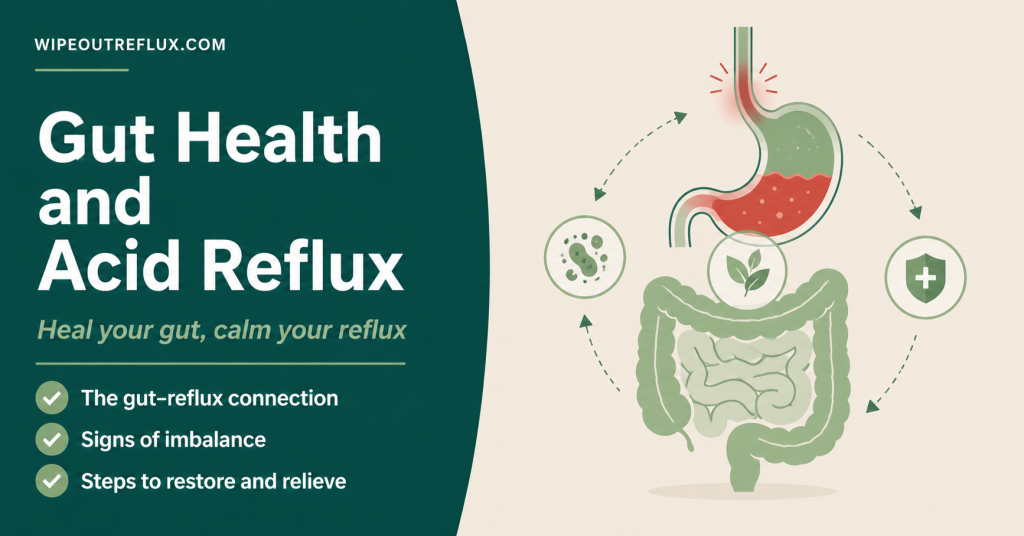
If you have spent any time researching reflux, you have probably run into the claim that it all comes down to your gut. The truth is more nuanced — and more interesting. Yes, gut health and acid reflux are closely connected, but not in the simplistic “heal your gut and reflux disappears” way many sites suggest. Your gut microbiome influences digestion, motility, inflammation, and abdominal pressure, and all of those feed directly into whether you reflux and how badly.
This matters just as much for laryngopharyngeal reflux (LPR), or silent reflux, where the picture extends beyond the gut to the microbiome of your throat and mouth. In fact, some of the most thought-provoking recent research points exactly there.
I have spent years untangling my own reflux, and the gut connection is one of the areas where understanding the mechanism completely changes how you approach treatment. Let me walk you through what the evidence actually shows.
Key Takeaways
- Gut health and acid reflux are genuinely linked, but a poor gut is usually a contributor to reflux rather than the single root cause.
- Your gut microbiome affects reflux through digestion speed, gas and pressure, inflammation, and the strength of your mucosal barrier.
- Bacterial overgrowth (SIBO) can worsen reflux by producing gas that raises pressure on the valve at the top of the stomach.
- For LPR specifically, researchers have proposed that refluxed enzymes may disrupt the microbiome of the throat and mouth, slowing recovery.
- Long-term PPI use can reduce gut microbial diversity and shift the balance toward oral-type bacteria.
- Probiotics show promising but still emerging evidence for reflux symptoms, with no clear consensus yet on the ideal strain or dose.
- Supporting your gut through whole foods, fiber, meal timing, and stress management can complement — not replace — standard reflux care.
Can Poor Gut Health Cause Acid Reflux?
The honest answer is that poor gut health can contribute to reflux, but it is rarely the whole story. Reflux is fundamentally a mechanical problem — stomach contents escaping upward past a valve that should keep them down. Your gut influences how often and how forcefully that happens, but factors like the strength of that valve, your weight, and your eating habits all play their part too.
So rather than asking “is my gut causing my reflux?” the more useful question is “how is my gut making my reflux better or worse?” Once you frame it that way, the mechanisms become clear and actionable. Whether you have classic GERD with heartburn or silent reflux (LPR) affecting your throat, your gut is part of the equation.
How Your Gut Microbiome Affects Reflux
Your gut is home to trillions of microbes that do far more than digest food. When that community is balanced, digestion runs smoothly. When it is disrupted — a state called dysbiosis — several things can go wrong that directly affect reflux.
Digestion and motility
A healthy microbiome supports normal gut motility, meaning food moves through at the right pace. When motility slows and the stomach empties sluggishly, food and acid sit around longer, raising the odds that some of it refluxes upward. Slow gastric emptying is a well-recognized contributor to reflux symptoms.
Gas, bloating, and pressure
This is one of the most direct mechanisms. When gut bacteria ferment poorly absorbed carbohydrates, they produce gas. A lot of gas means bloating, and bloating increases the pressure inside your abdomen. That pressure pushes up against the valve at the top of the stomach, making reflux more likely. This is exactly why small intestinal bacterial overgrowth (SIBO) is so tightly tied to reflux — I cover that relationship in detail in my article on SIBO and acid reflux.
Inflammation and the mucosal barrier
A balanced microbiome helps maintain the protective mucosal lining of your digestive tract and keeps inflammation in check. When the balance tips, low-grade inflammation can affect tissue sensitivity and barrier function, which may make the throat and esophagus more reactive to the acid and pepsin that reach them.
The gut–throat connection in LPR
Here is where it gets especially interesting for silent reflux. A 2021 hypothesis paper proposed that the mix of enzymes refluxing up to the larynx and pharynx in LPR may modify the local microbiome of the throat and mouth, impairing the tissue’s ability to maintain and repair itself [Lechien et al., Medical Hypotheses, 2021]. In other words, the microbiome story for LPR is not only about your gut — it may extend all the way up to the tissues where your symptoms actually show up. This is still an emerging theory rather than settled fact, but it reframes LPR as a condition involving microbial balance throughout the aerodigestive tract, not just acid in the throat.
The PPI Problem: How Acid-Suppressing Drugs Affect Your Gut
This is the part that creates a genuine dilemma for a lot of people, and I want to handle it carefully because it is easy to misread.
Proton pump inhibitors (PPIs) like omeprazole are the standard medication for reflux, and they work by sharply reducing stomach acid. The catch is that stomach acid is also one of your body’s defenses, creating a low-pH barrier that limits which bacteria survive the journey into the lower gut. Two large studies published in the same journal found that PPI use is associated with reduced gut microbial diversity and a shift toward bacteria normally found in the mouth and upper digestive tract [Imhann et al., Gut, 2016]. A companion study in over 1,800 people proposed that removing that low-pH barrier allows upper-GI and oral bacteria to colonize further down [Jackson et al., Gut, 2016].
Here is the important part: this does not mean PPIs are bad or that you should stop yours. For many people they are necessary and helpful, and stopping abruptly can trigger a brutal acid rebound — something I explain in my guide to getting off PPIs and acid rebound. What it does mean is that long-term acid suppression has a cost worth being aware of, and that supporting your gut alongside any medication is a sensible strategy. Any changes to medication should always be made with your doctor.
Does Improving Gut Health Help Acid Reflux and LPR?
This is the practical question, and the evidence here is encouraging without being a magic bullet.
On the probiotic side, a systematic review of prospective studies found that the majority of comparisons reported improvements in GERD symptoms such as heartburn and regurgitation with probiotic use [Cheng & Ouwehand, Nutrients, 2020]. That is a meaningful signal. What the research cannot yet tell you is which specific strain, at what dose, for how long — which is exactly where most generic probiotic advice falls short. I dug into the strain-level detail in my guide to the best probiotics for acid reflux.
For LPR specifically, the probiotic evidence is still in its early stages, but the microbiota theory above suggests that approaches aimed at rebalancing the microbiome could eventually become part of treatment. For now, the most reliable gains come from broader gut-supportive habits rather than any single supplement.
How to Support Your Gut for Reflux Relief
Here is the practical approach I would take, built around mechanisms rather than hype.
- Eat more whole, fiber-rich foods. A varied, fiber-rich, mostly whole-food diet is the single best thing you can do for your microbiome. Fiber feeds beneficial bacteria and supports healthy motility.
- Cut back on ultra-processed foods. Heavily processed, high-sugar foods tend to favor the less helpful end of your gut ecosystem and are common reflux triggers in their own right.
- Be strategic about fermented foods. Foods like kefir and yogurt can support gut balance, but if your reflux is driven by bloating and pressure, introduce them slowly and watch your response — some people tolerate them beautifully, others react.
- Manage portion size and meal timing. Smaller meals and finishing eating at least three hours before lying down reduce both pressure and overnight reflux. This helps your gut and your valve at the same time.
- Address stress. The gut and brain are in constant communication, and stress measurably affects digestion and gut function. This is also why reflux and anxiety so often travel together, as I discuss in can LPR be caused by anxiety.
- Avoid unnecessary antibiotics. Antibiotics are sometimes essential, but each course disrupts your microbiome. Use them when needed and not casually.
As always, change one thing at a time. The gut is complex and individual, and the only way to know what genuinely helps your reflux is to test changes methodically rather than overhauling everything at once. Building your plate around reflux-friendly foods gives you a stable foundation to experiment from.
When to See a Doctor
Gut-focused changes are safe for most people, but see a doctor if you have persistent reflux that does not improve, difficulty swallowing, unexplained weight loss, ongoing bloating and altered bowel habits, or symptoms that point toward SIBO or another underlying gut condition. These deserve proper evaluation rather than self-treatment, and a clinician can help you investigate the root cause instead of guessing. And never change prescribed reflux medication without medical guidance.
Frequently Asked Questions
Can poor gut health cause acid reflux?
Poor gut health can contribute to reflux, mainly by slowing digestion, producing gas that raises abdominal pressure, and promoting inflammation. It is usually one piece of the puzzle rather than the sole cause, since reflux is also driven by the mechanics of the valve at the top of the stomach, body weight, and eating habits.
Can fixing my gut cure acid reflux or LPR?
Improving your gut health can meaningfully reduce reflux for many people, but framing it as a guaranteed cure is overpromising. Reflux is multifactorial. Gut support works best as part of a complete approach that also addresses diet, meal timing, weight, and, where needed, medication.
Do probiotics help silent reflux (LPR)?
The evidence for probiotics in GERD is promising, with most studies showing symptom improvement, but the data for LPR specifically is still emerging. The mechanisms are plausible, and an interesting theory links LPR to the throat and oral microbiome, but there is not yet a clear consensus on the best strain or dose.
Can SIBO cause acid reflux?
SIBO can worsen reflux. When excess bacteria in the small intestine ferment carbohydrates, they produce gas that causes bloating and raises intra-abdominal pressure, which pushes stomach contents upward. This is one of the more direct ways a gut imbalance feeds reflux.
Do PPIs damage your gut?
Long-term PPI use is associated with reduced gut microbial diversity and a shift toward oral-type bacteria, because lowering stomach acid removes a natural barrier against bacteria. This does not mean PPIs are bad or that you should stop them — they are often necessary — but it is a reason to support your gut alongside them and to review long-term use with your doctor.
Does leaky gut cause acid reflux?
The concept of increased intestinal permeability is still being researched, and a direct causal link to reflux is not firmly established. What is clearer is that gut inflammation and dysbiosis can affect digestion, motility, and tissue sensitivity in ways that may worsen reflux symptoms.
How long does it take to improve gut health for reflux?
Gut composition can start shifting within a few weeks of consistent dietary change, but meaningful, lasting improvement usually takes longer and varies a lot between people. Consistency matters far more than speed, and reflux improvements tend to follow gradually as the underlying gut environment steadies.
Conclusion
The link between gut health and acid reflux is real, but it rewards a clear-eyed approach rather than a hopeful one. Your microbiome shapes how quickly you digest, how much pressure builds in your abdomen, how inflamed and sensitive your tissues are, and — in the case of LPR — possibly even the microbial balance of your throat itself. Those are powerful levers, and they are largely within your control. But they sit alongside the mechanics of reflux, not in place of them, which is why the people who get the best results treat their gut as one important part of a complete plan.
That is also why I am cautious about the “just heal your gut” messaging. It contains a real truth wrapped in an overpromise. The genuinely useful move is to support your gut through whole foods, fiber, sensible meal timing, and stress management, while being thoughtful about long-term acid suppression and testing changes one at a time. Do that consistently and the gut becomes a powerful ally in calming reflux rather than a mysterious villain.
If you want a complete, structured system that ties all of this together — diet, mechanisms, and the day-to-day practice of getting reflux under control — that is exactly what I built the Wipeout Diet Plan to provide. It walks you through the reflux-friendly approach I used on my own LPR, explaining the why behind every step rather than just handing you rules. To use alongside it, the Wipeout Food Reference Guide is the essential companion that lays out which foods and drinks are safe for acid reflux and LPR along with their pH values, so you can build a gut-supportive, reflux-friendly plate with confidence. Together they give you the mechanism and the practical detail to make your gut work for you instead of against you.
Research Sources
- Lechien et al., Medical Hypotheses, 2021 — Proposed the “microbiota theory” of LPR, suggesting refluxed enzymes alter the laryngopharyngeal and oral microbiome and impair mucosal recovery.
- Imhann et al., Gut, 2016 — Found PPI use is associated with reduced gut microbial diversity and an increase in oral and upper-GI bacteria.
- Jackson et al., Gut, 2016 — In over 1,800 people, PPI users showed lower microbial diversity and a shift toward oral-type bacteria, attributed to loss of the stomach’s low-pH barrier.
- Cheng & Ouwehand, Nutrients, 2020 — A systematic review reporting that most studies found probiotics improved GERD symptoms, while noting uncertainty over ideal strain and dose.

David Gray
12 years living with LPR · Consultant & researcher
I've lived with LPR for twelve years — the misdiagnoses, the PPI courses that did nothing, the slow work of figuring out what actually helps. Wipeout Reflux is where I translate the research into plain terms for people stuck in the same place. Every claim here is sourced to peer-reviewed work, and I consult one-to-one with LPR sufferers.