
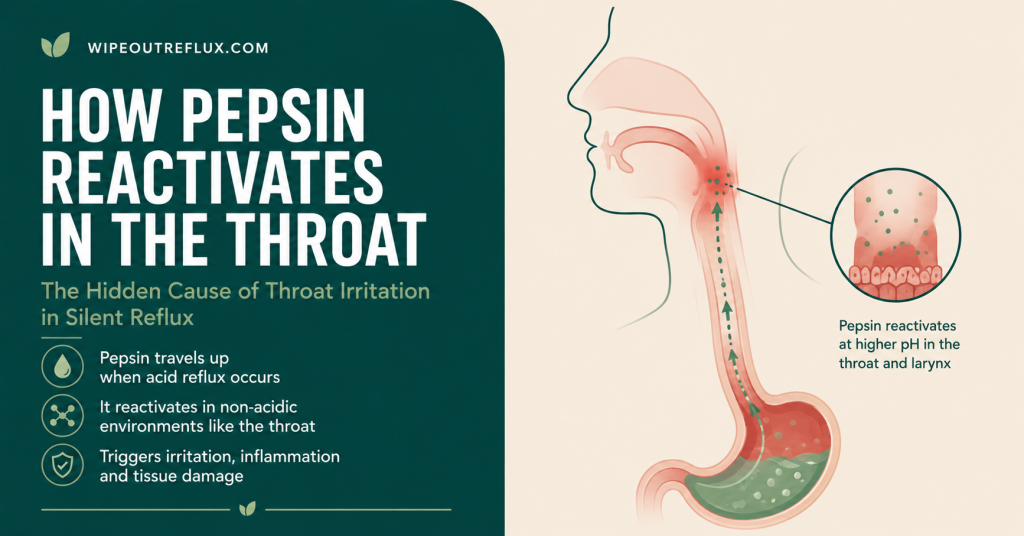
If there is one idea that finally made silent reflux make sense to me, it is pepsin reactivation. It explains the thing that confused me for years: why my throat kept getting worse even on days I hadn’t obviously refluxed, and why a single “healthy” glass of orange juice could set me back.
Here is the short version. During a reflux event, the stomach enzyme pepsin travels up and lodges in the delicate tissue of your throat. At the near-neutral pH of your throat it goes dormant — but it does not die. Then, the moment anything acidic lowers the local pH again, whether that’s an acidic food, a fizzy drink, or a fresh splash of reflux, that dormant pepsin switches back on and resumes digesting your throat tissue. That switching-back-on is reactivation, and it is the single most important reason the laryngopharyngeal reflux (LPR) diet is so obsessed with acidity.
Let me walk through exactly how it works, because once you understand it, a lot of otherwise baffling advice suddenly clicks into place.
Key takeaways
- Pepsin is a stomach enzyme that digests protein — and it needs an acidic environment to do its job.
- During reflux, pepsin binds to and is absorbed into the tissue of your throat, where it can remain after the reflux event is over.
- At the throat’s mean pH of around 6.8, pepsin is dormant but stable and intact — switched off, not destroyed.
- A later drop in pH — from acidic food or drink, or a new acid reflux event — reactivates the lodged pepsin, and it starts digesting tissue again.
- This is why acidic foods matter even when you haven’t just refluxed, and why LPR damage feels ongoing rather than episodic.
- Pepsin is only irreversibly destroyed at around pH 8, which is part of the rationale behind alkaline water.
- It also helps explain why acid-suppressing drugs alone often disappoint in LPR — they don’t remove the pepsin already in your throat.
What pepsin actually is
Pepsin is one of the main digestive enzymes in your stomach. Its whole purpose is to break down protein, and it is designed to do that in the harsh, acidic environment the stomach provides. Your body produces it in an inactive form called pepsinogen, which stomach acid then converts into active pepsin.
The key thing to hold onto is that pepsin and acid are a team. Pepsin needs acidity to function — take the acid away and the enzyme goes quiet. During reflux, both travel up together out of the stomach, and while acid gets most of the blame, it is increasingly clear that pepsin is doing much of the real damage in the throat. If you want the full background, I’ve written a dedicated explainer on what pepsin is and how it affects reflux.
The pH story: why pepsin switches on and off
This is the heart of reactivation, and it comes down to how pepsin behaves at different pH levels.
Pepsin is most powerfully active in a strongly acidic environment, around pH 1.5 to 2.5 — exactly the conditions of your stomach. As the pH rises and the environment becomes less acidic, pepsin works more and more slowly. By around pH 6.5 to 7, it is essentially switched off and no longer digesting protein.
But — and this is the crucial part — switched off is not the same as destroyed. Research shows that pepsin remains stable and structurally intact at these near-neutral pH values for up to 24 hours, and is only irreversibly denatured at around pH 8. Below that, it can be reactivated whenever the pH drops again [Johnston et al., The Laryngoscope, 2007].
Now overlay that on your anatomy. The mean pH of the laryngopharynx — your throat — is around 6.8. So when pepsin lands there during a reflux event, it sits in exactly the zone where it is dormant but perfectly preserved, lying in wait for the next acidic moment.
How pepsin gets stuck in your throat
You might assume that dormant pepsin would simply be rinsed away by saliva or swallowing. Unfortunately, it is not that simple.
Pepsin binds to the cells lining the throat and is actively taken up into them through a process called receptor-mediated endocytosis [Johnston et al., Annals of Otology, Rhinology & Laryngology, 2007]. In other words, it is not just loose residue sitting on the surface — a reservoir of pepsin ends up stored inside your throat cells, where a drink of water won’t reach it.
This is why LPR is so persistent. A single reflux event can leave pepsin embedded in your tissue that stays there, ready to be reactivated repeatedly over the hours and days that follow.
Reactivation: the moment it switches back on
Here is where it all comes together. That dormant, stable pepsin sitting in your throat cells needs only one thing to come back to life: a drop in pH.
When you consume something acidic — a coffee, a soft drink, citrus, a glass of wine — or when a fresh acidic reflux event reaches your throat, the local pH falls. The lodged pepsin senses that acidity and reactivates, and it goes straight back to doing what it was built to do: digesting protein. Except the protein it now has access to is the lining of your own throat. A large proportion of its enzymatic activity can return when it is re-acidified in this way.
This single mechanism reframes everything. It means that after a reflux event, every acidic thing you eat or drink has the potential to re-trigger damage, even if no new reflux has occurred. The reflux event loaded the gun; acidic food pulls the trigger, over and over. This is precisely the mechanistic reasoning behind the LPR advice to avoid foods and drinks below about pH 5, and it is the foundation of the whole approach I take to neutralising pepsin in the throat.
The non-acidic twist (why “dormant” isn’t fully harmless)
I want to be accurate rather than tidy here, because the science has a wrinkle worth knowing. “Dormant” refers mainly to pepsin’s protein-digesting activity, which does depend on acidity. But once pepsin is taken up inside cells, it may not be entirely harmless even at neutral pH.
Studies have shown that pepsin at a neutral pH of 7.4 can still cause damage inside hypopharyngeal cells — including harm to structures like mitochondria — and can drive inflammatory signalling [Johnston et al., Annals of Otology, Rhinology & Laryngology, 2009]. This is a big reason that non-acid reflux still matters and why simply neutralising acid is not the complete answer. Reactivation by acid makes things dramatically worse, but pepsin’s mere presence in your tissue isn’t benign either.
What this means in practice
Understanding reactivation changes how you approach LPR in several concrete ways.
Why acid-suppressing drugs alone often disappoint
Proton pump inhibitors reduce how much acid your stomach makes. That can help, but it does nothing to remove the pepsin already lodged in your throat, and it doesn’t stop acidic foods from reactivating it. That mismatch is a large part of why so many people find PPIs underwhelming for throat symptoms — I go deeper into this in my guide on coming off PPIs and acid rebound.
Why the diet is built around pH
If reactivation is triggered by acidity, then keeping everything you consume above roughly pH 5 starves lodged pepsin of the conditions it needs to switch on. This is the entire logic behind low-acid approaches like the Koufman diet and the dietary structure of my own LPR diet.
Where alkaline water fits
Because pepsin is only irreversibly denatured near pH 8, alkaline water at around pH 8.8 has been proposed as a way to help deactivate it and buffer acid. The evidence is still limited and largely mechanistic, so I treat it as a reasonable supporting tool rather than a cure — I weigh it up honestly in my piece on alkaline water for LPR.
Testing and the future
If you want to know whether pepsin is actually part of your picture, the Peptest saliva test detects pepsin in your saliva. And on the horizon, researchers are investigating drugs that target pepsin directly, including repurposed medications I cover in my article on fosamprenavir for LPR — though these remain experimental and are not yet available as standard LPR treatments.
Conclusion
Pepsin reactivation is the mechanism that turns silent reflux from a series of isolated events into an ongoing, self-perpetuating problem. Once you grasp that pepsin lodges in your throat, lies dormant at neutral pH, and springs back to life the moment anything acidic arrives, the whole strange logic of LPR falls into place — including why acidic foods sabotage you between reflux episodes, and why acid suppression alone so often isn’t enough. The damage isn’t only about what refluxes; it’s about what you reactivate afterwards.
The practical takeaway is genuinely empowering: if acidity is the trigger, then controlling acidity — in your reflux and in everything you eat and drink — is how you take back control. That means keeping your food and drink above the reactivation threshold, reducing new reflux events, and giving lodged pepsin the chance to clear rather than constantly waking it up.
That is exactly what my Wipeout Diet Plan is built to do — a structured, step-by-step programme that puts the pepsin-reactivation science into a practical daily routine, going far deeper into the mechanisms and the how-to than any single article can. And to make the day-to-day decisions easy, the Wipeout Food Reference Guide is the essential companion, laying out the foods and drinks allowed on an acid reflux and LPR diet along with their pH values — so you can see at a glance what will keep pepsin dormant and what risks switching it back on. Together they turn the science on this page into a plan you can actually live by.
Frequently asked questions
What does it mean that pepsin “reactivates”?
Pepsin needs acidity to work. When it lodges in your throat, the near-neutral pH there switches it off — but it stays intact rather than being destroyed. If the local pH later drops, for example from an acidic food or a new reflux event, the pepsin becomes active again and resumes digesting tissue. That switching back on is reactivation.
Can pepsin damage my throat without a reflux event happening?
Yes, in two senses. Pepsin already lodged in your tissue from an earlier reflux event can be reactivated by acidic food or drink without any new reflux. And research suggests pepsin taken up inside cells can cause some damage and inflammation even at neutral pH. So damage can continue between obvious reflux episodes.
Why do acidic foods matter if I haven’t just refluxed?
Because the pepsin may already be there. Once a reflux event has deposited pepsin in your throat, anything acidic you consume can lower the local pH and reactivate that dormant enzyme. This is why the LPR diet focuses so heavily on avoiding foods and drinks below about pH 5, not just on preventing reflux itself.
How do I get rid of pepsin that’s stuck in my throat?
There is no instant way to strip it out, because a reservoir sits inside your throat cells. The practical approach is to stop reactivating it and stop adding more: keep everything you consume low in acidity, reduce new reflux events, and give the tissue time to clear and recover. Alkaline water and careful diet are the mainstays.
Why don’t PPIs get rid of pepsin?
PPIs reduce stomach acid production, but they don’t remove pepsin that is already bound in your throat, and they don’t prevent acidic foods from reactivating it. That’s why acid suppression alone often falls short for throat-based symptoms, and why diet and pepsin-focused strategies are so important in LPR.
Does alkaline water actually deactivate pepsin?
The rationale is sound: pepsin is irreversibly denatured at around pH 8, and alkaline water at roughly pH 8.8 can help deactivate it and buffer acid. That said, the clinical evidence is limited, so it’s best viewed as a helpful supporting measure within a broader low-acid approach rather than a standalone solution.
How do I know if pepsin is behind my symptoms?
A saliva-based pepsin test such as Peptest can detect pepsin in your saliva, which supports a reflux diagnosis. Combined with your symptom pattern — particularly throat symptoms without classic heartburn — it can help build the picture. It’s worth discussing testing and interpretation with a clinician familiar with LPR.
Research sources
- [Johnston et al., The Laryngoscope, 2007] — Found that pepsin remains in laryngeal tissue after a reflux event; at the throat’s mean pH of 6.8 it is enzymatically inactive but stable, and can be reactivated by a subsequent drop in pH.
- [Johnston et al., Annals of Otology, Rhinology & Laryngology, 2007] — Demonstrated that laryngeal epithelial cells take up pepsin via receptor-mediated endocytosis, creating an intracellular reservoir rather than mere surface residue.
- [Johnston et al., Annals of Otology, Rhinology & Laryngology, 2009] — Showed that pepsin at a neutral pH of 7.4 can still damage hypopharyngeal cells, including mitochondrial injury, indicating that non-acidic pepsin is not entirely harmless.

David Gray
12 years living with LPR · Consultant & researcher
I've lived with LPR for twelve years — the misdiagnoses, the PPI courses that did nothing, the slow work of figuring out what actually helps. Wipeout Reflux is where I translate the research into plain terms for people stuck in the same place. Every claim here is sourced to peer-reviewed work, and I consult one-to-one with LPR sufferers.