
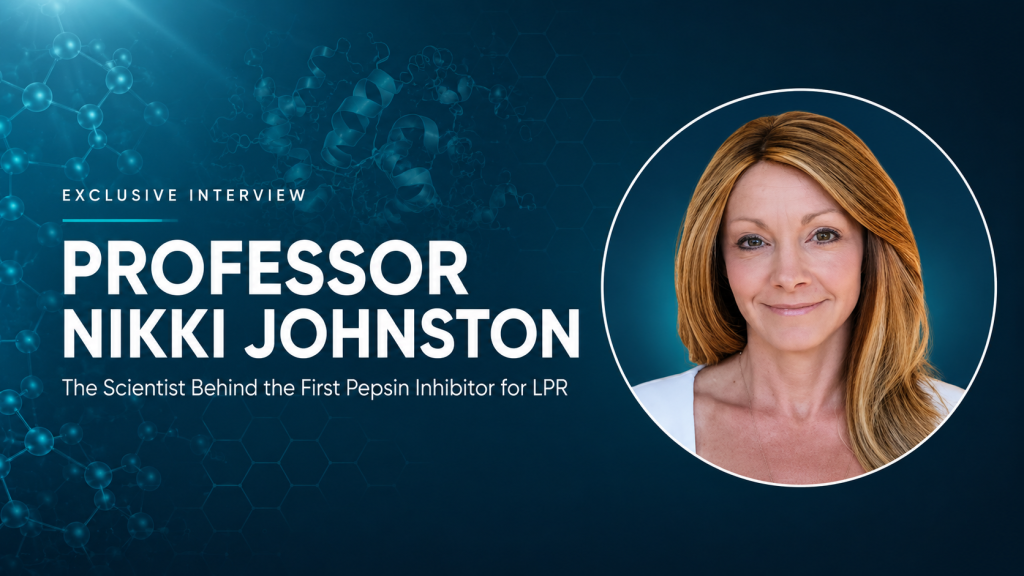
This is a first for Wipeout Reflux. If you’ve spent any time reading this site, you’ll know that one name comes up again and again in the research I cite: Professor Nikki Johnston of the Medical College of Wisconsin. She is the scientist who discovered how pepsin damages the throat independently of acid — the finding that explains why PPIs fail so many of us — and she is now leading the clinical trials of the world’s first pepsin inhibitor, a treatment designed to switch off the enzyme that actually causes LPR damage.
Professor Johnston kindly agreed to answer my questions about her research, the pepsin inhibitor trials, and what LPR sufferers should be doing while we wait. Her answers are published in full below, with my own commentary at the start and end.
Having lived with LPR (silent reflux) for 12 years — including the years I wasted on PPIs that did nothing — this interview means a great deal to me personally. Her work is the scientific backbone of the approach I’ve recommended on this site for years: target pepsin, not just acid.
Key Takeaways
- Pepsin, not acid, is the main driver of LPR damage. Professor Johnston discovered that throat cells actually take pepsin up inside themselves, where it can be reactivated and cause damage — completely independent of stomach acid.
- PPIs don’t stop reflux and don’t touch pepsin. Your acid can be perfectly controlled while pepsin continues causing inflammation — which is why so many people fail PPI therapy.
- The first pepsin inhibitor is in Phase II trials right now. Fosamprenavir, a repurposed HIV drug, directly binds to and blocks pepsin. Phase II efficacy data is expected in 2027.
- The trial is five times oversubscribed. 104 participants were needed — over 500 people volunteered. That tells you everything about how underserved LPR patients are.
- Until it arrives, alginates and diet are the most evidence-based tools we have. Professor Johnston’s own lab has studied how alginates protect tissue against pepsin-acid injury.
Who Is Professor Nikki Johnston?
For readers who haven’t come across your work before, could you tell us a little about yourself — your background, your role at the Medical College of Wisconsin, and how you came to specialise in reflux research?
Thank you for the opportunity to share some information about our research and drug development program with your readers.
I’m a Professor of Otolaryngology and Communication Sciences and Microbiology and Immunology at the Medical College of Wisconsin, where I have the privilege of leading a research team dedicated to providing better diagnostics and therapeutics for patients with reflux disease.
I trained at the University of Dundee in Scotland, where I completed my PhD in Molecular and Cellular Pathology. After completing my PhD, I worked with Dr. Jamie Koufman at Wake Forest University in Winston-Salem, NC where we measured pepsin, the main digestive enzyme in the stomach, as a diagnostic biomarker for reflux and aspiration, and investigated the role of refluxed pepsin in laryngeal injury and disease.
I wanted to learn why her patients had persistent symptoms of reflux despite maximal proton pump inhibitor (PPI) acid suppression therapy. At that time, it was thought that PPIs, by decreasing acid production, would also neutralize pepsin (indirectly by increasing the pH), and thus prevent inflammation and damage from both acid and pepsin. I discovered that pepsin is taken up by laryngeal epithelial cells by receptor mediated endocytosis and transported through compartments of the cells which are acidic, generating conditions that would restore its proteolytic activity inside the cell, so independent of refluxed stomach acid. This revealed a novel mechanism by which pepsin-induced cellular injury is independent of the pH/acidity of gastric refluxate and likely explains why many patients have persistent symptoms despite maximal acid suppression therapy. Current medical therapies for reflux are focused on reducing or eliminating stomach acid. This work paved the way for research into novel therapeutics for reflux which specifically target pepsin.
What Does Pepsin Do to Your Throat — and Why Do PPIs Fail?
Your research has shown that pepsin — not acid — is the main driver of tissue damage in LPR. Can you explain in plain terms what pepsin does to the throat, and why that means PPIs fail so many patients?
Pepsin is the main digestive enzyme secreted in the stomach – it breaks down proteins allowing your body to digest, e.g., meat. When refluxed up into your throat it causes inflammation and tissue injury.
Pepsin is present in all gastric refluxate and frequently detected in airway tissue and secretions from patients with LPR, absent in reflux-free control subjects. Studies have shown that pepsin causes laryngeal inflammation and damage, including changes consistent with those observed in LPR patients, independent of stomach acid.
Pepsin is increasingly recognized as a central player in LPR because it links reflux exposure to tissue inflammation, injury, and disease, even in the absence of acid. Pepsin remains stable at neutral pH, so as in non-acid reflux, and can be reactivated inside cells after it is taken up by the laryngeal epithelium. As I mentioned, the finding of pepsin uptake by laryngeal cells explains how pepsin causes damage even in non-acid reflux.
PPIs don’t stop reflux from occurring, they decrease the acidity. Data showing pepsin disrupts cellular pathways, promotes inflammation, and impairs mucosal defenses in non-acid reflux, explains why acid suppression alone often fails—PPIs don’t inactivate pepsin. Understanding pepsin’s role has fundamentally changed how we think about both diagnosis and treatment, opening the door to targeted therapies aimed at blocking pepsin activity rather than simply neutralizing acid. Several studies have now reported the potential and need to inactivate pepsin.
PPIs are very good at reducing how much acid the stomach produces, but they don’t stop reflux and they do not stop pepsin from being present in refluxate or from reaching the throat and causing inflammation and damage. So a patient can be doing everything right on their medication, have their acid well controlled, and still have an active, damaging process going on — because acid was never really the main problem for them in the first place. That’s why so many patients don’t get better on PPIs.
How Did an HIV Drug Become the First Pepsin Inhibitor?
What first led you to start investigating pepsin, and how did you arrive at the idea of repurposing an HIV protease inhibitor like fosamprenavir as a pepsin inhibitor? It’s an unusual connection to have made.
New technology called hypopharyngeal-esophageal multi-channel intraluminal impedance – pH monitoring (HEMII-pH) showed that many episodes of LPR are non-acidic and that weakly and non-acidic LPR is associated with persistent symptoms in acid-suppressed patients. Thus, one of the non-acid components must have a role in mucosal damage and inflammation. Our research revealed a key role for pepsin in causing inflammation and damage, independent of gastric acid and thus irrespective of acid-suppressing PPIs, likely explaining why many patients fail PPI therapy. The next natural step was to find a way to block/inhibit the pepsin enzyme directly, rather than only trying to manage the acid environment around it.
I took a two-pronged approach: I worked with chemists to try to synthesize a new molecule that would bind to and inhibit pepsin and screened existing libraries of agents that might inhibit pepsin. Pepsin is a protease so I thought certain drugs like HIV protease inhibitors might work. HIV inhibitors by design are molecules built to block a protease enzyme. We assessed all the commercially available HIV protease inhibitors and found four of them bind to and inhibit pepsin. One was excluded based on known side effects, interactions, and cost. Of the remaining three, fosamprenavir was the lead candidate to move into clinical trials because of its oral bioavailability and favorable tolerability profile and ability to prevent pepsin-mediated laryngeal inflammation and damage in models of LPR.
Fosamprenavir is an ideal drug to repurpose and reformulate because it not only has a good safety and tolerability profile but targets a foreign virus so will not have off-target side effects compared to e.g., repurposing a blood pressure medication which would then affect blood pressure in LPR patients. This allows safe assessment in a clinical trial. This repurposing approach also allows expeditious assessment in a clinical trial compared to that for a new molecule because its safety profile is already established.
When Will a Pepsin Inhibitor Be Available? The Trial Timeline
You’ve now been working on this for well over a decade and are into Phase II trials. How is the process going, and realistically what does the road ahead look like before a pepsin inhibitor could reach patients?
It has been a long road, and I feel very grateful to be at this stage. We now have three efforts moving through the clinical pipeline: a Phase II trial of oral fosamprenavir for LPR, a Phase I trial of an inhaled fosamprenavir formulation (designed for more targeted delivery to the throat allowing lower dosing), and a novel oral fosamprenavir-sodium alginate formulation (providing local delivery to the esophagus), heading into a Phase II trial for PPI-refractory GERD.
We enter clinical trials with very encouraging preclinical data showing that fosamprenavir binds to and inhibits pepsin and prevents pepsin-mediated laryngeal inflammation and damage in models of LPR. In support, patients taking HIV inhibitors have a significantly lower incidence of LPR (0.2%) compared to that reported for the general population (10 – 34.4%). Furthermore, some people have reported “life-changing” benefits after off-label use for LPR prior to manufacture discontinuation.
Our Phase II trial for LPR is five times oversubscribed – we need 104 people and currently have over 500 volunteers, so we expect to complete the trial expeditiously. Phase II efficacy data in 2027 will be a huge milestone. A Phase III marketing approval trial will then be needed before this drug can be made widely available to patients. I can’t comment on the timeframe for that as there are many things out with our control, but please be assured we are working diligently to perform these trials to provide a safe and effective treatment for LPR as quickly as possible.
How to Reduce Pepsin Damage Right Now
Until that treatment arrives, what should LPR sufferers be doing to reduce their pepsin burden — and where do alginates and dietary changes fit into that picture?
While we keep working toward a targeted medical treatment for pepsin, dietary and lifestyle changes remain the most evidence-based tools patients have today. Reducing fat intake and known trigger foods can lessen the volume and aggressiveness of reflux events, and avoiding eating too close to bedtime helps reduce nighttime reflux exposure.
Alginates are also a meaningful part of the picture, and it’s an area my lab has studied directly — we’ve looked at how topical alginate formulations help protect the esophageal lining against pepsin-acid injury. They work by forming a physical raft over the stomach contents that helps keep refluxate, pepsin included, away from vulnerable tissue. None of these measures switch off pepsin’s activity the way a targeted inhibitor could, but they can meaningfully ease symptom burden while we continue this work.
The One Thing She Wishes More Doctors Understood About LPR
What’s the one thing you wish more doctors understood about LPR that isn’t yet reflected in routine clinical practice?
I think the most important thing is this: when a patient doesn’t respond to a PPI, that doesn’t mean their symptoms aren’t real or aren’t reflux-related — it often just means acid wasn’t the whole story. Pepsin can cause inflammation and injury in a weakly acidic or even neutral environment, so a patient can have their acid well controlled and still have an active reflux problem. I’d love for that distinction to shape how we approach patients who don’t improve on acid suppression, rather than concluding there’s nothing further to treat. There is — we just need better tools, which our team are working to provide.

Professor Johnston is a Professor of Otolaryngology and Communication Sciences and Microbiology and Immunology at the Medical College of Wisconsin, where she leads a research team developing better diagnostics and therapeutics for reflux disease. After completing her PhD in Molecular and Cellular Pathology at the University of Dundee, she worked alongside Dr. Jamie Koufman at Wake Forest University, where she discovered that laryngeal cells absorb pepsin and reactivate it internally — the mechanism that explains why acid suppression fails so many LPR patients. She now leads the clinical development of fosamprenavir, the world’s first pepsin inhibitor for reflux disease.
→ Pepsin and Reflux Laboratory (MCW)
→ N-Zyme Biomedical
→ The Phase II LPR Trial (ClinicalTrials.gov)
My Thoughts on the Interview
A few things stand out to me from Professor Johnston’s answers that I want to draw your attention to.
The endocytosis discovery is the single most important fact in LPR. If you take one thing from this interview, make it this: your throat cells physically absorb pepsin, carry it into acidic compartments inside the cell, and reactivate it there. That means the damage can continue inside your own cells regardless of how well your stomach acid is suppressed. When your doctor tells you your reflux “should be controlled” because you’re on a high-dose PPI, this is the mechanism they’re missing. I cover the practical side of this in my article on how to neutralise pepsin in the throat.
The trial oversubscription tells its own story. Over 500 volunteers for 104 places. That is what happens when tens of millions of people are given a medication that was never designed for their condition and left to fend for themselves when it doesn’t work. The landmark [O’Hara et al., BMJ, 2021] TOPPITS trial showed PPIs were no better than placebo for throat symptoms, yet PPIs remain the default prescription. The demand for this trial confirms what I hear from readers and consultation clients every single week: people know acid suppression isn’t the answer, and they are desperate for something that targets the real problem.
A note of caution on off-label use. You’ll notice Professor Johnston mentioned that some patients reported major benefits using fosamprenavir off-label before the original manufacturer discontinued it. I want to be very clear: I am not suggesting anyone attempt to source this drug off-label. The correct formulation, dosing and safety monitoring for LPR are precisely what the trials exist to establish — the Phase II data in 2027 will tell us whether it genuinely works in patients [ClinicalTrials.gov, NCT04383262]. What those reports do tell us is that the biological rationale is strong, and the preclinical evidence backs it up: fosamprenavir prevented pepsin-mediated laryngeal damage in animal models of LPR [Johnston et al., The Laryngoscope, 2023]. For the full background on the drug itself — how it was discovered, the science behind it and the formulations in development — see my dedicated article on fosamprenavir for LPR.
Her interim advice validates the approach this site is built on. Notice what the world’s leading pepsin researcher recommends while we wait: reduce trigger foods and fat intake, don’t eat close to bedtime, and use alginates to physically keep pepsin away from vulnerable tissue — an area her own lab has published on directly [Blaine-Sauer et al., Int J Mol Sci, 2023]. That is, almost word for word, the strategy I lay out in my silent reflux treatment guide and the LPR diet. It isn’t a fringe alternative to medical treatment — right now, it is the most evidence-based treatment available.
Conclusion
My sincere thanks to Professor Johnston for taking the time to answer these questions so openly. It’s rare to get this level of direct insight from the researcher actually driving a new class of treatment forward, and I’ll be following the trials closely — I’ll update this article as results are published, starting with the Phase II efficacy data expected in 2027.
The message to take away is one of genuine hope grounded in patience. A drug that switches off pepsin — the actual cause of LPR damage — is closer than it has ever been. But it is not here yet, and the best thing you can do in the meantime is exactly what Professor Johnston recommends: reduce pepsin exposure through a low-acid diet, use alginates strategically, and stop expecting acid suppression alone to fix a problem it was never designed to fix.
If you want a structured way to do that, my Wipeout Diet Plan gives you the complete low-acid approach I used for my own recovery, and the Wipeout Food Reference Guide tells you exactly which foods reactivate pepsin and which are safe. And if you’d like tailored one-to-one guidance, you can book a private consultation with me here.
Frequently Asked Questions
What is a pepsin inhibitor?
A pepsin inhibitor is a drug that directly binds to and blocks pepsin — the stomach enzyme responsible for most of the throat and laryngeal damage in LPR. Unlike PPIs, which only reduce stomach acid, a pepsin inhibitor deactivates the enzyme itself, so it can prevent damage even from weakly acidic or non-acid reflux. Fosamprenavir, a repurposed HIV drug, is the first pepsin inhibitor to reach clinical trials.
Who is Professor Nikki Johnston?
Professor Nikki Johnston is a Professor of Otolaryngology and Communication Sciences and Microbiology and Immunology at the Medical College of Wisconsin. She discovered that laryngeal cells take up pepsin by receptor-mediated endocytosis, where it can be reactivated and cause damage independent of stomach acid — the key finding explaining why PPIs fail many LPR patients. She now leads the clinical development of fosamprenavir as the first pepsin inhibitor for reflux disease.
Why don’t PPIs work for LPR?
PPIs reduce how much acid the stomach produces, but they don’t stop reflux events from happening and they don’t inactivate pepsin. Pepsin still travels up with the refluxate, is absorbed by throat cells, and can be reactivated inside them to cause inflammation and damage — even when acid is well controlled. As Professor Johnston puts it, for many LPR patients acid was never the main problem in the first place.
When will a pepsin inhibitor be available for LPR?
Not for several years yet. The Phase II trial of oral fosamprenavir for LPR is now enrolling and Phase II efficacy data is expected in 2027. If the results are positive, a larger Phase III trial will still be required before the drug can be approved and made widely available. Professor Johnston was clear that the exact timeline beyond 2027 can’t be predicted.
Can I join the fosamprenavir clinical trial?
The Phase II LPR trial is heavily oversubscribed — 104 participants were needed and over 500 people volunteered. However, further trials are coming, including a Phase I trial of an inhaled formulation and a Phase II trial of a fosamprenavir-sodium alginate formulation for PPI-refractory GERD. You can monitor recruitment for these on ClinicalTrials.gov (the LPR study is listed under NCT04383262).
Can I get fosamprenavir off-label for LPR now?
I would strongly advise against attempting this. The original branded product was discontinued by its manufacturer, and the correct formulation, dose and safety monitoring for LPR haven’t yet been established — that’s precisely what the trials are for. The responsible path is to wait for the Phase II data in 2027 while using the evidence-based tools available today.
What can I do about pepsin while I wait for the trials?
Professor Johnston’s advice matches what I recommend across this site: follow a low-acid diet that avoids trigger foods and excess fat, leave at least three hours between your last meal and bed, and use an alginate product after meals to form a raft that keeps pepsin away from your throat. My silent reflux treatment guide and the Wipeout Diet Plan cover this approach step by step.
Research Sources
[Johnston et al., The Laryngoscope, 2023] — Demonstrated that oral and inhaled fosamprenavir reversed pepsin-induced laryngeal damage in a mouse model of LPR, providing the key preclinical evidence supporting the current clinical trials.[Blaine-Sauer et al., Int J Mol Sci, 2023] — Showed that amprenavir (the active form of fosamprenavir) protects oesophageal cells against pepsin-induced barrier disruption and cancer-associated changes, supporting its potential for PPI-refractory GERD.[O’Hara et al., BMJ, 2021] — The TOPPITS randomised controlled trial of 346 patients found PPIs were no better than placebo for persistent throat symptoms, underlining why a treatment targeting pepsin rather than acid is needed.[ClinicalTrials.gov, NCT04383262] — The official registry entry for the Phase II FLUTTER trial: a 12-week randomised, double-blind, placebo-controlled trial of oral fosamprenavir in 104 patients with PPI-refractory, impedance-confirmed LPR.[N-Zyme Biomedical, Press Release, June 2026] — Announcement of the initiation of the Phase II clinical trial of the first pepsin inhibitor for LPR, with patents granted in the US and Japan.[Medical College of Wisconsin, Pepsin and Reflux Laboratory] — Professor Johnston’s laboratory page, listing the full research programme including the oral, inhaled and fosamprenavir-sodium alginate clinical studies.
David Gray
12 years living with LPR · Consultant & researcher
I've lived with LPR for twelve years — the misdiagnoses, the PPI courses that did nothing, the slow work of figuring out what actually helps. Wipeout Reflux is where I translate the research into plain terms for people stuck in the same place. Every claim here is sourced to peer-reviewed work, and I consult one-to-one with LPR sufferers.