
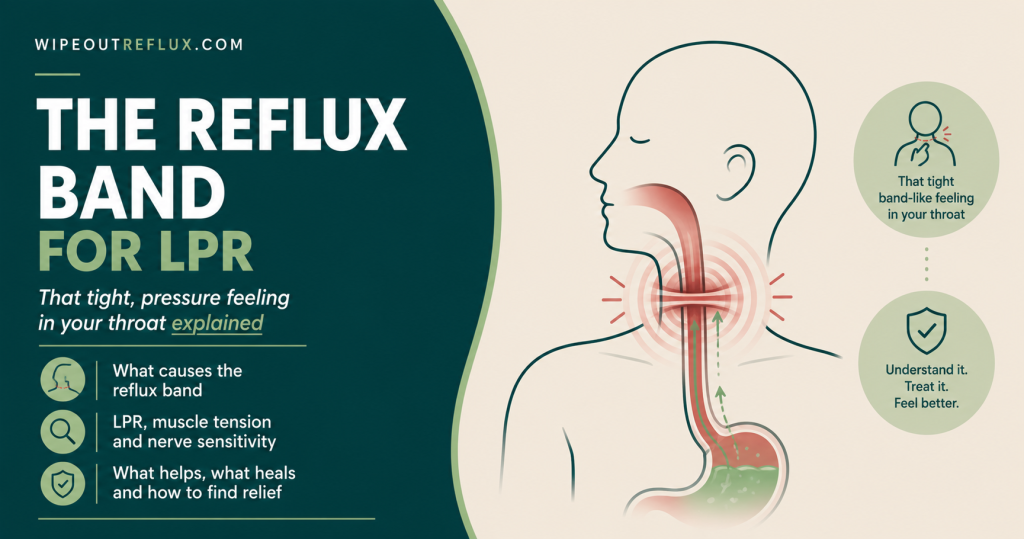
The Reflux Band is one of the more intriguing tools in the silent reflux world, because it does something no pill can: it physically stops reflux from reaching your throat. It is a soft band you wear around your neck at night, and it works by gently reinforcing the upper oesophageal sphincter (UES) — the last valve standing between your stomach contents and your voice box, throat, and airway.
So does it actually work? The honest answer is a qualified yes. Mechanistically, it is well-founded — studies show it genuinely raises the pressure of that upper valve and cuts down the reflux that escapes into the throat. Clinically, it can meaningfully reduce nighttime LPR symptoms for the right person. But the evidence base is still modest, and it is best thought of as a nighttime adjunct — one useful tool alongside diet and the other fundamentals — rather than a standalone cure.
I have managed my own LPR for over eight years, so let me explain exactly how it works, walk through what the research shows, and be straight about who it helps and where its limits lie.
Key Takeaways
- The Reflux Band (formerly the Reza Band) is a non-invasive device worn around the neck during sleep.
- It reinforces the upper oesophageal sphincter — the throat’s last barrier against reflux — by applying gentle pressure to the cricoid cartilage.
- The mechanism is well-proven. Studies show it raises UES pressure and reduces reflux reaching the throat.
- It targets what PPIs miss. Because it is a physical barrier, it blocks non-acid reflux, pepsin, and bile — not just acid.
- Clinical evidence is supportive but limited. Studies show symptom improvement, but they are mostly small, and large independent trials are lacking.
- It only works at night, while worn. It targets supine, nighttime reflux — not daytime symptoms.
- It is an adjunct, not a cure, and works best alongside diet, sleep positioning, and the fundamentals.
What Is the Reflux Band?
The Reflux Band — previously sold on prescription as the Reza Band, and now available over the counter — is a wearable strap with a small cushion that sits over the front of your neck. You put it on at bedtime and take it off when you wake. It grew out of roughly two decades of research into the upper oesophageal sphincter by a gastroenterologist at the Medical College of Wisconsin, and it is cleared by the FDA specifically to reduce the symptoms of laryngopharyngeal reflux (LPR).
What makes it different from every reflux medication is that it does nothing to your stomach acid. It is a purely mechanical device that reinforces a barrier — which, as you will see, is exactly why it can help with the parts of silent reflux that drugs cannot touch.
How the Reflux Band Works
To understand it, you need to know about the valve it targets.
The UES: your throat’s last line of defence
Most people know about the lower oesophageal sphincter at the bottom of the oesophagus. But there is a second valve at the top — the upper oesophageal sphincter — and in LPR, this one matters enormously. It is the final barrier before your larynx, throat, and airway. When it works properly, it stays firmly shut and stops anything that has refluxed up the oesophagus from spilling into your throat.
The problem is that during sleep, the UES naturally relaxes — and in people with silent reflux, it can relax too much. That is why so many LPR sufferers wake with a hoarse voice, a sore or tight throat, the urge to clear their throat, or a nighttime cough. Reflux has slipped past that relaxed upper valve while they slept. It is also why sleep position and timing matter so much, something I cover in my guides to acid reflux at night and the best sleeping position for silent reflux.
The band reinforces that valve
The Reflux Band applies a small, controlled amount of external pressure — around 20 to 30 mmHg — to the cricoid cartilage, the firm ring of cartilage just below your Adam’s apple. That gentle pressure raises the resting pressure inside the UES, helping a lazy valve stay closed. In effect, it lets a dysfunctional upper sphincter behave like a healthy one while you sleep, blocking stomach contents from reaching your throat and airway.
The advantage over acid drugs
Here is the part that matters most for LPR. A PPI reduces how acidic your stomach contents are, but it does nothing to stop reflux physically travelling up to your throat — and it does nothing about pepsin and bile, which are major drivers of silent reflux damage. Because the Reflux Band is a physical barrier, it blocks all of these regardless of whether they are acidic. If pepsin is central to your symptoms, that is a genuine advantage, and it pairs well with strategies to neutralise pepsin in the throat.
Does It Actually Work? The Evidence
Let me give you the honest picture — genuinely encouraging mechanism, more modest clinical proof.
The mechanism is well-demonstrated
The foundational study showed that applying external pressure at the cricoid augmented the UES pressure barrier and reduced esophagopharyngeal reflux — reflux crossing up into the throat [Shaker et al., The Laryngoscope, 2014]. A later study in tube-fed patients confirmed the same principle, showing the device significantly reduced reflux events crossing the upper sphincter [Jiao et al., The Laryngoscope, 2018]. So the core claim — that it raises UES pressure and blocks reflux from reaching the throat — is on solid physiological ground.
The clinical results are promising
Beyond the mechanism, studies have looked at whether it actually improves symptoms. One study found the device was associated with a symptom response in patients with reflux-associated laryngeal symptoms [Yadlapati et al., Clinical Gastroenterology and Hepatology, 2018].
More tellingly, a study tested the band on top of PPI therapy. Among 31 LPR patients, a meaningful (50% or greater) drop in the Reflux Symptom Index was achieved by 35% on a PPI alone, rising to 55% once the device was added. Average symptom scores fell from 24.1 at baseline to 15.5 with the device plus PPI [Yadlapati et al., Digestive Diseases and Sciences, 2021]. In other words, the band added benefit that acid suppression alone did not deliver — which fits its mechanism perfectly, since it tackles the nighttime and non-acid reflux a PPI leaves untouched.
The honest caveats
I do not want to oversell this. The clinical studies are relatively small, several have industry involvement (the device’s inventor has a commercial interest in it), and large independent randomised trials are still lacking. That is why clinical adoption has been cautious. So the fair summary is: the mechanism is proven, the early clinical data is encouraging, but the evidence is not yet strong enough to call it a guaranteed fix. For many people it clearly helps; for some it does not.
Who the Reflux Band Suits
Based on how it works, the Reflux Band tends to help people who have:
- Nighttime or morning-predominant LPR symptoms — waking with hoarseness, a sore or tight throat, the urge to clear the throat, or a nighttime cough. This is its sweet spot.
- A preference for a drug-free option, or concerns about long-term PPI use — see getting off PPIs and acid rebound.
- A partial response to PPIs, where the band can target the nighttime and non-acid reflux the medication misses.
- Suspected pepsin or non-acid reflux, given its mechanical barrier works regardless of acidity.
Who It Won’t Help — and the Cautions
It is not right for everyone. Be realistic if you have:
- Mainly daytime symptoms. The band only works while you wear it in bed, so it does little for reflux that troubles you during the day when you are upright.
- Difficulty tolerating neck pressure. Some people find it uncomfortable or disruptive to sleep in, and it can cause mild skin irritation.
- Certain neck conditions. Because it applies pressure to the neck, it is not suitable for everyone — anyone with relevant neck, carotid, or airway conditions, or recent neck surgery, should only use it under medical guidance and after proper fitting.
- An expectation of a cure. It manages symptoms while worn; it does not fix the underlying reflux or replace addressing your triggers.
The Downsides
To weigh it up fairly, the main limitations are that it is nighttime-only, requires correct fitting to deliver the right pressure, can be uncomfortable for some sleepers, carries a cost, and rests on a modest (if encouraging) evidence base. Reported side effects in studies were generally mild and short-lived — things like discomfort, disturbed sleep, or skin irritation.
Where It Fits in an LPR Plan
Here is how I would frame it. The Reflux Band is a targeted nighttime tool that plugs a very specific gap: reflux slipping past a relaxed upper valve while you sleep, including the non-acid and pepsin-laden reflux that medication ignores. That is a real and useful role, especially if your worst symptoms hit overnight or on waking.
But it is one piece of the puzzle, not the whole picture. It works best layered on top of the fundamentals — the right diet, sensible meal timing, sleeping elevated and on your left side, and managing pepsin. Those are the things that reduce how much reflux is there to escape in the first place, and they are exactly what my Wipeout Diet Plan is built around. If you are new to all this, my silent reflux treatment guide is a good starting point before investing in any device.
Conclusion
So, does the Reflux Band work? For the right person, genuinely yes — with honest caveats. The science behind it is sound: it demonstrably raises the pressure of the upper oesophageal sphincter and reduces the reflux that reaches your throat, and because it is a physical barrier, it blocks the pepsin and non-acid reflux that PPIs simply cannot. The early clinical data backs that up, showing real symptom improvement, particularly when the band is added on top of medication.
The caveats are equally honest. The evidence is still limited and mostly small-scale, it only works at night while you wear it, and it is a symptom-management tool rather than a cure. So I would think of it as a well-targeted nighttime adjunct — a sensible thing to try if your LPR symptoms are worst overnight or on waking, or if you want to reduce your reliance on medication, ideally under the guidance of a professional who can fit it properly.
Most importantly, do not let any single device distract from the foundations. In my experience, lasting improvement comes from changing what you eat and how you eat far more than from any one tool — a device like this simply reduces the damage while the real work happens. That is exactly what my Wipeout Diet Plan is designed to deliver, in the depth silent reflux needs, and the Wipeout Food Reference Guide is the essential companion that shows exactly which foods and drinks are reflux-friendly and their pH values. Get that foundation right, and let a tool like the Reflux Band be the boost on top — not the whole plan.
Frequently Asked Questions
Does the Reflux Band really work for LPR?
Mechanistically, yes — studies show it raises upper oesophageal sphincter pressure and reduces reflux reaching the throat, and clinical studies show symptom improvement, especially when added to a PPI. But the evidence base is still limited, and it works as a nighttime adjunct rather than a cure. Results vary from person to person.
How does the Reflux Band work?
It applies gentle external pressure (about 20 to 30 mmHg) to the cricoid cartilage in your neck, which raises the resting pressure of the upper oesophageal sphincter. This reinforces your throat’s last barrier against reflux, keeping stomach contents from reaching your larynx and airway while you sleep.
Is the Reflux Band better than PPIs for silent reflux?
It is not better or worse — it works differently. PPIs reduce acid; the band physically blocks reflux, including non-acid reflux, pepsin, and bile that PPIs do not affect. Studies suggest it can add benefit on top of a PPI, which is why the two are sometimes used together.
Do you wear the Reflux Band all day?
No. It is designed to be worn only during sleep, because that is when the upper sphincter relaxes and nighttime reflux reaches the throat. You put it on at bedtime and remove it on waking. It does not help daytime symptoms.
Is the Reflux Band safe?
It is FDA-cleared, and reported side effects in studies were generally mild and short-lived, such as discomfort, disturbed sleep, or skin irritation. However, because it applies pressure to the neck, anyone with relevant neck, carotid, or airway conditions should only use it under medical guidance and after proper fitting.
Who should not use the Reflux Band?
People whose symptoms are mainly during the day, those who cannot tolerate neck pressure, and anyone with certain neck, carotid, or airway conditions or recent neck surgery. It is also not a fix if you are expecting it to cure reflux rather than manage nighttime symptoms.
Can the Reflux Band replace my reflux medication?
Not necessarily, and you should never stop prescribed medication without medical advice. Some people use it as a drug-free option and others alongside a PPI. Because it targets nighttime and non-acid reflux, it can complement medication rather than simply replace it.
Research Sources
- [Shaker et al., The Laryngoscope, 2014] — Demonstrated that external pressure applied at the cricoid augmented the upper oesophageal sphincter pressure barrier and reduced esophagopharyngeal reflux, establishing the mechanism behind the device.
- [Jiao et al., The Laryngoscope, 2018] — Found that the upper oesophageal sphincter assist device significantly reduced reflux events crossing the upper sphincter in nasogastric tube-fed patients, confirming its barrier effect.
- [Yadlapati et al., Clinical Gastroenterology and Hepatology, 2018] — Reported that the upper oesophageal sphincter assist device was associated with symptom response in patients with reflux-associated laryngeal symptoms.
- [Yadlapati et al., Digestive Diseases and Sciences, 2021] — In 31 LPR patients, adding the device to PPI therapy raised the proportion achieving a 50% or greater reduction in Reflux Symptom Index from 35% (PPI alone) to 55%, with mean scores falling from 24.1 to 15.5.

David Gray
12 years living with LPR · Consultant & researcher
I've lived with LPR for twelve years — the misdiagnoses, the PPI courses that did nothing, the slow work of figuring out what actually helps. Wipeout Reflux is where I translate the research into plain terms for people stuck in the same place. Every claim here is sourced to peer-reviewed work, and I consult one-to-one with LPR sufferers.