
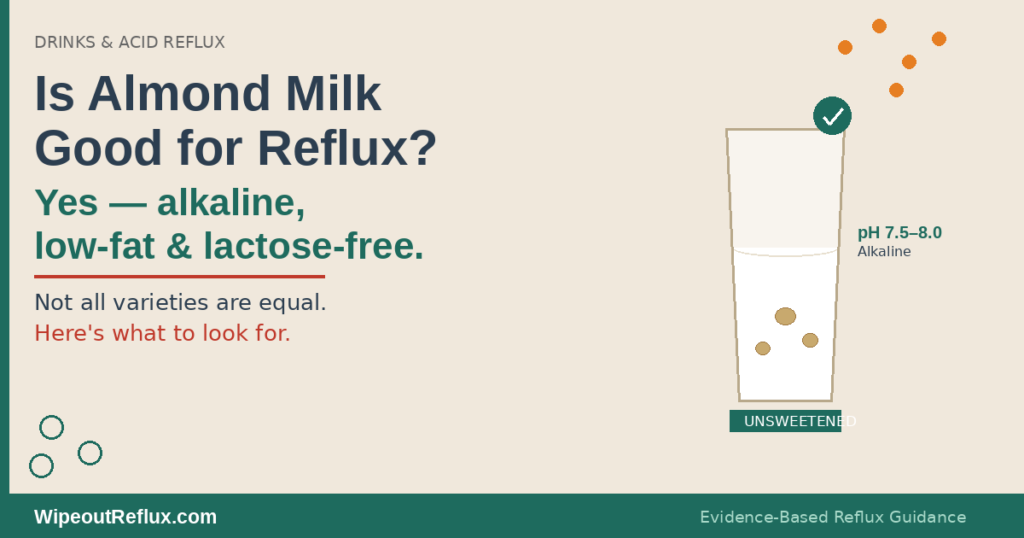
Yes — almond milk is one of the better drink choices for acid reflux and GERD. Its main advantage is that it’s naturally alkaline, typically sitting at a pH of around 7.5–8.0 for unsweetened varieties. That alkalinity means it can help buffer excess stomach acid rather than adding to it, and when it passes through the throat on the way down, it may offer some transient soothing effect — particularly useful if you have silent reflux (LPR) and are dealing with throat irritation.
Compared to regular cow’s milk, almond milk has a significantly lower fat content, contains no lactose, and is less likely to trigger the delayed rebound in stomach acid that full-fat dairy can cause. It’s also a better option than many other beverages people turn to — certainly better than coffee, fizzy drinks, or citrus juices, all of which are common acid reflux triggers.
That said, not all almond milk is equal. Sweetened, flavoured, or additive-heavy varieties can undermine those benefits. Here’s what matters most when choosing almond milk with reflux in mind.
Key Takeaways
- Almond milk is naturally alkaline (pH ~7.5–8.0 unsweetened), which can help buffer stomach acid and is unlikely to aggravate reflux symptoms.
- Alkaline liquids with a pH above 8.0 have been shown in laboratory studies to irreversibly inactivate pepsin — the enzyme responsible for throat and oesophageal tissue damage in reflux disease.
- Almond milk is very low in fat (~1–3g per 250ml serving), which means it doesn’t relax the lower esophageal sphincter or slow gastric emptying the way full-fat dairy does.
- It’s lactose-free, making it suitable for people who find regular milk aggravates their digestion or reflux symptoms.
- Unsweetened, plain almond milk is the best choice — sweetened or flavoured versions (particularly chocolate or coffee varieties) can be more acidic and more likely to trigger symptoms.
- Watch for carrageenan on the ingredients list — this common thickener used in plant milks has been linked to gut inflammation and digestive discomfort in some people.
- Almond milk is a sensible everyday alternative to dairy, but it won’t resolve reflux on its own — diet and lifestyle remain the foundation of long-term symptom management.
How Almond Milk Is Made and Why It Matters for Reflux
Almond milk is made by soaking almonds in water, blending them, then straining out the solid pulp. What you’re left with is a thin, slightly nutty liquid that carries the water-soluble nutrients and compounds from the almonds — but not the fibre or most of the fat, both of which remain in the discarded pulp.
This production process matters for reflux for two reasons. First, because the fat content of the final liquid is very low — typically around 1–3g per 250ml glass — it doesn’t carry the same risk as full-fat dairy. High-fat foods are well-established reflux triggers because they slow gastric emptying, increase stomach pressure, and promote relaxation of the lower esophageal sphincter (LES). Almond milk sidesteps all of that. Second, because the fibre content is minimal, it’s easy to digest and unlikely to cause the bloating or gas that can raise intra-abdominal pressure and worsen reflux.
The result is a drink that’s genuinely mild on the digestive system — which is exactly what you want when you’re managing reflux.
Why Almond Milk’s Alkalinity Matters — Especially for LPR
The most clinically relevant reason almond milk is beneficial for reflux is its pH. Unsweetened almond milk typically has a pH of around 7.5–8.0, making it mildly to moderately alkaline. This matters for two reasons.
First, alkaline drinks help buffer excess acidity in the stomach and oesophagus. When you’re experiencing a reflux episode, drinking something alkaline works in the opposite direction of an acidic drink — rather than adding to the acid load, it temporarily helps neutralise it.
Second, and particularly important for people with LPR or silent reflux, there’s a well-established link between alkalinity and pepsin inactivation. Pepsin is the digestive enzyme that travels up from the stomach with acid during reflux episodes and binds to throat tissue, where it can cause ongoing inflammation even between reflux events. Research has shown that alkaline water at pH 8.8 instantly and irreversibly denatures human pepsin, rendering it permanently inactive — and has superior acid-buffering capacity compared to neutral pH water [Koufman & Johnston, Annals of Otology, Rhinology & Laryngology, 2012].
Almond milk at pH 7.5–8.0 sits at the lower end of this therapeutic range. It won’t inactivate pepsin as efficiently as a dedicated pH 8.8 alkaline water, but it’s a meaningful step up from neutral or acidic drinks, and the act of passing alkaline liquid through the throat provides a direct buffering effect on any pepsin sitting on the throat lining. For LPR sufferers, this is a genuine benefit that regular milk, coffee, or juice cannot offer.
A cohort study comparing a dietary approach — using alkaline water alongside a plant-based Mediterranean-style diet — against standard PPI therapy for LPR found no significant difference in symptom reduction between the two groups, with the dietary group achieving a 39.8% reduction in the Reflux Symptom Index [Zalvan et al., JAMA Otolaryngology — Head & Neck Surgery, 2017]. This supports the broader principle that alkaline, plant-based choices like almond milk can play a meaningful role in a reflux management strategy.
Almond Milk vs. Regular Cow’s Milk for Reflux
For most reflux sufferers, almond milk is the better choice over regular cow’s milk. Here’s why, broken down clearly.
Fat content. Full-fat cow’s milk contains around 8g of fat per 250ml. Even semi-skimmed contains 4–5g. Almond milk typically has 1–3g. As discussed above, fat is one of the most consistent dietary reflux triggers — it slows gastric emptying, increases stomach pressure, and relaxes the LES. Lower fat means lower risk.
Lactose. A significant portion of the population has some degree of lactose intolerance. For these people, regular milk causes bloating, gas, and increased intra-abdominal pressure — all of which can worsen reflux symptoms. Almond milk is entirely lactose-free, so it sidesteps this issue completely.
pH. Cow’s milk has a pH of around 6.5–6.8 — mildly acidic. Unsweetened almond milk sits at roughly 7.5–8.0 — alkaline. For reflux management, the higher pH of almond milk makes it the preferable choice, particularly for LPR where throat acidity is a specific concern.
Rebound acidity. Regular milk temporarily neutralises stomach acid, but its protein and calcium content then stimulates further acid production a couple of hours later — sometimes making symptoms worse than before. This rebound effect is a known issue with dairy milk as a reflux remedy. Almond milk, with its much lower protein content, doesn’t produce the same rebound.
Almond Milk vs. Other Plant-Based Milks for Reflux
If you’re choosing between plant-based milk alternatives, almond milk generally comes out favourably for reflux — though the picture is more nuanced than simply ranking one above all others.
Soy milk has a similar pH to almond milk (around 7.5–8.0) and is also lactose-free. It’s higher in protein, which some people find harder to digest. Some people with reflux also find soy specifically can be a trigger, possibly related to its phytoestrogen content or individual sensitivity. Check our dedicated article on soy milk and acid reflux for a full comparison.
Oat milk has a pH of around 6.0–7.0 — slightly more acidic than almond milk — and contains more carbohydrates and natural sugars. It’s thicker and more filling, which some people find comforting, but its lower alkalinity is worth noting if pH is your primary concern.
Rice milk tends to be more acidic still, with a pH around 6.0–6.5. It’s also relatively high in sugar and low in nutrition. Generally not the best choice for reflux.
Coconut milk (the carton variety, not canned) is typically lower in fat than canned coconut milk and has a reasonably neutral pH. However, full-fat canned coconut milk is very high in saturated fat — clearly unsuitable for reflux.
Overall, almond milk and soy milk sit at the top of the list for reflux-friendly plant-based options. Almond milk has a slight edge due to its lower fat content and the absence of the individual sensitivities that some people experience with soy.
Choosing the Right Almond Milk for Acid Reflux
Not all almond milk is equally reflux-friendly. The label matters.
Choose unsweetened. Sweetened almond milks can be significantly more acidic than unsweetened versions and contain added sugars that may worsen symptoms for people with more sensitive reflux — particularly those with LPR. The sweet taste might be appealing, but the trade-off in pH and sugar content isn’t worth it.
Avoid flavoured varieties. Chocolate almond milk and coffee almond milk both combine almond milk’s base with strong reflux triggers. Chocolate contains methylxanthines that relax the LES. Coffee contains caffeine that stimulates acid secretion. Adding either to almond milk erases the benefit of using it in the first place.
Check for carrageenan. This seaweed-derived thickener is commonly added to plant-based milks to improve texture. Some research suggests it can cause gut inflammation and digestive discomfort in sensitive individuals, and it’s worth avoiding if you have underlying gut issues alongside your reflux. Look for carrageenan-free varieties — they exist and are becoming more widely available.
Go as natural as possible. The shorter the ingredients list, the better. Ideally you want water, almonds, and perhaps a small amount of added calcium or vitamins. Heavy preservatives, emulsifiers, and flavour enhancers add little benefit and may irritate a sensitised digestive tract.
How to Use Almond Milk for Acid Reflux
Almond milk works well as a practical everyday substitute in contexts where you’d normally use regular milk or a more acidic drink. A few ideas:
Replace your morning dairy milk with almond milk — in cereal, porridge, or a smoothie. This is an easy switch that reduces your daily fat and lactose load without sacrificing taste. For smoothie ideas that suit reflux, almond milk pairs particularly well with ripe bananas, melon, or cooked oats — all alkaline-friendly ingredients.
Use it as a soothing drink between meals. A small glass of unsweetened almond milk between meals, particularly if you’re experiencing throat discomfort from LPR, can help coat and temporarily buffer the throat lining. It won’t cure anything, but it’s a useful tool in the management toolkit.
Don’t drink it in large quantities right before bed. Even though almond milk is gentle, any liquid consumed in large amounts close to lying down can increase the risk of nocturnal reflux. Keep evening intake modest and try to stay upright for at least two to three hours after your last meal or drink.
The Bottom Line on Almond Milk and Acid Reflux
Almond milk is one of the most reflux-friendly drinks available — low in fat, alkaline in pH, lactose-free, and easy to digest. For people with GERD it removes several of the common dairy-related triggers. For people with LPR specifically, its alkalinity provides a meaningful benefit in terms of buffering throat acidity and partially neutralising pepsin in the upper airway. It’s not a treatment, but it’s a smart everyday choice that fits naturally into a reflux-conscious diet.
The key is choosing the right version: unsweetened, plain, carrageenan-free where possible, and with a minimal ingredient list. Sweetened, flavoured, or additive-heavy almond milks reduce or eliminate the benefits.
Almond milk is a good starting point, but managing reflux effectively takes more than swapping your milk. If you want a complete dietary framework that covers exactly what to eat and drink — across all meals, in the right portions, with clear guidance on what to avoid — the Wipeout Diet Plan lays it all out in a structured, practical format specifically designed for GERD and LPR. It goes well beyond individual food choices to give you a full system you can actually follow.
And if you’re still struggling despite dietary changes, or want personalised guidance on your specific situation, a personal consultation is available to help you work through it directly.
Frequently Asked Questions
Is almond milk acidic or alkaline?
Unsweetened almond milk is alkaline, typically sitting at a pH of around 7.5–8.0. Sweetened or flavoured varieties tend to be more acidic. For acid reflux management, always opt for unsweetened plain almond milk to maintain the alkaline benefit.
Can almond milk soothe heartburn?
It can offer temporary relief. Because it’s alkaline, drinking a small glass of unsweetened almond milk during or after a reflux episode helps buffer excess stomach acid and coats the oesophagus and throat. The effect is transient rather than curative, but it’s a sensible, low-risk option — particularly compared to acidic drinks or full-fat dairy.
Is almond milk good for LPR (silent reflux)?
Yes, it’s one of the better drink choices for LPR. Its alkalinity helps buffer pepsin sitting in the throat — and research confirms that alkaline liquids above pH 8.0 can irreversibly inactivate pepsin, which is the primary driver of tissue damage in LPR. Plain unsweetened almond milk at pH ~7.5–8.0 provides meaningful benefit in this regard, particularly as part of a broader low-acid diet.
Is almond milk better than regular milk for acid reflux?
For most reflux sufferers, yes. Almond milk has a higher pH (more alkaline), significantly lower fat content, and no lactose. Regular full-fat milk can slow gastric emptying, relax the LES, and cause a rebound increase in acid production several hours after consumption. Almond milk avoids all of these issues.
What should I look for when buying almond milk for acid reflux?
Choose unsweetened, plain varieties with a short ingredient list. Avoid chocolate or coffee-flavoured versions — both add strong reflux triggers on top of the base milk. Check for carrageenan on the label; if you have gut sensitivity alongside your reflux, opting for carrageenan-free almond milk is a sensible precaution.
Can I drink almond milk every day with acid reflux?
Yes, for most people it’s a safe daily choice. It’s one of the most reflux-compatible drinks available and can comfortably replace cow’s milk in everyday use — in smoothies, with cereal, or as a standalone drink. Just stick to unsweetened, plain varieties and avoid drinking large amounts immediately before lying down.
Related Articles
- Is Soy Milk Acid or Alkaline? Good or Bad for Acid Reflux?
- The Ultimate Guide to Acid Reflux & GERD
- The Complete Guide to LPR (Silent Reflux)
- LPR Diet: What to Eat and Avoid for Silent Reflux
- Are Bananas Acidic or Alkaline? Good or Bad for Reflux?
- The Lower Esophageal Sphincter and Acid Reflux
- Is Yogurt Good for Acid Reflux?
Research Sources
Alkaline water at pH 8.8 irreversibly inactivates human pepsin in vitro and has far superior acid-buffering capacity compared to conventional drinking water, suggesting therapeutic benefits for reflux disease patients [Koufman & Johnston, Annals of Otology, Rhinology & Laryngology, 2012]. A cohort study comparing a dietary approach using alkaline water and a plant-based Mediterranean diet against standard PPI therapy for LPR found no significant difference between groups, with the dietary group achieving a 39.8% reduction in Reflux Symptom Index scores [Zalvan et al., JAMA Otolaryngology — Head & Neck Surgery, 2017].

David Gray
12 years living with LPR · Consultant & researcher
I've lived with LPR for twelve years — the misdiagnoses, the PPI courses that did nothing, the slow work of figuring out what actually helps. Wipeout Reflux is where I translate the research into plain terms for people stuck in the same place. Every claim here is sourced to peer-reviewed work, and I consult one-to-one with LPR sufferers.