
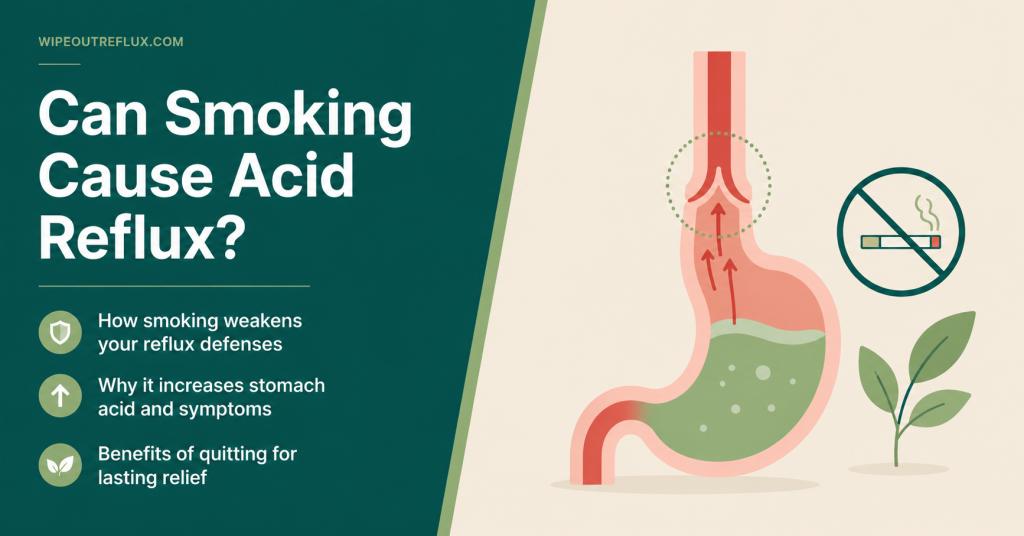
Yes, smoking can cause acid reflux — and if you already have it, smoking is actively making it worse in multiple specific, well-documented ways. The research on this goes far deeper than a vague lifestyle warning.
Whether you smoke cigarettes, use a vape, or you’re simply trying to understand why your reflux is so hard to manage, what follows is a clear, mechanism-first breakdown of what the science actually shows. I’ll also cover what the data says about LPR and silent reflux specifically, and — most importantly — what happens to your symptoms when you stop.
Key Takeaways
- Smoking is a recognised cause of GERD, with current smokers facing roughly 23% higher odds of developing the condition compared to non-smokers.
- Nicotine is the primary driver — it relaxes the lower esophageal sphincter (LES), the valve that prevents stomach acid from rising back up into the esophagus and throat.
- Smokers have significantly reduced saliva production and bicarbonate secretion, removing one of the body’s most important acid-clearing defences.
- Smoking-related coughing creates repeated abdominal pressure spikes that force acid through a weakened LES — a compounding mechanism unique to smokers.
- Vaping carries similar reflux risks because most e-liquids contain nicotine, which acts on the LES in the same way as cigarette smoke.
- For those with LPR (silent reflux), smoking directly increases acid exposure at the throat level, worsening hoarseness, chronic throat clearing, and post-nasal drip.
- Quitting smoking is associated with over double the rate of GERD symptom improvement compared to continuing to smoke, with benefits building over months.
- Even regular secondhand smoke exposure is linked to a significantly higher risk of GERD in non-smokers.
Does Smoking Cause Acid Reflux?
The short answer is yes — and this has been confirmed both by large population studies and controlled laboratory research measuring actual acid exposure in the esophagus.
A large population-based study involving 9,631 adults aged 35 to 65 found that the odds of developing GERD were 23% higher in current smokers compared to non-smokers, after adjusting for age, sex, BMI, and other lifestyle factors [Najafi et al., BMC Gastroenterology, 2024].
Even secondhand smoke plays a measurable role. A large Taiwanese population study of over 88,000 never-smokers found that regular secondhand smoke exposure was significantly associated with a 13% higher risk of GERD — rising to a 20% higher risk in those exposed for an hour or more per week [Yen PC et al., Frontiers in Public Health, 2024].
What makes this particularly significant if you’re already managing reflux is that smoking doesn’t just raise risk — it actively worsens the severity and frequency of symptoms through four specific, compounding mechanisms. Understanding those mechanisms matters, because it explains why reflux medication alone often isn’t enough when you’re still smoking. It’s worth reading why acid reflux medication stops working for more on this.
How Nicotine and Acid Reflux Are Connected: The Four Mechanisms
Most of the damage smoking does to your reflux comes down to nicotine — and it operates through four distinct pathways. Understanding these helps explain why the condition is so hard to manage without addressing the habit itself.
1. Nicotine Weakens the Lower Esophageal Sphincter
The lower esophageal sphincter (LES) is the muscular valve at the bottom of the esophagus. Its job is to stay closed between swallows and prevent stomach contents from refluxing upward. Nicotine interferes with this directly — it blocks cholinergic receptors, which causes the circular muscle fibres of the LES to relax and lose pressure.
Research has confirmed that smokers have chronically diminished LES pressure compared to non-smokers, and that active smoking periods are directly associated with increased reflux episodes [Kahrilas PJ & Gupta RR, Digestive Diseases, 1992]. A comprehensive review using pH monitoring data confirmed that smoking increases overall esophageal acid exposure through this LES pressure reduction, predisposing smokers to strain-induced reflux [Pandolfino JE & Kahrilas PJ, European Journal of Gastroenterology & Hepatology, 2000].
The critical point here is that it is the nicotine causing the sphincter problem — not just the smoke. This is directly relevant to vaping, which I’ll cover in its own section below.
2. Smoking Reduces Saliva and Slows Acid Clearance
Saliva is one of the body’s most underrated defences against reflux damage. It’s mildly alkaline, and every swallow carries a small wave of acid-neutralising fluid down the esophagus. This is called acid clearance — the process by which your esophagus (and to a lesser extent, your throat) recovers between reflux events.
Smoking significantly impairs this. Studies found that smokers have only about 60% of the salivary bicarbonate secretion of non-smokers, with acid clearance times running approximately 50% longer [Kahrilas PJ & Gupta RR, Journal of Laboratory and Clinical Medicine, 1989]. A review of the full evidence base confirmed that tobacco smoking reduces saliva rich in bicarbonate — precisely the compound responsible for buffering and clearing acid from the esophagus [Eusebi LH et al., Best Practice & Research Clinical Gastroenterology, 2017].
In practical terms: when acid does enter your esophagus during a reflux episode, it stays there longer and causes more damage per episode. For those dealing with pepsin reaching the throat — a key driver of LPR tissue damage — this extended exposure window is particularly harmful. Pepsin requires an acidic environment to remain active. Less saliva means more pepsin activity, for longer, at each reflux event.
3. Smoking-Related Coughing Forces Acid Upward
Here’s a mechanism that rarely gets discussed in typical reflux advice. Research has shown that much of the acid reflux in smokers doesn’t happen through the usual “transient LES relaxation” pathway that’s most commonly described. Instead, it occurs predominantly through what researchers call the “abdominal strain mechanism” — coughing or deep breathing creates a sudden, sharp increase in intra-abdominal pressure that physically forces acid through a weakened sphincter [Kahrilas PJ & Gupta RR, Gut, 1990].
Smoking causes chronic coughing in most regular smokers. The result is a compounding problem: a weakened valve, and repeated mechanical pressure events driving acid through it throughout the day. Every coughing spell becomes a reflux event.
4. Smoking May Increase Stomach Acid Production
On top of the sphincter, saliva, and coughing effects, tobacco smoking also appears to enhance gastric acid secretion — increasing the volume of acid that the weakened LES needs to contain [Pandolfino JE & Kahrilas PJ, European Journal of Gastroenterology & Hepatology, 2000]. More acid below, a weaker valve above, and a reduced ability to clear what escapes — all three problems compounding each other simultaneously.
Put together, these four mechanisms explain exactly why smokers consistently have more severe reflux than non-smokers, and why addressing smoking is often the missing variable when medications and other strategies aren’t delivering the results expected.
Vaping and Acid Reflux — Does Vaping Cause Acid Reflux?
Vaping tends to get a pass in reflux conversations — mainly because it’s marketed as a less harmful alternative to smoking. When it comes to acid reflux specifically, though, the picture is more complicated than that framing suggests.
The core issue is nicotine. Most e-cigarettes and vapes contain it, and nicotine is the mechanism through which smoking impairs LES function, reduces saliva, and extends acid clearance time. If you’re vaping with nicotine-containing e-liquid, you’re exposing your digestive system to the same physiological chain reaction that cigarettes trigger — minus most of the combustion products, but with the key reflux-relevant compound still very much present.
A 2024 cross-sectional study of 403 university students found that those who smoked or vaped reported significantly greater GERD symptom scores than non-smokers, with increased frequency of vaping correlating with increased symptom severity [Farooqi W et al., Cureus, 2024]. A separate 2023 study of university students in Jeddah found a notably higher prevalence of GERD among e-cigarette users than non-smokers, adding to the growing body of evidence connecting vaping to digestive symptoms [Alturki NA et al., Cureus, 2023].
Beyond nicotine, some e-liquid formulations contain propylene glycol, acidic flavouring compounds, and other additives that may irritate the esophageal lining or throat tissue independently. Higher-nicotine vapes carry greater reflux risk, but lower-nicotine options aren’t safe by default for people already managing active GERD or LPR.
The honest answer: vaping is not a reflux-safe alternative to smoking if the e-liquid contains nicotine. Zero-nicotine vaping removes the LES-relaxation mechanism, but if you already have active reflux or LPR, inhaling aerosol into an already-inflamed throat carries its own risks. If you’re currently managing reflux and vaping, it’s worth reading up on what else is driving your symptoms — and addressing vaping alongside your diet will produce a much stronger combined effect than dietary changes alone.
Smoking, Vaping, and Silent Reflux (LPR)
If you have LPR (laryngopharyngeal reflux) — the type of reflux that reaches the throat and causes symptoms like hoarseness, post-nasal drip, a persistent lump feeling, or constant throat clearing — smoking creates a specific and more severe problem than it does for standard GERD.
LPR occurs when acid and pepsin escape the esophagus entirely and reach the larynx and pharynx. The tissue in this area is far more sensitive to acid exposure than the esophageal lining. It doesn’t have the same protective mucous layer, the same peristaltic clearance mechanism, or the same acid-resistant surface cells. Even brief, small-volume reflux events reaching the throat can cause disproportionate inflammation.
A study using 24-hour dual-probe pH monitoring — which simultaneously measures acid levels at the upper esophageal sphincter (throat level) and in the lower esophagus — found that smoking significantly increased acid exposure at both measurement sites. The percentage of time the pH fell below 4 (the threshold at which pepsin becomes active) was meaningfully higher during smoking periods than during non-smoking periods, at both the lower and upper sphincter [Smit CF et al., Annals of Otology, Rhinology & Laryngology, 2001]. The researchers concluded that smokers with reflux complaints — and especially those with throat and ENT symptoms — should be specifically advised to stop smoking to reduce this gastropharyngeal (throat-level) reflux.
A cross-sectional population study of 734 individuals in Syria found that smoking was one of the significant independent risk factors associated with LPR symptoms as measured by the validated Reflux Symptom Index, with researchers noting that high smoking prevalence was likely a contributing factor to the elevated rates of LPR observed in that population [Kakaje A et al., BMJ Open, 2020].
For those with LPR specifically, smoking and vaping are effectively adding fuel to a fire that’s already burning in a particularly sensitive area. The throat doesn’t tolerate reflux the way the esophagus does. The silent reflux treatment guide covers the full range of management strategies — but reducing or eliminating smoking is one of the highest single-impact changes you can make for throat symptom relief.
Does Quitting Smoking Help Acid Reflux?
This is the question that matters most — and the research here is genuinely encouraging, even if the timeline requires some patience.
A prospective study published in PLOS ONE followed 191 patients through smoking cessation attempts over twelve months. Among those who successfully quit, 43.1% experienced meaningful improvement in GERD symptoms. In the group that did not manage to quit, only 18.2% saw improvement [Kohata Y et al., PLOS ONE, 2016]. That’s more than double the recovery rate — a clinically significant difference that clearly points to smoking as an active driver of ongoing symptoms.
The short-term picture is also positive. Stopping smoking for just one day was found to reduce daily reflux episodes from 95.7 down to 70.0 in a study of patients with endoscopically confirmed GERD [Waring JP et al., American Journal of Gastroenterology, 1989]. However, total acid exposure time doesn’t normalise immediately — the LES needs time to recover its pressure, and saliva production takes weeks to months to restore.
The larger, sustained gains build over time. The HUNT study — a prospective population-based cohort of nearly 30,000 individuals followed over more than a decade — found that tobacco smoking cessation was associated with meaningful improvement in severe GERD symptoms, particularly in those using antireflux medication at least weekly [Ness-Jensen E et al., American Journal of Gastroenterology, 2014].
One nuance worth addressing directly: nicotine replacement therapy (NRT) — patches, gum, lozenges — still contains nicotine, and nicotine itself does reduce LES pressure. So NRT alone doesn’t fully resolve the reflux mechanism. But stopping cigarettes using NRT is still substantially better for your reflux than continuing to smoke, because you remove the chronic cough mechanism, the smoke irritants, and the most severe impairment of salivary function that comes with burning tobacco. Over time, tapering off nicotine entirely gives the LES the best chance to fully recover.
Quitting smoking is one of the most impactful single steps you can take for reflux management. Paired with a structured LPR and reflux diet, the combined effect is far greater than either change alone.
Frequently Asked Questions
Can smoking cause acid reflux even if I’ve never had it before?
Yes. Smoking can initiate acid reflux in people with no prior history by weakening the LES, reducing saliva production, and increasing stomach acid secretion. Population data consistently shows that current smokers have meaningfully higher rates of GERD development than non-smokers.
Does smoking make silent reflux (LPR) worse?
Yes — particularly for throat symptoms. Studies using dual-probe pH monitoring confirm that smoking increases acid exposure at the upper esophageal sphincter (throat level), not just in the lower esophagus. This directly worsens LPR symptoms including hoarseness, chronic cough, and persistent throat clearing, because more acid and activated pepsin is reaching delicate throat tissue.
Does vaping cause acid reflux?
Vaping can cause and worsen acid reflux, primarily through the nicotine in most e-liquids. Nicotine relaxes the LES in the same way cigarette smoke does. Multiple studies have found that people who vape report higher GERD symptom scores than non-smokers, and symptom severity correlates with how often they vape. It is not a reflux-safe alternative to cigarettes.
How long after quitting smoking does acid reflux improve?
Some reduction in daily reflux episodes can occur within a few days of stopping. However, meaningful, sustained improvement typically develops over several weeks to months as LES pressure normalises, saliva production recovers, and smoking-related chronic cough resolves. The most significant gains tend to be visible after three to twelve months of sustained cessation.
Can nicotine patches or gum make acid reflux worse?
Nicotine itself — regardless of delivery method — can reduce LES pressure, so NRT isn’t completely neutral from a reflux standpoint. However, quitting cigarettes using NRT is considerably better overall for reflux than continuing to smoke, because it removes the coughing mechanism, smoke irritants, and the severe impairment of salivary function associated with burning tobacco.
Does secondhand smoke cause acid reflux?
Evidence suggests it can. A large Taiwanese population study found that regular secondhand smoke exposure was significantly associated with higher rates of GERD in non-smokers, with those exposed for one or more hours per week facing a 20% higher risk compared to those with no exposure.
Why doesn’t my reflux medication work properly even though I’m taking it every day?
Smoking actively undermines the conditions that reflux medication needs to work effectively. Continuing to smoke while on PPIs or H2 blockers means your LES remains weakened, your acid clearance remains impaired, and coughing-triggered reflux events continue regardless of what’s happening with acid suppression. Quitting gives your medication a dramatically better chance of working. More on this at why acid reflux medication stops working.
Conclusion
Smoking and acid reflux have a deep, mechanistic relationship — one that’s far more specific than a general health warning suggests. Nicotine weakens the valve that keeps stomach acid in the stomach. Smoking depletes the saliva your body depends on to neutralise and clear that acid. And the chronic cough that comes with regular smoking repeatedly forces acid upward through a valve that can no longer properly resist that pressure. These mechanisms don’t cancel each other out — they reinforce each other, which is why smokers tend to have significantly worse reflux outcomes and respond less well to medication alone.
For those of us with LPR specifically, the consequences reach even further. Acid and pepsin reaching the throat is damaging in ways that heartburn-focused GERD treatments often fail to address — and smoking is directly increasing the frequency and volume of acid exposure at that critical level. Reducing this is one of the most meaningful changes you can make for throat healing.
Quitting smoking is a major piece of the puzzle, but it works best as part of a broader strategy. Diet is the other pillar that delivers the most impact. If you’re looking for a clear, practical starting point for what to eat and drink, the Wipeout Food Reference Guide is an excellent place to start — it covers which foods and drinks are reflux-compatible, their pH values, and what to prioritise on a daily basis. For a more comprehensive, in-depth approach that brings together the diet strategy, lifestyle factors, and the mechanisms of LPR recovery, the Wipeout Diet Plan covers everything in full detail. Addressing smoking and diet together gives you two of the most powerful tools available — and the combined effect is considerably greater than either one in isolation.
Research and References
- Smokers have chronically reduced LES pressure, increased reflux episodes driven primarily by the abdominal strain mechanism, and prolonged acid clearance due to impaired saliva production. [Kahrilas PJ & Gupta RR, Digestive Diseases, 1992]
- A comprehensive review using pH monitoring data confirms that smoking increases esophageal acid exposure via reduced LES pressure and decreased salivation; nicotine is identified as the primary driver, with similar effects observed from transdermal nicotine. [Pandolfino JE & Kahrilas PJ, European Journal of Gastroenterology & Hepatology, 2000]
- Controlled smoking experiments confirmed that cigarette smoking directly provokes acid reflux events, with most reflux occurring via the coughing/strain mechanism rather than transient LES relaxation; long-lasting LES pressure reduction was also observed. [Kahrilas PJ & Gupta RR, Gut, 1990]
- Dual-probe 24-hour pH monitoring demonstrated that smoking significantly increases acid exposure at both the upper and lower esophageal sphincters, confirming its direct role in gastropharyngeal (throat-level) reflux and LPR. [Smit CF et al., Annals of Otology, Rhinology & Laryngology, 2001]
- Tobacco smoking reduces bicarbonate-rich saliva critical for acid clearance and is classified as an aetiological factor for GERD; both smoking and alcohol reduce LES pressure, facilitating reflux. [Eusebi LH et al., Best Practice & Research Clinical Gastroenterology, 2017]
- Smokers have only 60% of the salivary titratable base secretion of non-smokers and acid clearance times approximately 50% longer — chronic effects of smoking rather than just acute episode responses. [Kahrilas PJ & Gupta RR, Journal of Laboratory and Clinical Medicine, 1989]
- A population study of 9,631 adults found that current smokers had 23% higher odds of developing GERD compared to non-smokers after multivariate adjustment for lifestyle and metabolic factors. [Najafi et al., BMC Gastroenterology, 2024]
- A cross-sectional study of 403 university students found that both tobacco smokers and e-cigarette users reported significantly greater GERD symptom scores than non-smokers, with vaping frequency correlating with symptom severity. [Farooqi W et al., Cureus, 2024]
- A study of 397 university students in Jeddah found higher GERD prevalence among e-cigarette users than non-smokers, adding early evidence that vaping carries similar reflux risks to smoking. [Alturki NA et al., Cureus, 2023]
- A prospective study of 191 patients found that those who successfully quit smoking had 43.1% GERD improvement at one year versus 18.2% in those who did not quit — more than double the improvement rate. [Kohata Y et al., PLOS ONE, 2016]
- Immediate cessation of smoking for one day reduced daily reflux episodes from 95.7 to 70.0 in patients with confirmed GERD, though total acid exposure time did not significantly normalise within a single day. [Waring JP et al., American Journal of Gastroenterology, 1989]
- In the HUNT cohort study of nearly 30,000 individuals followed over more than a decade, tobacco smoking cessation was associated with improvement in severe GERD symptoms, particularly in those of normal BMI using antireflux medication. [Ness-Jensen E et al., American Journal of Gastroenterology, 2014]
- A cross-sectional study of 734 individuals in Syria found that smoking was a significant independent risk factor for LPR symptoms as measured by the Reflux Symptom Index, with the authors noting high regional smoking prevalence as a likely contributor to elevated LPR rates. [Kakaje A et al., BMJ Open, 2020]
- A large Taiwanese population study of over 88,000 never-smokers found that regular secondhand smoke exposure was associated with a 13% higher risk of GERD, rising to a 20% higher risk with exposure of one or more hours per week. [Yen PC et al., Frontiers in Public Health, 2024]

David Gray
12 years living with LPR · Consultant & researcher
I've lived with LPR for twelve years — the misdiagnoses, the PPI courses that did nothing, the slow work of figuring out what actually helps. Wipeout Reflux is where I translate the research into plain terms for people stuck in the same place. Every claim here is sourced to peer-reviewed work, and I consult one-to-one with LPR sufferers.