
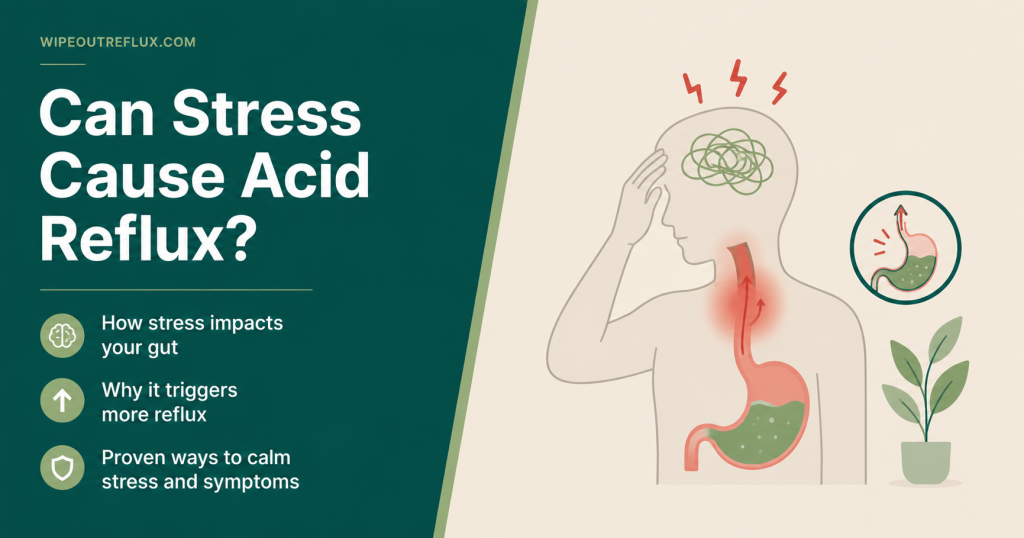
Yes — stress can cause acid reflux, and if you already have it, stress is one of the most underappreciated reasons your symptoms keep flaring. The relationship is real, it’s well-studied, and the mechanisms behind it are more specific than most people realise.
What makes stress-driven reflux particularly frustrating is that it can make your symptoms feel dramatically worse even when the actual amount of acid in your esophagus hasn’t changed. That distinction matters — because it changes how you manage it. This article covers what the research shows about stress, cortisol, the sphincters that protect your esophagus and throat, and how to reduce stress-related reflux in practical, evidence-informed ways.
If you have LPR (silent reflux) rather than classic heartburn, there’s a dedicated section for that too — because the interaction between stress and throat symptoms has some important nuances.
Key Takeaways
- People with moderate to high stress levels have roughly double the odds of experiencing GERD symptoms compared to those with low stress, according to a large countrywide study.
- Stress doesn’t only increase acid production — it dramatically increases how much you feel the acid that’s already there, by sensitising the esophagus and throat to even normal levels of reflux.
- Corticotropin-releasing hormone (CRH), the brain’s primary stress signal, has been shown in controlled studies to increase esophageal sensitivity and impair lower esophageal sphincter (LES) relaxation.
- Elevated cortisol disrupts gut permeability and impairs the protective barriers of the esophageal lining, making tissue damage from reflux more likely.
- Anxiety is found in up to 39% of LPR patients — and stress levels are significantly higher in those with more severe throat symptoms.
- People under high stress are more likely to need acid-suppressing medication — and less likely to respond well to it.
- Mindfulness-based stress reduction (MBSR) has been shown to reduce depression and distress in GERD patients, improving quality of life outcomes.
- Addressing stress isn’t a “soft” addition to reflux management — it’s a physiological intervention that targets the actual mechanisms driving symptoms.
Stress and Acid Reflux — Does Stress Cause GERD?
The evidence here is clear and consistent: stress and reflux are tightly linked. A large countrywide study of 1,200 adults across all 25 districts of Sri Lanka found that individuals with moderate to high stress levels had an adjusted odds ratio of 1.96 times higher for GERD symptoms — nearly double the risk — compared to those with low stress levels. Heartburn, regurgitation, chest pain, cough, and burping were all significantly more frequent in the high-stress group. Notably, people with higher stress scores were also more likely to be using acid-suppressing medication long-term, and were less likely to respond well to it [Wickramasinghe N et al., PLOS ONE, 2023].
A large cross-sectional study of 19,099 subjects found a significant association between elevated anxiety and GERD, with state anxiety associated with an adjusted odds ratio of 1.89 and trait anxiety with an odds ratio of 1.78 for developing GERD — even after controlling for other variables [Kim HJ et al., Journal of Neurogastroenterology and Motility, 2018].
A systematic review and meta-analysis found that anxiety and depressive symptoms were more than twice as likely in GERD patients compared to healthy controls, with up to one in three people with GERD experiencing significant anxiety — and evidence pointing toward a bidirectional relationship where each condition can worsen the other [Zamani M et al., American Journal of Gastroenterology, 2023].
So the link is robust. But the more interesting question is: what’s actually happening in your body when stress makes reflux worse?
Cortisol and Acid Reflux — How the Stress Hormones Drive Symptoms
The connection between stress and reflux isn’t just psychological — it runs through specific hormones and neurological pathways that directly alter how your esophagus functions. Three mechanisms are particularly well-established.
1. CRH Makes Your Esophagus Hypersensitive to Acid
When you experience stress, the brain releases corticotropin-releasing hormone (CRH) — the primary neurochemical trigger of the body’s stress cascade. CRH activates the hypothalamic-pituitary-adrenal (HPA) axis, which in turn releases cortisol and ACTH. But CRH also has direct effects on the gut and esophagus through what’s known as peripheral gut stress response pathways.
A controlled study administered intravenous CRH to healthy volunteers and measured what happened to their esophageal sensitivity. CRH significantly increased esophageal sensitivity to mechanical distension and decreased lower esophageal sphincter relaxation [Broers C et al., American Journal of Physiology–Gastrointestinal and Liver Physiology, 2017]. A separate study found that CRH injection also increased esophageal electrical sensitivity — and simultaneously raised plasma cortisol and ACTH levels in the same participants [Yamasaki T et al., Journal of Neurogastroenterology and Motility, 2017].
What this means in real terms: when you’re stressed, your esophagus becomes significantly more sensitive. The same level of acid that caused mild discomfort on a calm day can cause genuine pain when you’re under pressure. This is why stress feels like it “causes” more acid — the problem often isn’t the acid volume, it’s how intensely your nervous system is registering it.
This also partially explains why PPIs don’t work as well during periods of high stress. If hypersensitivity is driving your symptoms, suppressing acid doesn’t address the core issue.
2. Cortisol Weakens Gut Barrier Function
Elevated cortisol — the hallmark hormone of chronic stress — disrupts the lining of the gastrointestinal tract. Research shows that sustained cortisol elevation increases intestinal permeability and impairs the protective barrier function of gut tissue, including the esophageal mucosa [Zheng J & Tao L, Frontiers in Immunology, 2025].
A compromised esophageal mucosal barrier means acid can penetrate deeper into the tissue and reach the nerve endings that generate the sensation of burning. This is sometimes called “dilated intercellular spaces” in the research literature — essentially, stress-driven cortisol opens up microscopic gaps in the esophageal lining that allow acid to cause more tissue damage and more intense symptom perception, even from relatively minor reflux events.
3. Stress Alters Gastric Emptying and Motility
Stress activates the sympathetic nervous system — the “fight or flight” branch — which suppresses digestive function. Blood is redirected away from the gut, gastric motility slows, and gastric emptying is delayed. Food staying in the stomach longer increases intragastric pressure, which in turn increases the likelihood of reflux. GERD patients are frequently characterised by an imbalance between sympathetic and parasympathetic tone, and this dysregulation delays gastric emptying and creates conditions that favour reflux [Zheng J & Tao L, Frontiers in Immunology, 2025].
Stress also changes eating behaviour for most people — faster eating, larger portions, more processed or fatty foods, more alcohol or caffeine — each of which contributes its own reflux trigger on top of the hormonal effects already in play.
The Gut-Brain Axis and Acid Reflux — How Your Mind and Stomach Are Wired Together
The gut-brain axis is the bidirectional communication system linking the central nervous system with the enteric nervous system — the extensive neural network embedded in the gut wall, sometimes called the “second brain.” This system communicates via the autonomic nervous system, the HPA stress axis, circulating hormones, and the immune system.
The vagus nerve is the central highway of this connection. It carries roughly 80% of its signals upward — from gut to brain — and only 20% downward. This means the brain is largely receiving information about your gut’s state rather than simply giving it instructions. The vagus nerve controls LES tone, gastric emptying, and digestive motility through its parasympathetic fibres. When vagal tone is healthy, digestion proceeds efficiently: the LES maintains appropriate pressure, stomach contents move forward, and acid clearance is supported [Bonaz B et al., Frontiers in Neuroscience, 2018].
Chronic stress disrupts vagal tone by pushing the autonomic nervous system toward sympathetic dominance. This suppresses the parasympathetic “rest and digest” state that normal digestion depends on. The LES loses some of its resting tone, gastric emptying slows, and the gut becomes more sensitive to chemical signals that it would normally ignore — including low-level acid reflux events that would otherwise pass unnoticed.
This gut-brain axis disruption is one of the reasons why reflux in anxious or stressed individuals often presents as a complex, hard-to-treat picture — the underlying driver is neurological and hormonal, not just mechanical. A future article will cover the vagus nerve and its relationship to reflux in more depth, including evidence-based approaches to improving vagal tone directly.
Stress and Silent Reflux (LPR) — Why Anxiety Can Hit Harder When You Have Throat Symptoms
For those of us with LPR rather than classic GERD, the relationship between stress and symptoms is even more pronounced — and for a specific reason.
LPR symptoms — hoarseness, chronic throat clearing, post-nasal drip, globus sensation, and persistent cough — are already driven partly by hypersensitivity of the laryngeal and pharyngeal tissues, which are far more sensitive to acid exposure than the esophagus. When stress-induced CRH and cortisol add a layer of general visceral hypersensitivity on top of this, LPR symptoms can become significantly more intense even when reflux activity hasn’t objectively changed.
Research confirms this. A study evaluating LPR patients with full psychological assessment found that perceived stress scores were significantly higher in LPR patients than in healthy controls, with patients who had more severe symptom scores also showing subclinical insomnia and a borderline anxious-depressive picture [Fariña M et al., European Archives of Oto-Rhino-Laryngology, 2025].
A systematic review covering 2,162 patients with suspected LPR found anxiety present in 28.8–39.3% of LPR patients, with many patients reporting notable exacerbation of their LPR symptoms during periods of high psychological strain. The researchers noted a vicious cycle: stress worsens LPR, and LPR symptoms create further anxiety, driving a self-reinforcing loop.
What’s particularly relevant here is that this cycle can make LPR feel treatment-resistant even when the diet and lifestyle approach is otherwise sound. Stress management isn’t optional for persistent LPR — it’s an active intervention targeting one of the condition’s core amplifiers. The natural remedies for LPR guide covers this broader picture, including how different strategies work together.
How to Reduce Stress-Related Acid Reflux
The good news is that there are specific, research-supported strategies for breaking the stress-reflux cycle. These aren’t soft lifestyle suggestions — they target the actual mechanisms driving symptoms.
Mindfulness-Based Stress Reduction (MBSR)
A longitudinal interventional study of 60 GERD patients found that mindfulness-based stress reduction was an effective approach for reducing depression symptoms and distress levels in GERD patients, with meaningful improvements in health-related quality of life scores [Chandran D et al., Indian Journal of Gastroenterology, 2019]. The Sri Lanka countrywide study noted that psychological therapies including mindfulness meditation, CBT, and yoga are likely effective management options for GERD symptoms and should be assessed in well-designed trials [Wickramasinghe N et al., PLOS ONE, 2023].
The mechanism is direct: MBSR shifts the autonomic nervous system away from sympathetic dominance and toward parasympathetic activity — the “rest and digest” state that supports healthy digestion. Even 10–15 minutes of structured breathing or body-scan practice can measurably shift cortisol levels and autonomic balance.
Diaphragmatic Breathing
This one is particularly relevant for reflux specifically. Diaphragmatic breathing directly engages the vagus nerve, increases LES pressure, and reduces the frequency of transient LES relaxations — the events that allow acid to escape upward. There is emerging evidence that diaphragmatic breathing exercises can reduce postprandial reflux events and improve reflux-related symptom scores. It’s one of the simplest, most targeted interventions for stress-driven reflux and takes no equipment. You can read more about this approach in the silent reflux treatment guide.
Prioritise Sleep and Overnight Recovery
Chronic sleep deprivation is one of the most reliable ways to maintain elevated cortisol levels. The brain’s cortisol recovery happens primarily in the first half of the night during deep sleep. When sleep is disrupted — whether by reflux itself, anxiety, or insomnia — cortisol stays elevated, esophageal hypersensitivity persists, and reflux symptoms are amplified the next day. Elevating the head of the bed, eating well before lying down, and addressing nighttime acid reflux directly are all part of breaking this cycle.
Physical Activity
Regular moderate exercise is one of the most evidence-backed ways to reduce HPA axis reactivity, lower resting cortisol, and improve vagal tone. Walking, swimming, cycling, and yoga all provide stress-reduction benefits without the intra-abdominal pressure effects of high-intensity exercise that can worsen reflux mechanically. Timing matters: intense exercise immediately after meals should be avoided, but regular aerobic movement throughout the week directly targets the stress biology driving reflux.
Diet as a Stress Buffer
A reflux-appropriate diet reduces the acid load on an already-sensitised esophagus. When you’re stressed, your esophagus is hypersensitive — which means dietary triggers that might be tolerable in calm periods can tip you into symptoms much more easily. Addressing diet during high-stress periods isn’t about deprivation; it’s about lowering the physiological threshold so that stress-driven hypersensitivity has less to react to. What to eat on an LPR diet gives a practical starting point for the dietary side of this equation.
Frequently Asked Questions
Can stress alone cause acid reflux with no other triggers?
Yes — stress can generate reflux symptoms even without typical dietary triggers, particularly through esophageal hypersensitivity. When CRH sensitises the esophagus, even small, normal amounts of acid that would ordinarily be undetectable can cause burning, tightness, or chest discomfort. This is one reason why some people notice symptoms even when they’ve “eaten perfectly.”
Why do my reflux symptoms get worse during anxious periods even though I haven’t changed my diet?
Almost certainly because of esophageal and laryngeal hypersensitivity. Stress hormones — particularly CRH and cortisol — directly lower the sensory threshold of the esophagus and throat. The same acid events that were tolerable are now producing stronger signals. This is a central nervous system phenomenon, not a dietary one, which is why managing stress is just as important as managing diet.
Does stress increase stomach acid production?
The evidence on stress and stomach acid production is mixed. Some studies show increased acid secretion under stress in some individuals, while others show no significant change. The more consistently demonstrated mechanism is increased sensitivity to acid, rather than increased acid volume. However, stress-driven changes in gastric emptying can increase intragastric pressure and make reflux more likely regardless of acid volume.
Is the connection between anxiety and LPR stronger than with regular GERD?
There’s strong evidence that anxiety is particularly prevalent in LPR, with rates of 28–39% found in LPR patient populations. The throat and larynx are more sensitive to acid exposure than the esophagus, so when stress heightens sensory sensitivity throughout the upper digestive tract, LPR symptoms can escalate quickly. This is one of the reasons LPR can feel so relentless during high-stress periods even with medication and dietary management in place.
Can treating anxiety improve acid reflux symptoms?
Evidence suggests yes. Studies have found that high-stress individuals are more likely to be on acid-suppressing medication and less likely to respond adequately to it — meaning the anxiety is a real, measurable obstacle to treatment response. Conversely, interventions that reduce psychological distress — including MBSR and CBT — are associated with improvements in GERD-related quality of life. Treating the anxiety isn’t separate from treating the reflux; in many patients, they need to be addressed together.
What is the vagus nerve’s role in acid reflux?
The vagus nerve regulates LES tone, gastric emptying, and digestive motility through its parasympathetic fibres. When stress pushes the autonomic nervous system into sympathetic dominance, vagal tone decreases, and the digestive functions it normally supports — including LES pressure and efficient gastric emptying — are impaired. Improving vagal tone through techniques like diaphragmatic breathing, cold exposure, singing, or progressive relaxation can support LES function and reduce reflux frequency.
Does stress affect reflux during sleep?
Yes — particularly through elevated cortisol at night and through the way anxiety disrupts sleep architecture. Disrupted sleep impairs the overnight cortisol recovery process, keeps visceral sensitivity elevated, and also tends to increase the frequency of transient LES relaxations that allow nighttime acid to escape the stomach. Sleeping position and elevation strategies help, but addressing the stress driving the disrupted sleep is the more complete solution.
Conclusion
Stress and acid reflux are connected by real, measurable biology — not just a vague association between feeling bad and feeling worse. The stress hormone cascade triggers esophageal hypersensitivity through CRH, weakens the protective lining of the esophagus through elevated cortisol, slows digestion through sympathetic nervous system activation, and disrupts the gut-brain axis in ways that make symptoms more intense, harder to treat, and more likely to persist.
For those with LPR, this matters even more. The throat is the most sensitive part of the digestive system to acid exposure, and stress-driven hypersensitivity makes that sensitivity worse. Breaking the cycle — where stress worsens reflux, and reflux increases anxiety — requires actively addressing both sides of the equation, not just managing food triggers.
Diet and stress management work best together. Reducing the acid load through good dietary choices gives your already-sensitised esophagus and throat less to react to, while stress reduction directly targets the hypersensitivity and barrier dysfunction that makes those reactions so intense. The Wipeout Food Reference Guide is a practical starting point for understanding which foods to prioritise and which to avoid — complete with pH values and reflux-compatibility ratings. For a fully integrated approach that brings together diet, lifestyle, and the mechanisms of LPR recovery, the Wipeout Diet Plan covers everything in depth — including the role of nervous system regulation in long-term symptom improvement.
Research and References
- A countrywide study of 1,200 individuals across all 25 districts of Sri Lanka found that moderate to high stress nearly doubled the odds of GERD symptoms (adjusted OR 1.96); those with higher stress scores were more likely to use acid-suppressing medication and less likely to respond well to it. [Wickramasinghe N et al., PLOS ONE, 2023]
- A large cross-sectional analysis of 19,099 subjects found significant associations between increased state anxiety (adjusted OR 1.89) and trait anxiety (adjusted OR 1.78) with GERD, particularly in the non-erosive subtype. [Kim HJ et al., Journal of Neurogastroenterology and Motility, 2018]
- A systematic review and meta-analysis found anxiety and depressive symptoms more than twice as likely in GERD patients than healthy controls, with evidence for a bidirectional causal relationship between GERD and psychiatric conditions. [Zamani M et al., American Journal of Gastroenterology, 2023]
- A prospective study of 225 consecutive GERD patients using 24-hour pH impedance monitoring found that increased anxiety levels were associated with significantly more severe heartburn and retrosternal pain symptoms. [Kessing BF et al., Clinical Gastroenterology and Hepatology, 2015]
- In a controlled study, intravenous administration of CRH to healthy volunteers increased esophageal sensitivity to mechanical distension and decreased LES relaxation — the first study demonstrating CRH’s direct effect on esophageal function in healthy subjects. [Broers C et al., American Journal of Physiology–Gastrointestinal and Liver Physiology, 2017]
- CRH administration via intravenous infusion significantly increased esophageal electrical sensitivity in healthy individuals and raised plasma cortisol and ACTH levels, confirming CRH’s central role in stress-driven esophageal hypersensitivity. [Yamasaki T et al., Journal of Neurogastroenterology and Motility, 2017]
- A comprehensive review of the gut-brain axis and GERD found that elevated cortisol from HPA axis activation increases intestinal permeability and disrupts esophageal barrier function; ANS dysfunction with sympathetic-parasympathetic imbalance is characteristic of GERD patients, especially NERD. [Zheng J & Tao L, Frontiers in Immunology, 2025]
- The vagus nerve — carrying 80% of signals from gut to brain — is the principal interface of the gut-brain axis; vagal tone regulates parasympathetic digestive function, and its disruption under chronic stress impairs LES function, gastric motility, and intestinal permeability. [Bonaz B et al., Frontiers in Neuroscience, 2018]
- In a study of 45 LPR patients using validated psychological instruments including the Reflux Symptom Index and Perceived Stress Scale, stress scores were significantly higher in LPR patients than healthy controls, and patients with higher RSI scores had elevated subclinical insomnia and anxiety. [Fariña M et al., European Archives of Oto-Rhino-Laryngology, 2025]
- A longitudinal interventional study of 60 GERD patients found that mindfulness-based stress reduction (MBSR) was an effective modality for alleviating depression symptoms and reducing distress levels, with improvements in health-related quality of life scores. [Chandran D et al., Indian Journal of Gastroenterology, 2019]

David Gray
12 years living with LPR · Consultant & researcher
I've lived with LPR for twelve years — the misdiagnoses, the PPI courses that did nothing, the slow work of figuring out what actually helps. Wipeout Reflux is where I translate the research into plain terms for people stuck in the same place. Every claim here is sourced to peer-reviewed work, and I consult one-to-one with LPR sufferers.