
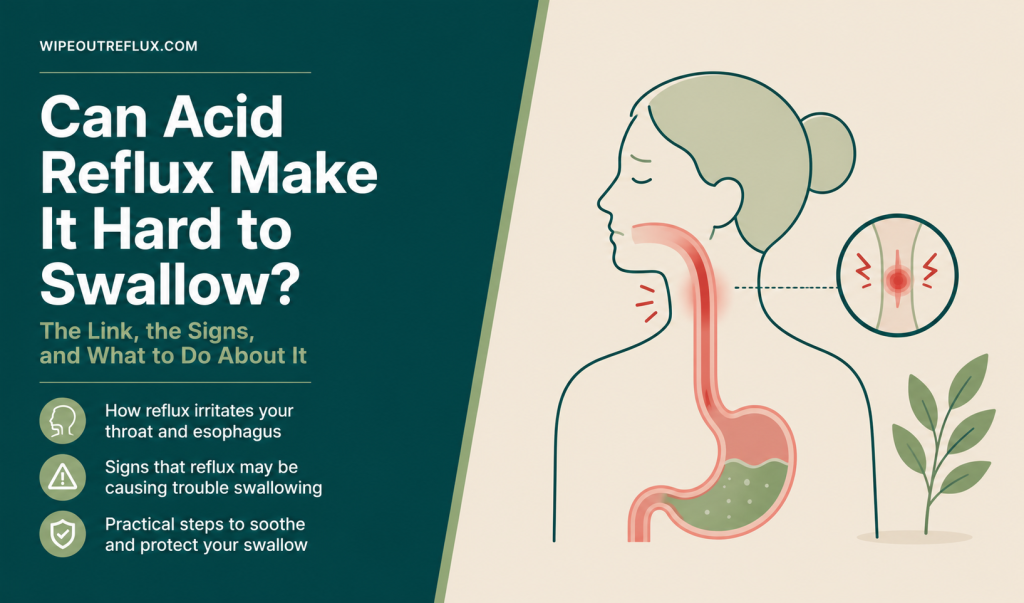
Yes — acid reflux can make it hard to swallow, and it does so in several distinct ways. Swallowing difficulties affect a significant proportion of people with GERD and LPR, ranging from a vague sensation of food moving slowly to a real physical narrowing of the esophagus caused by long-term acid damage.
Understanding which type you’re dealing with matters, because the mechanisms are different and so are the management approaches. Some causes of reflux-related swallowing difficulty are functional — meaning there’s no structural blockage, but the esophagus is inflamed, hypersensitive, or spasming. Others, like peptic strictures, are structural and require specific medical treatment. And some are alarm symptoms that warrant investigation promptly.
This article covers all of them.
Key Takeaways
- Difficulty swallowing (dysphagia) is significantly more common in people with GERD: 28% of GERD patients report it compared to just 3% of those without reflux, rising to 65% in those with moderate to severe symptoms.
- Reflux causes swallowing difficulties through five main mechanisms: esophagitis and swelling, peptic stricture formation, esophageal spasm, impaired motility, and non-obstructive hypersensitivity.
- Peptic strictures — physical narrowing of the esophagus from scarring — develop in 7–25% of people with untreated GERD and account for 70–80% of all adult esophageal stricture cases.
- The globus sensation (a persistent lump or tightness in the throat) is distinct from true dysphagia but is closely linked to reflux — affecting 15–28% of people with GERD.
- LPR (silent reflux) causes its own form of swallowing difficulty, involving the upper esophageal sphincter and throat tissue rather than the lower esophagus.
- New or worsening difficulty swallowing is an alarm symptom in GERD patients that warrants investigation — it should not be managed by self-treating alone.
- PPI use has substantially reduced the incidence of peptic strictures since the 1990s, but they still occur in people whose reflux is poorly controlled.
Can Acid Reflux Cause Difficulty Swallowing?
Yes, definitively. Dysphagia — the medical term for difficulty swallowing — is one of the recognised complications and symptoms of GERD, and the population data makes the connection clear.
A population-based study of 500 residents in Cologne found that dysphagia was significantly more common in people with GERD (28%) compared to the non-GERD population (3%) — a near-tenfold difference. Crucially, the rate scaled with symptom severity: 16% of those with mild reflux reported swallowing difficulties, rising to 65% in those with moderate to severe and frequent reflux symptoms [Bollschweiler E et al., Dysphagia, 2008].
A separate population study found that intermittent dysphagia was independently associated with GERD (adjusted odds ratio 2.96), confirming the relationship holds after controlling for other variables. The same study found that GERD was also an independent risk factor for odynophagia — painful swallowing [Eslick GD & Talley NJ, Alimentary Pharmacology & Therapeutics, 2008].
The relationship is not simple, though. Dysphagia in reflux patients can have several different causes — and distinguishing between them helps clarify what’s needed for management and when to seek medical attention.
The Five Ways Reflux Causes Difficulty Swallowing
1. Esophageal Inflammation and Swelling (Esophagitis)
The most straightforward cause. When stomach acid repeatedly contacts the esophageal lining, it causes inflammation — esophagitis. An inflamed, swollen esophagus is a narrower, more sensitive esophagus. Food that would normally pass through easily can now feel like it’s scraping or sticking. This type of swallowing difficulty tends to vary with reflux activity: worse during flares, better when reflux is controlled. It typically affects solid foods more than liquids, and there’s often accompanying chest discomfort or a burning sensation during or after swallowing.
This is the most reversible cause of reflux-related dysphagia. Reducing acid exposure through diet, posture, and where necessary medication typically improves the swallowing difficulty alongside the reflux symptoms themselves.
2. Peptic Stricture — When Scarring Narrows the Tube
This is the structural end of the spectrum, and arguably the most important to understand. Over years of chronic acid exposure, the repeated cycle of inflammation, damage, and healing can produce fibrous scar tissue that physically narrows the esophagus — a peptic stricture.
The normal esophagus is up to 30mm in diameter. A peptic stricture is typically defined as a narrowing to 13mm or less, though symptoms often begin before this threshold is reached. A stricture causes progressive dysphagia — food starts getting stuck, initially with solid foods, then potentially with softer foods as narrowing worsens.
GERD is the leading cause of benign esophageal strictures, accounting for approximately 70–80% of adult cases. Strictures occur in 7–25% of people with untreated or poorly controlled GERD and are particularly associated with a long duration of reflux, low LES pressure, impaired esophageal motility, and the presence of a hiatal hernia [Malik A & Bhatt DL, StatPearls — Esophageal Stricture, NCBI Bookshelf, 2023].
The incidence of peptic strictures declined significantly from 1994 to 2000 in parallel with increased PPI prescribing, confirming that adequate acid suppression is protective [Richter JE et al., American Journal of Gastroenterology, 2007]. However, they still occur in people whose reflux is undertreated or poorly controlled over the long term. If a peptic stricture is diagnosed, it is typically managed with esophageal dilation (a procedure that physically widens the narrowed area) alongside ongoing acid suppression to prevent recurrence.
3. Esophageal Spasm
Acid exposure can trigger esophageal spasms — episodes where the smooth muscle of the esophageal wall contracts abnormally and powerfully, rather than in the coordinated peristaltic wave that normally propels food downward. During a spasm, swallowing becomes painful and food may feel acutely stuck. Spasms can occur both during active reflux events and independently if the esophagus has become sensitised by chronic acid exposure.
This type of dysphagia tends to be intermittent and can be difficult to distinguish from cardiac chest pain — one of the reasons unexplained chest pain with swallowing difficulty always warrants evaluation.
4. Impaired Esophageal Motility
Normal swallowing depends on coordinated peristaltic contractions that move food and liquid from the throat through the esophagus into the stomach. Chronic GERD can impair this motility — weakening contractions, producing ineffective peristalsis, or causing disorganised contractions that fail to propel the bolus properly.
This means food moves more slowly and less reliably, creating a sense of food sitting in the mid-chest or failing to clear the esophagus promptly. Impaired motility also worsens reflux itself, because the same peristaltic contractions are responsible for clearing acid from the esophagus after a reflux event. As covered in the vagus nerve and acid reflux article, autonomic dysfunction — specifically reduced vagal tone — is measurable in a significant proportion of GERD patients and contributes directly to this motility impairment.
5. Non-Obstructive Dysphagia and Esophageal Hypersensitivity
This is the most common form of reflux-related swallowing difficulty, and perhaps the most misunderstood. In non-obstructive dysphagia, there is no physical narrowing or structural blockage — yet swallowing feels difficult, effortful, or uncomfortable. The esophagus itself is functioning, but it has become hypersensitive: the same signals that would normally pass unnoticed are being amplified into the sensation of something catching or sticking.
Chronic acid exposure sensitises the esophageal sensory nerves — a process linked to the same stress hormones and CRH pathways covered in the stress and acid reflux article. The symptom is real, but its cause is neurological rather than mechanical. This type of dysphagia often fluctuates with stress and anxiety levels and may not respond to acid suppression alone, because the underlying problem is sensitisation rather than active acid damage.
The Globus Sensation — A Lump in the Throat That Won’t Go Away
Globus sensation — the feeling of a persistent lump, tightness, or foreign body in the throat that isn’t associated with eating and doesn’t worsen swallowing — is distinct from dysphagia but strongly associated with reflux. The lump in throat from reflux guide covers this in depth, but the key points are worth understanding in this context.
The prevalence of globus sensation is notably higher in reflux patients (15–28%) than in those without reflux (4–10%). Research consistently supports a link between GERD and globus, though the mechanism appears complex. Distal acid reaching the upper esophagus increases upper esophageal sphincter (UES) tone — creating the lump sensation. Inflammation and irritation from LPR can cause direct laryngeal and pharyngeal tissue changes that are perceived as a foreign body feeling.
A study of 25 patients with globus and laryngeal findings suggesting GERD found that 52% had confirmed reflux esophagitis, and 68% improved with PPI treatment — confirming that reflux was driving the globus in the majority of cases [Tokashiki R et al., Auris Nasus Larynx, 2002].
Importantly, another study found that globus sensation can occur with reflux limited to the distal (lower) esophagus — meaning acid doesn’t have to reach the throat to produce the lump-in-throat feeling. The effect can be mediated by reflex pathways triggered from the lower esophagus [Harar RP et al., Journal of Laryngology & Otology, 2004].
LPR and Difficulty Swallowing
For those of us with LPR (laryngopharyngeal reflux) rather than typical GERD, the swallowing difficulty is different in character and origin.
The typical LPR patient presents with a constellation that includes globus sensation, chronic throat clearing, cough, hoarseness, and vague symptoms of dysphagia — a sense that swallowing requires more effort than it should, or that something lingers in the throat after swallowing [Lechien JR et al., StatPearls — Laryngopharyngeal Reflux, NCBI Bookshelf, 2025].
This occurs because acid and pepsin reaching the laryngopharynx cause direct tissue inflammation of structures involved in swallowing coordination — the arytenoids, the posterior larynx, the UES muscle. The larynx and upper esophagus work together to coordinate swallowing, and when they’re inflamed and irritated, the process becomes less smooth and less comfortable.
Unlike the dysphagia of peptic stricture, LPR-related swallowing difficulty is rarely progressive in the way stricture dysphagia is, and it typically varies with overall LPR symptom activity. It usually responds to the same interventions that improve LPR broadly: dietary modification, reducing pepsin exposure, elevating at night, and Gaviscon Advance or similar alginate barriers. The LPR diet covers the food side in detail.
LPR may also produce dysphagia via a vagal reflex arc between the esophagus and the upper aerodigestive tract — triggered by acid reflux in the lower esophagus, it produces symptoms including globus, throat clearing, and swallowing difficulty through a neurological pathway rather than direct acid contact with the throat.
When Difficulty Swallowing Is an Alarm Symptom
This section is important. Difficulty swallowing is classified as an alarm symptom in GERD patients — one that warrants medical evaluation rather than self-management. Not because it’s usually something serious, but because it can occasionally be, and because the serious causes need to be identified or excluded.
The conditions that need to be ruled out include peptic stricture (treatable with dilation), eosinophilic esophagitis (a distinct inflammatory condition that mimics GERD), Barrett’s esophagus (a precancerous change in esophageal lining from chronic acid exposure), and — most importantly — esophageal adenocarcinoma.
The features that make swallowing difficulty more concerning and warrant prompt medical attention are:
- Progressive dysphagia — difficulty that starts with solids and advances to soft foods and liquids over weeks to months
- Dysphagia combined with unintentional weight loss
- Food getting genuinely stuck — requiring regurgitation or fluids to dislodge
- Painful swallowing (odynophagia) — burning or sharp pain on swallowing
- New dysphagia in someone with longstanding GERD — particularly over the age of 50
- Dysphagia that doesn’t respond to a PPI trial
- Regurgitation of undigested food
If you’re experiencing any of the above, the appropriate step is investigation — typically an upper endoscopy — rather than adjusting your acid medication or waiting to see if it resolves. The investigation is usually straightforward and often reassuring, but it shouldn’t be deferred. Understanding the risks of untreated silent reflux covers the long-term tissue consequences of sustained acid exposure in more depth.
What to Do If Acid Reflux Is Making It Hard to Swallow
The right approach depends on which mechanism is likely at play.
If the swallowing difficulty is mild and fluctuates with your reflux symptoms — better when you’re eating well and managing reflux, worse during flares — it’s most likely esophagitis, non-obstructive dysphagia, or globus. In this case:
- Focus on reducing dietary triggers to lower the acid load and reduce esophageal inflammation
- Eat slowly, chew thoroughly, and avoid eating close to bedtime
- Eat smaller, more frequent meals to reduce gastric pressure and distension
- Drink water with meals to help clear the esophagus after swallowing
- Ensure posture after meals — staying upright for at least 2–3 hours
- Address stress and anxiety, which amplify esophageal hypersensitivity
If the dysphagia is new, progressive, or associated with any of the alarm features listed above, seek medical evaluation before making dietary changes — the priority is investigation.
If you’ve been diagnosed with LPR and have swallowing difficulty as a symptom, the silent reflux treatment guide covers the full management approach including the role of alginates, dietary strategies, and lifestyle modifications that target throat tissue recovery specifically.
Frequently Asked Questions
Can acid reflux cause food to feel stuck in the throat?
Yes — in several different ways. The globus sensation (a lump or tightness not related to eating) is common in reflux patients and creates exactly this feeling. During active swallowing, esophagitis, spasm, impaired motility, or a peptic stricture can all cause the sensation of food catching, sticking, or moving slowly. The distinction between the globus feeling and food genuinely getting stuck during eating matters — the latter is more likely to indicate a structural cause.
Is difficulty swallowing always a serious sign with acid reflux?
Not always — but it’s always worth investigating rather than assuming it’s benign. Mild, intermittent swallowing difficulty that fluctuates with reflux activity is usually esophagitis or hypersensitivity. Progressive difficulty swallowing, difficulty with both solids and liquids, or dysphagia combined with weight loss are alarm features requiring prompt endoscopy.
Can LPR cause difficulty swallowing without heartburn?
Yes. LPR commonly causes vague dysphagia, globus, and throat-related symptoms without significant heartburn — that’s one of the defining features of LPR versus GERD. The swallowing difficulty in LPR comes from laryngeal and pharyngeal inflammation, upper esophageal sphincter dysfunction, and vagally-mediated reflex pathways, rather than from a structural esophageal problem.
What is a peptic stricture and how do I know if I have one?
A peptic stricture is a physical narrowing of the esophagus caused by fibrous scar tissue from chronic acid damage. The main symptom is progressive dysphagia — food becoming harder and harder to swallow, starting with solid foods and potentially advancing to softer textures. It typically builds gradually over months. Diagnosis is by upper endoscopy, and treatment is esophageal dilation alongside long-term acid suppression to prevent recurrence.
Can dietary changes improve reflux-related swallowing difficulty?
Yes, for dysphagia caused by esophagitis, hypersensitivity, or LPR-related throat inflammation — all of which respond to reducing acid load. A reflux-appropriate diet that eliminates the main triggers lowers the frequency and severity of acid exposure, allowing inflamed tissue to heal and sensitivity to reduce. For structural causes like peptic stricture, dietary changes help prevent further damage but the stricture itself requires medical treatment.
Does Gaviscon or an alginate help with swallowing difficulty from reflux?
Gaviscon Advance (the alginate-containing UK formulation) can help with swallowing difficulty that’s driven by reflux activity at the throat level, particularly in LPR. It forms a raft on the stomach contents that physically blocks reflux from reaching the esophagus and throat. For globus sensation and LPR-type swallowing difficulty, many people find it useful as a post-meal and pre-sleep intervention. It doesn’t treat structural strictures.
How quickly does dysphagia from acid reflux improve with treatment?
Swallowing difficulty driven by esophagitis or hypersensitivity tends to improve gradually as inflammation reduces — typically over several weeks of consistent treatment. LPR-related throat symptoms, including swallowing difficulty, typically take longer — three to six months is a realistic timeframe for meaningful improvement with dietary and lifestyle management. Peptic stricture requires procedural treatment (dilation) with improvement typically immediate, but ongoing acid control is needed to prevent recurrence.
Conclusion
Acid reflux making it hard to swallow is common, well-documented, and caused by a clear chain of mechanisms — from straightforward inflammation that makes the esophagus sore and tight, to the chronic scarring of peptic stricture, to the sensitised nerves and vagal reflex pathways that create swallowing difficulty without any structural cause at all.
The most important distinction is between dysphagia that varies with your reflux symptoms — which is usually functional and responds to good management — and dysphagia that is progressive, associated with weight loss, or involves food genuinely getting stuck. The latter is an alarm symptom that needs endoscopic investigation, not dietary adjustment alone.
For functional reflux-related swallowing difficulty, the same foundation applies as for all LPR and GERD management: reducing the acid load on an already-irritated system through careful dietary choices. The Wipeout Food Reference Guide is the most direct starting point — it lists which foods and drinks are safe, which are problematic, and their pH values, making it straightforward to build a reflux-compatible daily diet. For the complete approach covering mechanisms, dietary strategy, and the lifestyle factors that drive long-term recovery, the Wipeout Diet Plan addresses everything in depth.
Research and References
- A population-based study of 500 residents found dysphagia in 28% of GERD patients versus 3% of those without reflux; the rate rose to 65% in those with moderate to severe reflux symptoms, confirming the strong dose-response relationship between reflux severity and swallowing difficulty. [Bollschweiler E et al., Dysphagia, 2008]
- A population study found intermittent dysphagia was independently associated with GERD (OR 2.96) after multivariate adjustment; GERD was also an independent risk factor for odynophagia (painful swallowing). [Eslick GD & Talley NJ, Alimentary Pharmacology & Therapeutics, 2008]
- GERD is the leading cause of benign esophageal strictures, accounting for 70–80% of adult cases; strictures occur in 7–25% of untreated GERD patients and are particularly associated with low LES pressure, impaired motility, and hiatal hernia. [Malik A & Bhatt DL, StatPearls — Esophageal Stricture, NCBI Bookshelf, 2023]
- A study of esophageal stricture incidence in primary care (n = 1,026 cases) found 68% were peptic strictures; GERD, hiatus hernia, and prior dysphagia were independently associated risk factors; PPI use reduced stricture incidence from 1994 to 2000. [Richter JE et al., American Journal of Gastroenterology, 2007]
- The typical LPR patient presents with globus sensation, throat clearing, cough, hoarseness, and vague dysphagia; LPR may also produce these symptoms via vagal reflex arcs between the esophagus and upper aerodigestive tract, without acid reaching the larynx directly. [Lechien JR et al., StatPearls — Laryngopharyngeal Reflux, NCBI Bookshelf, 2025]
- A review of LPR pathophysiology confirmed that typical LPR symptoms include dysphonia, globus pharyngeus, mild dysphagia, chronic cough, and throat clearing; only 35% of LPR patients report heartburn. [Koufman JA et al., Laryngoscope, 2006]
- A study of 25 globus patients with laryngeal findings found 52% had confirmed reflux esophagitis; 68% of patients improved their globus symptoms following PPI treatment, confirming GERD as an inducing factor for globus sensation. [Tokashiki R et al., Auris Nasus Larynx, 2002]
- A study of 20 ENT patients with globus using four-channel 24-hour pH monitoring found 13 had pathologic reflux, mostly limited to the distal esophagus; 10 of 13 treated with PPIs improved — demonstrating that acid does not need to reach the pharynx to produce globus sensation. [Harar RP et al., Journal of Laryngology & Otology, 2004]

David Gray
12 years living with LPR · Consultant & researcher
I've lived with LPR for twelve years — the misdiagnoses, the PPI courses that did nothing, the slow work of figuring out what actually helps. Wipeout Reflux is where I translate the research into plain terms for people stuck in the same place. Every claim here is sourced to peer-reviewed work, and I consult one-to-one with LPR sufferers.