
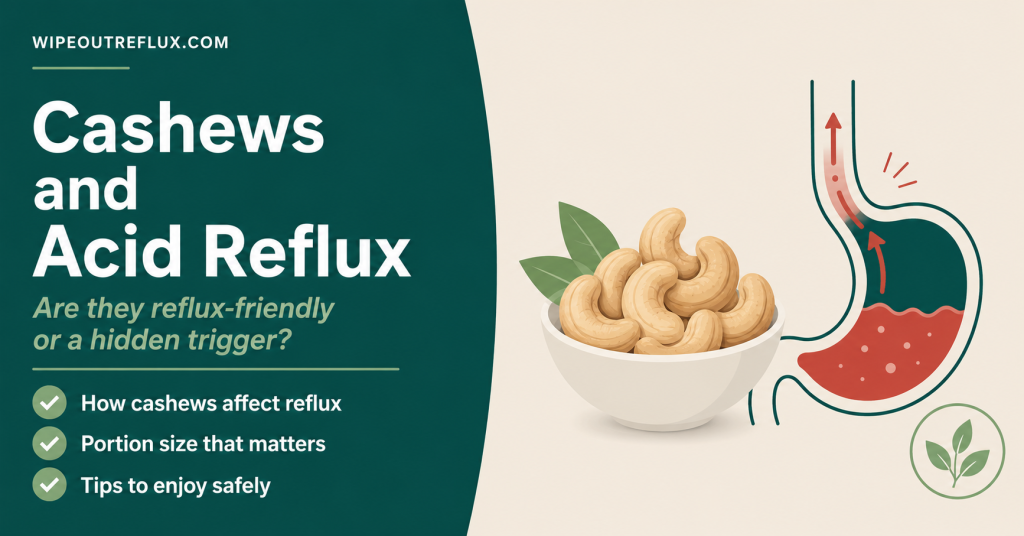
If you love cashews but you are managing acid reflux, you have probably wondered whether that handful is helping or hurting. Here is the honest answer: cashews are not acidic, so acidity is not the problem. The real issues are that cashews are high in fat and high in fermentable carbohydrates (FODMAPs), and both of those can trigger reflux symptoms in some people, especially in larger portions.
That means cashews are not a clear-cut “good” or “bad” food for reflux. For many people a small portion is perfectly fine. For others, even a modest handful brings on bloating and that familiar pressure that pushes reflux upward. Portion and personal tolerance are everything.
I have tested nuts carefully on my own reflux over the years, and cashews are one where the details really matter. Let me walk through exactly why, and how to eat them in a way that keeps symptoms down.
Key Takeaways
- Cashews are not acidic — they sit close to neutral, so pH is not the reason they can trigger reflux.
- The two real concerns are their high fat content and their high FODMAP content.
- High-fat foods can increase reflux symptoms in susceptible people, particularly in large amounts or close to bedtime.
- Cashews are high in the FODMAPs GOS and fructans, which can cause bloating and gas that raise pressure on the stomach.
- A small portion of around 10 to 15 cashews is far less likely to cause trouble than a large handful.
- Soaking (“activating”) cashews and choosing dry-roasted, unsalted versions can both help.
- Cashews are still nutrient-dense, offering magnesium, fiber, protein, and healthy unsaturated fats.
- If cashews consistently bother you, lower-FODMAP nuts like macadamias, peanuts, or small portions of almonds are gentler alternatives.
Are Cashews Acidic?
No. Cashews are roughly neutral to mildly alkaline, so they are not going to irritate your throat or esophagus the way an acidic food like citrus or tomato might. This is an important point, because a lot of reflux advice fixates only on the pH of foods.
While food pH does matter for reflux — especially for those of us dealing with silent reflux (LPR) and pepsin in the throat — it is only part of the picture. A food can be perfectly non-acidic and still trigger reflux through other mechanisms. Cashews are a textbook example. The trouble they cause has nothing to do with acidity and everything to do with fat and fermentation.
The Real Reasons Cashews Can Trigger Reflux
1. They are high in fat
Cashews are calorie-dense and fat-rich, and dietary fat has a complicated relationship with reflux. The evidence is genuinely mixed — some large population studies find no clear link once you account for body weight — but the better-controlled studies suggest fat does matter for symptoms.
In one carefully controlled study of people with reflux, a high-fat diet increased the frequency of reflux symptoms compared with a low-fat diet, even though calorie density was what drove actual acid exposure [Fox et al., Clinical Gastroenterology & Hepatology, 2007]. A separate cross-sectional study found high dietary fat intake was associated with reflux symptoms and erosive esophagitis, although the effect was tied up with body weight [El-Serag et al., Gut, 2005].
The practical takeaway is that fat tends to make reflux symptoms feel worse, partly by slowing stomach emptying so food sits longer and by heightening sensitivity. A big handful of cashews delivers a substantial dose of fat in one sitting, which is exactly the kind of thing that can tip a sensitive system over. A balanced review of the topic concluded the relationship between fat and reflux is real but heavily influenced by overall calories and weight [Newberry & Lynch, Journal of Thoracic Disease, 2019].
2. They are high in FODMAPs
This is the one most people never hear about. Cashews are classified as high FODMAP by Monash University, the gold-standard source for this data, because they contain significant amounts of GOS (galacto-oligosaccharides) and fructans [Monash University FODMAP].
These are fermentable carbohydrates that your small intestine cannot fully absorb. When they reach the gut bacteria, they ferment, producing gas and bloating. That extra gas increases pressure inside your abdomen, and that pressure can push stomach contents up against the valve at the top of the stomach — promoting reflux. If you have ever noticed reflux getting worse after a bloated, gassy meal, this mechanism is likely why. I cover the broader gut-pressure connection in my article on SIBO and acid reflux.
Because cashews stack two FODMAP types together, they can be harder on a sensitive gut than nuts that contain only one. That is why portion size matters so much with cashews specifically.
The Upside: Cashews Are Not All Bad
I do not want to scare anyone off cashews entirely, because they have real nutritional value and most people with reflux can enjoy them in sensible amounts.
Cashews provide magnesium, which many people are low in, along with plant protein, fiber, and mostly unsaturated fats — the heart-friendly kind. They are not acidic, they do not contain caffeine or other classic chemical triggers, and they make a far better snack than the processed, sugary options most of us reach for. The goal is not avoidance; it is moderation and smart preparation. For a wider look at how nuts fit into a reflux-friendly diet, see my guide to what nuts are good for acid reflux.
How to Eat Cashews Without Triggering Reflux
Here is how I would approach cashews if you want to keep them in your diet while managing reflux.
- Keep the portion small. Aim for around 10 to 15 cashews rather than a large handful. A small serving keeps both the fat load and the FODMAP load low enough that many people tolerate it well.
- Soak or buy “activated” cashews. Soaking raw cashews in water leaches out some of the water-soluble FODMAPs. Activated cashews (soaked, then dried) have a documented low-FODMAP serving of about 15 grams, making them gentler on the gut.
- Choose dry-roasted and unsalted. Oil-roasted cashews add even more fat, and heavily salted versions are not ideal either. Dry-roasted, lightly salted or unsalted is the cleaner choice.
- Eat them earlier in the day. Fat slows stomach emptying, so a high-fat snack close to bedtime is asking for overnight reflux. Enjoy cashews earlier rather than as a late-night nibble, and stay upright afterward.
- Do not pair them with other triggers. A small portion of cashews on its own is very different from cashews alongside coffee, chocolate, or a large fatty meal. Watch the whole context.
As always, the smartest move is to test cashews on their own, in a small portion, and see how your body responds. This one-variable-at-a-time approach is the most reliable way to learn your real triggers. My lists of LPR foods to eat and foods to avoid can help you build the rest of your plate around them.
Better Options If Cashews Don’t Agree With You
If you have tested cashews and they reliably cause bloating or reflux, you have plenty of alternatives that are easier on a sensitive gut.
Lower-FODMAP nuts include macadamias, peanuts (technically a legume, but nutritionally similar), and small portions of almonds or walnuts. These give you the protein, fiber, and healthy fats without the heavy GOS-and-fructan combination cashews carry. If you prefer spreads, a thin layer of peanut butter or almond butter in a controlled portion is often well tolerated. For more snack inspiration that keeps reflux in mind, take a look at my round-up of snacks for the LPR diet.
Frequently Asked Questions
Are cashews acidic?
No, cashews are close to neutral on the pH scale and are not considered an acidic food. Any reflux they cause comes from their high fat and FODMAP content rather than from acidity, which is why even non-acidic foods can sometimes trigger symptoms.
How many cashews can I eat with acid reflux?
A small portion of around 10 to 15 cashews is usually the sweet spot. That keeps both the fat and the FODMAP load low. Larger handfuls are far more likely to cause bloating and reflux, so the amount matters as much as the food itself.
Are roasted or raw cashews better for acid reflux?
Dry-roasted, unsalted cashews are generally the best choice. Oil-roasted versions add extra fat, and heavily salted ones are not ideal. Soaked or “activated” cashews are gentler still, because soaking reduces some of the FODMAP content that causes gas and bloating.
Is cashew butter bad for acid reflux?
Cashew butter concentrates the fat and FODMAPs of the nuts into a denser form, so it can be more triggering than a small portion of whole cashews. If you enjoy it, keep the serving thin and small, and watch how your body responds. Peanut or almond butter in a controlled amount may be a gentler option.
Is cashew milk okay for acid reflux?
It depends on how concentrated it is, since FODMAP content varies with how many cashews are used. Cashew milk has not been formally FODMAP-tested, so it is harder to predict. If you are sensitive, a low-FODMAP plant milk may be a safer bet — you can compare options in my article on almond milk for acid reflux.
Do salted cashews make reflux worse?
Heavily salted snacks are not ideal as a routine choice, and the salt often comes with oil-roasting that adds fat. Salted cashews are not a disaster in a small portion, but dry-roasted and unsalted is the cleaner, more reflux-friendly option day to day.
What nuts are best for acid reflux?
Lower-FODMAP nuts like macadamias, peanuts, and small servings of almonds or walnuts tend to be the easiest on a sensitive gut. They deliver the same protein, fiber, and healthy fats as cashews without the double dose of fermentable carbohydrates. Portion control still applies to all of them.
Conclusion
So, are cashews bad for acid reflux? Not inherently. They are not acidic, they are genuinely nutritious, and most people can enjoy a small portion without trouble. The catch is that cashews combine two things reflux-prone guts do not always handle well — a high fat load and a high dose of fermentable FODMAPs — and those add up quickly once you go past a modest handful. Keep the portion small, lean toward soaked or dry-roasted versions, eat them earlier in the day, and pay attention to how your own body responds.
That last point is the heart of it. Reflux is deeply individual, and the only way to know where cashews sit for you is to test them carefully and in isolation, rather than guessing or cutting out an entire healthy food group on a hunch. Once you understand the mechanisms — fat slowing digestion, FODMAPs creating pressure — you can make a calm, informed decision instead of fearing your snacks.
If you want a complete, structured system for figuring out exactly which foods help and which ones hurt, that is precisely what I built the Wipeout Diet Plan to do. It is the in-depth guide that walks you through the whole reflux-friendly approach I used to get my own symptoms under control, mechanisms and all. To use alongside it, the Wipeout Food Reference Guide is the essential companion that lays out which foods and drinks are safe for acid reflux and LPR along with their pH values, so you always know at a glance where a food like cashews stands. Together they take the guesswork out of building a diet that actually keeps your reflux quiet.
Research Sources
- Fox et al., Clinical Gastroenterology & Hepatology, 2007 — In people with reflux, a high-fat diet increased the frequency of reflux symptoms, while calorie density drove esophageal acid exposure.
- El-Serag et al., Gut, 2005 — High dietary fat intake was associated with reflux symptoms and erosive esophagitis, though the effect was influenced by body mass index.
- Newberry & Lynch, Journal of Thoracic Disease, 2019 — A review of diet and GERD concluding the link between dietary fat and reflux is real but strongly modified by total calories and body weight.
- Monash University FODMAP — Lab-based FODMAP testing classifying cashews as high FODMAP due to their GOS and fructan content, which can drive bloating and gas.

David Gray
12 years living with LPR · Consultant & researcher
I've lived with LPR for twelve years — the misdiagnoses, the PPI courses that did nothing, the slow work of figuring out what actually helps. Wipeout Reflux is where I translate the research into plain terms for people stuck in the same place. Every claim here is sourced to peer-reviewed work, and I consult one-to-one with LPR sufferers.