
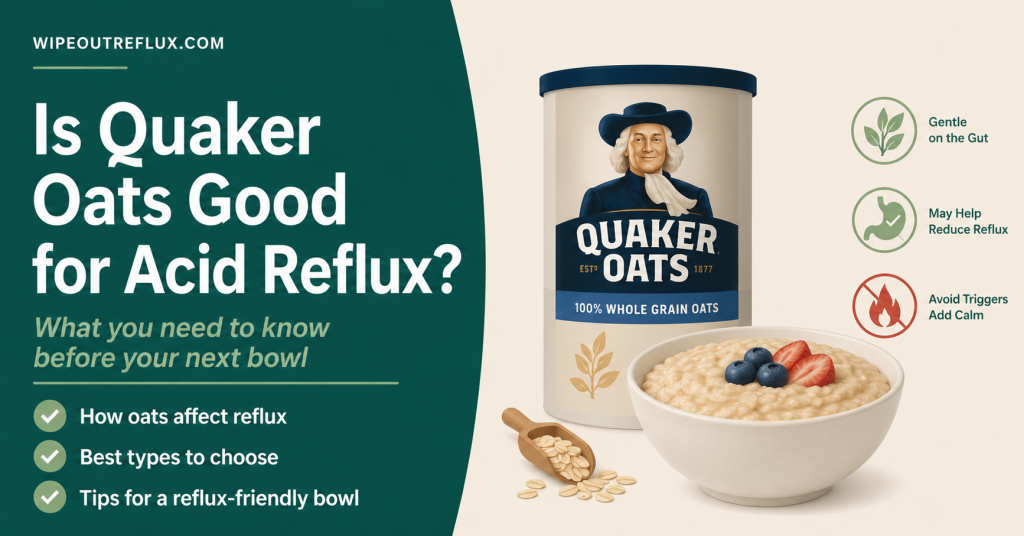
Good news if oatmeal is your go-to breakfast: plain Quaker oats are one of the better choices you can make for acid reflux. Oats are low in acid, rich in soluble fiber, and filling — all things that tend to help rather than hurt reflux. So yes, Quaker oats are generally good for acid reflux.
But there is an important catch, and it is the reason some people swear oatmeal calms their reflux while others find it sets them off. It is almost never the oats themselves. It is the flavored instant packets loaded with sugar, and the toppings and milk people add on top, that turn a reflux-friendly food into a trigger.
I eat oats regularly myself, and getting the details right makes all the difference. Let me break down exactly why plain oats help, which Quaker products to choose, and how to build a bowl that keeps reflux quiet.
Key Takeaways
- Plain Quaker oats are low-acid, high-fiber, and generally reflux-friendly.
- The soluble fiber in oats is linked in research to fewer reflux and heartburn episodes.
- Oats are absorbent and gentle, which is why many people find them soothing rather than triggering.
- Flavored instant packets (maple & brown sugar, apples & cinnamon) are high in added sugar and a less ideal choice.
- What you add matters most — whole milk, butter, citrus, chocolate, and large amounts of sugar can all trigger reflux.
- Old-fashioned rolled oats, quick oats, and steel-cut oats prepared plain are your best options.
- Keep portions moderate and pair oats with low-acid toppings like banana for a genuinely reflux-friendly bowl.
Are Quaker Oats Good for Acid Reflux?
Yes — in their plain form, they are a solid choice. Oats sit comfortably on the reflux-friendly side of the ledger for two main reasons: they are not acidic, and they are high in the kind of fiber that supports digestion and may reduce reflux. That combination makes plain oatmeal one of the easier breakfasts on a sensitive stomach and throat, whether you are dealing with classic heartburn or silent reflux (LPR).
The reason oatmeal has a mixed reputation is entirely about how it is prepared and what goes with it — which I will get to. First, here is why the oats themselves are on your side.
Why Oats Help with Acid Reflux
They are low-acid and absorbent
Oats are close to neutral on the pH scale, so they will not irritate your esophagus or throat the way an acidic food might. They are also highly absorbent — cooked oats soak up liquid and form a soft, soothing mass that many people find gentle on the gut. That absorbent quality is part of why a plain bowl of oatmeal so rarely causes trouble on its own.
They are rich in soluble fiber
This is the real standout. Oats are loaded with beta-glucan, a soluble fiber, and dietary fiber has genuinely encouraging evidence behind it for reflux. In one prospective study, supplementing the diet with fiber increased the resting pressure of the valve at the top of the stomach and reduced both the number of reflux episodes and weekly heartburn in people with reflux [Morozov et al., World Journal of Gastroenterology, 2018]. A separate large study found that higher fiber intake was associated with a reduced risk of reflux symptoms [El-Serag et al., Gut, 2005].
Fiber appears to help in a few ways: it supports better gut motility and emptying, so food and acid spend less time sitting around, and it may help maintain healthy pressure at that all-important valve. A bowl of oats is one of the easiest ways to get a meaningful dose of soluble fiber first thing in the day.
They are filling and support a healthy weight
Oats are satisfying and keep you full, which helps you avoid the kind of overeating and snacking that drives reflux. Since excess weight is one of the strongest risk factors for reflux, a filling, fiber-rich breakfast that keeps hunger in check is quietly working in your favor.
The Catch: When Quaker Oats Can Trigger Reflux
Here is where most people go wrong, and why oatmeal sometimes gets blamed unfairly. I cover this in depth in my article on why oatmeal can give you heartburn, but here are the main culprits.
Flavored instant packets and added sugar
Quaker’s flavored instant packets — think maple & brown sugar or apples & cinnamon — can contain a surprising amount of added sugar. High-sugar, refined foods are common reflux aggravators, and they undercut the benefit of the oats underneath. The convenience is real, but for reflux they are the least ideal way to eat oats.
What you cook them in and pile on top
This is the big one. A plain bowl of oats is reflux-friendly. The same bowl made with full-fat milk, a knob of butter, a heap of sugar, chocolate chips, or a pile of citrus and berries is a different story entirely. High-fat dairy, butter, chocolate, and acidic fruit are all classic triggers. The oats are innocent; the toppings are doing the damage.
Portion size
Even a perfect bowl can cause trouble if it is enormous. A very large, dense serving sits heavily in the stomach and raises pressure, which can promote reflux. Moderate portions are gentler.
Which Quaker Oats Are Best for Acid Reflux?
Not all Quaker products are equal when it comes to reflux. Here is how I would rank them:
- Best: Old-fashioned rolled oats, quick 1-minute oats, and steel-cut oats — all prepared plain. These are just oats, with no added sugar, giving you all the fiber and none of the triggers.
- Fine: Plain instant oatmeal (the unsweetened, unflavored kind). Convenient and still reflux-friendly — just glance at the sodium on the label.
- Limit: Flavored and sweetened instant packets. The added sugar makes these the weakest choice for reflux, even though the oat base is fine.
Steel-cut versus rolled makes little difference for reflux specifically — both are excellent. Steel-cut oats are less processed and digest a touch more slowly, which some people prefer, but a plain bowl of either is a great choice.
How to Make Reflux-Friendly Oatmeal
Here is the simple formula I would follow to keep your bowl on the safe side:
- Start with plain oats — rolled, quick, or steel-cut.
- Cook with water or a low-fat or plant-based milk. Oat milk or almond milk are gentler than full-fat dairy for many people.
- Sweeten lightly, if at all. A small drizzle of honey or maple syrup is far better than a flavored packet’s worth of sugar.
- Top with low-acid fruit. A sliced banana is a classic reflux-friendly choice. Melon and pear work well too. Go easy on citrus and large amounts of berries.
- Skip the heavy add-ins. Leave out butter, cream, chocolate, and big spoonfuls of sugar.
- Keep the portion moderate and eat it sitting up, with time to digest before lying down.
Plain oats also make a great reflux-friendly snack later in the day — you can find more ideas in my round-up of snacks for the LPR diet, and oats feature among my wider list of reflux-friendly foods to eat.
Frequently Asked Questions
Are Quaker oats acidic?
No, oats are close to neutral on the pH scale and are not considered acidic. That is one of the main reasons plain oatmeal is gentle on reflux — it will not irritate the esophagus or throat the way an acidic food can.
Is instant Quaker oatmeal bad for acid reflux?
Plain instant oatmeal is fine for reflux. The flavored, sweetened instant packets are the issue, because they tend to be high in added sugar. If you like the convenience of instant, choose the plain unflavored version and add your own low-acid toppings.
Can oatmeal cause heartburn?
Oats themselves rarely cause heartburn, but how you prepare them can. Full-fat milk, butter, chocolate, acidic fruit, large amounts of sugar, and oversized portions are the usual triggers. Strip those back and a plain bowl is one of the more reflux-friendly breakfasts available.
What can I put on oatmeal for acid reflux?
Low-acid toppings work best: sliced banana, melon, or pear, a small drizzle of honey or maple syrup, and a splash of low-fat or plant-based milk. Avoid loading it with butter, cream, chocolate, citrus, or heaps of sugar, all of which can provoke reflux.
Are overnight oats good for acid reflux?
Overnight oats can be reflux-friendly as long as you build them sensibly — plain oats, a gentle milk, and low-acid fruit. Just watch out for high-fat dairy, yogurt that does not agree with you, and added sugar, since those are where overnight oats often go wrong for reflux.
Is oat milk good for acid reflux?
Oat milk is generally well tolerated and a reasonable low-acid option for many people with reflux. I go into the detail, including what to watch for on labels, in my article on whether oat milk is good for acid reflux.
Are steel-cut or rolled oats better for reflux?
Both are excellent for reflux, and the difference is small. Steel-cut oats are less processed and digest slightly more slowly, while rolled oats are quicker to make. Choose whichever you enjoy — just keep them plain and mind the toppings.
Conclusion
So, are Quaker oats good for acid reflux? In their plain form, genuinely yes. Oats are low in acid, packed with the soluble fiber that research links to fewer reflux symptoms, filling enough to help with weight, and gentle on an irritated gut and throat. That makes a simple bowl of oatmeal one of the more reliable breakfasts you can lean on while managing reflux.
The whole game comes down to keeping it simple. Reach for plain rolled, quick, or steel-cut oats rather than the sugary flavored packets, cook them with water or a gentle milk, sweeten lightly, and top with low-acid fruit instead of butter, chocolate, or citrus. Get that right and the oats work for you. Get sloppy with the extras and you can turn a healthy breakfast into a trigger — which is exactly why oatmeal gets unfairly blamed so often.
If you want a complete, structured approach to figuring out which foods soothe your reflux and which set it off, that is exactly what I built the Wipeout Diet Plan to do. It is the in-depth guide that walks you through the reflux-friendly way of eating I used to get my own symptoms under control, mechanisms and all. To use alongside it, the Wipeout Food Reference Guide is the essential companion that lays out which foods and drinks are safe for acid reflux and LPR along with their pH values, so you always know at a glance where a food like oats — and everything you put on top — really stands. Together they take the guesswork out of building a breakfast, and a whole diet, that keeps your reflux calm.
Research Sources
- Morozov et al., World Journal of Gastroenterology, 2018 — A prospective study showing that increasing dietary fiber raised lower esophageal sphincter pressure and reduced reflux episodes and weekly heartburn in people with non-erosive reflux.
- El-Serag et al., Gut, 2005 — A cross-sectional study finding that high dietary fiber intake correlated with a reduced risk of reflux symptoms.

David Gray
12 years living with LPR · Consultant & researcher
I've lived with LPR for twelve years — the misdiagnoses, the PPI courses that did nothing, the slow work of figuring out what actually helps. Wipeout Reflux is where I translate the research into plain terms for people stuck in the same place. Every claim here is sourced to peer-reviewed work, and I consult one-to-one with LPR sufferers.