
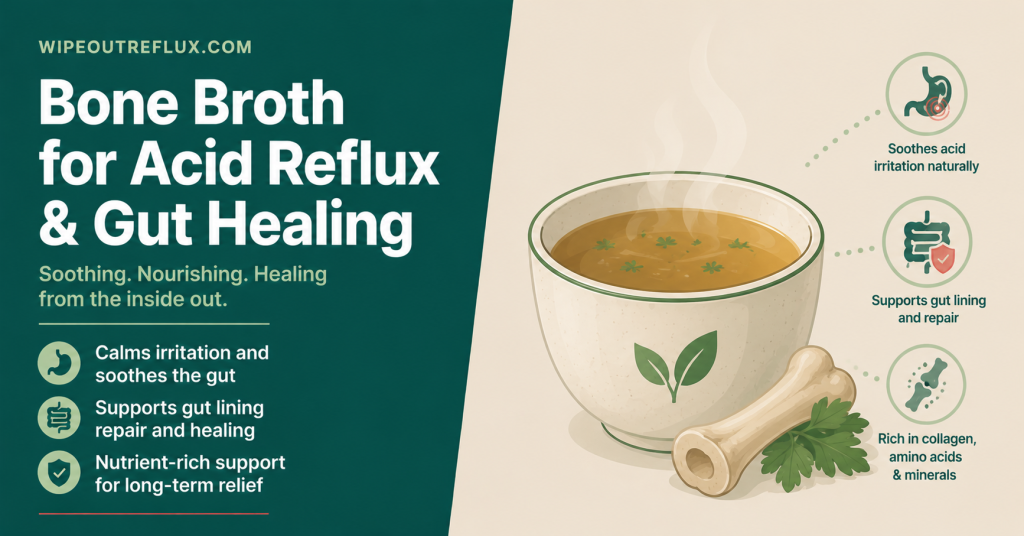
Bone broth is a mixed bag for acid reflux — it can be soothing and gut-supportive for some people, but genuinely problematic for others, and the truth depends heavily on how it’s made. On the plus side, plain bone broth is naturally low in acid and rich in amino acids like glycine and glutamine that support the gut lining. On the downside, many recipes add acidic apple cider vinegar, and long-cooked or shop-bought broths can be high in histamine and free glutamate — both of which trigger symptoms in sensitive people, including some with silent reflux (LPR).
So bone broth isn’t the universal “gut-healing miracle” it’s often sold as, but it isn’t off-limits either. Made the right way, it can be a gentle, reflux-friendly food. Made the wrong way, it can set you back.
Having managed LPR for over eight years, I’ve seen bone broth help some people and quietly aggravate others. Let me give you the honest, mechanism-based picture so you can decide whether — and how — it fits your diet.
Key Takeaways
- Plain bone broth is naturally low in acid, which makes the base itself reflux-friendly.
- It contains glycine and glutamine, amino acids with real evidence for supporting the gut barrier.
- The gut-healing claims are mostly extrapolated from supplement studies, not trials on bone broth itself.
- Many recipes add apple cider vinegar, which is acidic and can aggravate reflux and LPR.
- Long-cooked and commercial broths can be high in histamine and free glutamate, triggering symptoms in sensitive people.
- Homemade, fresh, low-vinegar, moderately cooked broth is the most reflux-friendly version.
What’s Actually in Bone Broth?
Bone broth is made by simmering animal bones and connective tissue, often for many hours. That process pulls out a range of compounds:
- Collagen and gelatin — the proteins that give broth its body and “gut-soothing” reputation.
- Glycine — an amino acid involved in gut lining maintenance and calming effects.
- Glutamine — a key fuel source for the cells lining your intestine.
- Minerals — calcium, magnesium, potassium, and others leached from the bones.
On paper, that’s a nutritious profile, and it’s the basis for most of the health claims. But the important nuance is that the amounts of these compounds vary enormously depending on the bones, cooking time, and recipe — and, crucially, the reflux-relevant evidence is for the isolated amino acids, not for bone broth as a whole.
The Case For Bone Broth and Reflux
It’s naturally low in acid
The single best thing about bone broth for reflux is that, in its plain form, it’s low in acid. Unlike citrus, tomatoes, coffee, or vinegar, a simple broth of bones and water sits gently on the stomach and throat. For anyone following a low-acid diet — the most effective dietary approach for reflux and LPR — a warm, plain broth can be a comforting, non-irritating option. It fits naturally alongside other gentle choices in my LPR foods to eat guide.
Glutamine and glycine may support the gut lining
Here’s where the “gut healing” idea has some legitimate grounding — with a caveat. Glutamine is the preferred fuel for the cells lining your intestine and plays a key role in maintaining barrier integrity [Zhang et al., Journal of Parenteral and Enteral Nutrition, 2019]. A systematic review and meta-analysis of clinical trials found that glutamine supplementation improved measures of intestinal permeability in adults [Zhou et al., Amino Acids, 2024].
The honest caveat: those studies used supplemental doses of isolated glutamine, not bone broth. A bowl of broth contains some glutamine and glycine, but in variable and generally much smaller amounts. So it’s fair to say bone broth may offer some gut-lining support, but overstating it as a proven gut-healing therapy goes beyond what the evidence shows. This distinction between mechanism and proof is exactly the kind of honesty I think reflux content usually lacks.
The Case Against: Where Bone Broth Can Backfire
This is the part wellness marketing tends to skip, and it matters a lot for reflux sufferers.
Added apple cider vinegar makes it acidic
Most bone broth recipes tell you to add a splash of apple cider vinegar (ACV) to the water, because the acid helps extract minerals from the bones. The problem is obvious for reflux: you’ve just added an acidic ingredient to an otherwise low-acid food. For LPR in particular, acidic food can reactivate pepsin lurking in the throat tissue, so that vinegar can turn a soothing broth into a trigger. If you want to understand why acidity matters so much in silent reflux, my article on neutralising pepsin in the throat explains the mechanism, and my piece on apple cider vinegar for acid reflux covers why ACV is a double-edged sword.
Histamine can be a problem for sensitive people
Bone broth’s histamine content is debated, but the practical picture is this: histamine forms mainly from bacteria acting on the amino acid histidine, so the freshness of the bones and meat matters most. Long-cooked broths, commercial broths, and those made with older or meatier ingredients tend to carry more. For people with histamine intolerance — a group that overlaps with reflux and throat-symptom sufferers — this can trigger flushing, congestion, and throat or digestive symptoms. If bone broth consistently makes you feel worse rather than better, histamine sensitivity is a plausible reason.
Free glutamate can trigger symptoms too
Slow-cooked broths are also high in free glutamate — the same compound family as MSG. In sensitive individuals, free glutamate can cause flushing, headaches, and a wired, anxious feeling. This is worth knowing because those symptoms can be mistaken for something else entirely, and anxiety itself can worsen reflux perception — a link I explore in can LPR be caused by anxiety.
How to Make Bone Broth Reflux-Friendly
The good news is that most of the downsides are avoidable. If you want to try bone broth, here’s how to give yourself the best chance of tolerating it:
- Make it yourself where possible, so you control the ingredients and cooking time. Commercial broths are the most likely to be high in histamine and glutamate.
- Use fresh or freshly frozen bones — freshness is the biggest factor in keeping histamine low.
- Skip or minimise the apple cider vinegar. If you use any, keep it to a tiny amount, or leave it out entirely to keep the broth low-acid.
- Consider a shorter cook (around 4 hours rather than 24–48) if you’re histamine- or glutamate-sensitive.
- Start small and watch your response. Try a small cup and see how your throat and stomach feel over the next few hours before making it a regular habit.
As always with reflux, personal tolerance is everything. Test bone broth as a single variable — one small serving, made gently — so you can actually tell whether it helps or hurts. If it soothes you, it’s a nice low-acid addition. If it aggravates you, it’s not worth forcing. For other gentle, soothing options, my guide to natural remedies for LPR covers alternatives with a calmer risk profile.
Frequently Asked Questions
Is bone broth acidic or alkaline?
Plain bone broth made from just bones and water is close to neutral and naturally low in acid, which makes it reflux-friendly. The acidity problem comes from recipes that add apple cider vinegar to help extract minerals. Leave the vinegar out or use very little, and the broth stays gentle.
Does bone broth really heal the gut?
It may offer some support, but the claim is overstated. Bone broth contains glutamine and glycine, which have evidence for supporting the gut barrier — but that evidence comes from concentrated supplement doses, not from bone broth itself. Think of broth as a gentle, nourishing food that might help, rather than a proven gut-healing treatment.
Can bone broth cause acid reflux?
It can in certain situations — mainly if it’s made with apple cider vinegar (acidity), if it’s high in histamine or glutamate (in long-cooked or commercial versions), or if you’re sensitive to those compounds. Plain, fresh, homemade broth without added vinegar is the least likely to cause problems.
Is bone broth good for silent reflux (LPR)?
It can be, if made carefully. A plain, low-acid, vinegar-free broth is gentle on the throat and can be soothing. But watch out for the histamine and acidity issues, since acidic food can reactivate pepsin in the throat tissue that drives LPR symptoms. Make it fresh, skip the vinegar, and monitor how your throat responds.
Is store-bought bone broth okay for reflux?
It’s the version most likely to cause issues, because commercial broths are often long-cooked and can be higher in histamine and free glutamate, and some contain added acidic ingredients. If you’re reflux- or histamine-sensitive, homemade broth where you control the ingredients is the safer choice.
How much bone broth should I drink for reflux?
There’s no established therapeutic dose, so start small — a single small cup — and see how you feel. If it agrees with you, a modest daily serving is reasonable. More isn’t necessarily better, especially given the histamine and glutamate considerations with larger amounts.
Conclusion
So, is bone broth good or bad for acid reflux? The honest answer is: it depends on how it’s made and how your body responds. At its best — plain, fresh, homemade, and vinegar-free — bone broth is a naturally low-acid, gently nourishing food that may offer some gut-lining support through its glycine and glutamine. At its worst — long-cooked, commercial, or loaded with apple cider vinegar — it can be acidic, high in histamine and glutamate, and a genuine trigger. It’s neither miracle nor menace; it’s a food to approach thoughtfully and test on your own terms.
What bone broth can’t do is replace the foundations of reflux recovery. No single food heals reflux — it’s your overall pattern of low-acid, well-timed eating that does the heavy lifting. That’s exactly what the Wipeout Diet Plan is built around: a structured, done-for-you low-acid eating plan for reflux and LPR recovery, so you’re not left guessing which foods help and which quietly set you back. It puts your energy where it actually counts.
To check individual foods and drinks quickly, the Wipeout Food Reference Guide is an essential companion — it lists exactly which foods are safe for acid reflux and LPR along with their pH values, so you can look anything up at a glance. Use the Food Reference Guide as your everyday quick-check and the Wipeout Diet Plan as the deeper, more complete roadmap to getting better. Make your broth gently, skip the vinegar, listen to your body, and it can be a comforting part of a reflux-friendly kitchen.
Research and References
- [Zhang et al., Journal of Parenteral and Enteral Nutrition, 2019] — Randomised trial and review noting glutamine is the preferred fuel for intestinal cells and supports barrier integrity and reduced permeability.
- [Zhou et al., Amino Acids, 2024] — Systematic review and meta-analysis of clinical trials finding glutamine supplementation improved intestinal permeability measures in adults.

David Gray
12 years living with LPR · Consultant & researcher
I've lived with LPR for twelve years — the misdiagnoses, the PPI courses that did nothing, the slow work of figuring out what actually helps. Wipeout Reflux is where I translate the research into plain terms for people stuck in the same place. Every claim here is sourced to peer-reviewed work, and I consult one-to-one with LPR sufferers.