
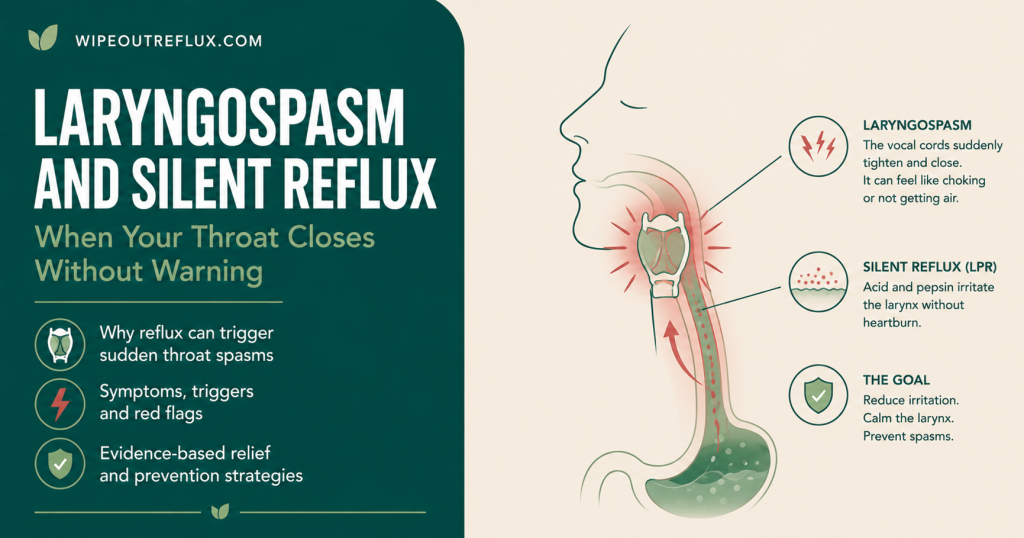
Few things reflux does are as frightening as this: you’re fast asleep, and then suddenly you’re bolt upright, throat clamped shut, unable to pull in any air. It might last only seconds, but in the moment it feels like you’re suffocating. If that’s happened to you, I want to start with reassurance, because I know how terrifying it is.
What you’re almost certainly experiencing is laryngospasm — a brief, protective reflex in which your vocal cords snap shut. The crucial thing to hold onto is that it’s self-limiting: it releases on its own, usually within a few seconds to a couple of minutes, and then you can breathe again. In silent reflux, it’s typically set off by a small amount of acid or pepsin reaching your voice box while you sleep.
It feels like an emergency, and yet the spasm itself is your body over-protecting your airway rather than failing it. That said — and I’ll come back to this — waking up gasping should always be checked out properly by a doctor to confirm the cause and rule out other conditions. I’m not a doctor, and this article is background to help you understand what’s happening, not medical advice.
Key takeaways
- Waking up gasping with your throat closed is usually laryngospasm — a brief, involuntary closing of the vocal cords.
- It’s self-limiting and resolves on its own, typically within seconds to about two minutes.
- In silent reflux (LPR), it’s triggered by acid or pepsin reaching the voice box and setting off a protective reflex.
- You don’t need to feel heartburn for reflux to cause it — in one study only a third of sufferers had heartburn.
- It happens at night because lying flat lets acid pool at throat level while your natural defences are switched off.
- During an episode, staying calm and breathing gently in through the nose helps it pass.
- Reflux treatment is highly effective — studies show episodes stop in the large majority of people once reflux is controlled.
- Always get waking-up-gasping assessed to confirm it’s reflux and to rule out sleep apnoea, asthma and other causes.
What laryngospasm actually is
Your vocal cords do more than let you speak — they’re the gatekeepers of your airway. Normally they sit open so air can pass freely into your lungs, and they close only briefly when you swallow, to keep food and drink out of your windpipe.
Laryngospasm is when those vocal cords involuntarily clamp shut and stay shut, briefly blocking air from getting through. It’s essentially a protective reflex that’s gone into overdrive: the body slams the airway closed to stop something harmful getting into the lungs. You may notice a high-pitched noise as you try to breathe through the narrowed opening. And then, just as suddenly, the muscles relax, the cords open, and normal breathing returns. The whole thing is frightening precisely because it’s so sudden — but it is temporary and it does end on its own.
Why reflux triggers laryngospasm
Here’s the mechanism, and it’s simpler than you might expect. The tissue around and above your vocal cords is dotted with sensitive receptors. When acid or pepsin from reflux reaches your voice box, it irritates those receptors, which fire off a signal along the vagus nerve. The nerve responds by triggering the vocal cords to snap shut — a reflex designed to protect your lungs from whatever has reached the throat.
In other words, your larynx overreacts to a threat. It senses acid where acid should never be and slams the door to keep it out of your airway. And because this is about irritation rather than volume, it takes only a tiny amount of refluxate to set it off — which is exactly why this happens in silent reflux without any heartburn. In a study of people with this kind of paroxysmal laryngospasm, only 33% had heartburn at all, yet the great majority had clear evidence of reflux, and every single patient stopped having episodes once their reflux was treated [Loughlin & Koufman, The Laryngoscope, 1996]. Reflux-triggered laryngospasm is a recognised, though under-diagnosed, feature of LPR — you can read more about the breathing side of it in my guide to silent reflux and shortness of breath.
Why it happens at night — and why you wake up gasping
This is the part that makes silent reflux laryngospasm so distinctive: it strikes when you’re asleep. There are a few reasons the night is when it happens.
When you lie flat, you lose the help of gravity, so refluxed acid can pool at throat level instead of draining back down. At the same time, sleep works against you in three ways: the valve at the top of your stomach relaxes, your oesophagus clears acid more slowly, and you more or less stop swallowing — which means very little saliva is being produced to neutralise acid. I explain that last defence in detail in my article on why reflux is worse at night. Put together, acid can sit against your voice box long enough to trip the reflex — and when the vocal cords slam shut, it jolts you straight out of sleep.
Because it comes out of nowhere and there’s no obvious cause, these episodes are very often mistaken for a nightmare, a panic attack, or choking on nothing. Many people spend years frightened and confused before they discover that silent acid hitting the throat is the real trigger.
What to do during an episode
In the moment, the single most helpful thing is to remember that it will pass on its own in seconds. Panic is understandable, but it tightens everything up, so calming yourself actually helps. Here’s what tends to work — as general self-help rather than medical advice:
- Stay upright and lean slightly forward. Sitting up helps more than lying back down.
- Breathe gently in through your nose. Slow, small nasal breaths encourage the cords to relax. Frantic, forceful gasping tends to make the spasm worse, not better.
- Breathe out slowly through pursed lips, as if you’re gently blowing out a candle. This relaxes the laryngeal muscles.
- Once air returns, a few sips of water can help settle things and clear any lingering acid.
The reflex will release by itself. Your job is simply to stay as calm as you can and breathe softly until it does.
How to prevent it: calming the reflux behind it
Since the trigger is acid reaching your throat at night, prevention is all about reducing night-time reflux — and the evidence here is genuinely encouraging. In a group of patients with sleep-related laryngospasm treated for reflux, nearly 90% reported no further episodes a year later, with the rare recurrences following a large, late meal and heavy alcohol [O’Shea et al., Irish Journal of Medical Science, 2022]. In plain terms: get the reflux under control and the episodes usually stop.
The most effective steps are the familiar night-time ones. Leave a three to four hour gap between your last meal and bed, and be especially strict about large late meals and alcohol in the evening. Elevate the head of your bed and sleep on your left side, both of which I cover in my guide to the best sleeping position for silent reflux. Keep your diet low in acid to reduce the pepsin and acid load on your throat — the reasoning behind that is in my article on neutralising pepsin in the throat. And an alginate such as Gaviscon Advance before bed forms a physical raft that helps keep reflux down while you sleep.
When to see a doctor (and rule out other causes)
This matters, so I want to be clear about it. While reflux laryngospasm itself is benign and self-limiting, waking up gasping should always be assessed by a doctor — both to confirm reflux is the cause and to rule out other conditions that can look similar. The most important one to exclude is obstructive sleep apnoea, which is far more common; nocturnal asthma, anxiety and panic attacks, and, rarely, other causes can also produce night-time breathing symptoms. My article on sleep apnoea and acid reflux covers how the two overlap, and if anxiety is part of your picture, whether anxiety can drive LPR is worth a read too.
Seek urgent medical help if breathing difficulty doesn’t resolve quickly, if your lips or face turn blue, if there’s swelling of the lips, tongue or throat (which points to an allergic reaction, a different and dangerous problem), or if you have chest pain. And if these episodes are frequent or distressing, ask your doctor about a referral to an ENT specialist or for a sleep study. Getting a clear diagnosis is not only safer — it’s also the fastest route to peace of mind.
Conclusion
Waking up gasping, with your throat sealed shut, is one of the most frightening experiences silent reflux can cause — but understanding it takes away a great deal of its power. What’s happening is laryngospasm: a brief, protective over-reaction in which your vocal cords clamp shut against acid that has reached your throat overnight. It feels like an emergency, yet the spasm passes on its own within seconds to a couple of minutes, and it’s a well-recognised, treatable feature of LPR rather than a sign that something is catastrophically wrong.
The genuinely hopeful part is how well this responds to treatment. When you calm the reflux that’s driving it — with careful evening habits, an elevated head, a low-acid diet and reflux control — the episodes typically stop, as the research consistently shows. Alongside that, please do get the symptom properly assessed, both to confirm the cause and to rule out sleep apnoea and other conditions. Knowing what you’re dealing with is half the battle, and it’s often the point at which the night-time fear finally starts to lift.
If you want a clear, structured way to bring that night-time reflux under control, my Wipeout Diet Plan is the step-by-step programme I built to calm reflux at the source, going far deeper into the mechanisms and the daily routine than any single article can. And to make everyday choices simple, the Wipeout Food Reference Guide is the essential companion, laying out the foods and drinks allowed on an acid reflux and LPR diet along with their pH values — so you can keep acid away from your throat, especially in the hours before bed. Together they turn the science on this page into a plan that helps you sleep soundly again.
Frequently asked questions
What does reflux laryngospasm feel like?
It’s a sudden sensation of your throat tightening or closing, followed by a brief inability to breathe in, often waking you from sleep. You may make a high-pitched noise as you try to breathe, and it can feel like suffocating. Episodes are short, usually lasting from a few seconds up to about two minutes, and resolve on their own as the vocal cords relax.
Is laryngospasm from reflux dangerous?
The spasm itself is self-limiting and resolves on its own, so it’s generally benign despite how frightening it feels. However, because waking up gasping can occasionally signal other conditions, it should always be assessed by a doctor. Seek urgent help if breathing doesn’t quickly return, if your lips turn blue, or if there’s swelling of the lips, tongue or throat.
Why does laryngospasm happen at night?
Lying flat lets refluxed acid pool at throat level instead of draining away, while sleep relaxes the valve above your stomach, slows acid clearance, and reduces the saliva that would normally neutralise acid. Together these let acid linger against your voice box long enough to trigger the reflex, which then jolts you awake.
What should I do during a laryngospasm episode?
Stay as calm as you can and remind yourself it will pass in seconds. Sit upright, lean slightly forward, and breathe gently in through your nose rather than gasping forcefully, which can make it worse. Breathing out slowly through pursed lips, as if blowing out a candle, helps relax the muscles. Sip water once your breathing returns.
How do I stop laryngospasm from happening?
Focus on reducing night-time reflux: leave a three to four hour gap before bed, avoid large late meals and evening alcohol, elevate the head of your bed, sleep on your left side, keep your diet low in acid, and consider an alginate before bed. Studies show that controlling reflux stops these episodes in the large majority of people.
Can silent reflux cause laryngospasm without heartburn?
Yes, and this is very common. Because laryngospasm is triggered by irritation rather than volume, only a tiny amount of acid or pepsin reaching the throat is needed to set it off — no heartburn required. In fact, research found that only about a third of people with reflux-induced laryngospasm experienced heartburn at all.
When should I see a doctor about waking up gasping?
Always get it assessed to confirm the cause and rule out other conditions, especially obstructive sleep apnoea, which is more common and must be excluded. Nocturnal asthma, anxiety and other causes can look similar. See a doctor promptly if episodes are frequent or distressing, and seek emergency care for breathing that doesn’t resolve, blue lips, throat or tongue swelling, or chest pain.
Research sources
- [Loughlin & Koufman, The Laryngoscope, 1996] — In 12 adults with paroxysmal laryngospasm, only 33% had heartburn, yet 92% showed evidence of reflux and all patients had complete cessation of episodes after antireflux treatment with diet, lifestyle changes and acid suppression.
- [O’Shea et al., Irish Journal of Medical Science, 2022] — A study of sleep-related laryngospasm as a manifestation of LPR, in which nearly 90% of patients reported no further episodes a year after antireflux treatment, and which outlines the conditions (such as sleep apnoea and nocturnal asthma) that must be excluded first.

David Gray
12 years living with LPR · Consultant & researcher
I've lived with LPR for twelve years — the misdiagnoses, the PPI courses that did nothing, the slow work of figuring out what actually helps. Wipeout Reflux is where I translate the research into plain terms for people stuck in the same place. Every claim here is sourced to peer-reviewed work, and I consult one-to-one with LPR sufferers.