
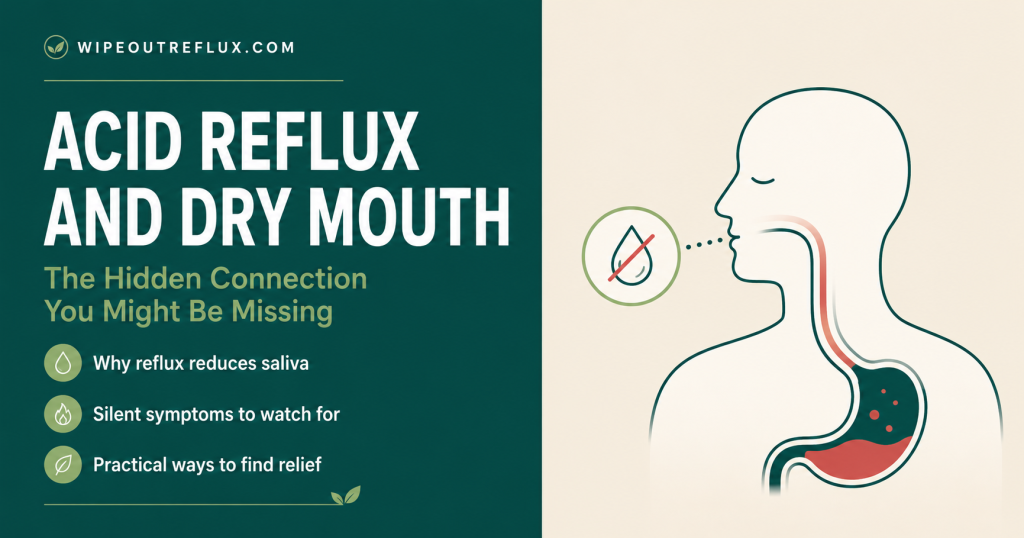
Yes — acid reflux can cause a dry mouth, and the relationship works in both directions. Saliva is your body’s first-line defence against stomach acid, so anything that reduces it (including reflux itself and the medications used to treat it) can leave your mouth feeling dry. At the same time, a dry mouth means less saliva to neutralise and clear acid, which can make reflux worse.
If you have silent reflux (LPR) or GERD and you keep waking up with a parched, sticky mouth — or you’re reaching for water constantly through the day — you’re not imagining the link. It’s a genuine, well-studied connection, and once you understand the mechanism it becomes much easier to break the cycle.
In this article I’ll walk through why reflux and dry mouth feed each other, the common triggers most people miss, and the practical steps that actually help.
Key Takeaways
- Acid reflux and dry mouth (xerostomia) are closely linked, and the relationship is a two-way street — each can worsen the other.
- Saliva neutralises acid and helps clear it from the oesophagus, so low saliva removes a key layer of protection.
- Many reflux-related medications (and others people commonly take) are “drying” and can reduce saliva flow.
- Mouth breathing at night, anxiety, and dehydration are frequent hidden contributors.
- Chronic dry mouth has been shown to impair acid clearance and increase oesophageal acid exposure.
- Stimulating saliva — with sugar-free gum, hydration, and nasal breathing — is one of the simplest ways to interrupt the cycle.
- Treating the reflux at its source, ideally through diet, gives saliva a fighting chance to do its job.
Can Acid Reflux Really Cause Dry Mouth?
It can, and to understand why, it helps to know what saliva actually does. Most people think of saliva as just “mouth lubrication,” but it’s a surprisingly clever protective fluid. It’s slightly alkaline, rich in bicarbonate, and it does two jobs that matter enormously for anyone with reflux: it neutralises acid, and it helps wash acid back down out of the oesophagus.
This isn’t a minor effect. In classic experiments, stimulating saliva production shortened the time it took to clear acid from the oesophagus, while removing saliva from the mouth almost completely abolished acid clearance (Helm et al., New England Journal of Medicine, 1984). In other words, saliva is doing a lot of quiet work to keep acid where it belongs.
So when reflux reduces your saliva — or the medications you take to manage it do — you lose part of that protection, and your mouth feels noticeably drier. People with GERD have been found to produce less saliva overall, with a more acidic salivary pH and lower buffering capacity than people without reflux (Bechir et al., International Journal of Environmental Research and Public Health, 2022). That’s the dry-mouth sensation, measured in a lab.
The Saliva–Reflux Connection Is a Two-Way Street
This is the part that trips a lot of people up, so I want to be clear about it. Reflux and dry mouth don’t just coexist — they actively reinforce each other.
On one side, reflux can lower or alter your saliva. On the other side, a chronically dry mouth makes reflux worse. When researchers studied people with long-standing xerostomia, they found markedly impaired clearance of acid from the oesophagus, abnormal 24-hour acid exposure, and even evidence of oesophageal injury (Korsten et al., American Journal of Medicine, 1991). Less saliva meant acid sat in contact with the tissue for longer and did more damage.
That’s the vicious cycle in a nutshell: reflux dries the mouth, and the dry mouth then lets reflux do more harm. The good news is that because it’s a cycle, you can break it at more than one point — which is exactly what the practical section below is about. If you also notice the opposite problem at times — a sudden flood of saliva — that’s a different reflex worth understanding, and I cover it in my guide to acid reflux and excess saliva (water brash).
Why Reflux Lowers (or Changes) Your Saliva
Dry mouth with reflux usually isn’t caused by one single thing. More often it’s a few overlapping factors. Here are the ones I see most.
Reflux medications that dry you out
This is the big one, and it’s frequently overlooked. A lot of medications are “xerogenic” — meaning they reduce saliva as a side effect. Some antihistamines, tricyclic antidepressants, certain blood pressure drugs, and various others all fall into this category. In patients dealing with reflux and oral burning, taking multiple drying medications was associated with significantly reduced unstimulated saliva flow (Sangalli et al., Frontiers in Dental Medicine, 2023).
The trap here is that reflux sufferers often end up on several medications at once — and the combined drying effect can quietly become a bigger problem than any single drug. If your dry mouth started or worsened after a medication change, that’s worth raising with your GP or pharmacist. If your reflux treatment generally feels like it’s not helping, my piece on what to do when acid reflux medication isn’t working is a good next read.
Mouth breathing, especially at night
If you breathe through your mouth while you sleep — common with nasal congestion, which reflux itself can cause — you’ll wake up with a dry, sticky mouth almost every time. Air moving across the oral tissues all night dries them out faster than saliva can replenish. Reflux at night is its own challenge for several reasons, and I’ve covered the bigger picture in my guide to acid reflux at night.
Anxiety and the stress connection
Stress and anxiety reliably reduce saliva — think of the classic “dry mouth” before public speaking. Since anxiety and reflux are tightly intertwined, it’s common to get hit by both at once: more reflux and less saliva, together. I dig into that relationship in can LPR be caused by anxiety.
How Dry Mouth Makes Reflux Worse
I touched on this above, but it deserves its own section because it changes how you should think about treatment.
Saliva’s bicarbonate is what buffers acid in the oesophagus and the back of the throat. When saliva drops, that buffering capacity drops with it, and acid lingers longer against delicate tissue. Reduced saliva has been directly linked to greater oesophageal mucosal damage in reflux, and a dry mouth often goes hand-in-hand with an oral burning sensation (Ranjitkar et al., Journal of Gastroenterology and Hepatology, 2012).
For people with LPR specifically, this matters even more. Because pepsin — the stomach enzyme that travels up with reflux — can be reactivated by acid in the throat, anything that lets acid linger gives pepsin more opportunity to cause irritation. Keeping saliva flowing is part of keeping that environment less hospitable. I explain the enzyme side of this in my article on how to neutralize pepsin in the throat.
Is It Dry Mouth, or Something Else?
Reflux can produce several throat and mouth sensations, and it’s worth knowing which is which.
- True dry mouth (xerostomia) — a persistent lack of moisture, often with a sticky feeling, difficulty swallowing dry food, or needing to sip water to speak.
- Thick mucus or post-nasal drip — LPR often produces excess throat mucus, which can feel like dryness but is really the opposite. This frequently overlaps with silent reflux and bad breath, because reduced saliva and stagnant mucus both contribute to odour.
- Oral burning — a scalded or burning feeling in the mouth or tongue that commonly travels alongside dryness. If this is prominent, my guide to burning mouth syndrome is worth reading.
One important caveat: persistent dry mouth isn’t always reflux. Conditions such as Sjögren’s syndrome, diabetes, and certain other issues also cause it. If your dry mouth is severe, constant, or accompanied by dry eyes or joint problems, see your doctor rather than assuming it’s reflux alone.
How to Fix Dry Mouth From Acid Reflux
Here’s where it gets practical. Because dry mouth and reflux form a loop, the most effective approach tackles both saliva flow and the reflux itself.
Stimulate saliva the easy way
Chewing sugar-free gum is one of the simplest, most evidence-backed tricks. Chewing gum has been shown to increase salivary flow and ease dry-mouth symptoms (Dodds et al., BMC Oral Health, 2023). It does double duty for reflux too, since more swallowing helps clear acid. Just avoid mint flavours if mint triggers your reflux. I’ve written more on this in chewing gum and acid reflux.
Hydrate consistently
Frequent small sips of water through the day keep oral tissues moist and help dilute and clear acid. Don’t gulp large volumes at once, which can leave the stomach overly full. For a rundown of the better and worse choices, see what to drink for acid reflux.
Fix nighttime mouth breathing
If congestion is forcing you to mouth-breathe, addressing the congestion (and the reflux behind it) often improves both your sleep and your morning dry mouth. Sleeping with your head elevated and on your left side can reduce overnight reflux, which in turn reduces the congestion driving the mouth breathing.
Review your medications
Go through your medication list with your pharmacist and ask which ones are drying. Sometimes there’s an alternative, a dose adjustment, or a timing change that helps. Never stop a prescribed medication on your own — but a conversation is free and frequently fruitful.
Treat the reflux at the source
This is the part that matters most over the long term. As long as acid and pepsin keep reaching your throat and mouth, you’ll be fighting an uphill battle against dryness and irritation. Reducing reflux at the root — primarily through diet — gives your saliva the breathing room to do its protective job. Diet is genuinely the foundation here, which is why I built the Wipeout Diet Plan around it. For the broader picture of how all of this fits together, my complete guide to LPR ties the mechanisms and the management together.
Frequently Asked Questions
Can acid reflux cause a dry mouth?
Yes. Reflux can reduce saliva flow and alter its composition, and the medications used to treat reflux often have a drying side effect. The result is a mouth that feels dry, sticky, or parched, especially first thing in the morning.
Why is my mouth so dry with silent reflux (LPR)?
With LPR, several things often combine: reflux-related congestion that promotes mouth breathing at night, drying medications, anxiety, and the loss of saliva’s normal buffering. Together they can leave the mouth and throat feeling dry and irritated.
Does dry mouth make reflux worse?
It does. Saliva neutralises and clears acid, so when saliva is low, acid lingers longer. Studies of chronic dry mouth show impaired acid clearance and increased oesophageal acid exposure, meaning dry mouth and reflux reinforce each other.
Can my acid reflux tablets cause dry mouth?
Some can, and many other commonly taken medications are drying too. If your dry mouth began after a medication change, ask your pharmacist whether any of your prescriptions are xerogenic and whether there’s an alternative.
How do I get rid of dry mouth from acid reflux?
Stimulate saliva with sugar-free gum, sip water regularly, address nighttime mouth breathing, review drying medications with your pharmacist, and — most importantly — reduce the reflux itself, primarily through diet.
Is dry mouth a sign of GERD or just dehydration?
It can be either, or both. If dry mouth comes with heartburn, throat clearing, a lump-in-throat feeling, or morning hoarseness, reflux is a likely contributor. If it’s severe or persistent and paired with dry eyes, see your doctor to rule out other causes.
Conclusion
If you take one thing away from this, let it be that acid reflux and dry mouth are two ends of the same loop. Reflux — and the medications used to manage it — can leave your mouth dry, and that lost saliva then removes one of your body’s most important defences against acid. Break the loop at as many points as you can: keep saliva flowing with gum and steady hydration, sort out nighttime mouth breathing, review any drying medications, and treat the reflux itself rather than just chasing the symptom.
That last point is where lasting relief really comes from. Saliva can only protect you so far if acid and pepsin keep arriving at the back of your throat night after night. The most reliable way to give your mouth — and your oesophagus — a rest is to reduce reflux at its source, and for the vast majority of people that starts with what they eat and drink. That’s exactly why I created the Wipeout Diet Plan: it’s the in-depth, step-by-step system for calming reflux through diet and lifestyle, covering the why and the how in far more detail than any single article can.
If you want a quicker, everyday reference for which foods and drinks are reflux-friendly and where they sit on the pH scale, the Wipeout Food Reference Guide is the essential companion — keep it handy when you’re shopping or planning meals. Use the guide for fast, in-the-moment decisions, and lean on the Wipeout Diet Plan when you’re ready to tackle the root of the problem properly. Get those foundations right, and a dry, irritated mouth often becomes one of the first things to improve.
References
- Stimulating saliva shortened the time to clear acid from the oesophagus, while removing saliva abolished acid clearance, confirming saliva’s central protective role (Helm et al., New England Journal of Medicine, 1984).
- Patients with chronic dry mouth showed markedly impaired oesophageal acid clearance, abnormal 24-hour acid exposure, and evidence of oesophageal injury (Korsten et al., American Journal of Medicine, 1991).
- People with GERD produced less saliva overall, with a more acidic salivary pH and lower buffering capacity than controls (Bechir et al., International Journal of Environmental Research and Public Health, 2022).
- Taking multiple drying (xerogenic) medications was associated with significantly reduced unstimulated saliva flow in patients with reflux and oral burning (Sangalli et al., Frontiers in Dental Medicine, 2023).
- Reduced saliva impairs the buffering of oesophageal acid and is linked to greater mucosal damage and oral burning in reflux (Ranjitkar et al., Journal of Gastroenterology and Hepatology, 2012).
- Chewing sugar-free gum increased salivary flow and improved dry-mouth symptoms (Dodds et al., BMC Oral Health, 2023).

David Gray
12 years living with LPR · Consultant & researcher
I've lived with LPR for twelve years — the misdiagnoses, the PPI courses that did nothing, the slow work of figuring out what actually helps. Wipeout Reflux is where I translate the research into plain terms for people stuck in the same place. Every claim here is sourced to peer-reviewed work, and I consult one-to-one with LPR sufferers.