
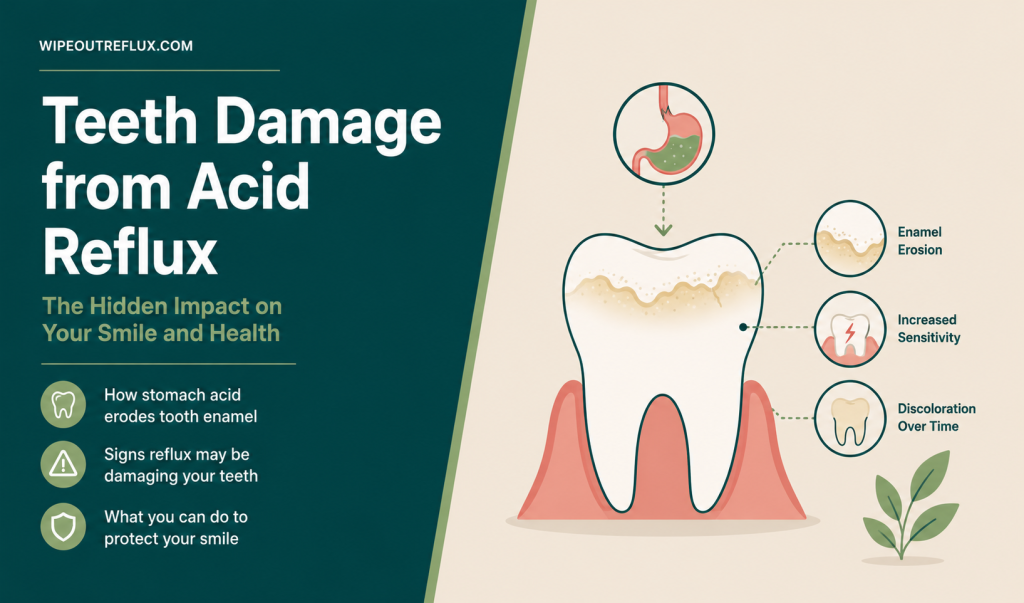
Yes — acid reflux can damage your teeth, and it does so in a way that’s irreversible once enamel is gone. The damage is caused by stomach acid repeatedly contacting the tooth surface, dissolving the mineral structure of enamel through a chemical process that has nothing to do with bacteria or sugar.
What makes this particularly significant — especially for those of us with LPR (silent reflux) — is that tooth erosion can be the first visible sign that reflux is happening at all, before any throat symptoms or heartburn have developed. Dentists are frequently the first clinicians to identify undiagnosed reflux in patients who come in with unexplained enamel wear.
This article covers the mechanism, the specific erosion pattern to watch for, what sensitivity from reflux feels like, the particular risk of silent reflux to dental health, and the practical steps that actually protect your teeth.
Key Takeaways
- A meta-analysis of 28 studies found dental erosion in approximately 51.5% of GERD patients, compared to 21.4% of controls — with an odds ratio of 5.0, meaning GERD patients are five times more likely to develop dental erosion.
- Stomach acid has a pH of 1.5–3.5 — far below the critical pH of 5.5 at which tooth enamel begins to dissolve. Each reflux event that reaches the mouth is a direct chemical attack on enamel.
- The erosion pattern from reflux is distinctive: it primarily affects the palatal (inner) surfaces of the upper front teeth and the occlusal (biting) surfaces of the lower back molars — areas that dietary acid erosion doesn’t typically reach.
- Pepsin — the digestive enzyme in gastric reflux — removes the protective protein pellicle coating from tooth surfaces, compounding the acid damage.
- Acid reflux teeth sensitivity occurs when enamel loss exposes the dentine layer, which contains microscopic tubules connected to the nerve.
- Sleep-related reflux is the most dangerous period for teeth — saliva production drops dramatically overnight, and the supine position allows acid to pool against tooth surfaces for longer.
- Brushing immediately after a reflux episode worsens damage. The acid-softened enamel must be allowed to remineralise first — waiting 30–60 minutes before brushing is the correct protocol.
- For people with silent reflux, unexplained dental erosion in the characteristic pattern may be the first indication that reflux is occurring at all.
Can Acid Reflux Damage Your Teeth?
The evidence here is definitive. A meta-analysis published in 2022 pooled data from 28 studies involving 4,379 people and found that the prevalence of dental erosion was 51.5% in GERD patients, compared to 21.4% in healthy controls. The pooled odds ratio was 5.0, meaning GERD patients were five times more likely to have dental erosion than people without reflux — even after accounting for other variables [Yanushevich OO et al., Dentistry Journal, 2022].
A separate systematic review of 15 studies concluded there is a strong association between dental erosion and GERD in adults, and recommended that early diagnosis and treatment of refluxed acid — through both lifestyle changes and medication — can prevent further tooth damage and loss [Firouzei MS et al., Dental Research Journal, 2012].
An overview of systematic reviews confirmed that GERD constitutes a meaningful risk factor for erosive tooth wear, with a positive association across the body of evidence [Lechien JR et al., Journal of Dentistry, 2023].
The damage is irreversible. Enamel doesn’t regenerate. Once it’s dissolved, the surface is gone — and restoring it requires dental intervention. This is why understanding the mechanism and the protective measures matters so much.
How Acid Reflux Causes Tooth Erosion — The Mechanism
Tooth enamel is the hardest substance in the human body, composed of a dense lattice of hydroxyapatite crystals. But it has one critical vulnerability: acid. When the pH in the mouth drops below approximately 5.5, hydroxyapatite crystals begin to dissolve — a process called demineralisation. At pH 5.5 or lower, enamel loses more mineral than saliva can replace.
Stomach acid sits at a pH of 1.5 to 3.5. This is vastly more acidic than the threshold at which enamel begins to dissolve, and dramatically more acidic than any dietary acid source. When gastric contents reach the mouth — even briefly, even in small amounts — the chemical attack on enamel is immediate [Lazarchik DA & Frazier KB, General Dentistry, 2009].
Two agents do the damage:
- Hydrochloric acid (HCl) — the primary component of stomach acid. It dissolves the hydroxyapatite crystal structure layer by layer, beginning with the prism sheath area and progressing inward. The early stages produce a honeycomb-like softening of the enamel surface; as this progresses, bulk material is lost.
- Pepsin — the digestive enzyme present in gastric reflux. Pepsin removes the protective protein pellicle that coats tooth surfaces, stripping away one of the teeth’s natural defences against acid attack. Sleep-related reflux is particularly damaging because in the supine position, acid migrates more easily to the upper esophagus and mouth, and simultaneously, normal saliva production is dramatically reduced overnight — removing the body’s primary acid-buffering and clearance mechanism [Rogers JR & Scher AL, Gastroenterology Research and Practice, 2011].
Saliva plays a crucial protective role under normal circumstances — it’s alkaline, and it continuously bathes the teeth with bicarbonate that neutralises acids and calcium and phosphate ions that help remineralise enamel. But chronic reflux overwhelms saliva’s capacity to neutralise, especially during sleep when production is lowest. This is why reflux-related dental damage accumulates most aggressively in people with nocturnal reflux — something worth being aware of if nighttime symptoms are part of your picture. The best sleeping position for silent reflux matters here for reasons beyond just throat comfort.
Signs of Acid Reflux on Teeth — What to Look For
The location of the erosion is the key distinguishing feature between reflux-related dental damage and erosion from dietary sources. Understanding the pattern is clinically important — and it’s genuinely useful to know what to look for yourself.
The Classic Reflux Erosion Pattern
Reflux-related dental erosion has a characteristic distribution that differs from the damage caused by acidic drinks or foods. Dietary acids typically cause erosion on the outer (labial/buccal) surfaces of teeth — the side that faces the cheeks and lips — because that’s where the acid contacts first when drinking.
Reflux erosion presents differently. Because regurgitated acid comes from behind, pooling on the tongue and washing against the inner surfaces of the teeth, it primarily affects:
- The palatal surfaces of the upper front teeth — the inner surfaces (facing the roof of the mouth) of the maxillary incisors and canines. This is the characteristic site of intrinsic acid erosion and is the area most accessible to rising gastric contents.
- The occlusal (biting) surfaces of the upper back teeth — the chewing surfaces of the upper molars, which can show cupping (dished-out lesions in the cusps) as enamel dissolves from the top down.
- The occlusal and lingual surfaces of the lower back teeth — because of how the tongue rests, the biting surfaces and inner faces of lower molars are also frequently exposed.
The palatal erosion pattern in particular is so specifically associated with reflux that it prompted a key research finding: a study of 36 patients with palatal dental erosion of unclear cause found that gastroesophageal reflux was strongly associated with the pattern — including in patients who had no symptoms of reflux at all [Bartlett DW et al., British Dental Journal, 1996].
Early to Advanced Signs of Erosion
The progression of reflux-related dental erosion follows a recognisable pattern:
- Early: Loss of surface gloss — affected areas look slightly duller than surrounding enamel. A slight yellowing may appear as the white enamel layer thins and the underlying yellow dentine begins to show through. Teeth may look slightly more translucent at the edges.
- Moderate: Visible flattening or rounding of biting edges and cusp tips. Cupping lesions visible on the occlusal surfaces of molars. Increased tooth sensitivity to temperature, sweetness, and pressure. Fillings may appear to “stand proud” of the surrounding tooth surface as enamel wears away while the restoration remains.
- Advanced: Significant reduction in tooth height — the vertical dimension of the bite closes. Edges of front teeth may appear chipped, cracked, or worn smooth. Severe sensitivity. Loss of natural tooth shape. At this stage, extensive restorative treatment is typically required.
Acid Reflux and Tooth Sensitivity
Tooth sensitivity from acid reflux is one of the earlier and more noticeable signs that enamel has been compromised. It happens because enamel erosion exposes the underlying dentine — a porous layer of calcified tissue that contains thousands of microscopic tubules running directly toward the nerve of the tooth. When these tubules are exposed, external stimuli — cold air, cold water, sweet foods, acidic foods — cause a sharp, transient pain response.
This is different from sensitivity caused by gum recession (which is more localised) or from cavities (which produces a deeper, more sustained pain). Reflux-related sensitivity tends to be generalised across multiple teeth, particularly affecting the palatal surfaces of upper front teeth and the biting surfaces of back teeth — following the same pattern as the erosion itself.
The sensitivity can also fluctuate with reflux activity. During periods of more frequent or more severe reflux — such as after dietary triggers or periods of high stress — sensitivity often worsens as acid exposure increases. Managing the underlying reflux is the most important long-term intervention; surface desensitising agents provide symptomatic relief but don’t address the cause.
Silent Reflux and Teeth — When Dental Erosion Is the First Sign
For those with LPR, the dental picture is particularly important — and particularly under-recognised.
In classic GERD, patients typically know they have reflux: heartburn, regurgitation, and an acid taste are hard to miss. But in silent reflux (LPR), reflux reaches the throat and mouth without causing the classic esophageal symptoms. The patient may have no heartburn whatsoever. What they may notice — or what their dentist notices — is unexplained erosion in the characteristic pattern.
A case series published in the Journal of the American Dental Association described a 30-year-old man presenting with enamel erosion on the occlusal surfaces of his posterior teeth and the palatal surfaces of his maxillary front teeth — with no history of gastrointestinal disease or heartburn. Dental examination led to the diagnosis of silent GERD. The authors concluded that enamel erosion may be a clinical sign of silent GERD that allows the dentist to make the initial diagnosis [Rodriguez DL et al., Journal of the American Dental Association, 2002].
A systematic review covering the oral implications of both GERD and LPR confirmed higher prevalence of dental erosion and caries in reflux patients compared to healthy individuals, and noted that in patients without classic heartburn symptoms, dental findings may precede any other diagnosis [Lechien JR et al., PLOS ONE, 2020].
This means that if you have unexplained tooth erosion in the palatal/occlusal pattern — particularly without obvious dietary causes — it’s worth discussing LPR specifically with your dentist or GP. The complete guide to LPR covers the full range of silent reflux symptoms that may be present alongside the dental findings. The Peptest is also one way to check whether pepsin is reaching the mouth and throat, which would confirm an active reflux contribution.
The takeaway for anyone managing LPR is that protecting your teeth isn’t just a cosmetic priority — it’s a window into how much acid and pepsin is reaching your upper digestive tract, and how aggressively you need to manage the reflux itself.
How to Protect Your Teeth from Acid Reflux
Several of these steps are counterintuitive, which is why they’re worth being explicit about.
1. Do Not Brush Immediately After Reflux
This is the most important and most frequently misunderstood point. When acid contacts your teeth, it temporarily softens the enamel surface. If you brush within this window, the abrasive action of toothpaste physically scrapes away softened mineral that hasn’t yet had the chance to remineralise. You cause more damage by brushing, not less.
Wait at least 30–60 minutes after a reflux episode before brushing. During this window, saliva gradually neutralises the acid and begins the remineralisation process. This applies after nighttime reflux in particular — if you’ve had nocturnal reflux, brushing immediately in the morning is the wrong approach.
2. Rinse Immediately with Water or Baking Soda Solution
While you’re waiting to brush, the right immediate action is rinsing — not brushing. Plain water dilutes and helps clear residual acid from tooth surfaces. A weak baking soda solution (half a teaspoon of bicarbonate of soda in a glass of water) actively neutralises acid, raising the oral pH faster. This is the one immediate step you should take after a reflux episode.
3. Use Fluoride Toothpaste and Consider Professional Fluoride Treatment
Fluoride is the most evidence-supported enamel protectant available. It works by substituting into the hydroxyapatite crystal structure of enamel to form fluorapatite — a significantly more acid-resistant mineral. Regular brushing with fluoride toothpaste strengthens and re-hardens softened enamel, offering meaningful protection against ongoing acid exposure [D’Agostino S et al., Dentistry Journal, 2025].
For people with active reflux-related erosion, a dentist can prescribe higher-concentration fluoride gels or provide professional fluoride varnish applications — a level of protection beyond what over-the-counter toothpaste provides. A soft-bristled toothbrush and gentle technique are essential alongside this — hard brushing on acid-softened enamel causes additional damage.
4. Chew Sugar-Free Gum After Meals and Reflux Episodes
Chewing sugar-free gum stimulates saliva flow — the most natural acid-buffering and remineralisation mechanism available. Saliva contains bicarbonate, calcium, and phosphate ions that raise oral pH and supply the minerals needed to remineralise softened enamel. Chewing gum containing xylitol has an added benefit of reducing the bacterial load that contributes to caries. 10–20 minutes of chewing after meals or reflux episodes is a practical, low-effort intervention.
5. Address Nighttime Reflux Specifically
Because saliva production drops to near-zero during sleep, nocturnal reflux causes disproportionate dental damage — acid pools against tooth surfaces for extended periods without saliva to neutralise it. Practical interventions include: eating at least 3 hours before lying down, elevating the head of the bed (not just pillows), sleeping on the left side, and using Gaviscon Advance before bed to create an alginate raft that prevents acid from escaping the stomach. These are discussed in more depth in the guide on acid reflux at night.
6. Treat the Reflux Itself
The most impactful long-term dental protection is reducing the frequency and volume of acid reaching your mouth in the first place. Dietary management — avoiding the foods and drinks that most reliably trigger reflux — directly reduces acid exposure to your teeth. The LPR foods to avoid guide covers this, and for daily choices it pairs with the foods that are safe on an LPR diet.
7. See Your Dentist Regularly and Tell Them About Your Reflux
If you have confirmed GERD or LPR, your dentist should know. Regular monitoring allows early erosion to be identified before it becomes severe, protective measures can be put in place (custom fluoride trays, monitoring, and if needed, dental bonding or other protective restorations), and your dentist can distinguish reflux-related erosion from other causes — ensuring you get the right treatment.
Frequently Asked Questions
Can acid reflux cause cavities as well as erosion?
Yes — both. Dental erosion (the direct chemical dissolution of enamel by acid) and dental caries (tooth decay from bacterial acid production in plaque) are both more prevalent in GERD patients than in healthy controls. The two processes can compound each other: erosion removes the protective enamel layer, making the underlying dentine more vulnerable to bacterial decay. Maintaining good oral hygiene alongside managing reflux is important for both reasons.
Can the enamel grow back after acid reflux damage?
No — enamel cannot regenerate. Once it’s dissolved, it’s gone permanently. However, active erosion can be halted by addressing the reflux and using fluoride, and dentine that’s been exposed can be desensitised and protected. For significant enamel loss, dental restoration (bonding, veneers, or crowns depending on severity) is the option for restoring tooth function and appearance.
How do I know if my tooth erosion is from reflux or from acidic food and drink?
The location is the main distinguishing feature. Dietary acid erosion tends to affect the outer (buccal/labial) surfaces of teeth — the side facing the lips and cheeks — because that’s where acidic drinks contact first. Reflux erosion primarily affects the inner (palatal) surfaces of the upper front teeth and the biting surfaces of the back teeth. If erosion is visible on the palatal surfaces without an obvious dietary explanation, reflux should be investigated — even if you have no other reflux symptoms.
Is teeth sensitivity always a sign of acid reflux damage?
Not always — sensitivity has several causes including gum recession, cracks, decay, and recently placed dental work. But if you have reflux and you’re experiencing widespread generalised sensitivity — particularly on the inner surfaces of upper teeth and the biting surfaces of back teeth — reflux-related enamel erosion is worth considering. Your dentist can assess the pattern and confirm the most likely cause.
How quickly does acid reflux damage teeth?
Dental erosion from reflux develops over months to years of repeated acid exposure rather than from isolated events. The rate depends on reflux frequency, how often acid reaches the mouth, nighttime vs daytime pattern, saliva quality and flow, and whether protective measures are in place. People with poorly controlled GERD or LPR for several years, particularly with nocturnal reflux, are at highest risk of significant erosion. This is another reason managing reflux aggressively from the outset matters beyond just comfort.
Should I use a specific toothpaste for acid reflux teeth damage?
A fluoride toothpaste is the core recommendation — look for toothpastes containing at least 1,450 ppm fluoride (standard adult formulation in the UK). Some products contain additional enamel-strengthening agents such as hydroxyapatite or CPP-ACP (casein phosphopeptide–amorphous calcium phosphate) which support remineralisation. Avoid highly abrasive whitening toothpastes if you have known enamel erosion, as abrasion compounds acid-related loss. A soft-bristled brush with gentle technique is as important as the paste itself.
Conclusion
Acid reflux and dental damage are more closely connected than most people — and many clinicians — fully appreciate. Stomach acid is dramatically more corrosive than any dietary acid, and each time it reaches the teeth it dissolves enamel through a direct chemical attack that leaves no opportunity for repair. The damage is silent in the early stages, irreversible once advanced, and particularly insidious in people with LPR who may have no heartburn or esophageal symptoms to alert them.
The palatal and occlusal erosion pattern is specific enough that unexplained dental erosion in these locations — without obvious dietary causes — should prompt investigation for reflux, even in people who feel fine. Dentists are frequently the first to make this connection, and it’s a connection worth actively looking for.
Protecting your teeth from reflux damage requires both dental hygiene discipline — particularly the counterintuitive step of not brushing after a reflux episode — and meaningful management of the reflux itself. Diet is the most powerful lever for reducing acid exposure. The Wipeout Food Reference Guide covers which foods and drinks are reflux-safe and which to avoid, with pH values to guide daily decisions. For the complete integrated approach to managing LPR and GERD — covering the dietary strategy, lifestyle factors, and the mechanisms of tissue recovery — the Wipeout Diet Plan covers everything in full.
Research and References
- A meta-analysis of 28 studies involving 4,379 people found dental erosion in 51.5% of GERD patients versus 21.4% of controls, with a pooled odds ratio of 5.0 — confirming GERD patients are five times more likely to develop dental erosion. [Yanushevich OO et al., Dentistry Journal, 2022]
- A systematic review of 15 studies found a strong association between dental erosion and GERD in adults; early diagnosis and treatment of acid reflux can prevent further tooth damage and loss. [Firouzei MS et al., Dental Research Journal, 2012]
- A systematic review covering reflux and dental disorders found a higher prevalence of dental erosion and caries in GERD and LPR patients compared with healthy individuals, supporting a positive association. [Lechien JR et al., PLOS ONE, 2020]
- A dental overview confirmed that the pH of stomach acid is far below the critical enamel dissolution threshold of pH 5.5; dentists must maintain a high index of suspicion for reflux-induced erosion when patients display characteristic patterns of unexplained enamel wear. [Lazarchik DA & Frazier KB, General Dentistry, 2009]
- Sleep-related GERD is particularly damaging to teeth because the supine position facilitates acid migration and saliva production is minimal; pepsin in refluxate removes the protective dental pellicle, compounding acid erosion. [Rogers JR & Sher AL, Gastroenterology Research and Practice, 2011]
- A study of 36 patients with palatal dental erosion of unclear origin found gastroesophageal reflux strongly associated with the erosion pattern even in those without reflux symptoms, establishing the link between palatal erosion and occult reflux disease. [Bartlett DW et al., British Dental Journal, 1996]
- A case report published in JADA described a patient presenting with classic palatal and occlusal erosion and no GI symptoms; the dental erosion led to the first diagnosis of silent GERD, confirming that enamel erosion may precede all other signs of reflux disease. [Rodriguez DL et al., Journal of the American Dental Association, 2002]
- A narrative review of erosive tooth wear and GERD management confirmed that fluoride substitutes into hydroxyapatite crystals to form acid-resistant fluorapatite; fluoride application is the primary preventive and remineralising intervention for reflux-related dental erosion. [D’Agostino S et al., Dentistry Journal, 2025]

David Gray
12 years living with LPR · Consultant & researcher
I've lived with LPR for twelve years — the misdiagnoses, the PPI courses that did nothing, the slow work of figuring out what actually helps. Wipeout Reflux is where I translate the research into plain terms for people stuck in the same place. Every claim here is sourced to peer-reviewed work, and I consult one-to-one with LPR sufferers.