
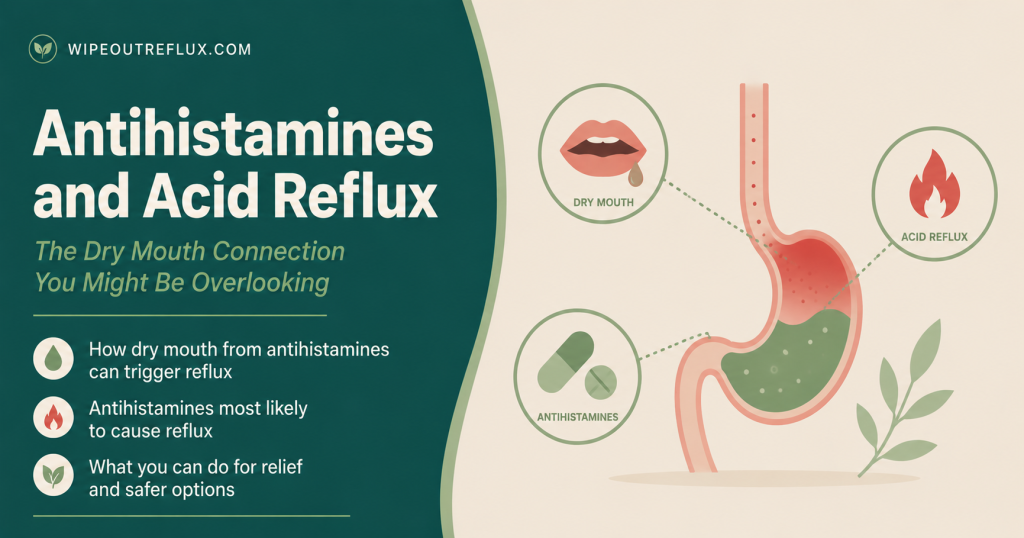
If you take antihistamines for allergies and also deal with acid reflux, you may have noticed the two seem connected — and there’s a real mechanism behind it, though it’s more subtle than “antihistamines cause reflux.” The strongest link runs through an unexpected route: dry mouth. Allergy antihistamines commonly reduce saliva, and saliva is one of your body’s most important natural defences against reflux. Less saliva means refluxed acid and pepsin linger longer in the oesophagus and throat, which can worsen symptoms even if the number of reflux episodes doesn’t change.
Before going further, there’s a crucial distinction to clear up, because the word “antihistamine” covers two completely different types of drug that do opposite things to reflux. Getting this straight is the key to the whole topic. Having managed LPR myself for over eight years, I’ve seen this confusion trip people up constantly, so let me walk through it properly.
Key Takeaways
- Two very different drugs share the name “antihistamine.” H1 antihistamines treat allergies; H2 antihistamines (like famotidine) block stomach acid and treat reflux.
- The dry mouth link is the real one. Allergy antihistamines reduce saliva, and saliva is essential for neutralising and clearing refluxed acid.
- Less saliva means slower acid clearance, so reflux sits in contact with the oesophagus and throat for longer, worsening symptoms and irritation.
- The effect on the reflux valve is mixed — the honest picture is that antihistamines don’t straightforwardly increase the number of reflux episodes.
- Dry mouth hits silent reflux (LPR) hardest, because saliva also helps clear pepsin from the throat.
- If you need allergy relief and have reflux, less-drying options and saliva-supporting habits can help — discuss the specifics with your doctor or pharmacist.
First, the confusion: two drugs called “antihistamine”
Histamine does different jobs in different parts of the body through different receptors, and the two main “antihistamine” drug classes block different ones:
- H1 antihistamines are what most people mean by “antihistamines” — the allergy and hay-fever medicines like cetirizine, loratadine, fexofenadine, and the older diphenhydramine and chlorpheniramine. They block H1 receptors to calm allergic reactions. They do not treat reflux, and this is the group linked to dry mouth.
- H2 antihistamines (H2 blockers) are a completely different tool. Histamine is one of the main triggers of stomach acid, acting on H2 receptors on the acid-producing cells to switch on the acid pump [Engevik, Kaji & Goldenring, Physiological Reviews, 2020]. Drugs like famotidine (Pepcid) block that receptor, reducing acid — so they treat reflux rather than causing it.
So “do antihistamines help or hurt reflux?” has two opposite answers depending on which you mean. H2 blockers like famotidine are an established reflux treatment — it’s worth understanding how famotidine (Pepcid) compares to Gaviscon and the alternatives to famotidine if that’s the route you’re considering. The rest of this article is about the H1 allergy antihistamines and the dry-mouth connection, because that’s the link people miss.
Why saliva matters so much for reflux
To understand the dry-mouth link, you need to appreciate just how important saliva is as an anti-reflux defence. It’s easy to overlook, but it’s doing constant, quiet work.
When reflux happens, your oesophagus clears it in two steps. First, a wave of muscular contraction sweeps out most of the refluxed liquid. But that leaves behind a thin, acidic residue that keeps the pH low — and that residue is neutralised by swallowed saliva, which is alkaline and rich in bicarbonate. In a landmark study, researchers showed that stimulating saliva shortened the time it took to clear acid from the oesophagus, while aspirating saliva from the mouth abolished acid clearance almost entirely [Helm et al., New England Journal of Medicine, 1984].
In other words, without saliva, refluxed acid just sits there. Saliva does several protective jobs at once: it buffers acid with bicarbonate, it carries the swallowing wave that clears the oesophagus, it dilutes pepsin (the damaging enzyme in reflux), and it delivers growth factors that help repair the lining. It’s a genuinely important part of your defence against reflux — which is exactly why reducing it matters.
How antihistamines dry you out
Here’s where allergy antihistamines come in. Saliva production is controlled largely by the parasympathetic nervous system acting on muscarinic receptors in the salivary glands. Many antihistamines — especially the older, first-generation ones — have anticholinergic (antimuscarinic) activity, meaning they block those receptors. Drugs with anticholinergic activity against the M3 muscarinic receptor are, in fact, the most common cause of reduced salivation [Scully, Oral Diseases, 2003].
Put the two facts together and the link is clear. An allergy antihistamine reduces your saliva; less saliva means the acid residue from reflux isn’t neutralised and cleared as efficiently; so refluxed acid and pepsin stay in contact with your oesophagus and throat for longer. Even if you’re not refluxing more often, each episode does more because your natural clean-up system has been turned down. That’s the dry-mouth–reflux connection in a nutshell, and it’s the most solid part of the whole picture.
An honest caveat: it’s not simply “more reflux”
I want to be straight about the evidence here, because a lot of health content oversimplifies it. You’ll often read that anticholinergic drugs worsen reflux by relaxing the valve at the top of the stomach and slowing digestion. There’s some truth to the mechanism, but the reality is more complicated.
When researchers gave atropine (a strong anticholinergic) to normal subjects, it did lower the pressure in the lower oesophageal valve — yet it actually reduced the frequency of reflux, because it also suppressed the transient valve relaxations that are the main trigger for reflux in the first place [Mittal, Holloway & Dent, Gastroenterology, 1995]. So the effect of anticholinergic drugs on how often you reflux is genuinely mixed and not straightforward.
This is why I’d frame the antihistamine–reflux link primarily around saliva and acid clearance, rather than claiming these drugs make you reflux more. The cleanest, best-supported issue is that dry mouth leaves refluxed material sitting longer — which matters most for symptoms and for tissue irritation, especially in the throat.
Why this hits silent reflux (LPR) hardest
For those of us dealing with throat-based symptoms, the dry-mouth problem is especially relevant. LPR (silent reflux) is driven less by acid volume and more by pepsin reaching the sensitive tissues of the throat and voice box, where even small amounts cause trouble. Saliva is part of what keeps those tissues moist and helps wash pepsin away, so a drier mouth and throat removes a layer of protection right where LPR does its damage. This is also why understanding how to neutralise pepsin in the throat matters so much for silent reflux.
There’s a second, sneakier issue worth flagging. Plenty of people take antihistamines for symptoms they assume are allergic — post-nasal drip, chronic throat clearing, a persistent cough — when the real cause is actually LPR. In that situation the antihistamine not only fails to fix the problem, it may quietly make it worse by drying the throat further. If your “allergy” throat symptoms never fully respond to antihistamines, silent reflux is well worth considering.
Not all antihistamines are equally drying
An important practical point: the anticholinergic (drying) effect varies a lot between antihistamines. The older, first-generation ones — diphenhydramine, chlorpheniramine, hydroxyzine — have the strongest anticholinergic activity and are the most drying. The newer, second-generation antihistamines — loratadine, fexofenadine, cetirizine — are generally far less anticholinergic, though they can still cause some dryness in sensitive people.
So if you have reflux and need allergy relief, the choice of antihistamine isn’t trivial. This is exactly the kind of thing worth discussing with your doctor or pharmacist, who can help you pick an option that manages your allergies with the least drying effect.
What to actually do about it
I’m not a doctor, so treat this as a framework for a conversation with yours rather than a set of instructions — and never stop or switch a prescribed medication without advice.
Know which “antihistamine” you’re dealing with. If it’s an H2 blocker like famotidine, it’s a reflux treatment. If it’s an H1 allergy antihistamine, the dry-mouth considerations below apply.
Favour less-drying allergy options. If you need an antihistamine for allergies and have reflux, a second-generation option is usually less drying than an older first-generation one. Ask your pharmacist — they’re well placed to advise on this.
Support your saliva. Staying well hydrated and stimulating saliva can help offset dryness. Chewing gum is a simple, evidence-friendly trick that boosts saliva flow and swallowing, which aids acid clearance — I’ve written more about chewing gum for acid reflux.
Question the diagnosis if antihistamines aren’t working. If you’re taking allergy medication for throat clearing, post-nasal drip or a chronic cough that never quite resolves, consider whether silent reflux might be the real driver — and worth investigating rather than reaching for more antihistamines.
Keep the fundamentals going. Meal timing, portion size and protecting the throat from pepsin still do most of the day-to-day work, whatever else is going on.
Frequently Asked Questions
Do antihistamines cause acid reflux?
Allergy (H1) antihistamines don’t straightforwardly cause more reflux, but they can worsen reflux symptoms indirectly by causing dry mouth. Since saliva is essential for neutralising and clearing refluxed acid, reduced saliva lets acid and pepsin linger longer, increasing irritation. H2 antihistamines like famotidine are the opposite — they reduce acid and treat reflux.
What’s the difference between H1 and H2 antihistamines?
H1 antihistamines (cetirizine, loratadine, diphenhydramine and similar) treat allergies and can cause dry mouth. H2 antihistamines, or H2 blockers (famotidine, and formerly ranitidine), block histamine’s effect on the stomach’s acid-producing cells and are used to reduce acid and treat reflux. They share a name but do very different jobs.
How does dry mouth make reflux worse?
Saliva neutralises the acidic residue left in the oesophagus after reflux and carries the swallowing wave that clears it. It also dilutes pepsin and helps protect the lining. When saliva is reduced, refluxed acid and pepsin stay in contact with the tissue for longer, so each reflux episode causes more irritation and symptoms even if you’re not refluxing more often.
Which antihistamines cause the most dry mouth?
The older, first-generation antihistamines — diphenhydramine, chlorpheniramine and hydroxyzine — have the strongest anticholinergic activity and are the most drying. Second-generation options like loratadine, fexofenadine and cetirizine are generally much less drying, though sensitive individuals may still notice some dryness.
Can antihistamines make silent reflux (LPR) worse?
They can, in two ways. Dry mouth and throat remove saliva’s protective clearing of pepsin from the sensitive throat tissues where LPR does its damage. And people sometimes take antihistamines for throat clearing or post-nasal drip that is actually LPR, so the drug fails to help and may worsen the dryness. Persistent “allergy” throat symptoms that don’t respond are worth reassessing.
Should I stop taking antihistamines if I have reflux?
Not without advice. If you need allergy relief, the better move is usually to choose a less-drying second-generation option and support your saliva, rather than going without. Discuss the specifics with your doctor or pharmacist, especially before stopping or switching any medication.
Does chewing gum help with antihistamine dry mouth and reflux?
It can help on both fronts. Chewing sugar-free gum stimulates saliva flow and increases swallowing, which supports the acid-clearing that dry mouth compromises. It’s a simple, low-risk habit that works with your body’s natural reflux defences rather than against them.
The bottom line
The link between antihistamines and acid reflux is real, but it’s not the crude “these drugs cause reflux” story you’ll often see. The key is the dry-mouth connection: allergy (H1) antihistamines reduce saliva, and saliva is one of your body’s most important defences against reflux — neutralising acid, clearing it from the oesophagus, and washing pepsin from the throat. Turn that defence down and refluxed material lingers longer, doing more damage, especially in silent reflux. Meanwhile, H2 antihistamines like famotidine are a completely different tool that actually treats reflux, which is why keeping the two straight matters so much.
As always with reflux, the real lesson is that it’s rarely about a single villain. Acid, pepsin, saliva, motility and the medications you take all interact, and lasting relief comes from understanding the whole system rather than fixating on one piece. That’s the thinking behind the Wipeout Diet Plan: a structured, pepsin-aware approach that calms reflux and gives your throat and oesophagus the conditions they need to heal, while you sort out contributing factors like drying medications alongside it. It’s the complete, in-depth system I wish I’d had when I started.
For a practical foundation, the Wipeout Food Reference Guide is the essential companion — it lays out exactly which foods and drinks are safe for acid reflux and LPR along with their pH values, so you can make confident choices from day one. Pair that with an understanding of how everyday medications affect your saliva and your reflux, and you’re addressing the real problem rather than treating a symptom while missing its cause.
References
- Helm et al., New England Journal of Medicine, 1984 — Landmark study showing esophageal acid is cleared in two steps, with swallowed saliva neutralising the residual acid; stimulating saliva sped clearance while aspirating saliva abolished it.
- Scully, Oral Diseases, 2003 — Review identifying drugs with anticholinergic activity against the M3 muscarinic receptor, including antihistamines, as the most common cause of reduced salivation.
- Mittal, Holloway & Dent, Gastroenterology, 1995 — Found that atropine lowered lower oesophageal sphincter pressure but reduced reflux frequency by suppressing transient sphincter relaxations, showing the anticholinergic effect on reflux is not straightforward.
- Engevik, Kaji & Goldenring, Physiological Reviews, 2020 — Account of parietal cell physiology showing histamine drives gastric acid via the H2 receptor, the target of H2-blocker reflux medications such as famotidine.

David Gray
12 years living with LPR · Consultant & researcher
I've lived with LPR for twelve years — the misdiagnoses, the PPI courses that did nothing, the slow work of figuring out what actually helps. Wipeout Reflux is where I translate the research into plain terms for people stuck in the same place. Every claim here is sourced to peer-reviewed work, and I consult one-to-one with LPR sufferers.