
If you’ve been searching for something you can actually do — beyond medication and diet — to help acid reflux, breathing exercises are one of the few natural interventions backed by proper clinical trials. Not wellness speculation. Actual randomised controlled studies showing measurable reductions in acid exposure, improved quality of life, and reduced reliance on proton pump inhibitors.
The reason this works isn’t mystical. The diaphragm — your primary breathing muscle — physically wraps around the lower oesophageal sphincter (LES) and acts as an external clamp on the valve that keeps stomach contents down. It can be trained like any other muscle. And when you train it through consistent diaphragmatic breathing practice, you strengthen the anti-reflux barrier at its source.
This article covers the mechanism, the evidence, the protocol, and — crucially — the specific angle for those of us dealing with silent reflux and LPR, where this technique carries an added layer of importance.
Key Takeaways
- The crural diaphragm wraps around the lower oesophageal sphincter and functions as an external clamp — making it a trainable part of the anti-reflux barrier.
- A landmark RCT found that diaphragmatic breathing training significantly reduced oesophageal acid exposure and quality-of-life scores, and cut PPI use by roughly 75% over 9 months in those who continued practising.
- A Mayo Clinic RCT demonstrated that post-meal diaphragmatic breathing roughly halved oesophageal acid exposure in the two-hour window after eating by increasing the pressure gap between the LES and the stomach.
- Diaphragmatic breathing has also been shown to reduce supragastric belching — a significant driver of PPI-refractory reflux symptoms that most patients aren’t even aware of.
- The basic protocol is straightforward: slow nasal inhale expanding the abdomen, longer pursed-lip exhale (4 counts in, 6 out), practised for 5–10 minutes several times daily, especially post-meal.
- For LPR and silent reflux, the benefit is double: fewer reflux events means less pepsin depositing on the throat, and the vagal relaxation effect helps calm the stress component that often worsens LPR.
- Breathing exercises work best as adjunctive therapy alongside diet and lifestyle changes, not as a standalone replacement for other treatment.
- Consistency over weeks matters more than session length — the diaphragm adapts and strengthens with regular practice, just as any skeletal muscle does.
Why the Diaphragm Matters for Acid Reflux
Most people think of the lower oesophageal sphincter as a simple valve — either open or closed. The reality is more interesting. The LES has two components: the intrinsic smooth muscle sphincter of the oesophagus itself, and the crural diaphragm, which surrounds the oesophagus at the gastro-oesophageal junction and acts as an external reinforcing clamp.
During normal inspiration, the crural diaphragm contracts and increases LES pressure — adding a squeeze to the barrier at precisely the moment when intra-abdominal pressure is also rising. This co-ordinated action is part of what keeps stomach contents from travelling upward. When this mechanism breaks down — due to a hiatal hernia, a weakened diaphragm, or transient LES relaxations — the anti-reflux barrier becomes incompetent and reflux follows.
The crucial insight is that the crural diaphragm is a striated muscle. Unlike the smooth muscle of the LES itself, striated muscle is under voluntary control and responds to training. This means that targeted breathing exercises genuinely can, over time, strengthen the crural component of the anti-reflux barrier — not just manage symptoms, but address one of the underlying structural vulnerabilities driving reflux.
Do Breathing Exercises Help Acid Reflux? The Evidence
This is one of the few areas where the answer moves beyond theoretical and into clinical trial territory.
The landmark study came from Eherer and colleagues, who conducted a prospective randomised controlled trial in GERD patients comparing an active diaphragmatic breathing training programme against a control group. After four weeks of training, the breathing group showed a significant decrease in time with oesophageal pH below 4.0 — a direct measure of acid exposure — alongside improved quality-of-life scores. Those who continued training for nine months showed a 75% reduction in weekly PPI use (from 98 to 25 mg/week), while those who stopped showed no lasting change [Eherer AJ et al., American Journal of Gastroenterology, 2012].
The mechanism was confirmed in a subsequent RCT from the Mayo Clinic, which found that post-meal diaphragmatic breathing significantly increased LES pressure (42.2 vs 23.1 mmHg compared to sham), reduced the number of postprandial reflux events from 2.60 to 0.36 per session, and roughly halved oesophageal acid exposure in the two-hour window after eating (from 11.8% to 5.2%). The mechanism was clear: diaphragmatic breathing widens the pressure gap between the LES and the stomach, making reflux mechanically harder [Halland M et al., American Journal of Gastroenterology, 2021].
There’s also a belching connection that most patients don’t know about. A study of 36 patients with PPI-refractory GERD and excessive belching found that most of their belches were supragastric — a behavioural reflex where air is sucked into the oesophagus and immediately expelled, generating reflux events in the process. Diaphragmatic breathing therapy reduced supragastric belching significantly: 60% of the treatment group achieved at least a 50% reduction in belching compared to none in the control group, with associated improvements in reflux symptoms and quality of life [Ong AML et al., Clinical Gastroenterology and Hepatology, 2018].
The body of evidence positions diaphragmatic breathing as one of the most evidence-supported natural interventions for reflux currently available. It’s not a replacement for medication or diet — but it is a genuine, mechanistically sound addition to a comprehensive treatment plan.
How to Do Diaphragmatic Breathing for Acid Reflux
The technique is straightforward but does require a bit of practice to do properly, especially if you’re accustomed to breathing primarily into your chest.
Getting started
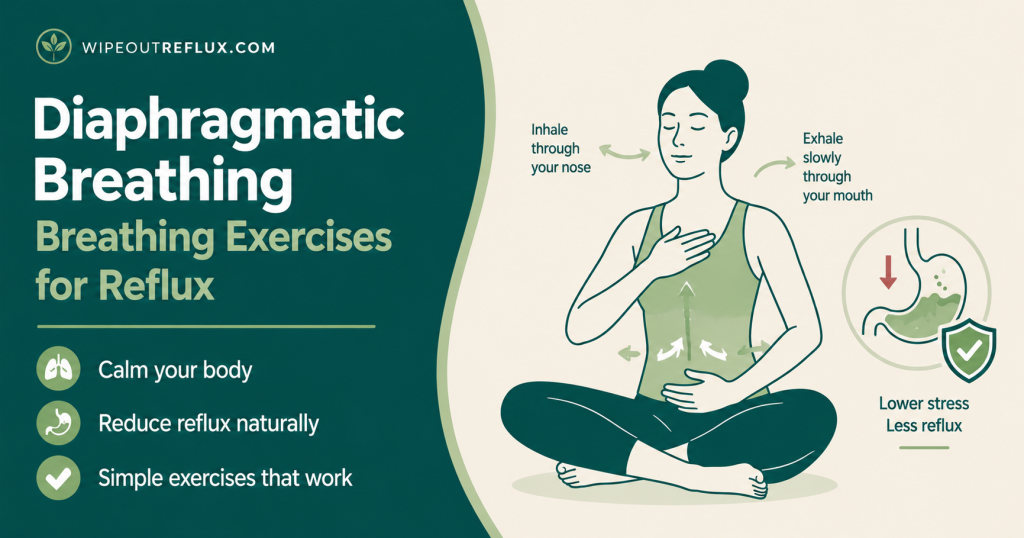
Sit comfortably upright in a chair, or lie flat on your back with knees bent. Place one hand lightly on your chest and one on your abdomen, just below your ribcage. This gives you real-time feedback on where the breath is going.
The inhale
Breathe in slowly through your nose, aiming to expand your abdomen outward rather than lifting your chest. The hand on your belly should rise; the hand on your chest should stay largely still. This is the diaphragm contracting downward and creating space for the lungs — rather than the chest wall expanding outward, which is the more shallow chest-breathing pattern most adults default to. Take 4 slow counts to inhale fully.
The exhale
Breathe out slowly through pursed lips (as if you were gently blowing out a candle). The exhale should be longer than the inhale — aim for 6 counts out. As you exhale, allow the abdomen to fall naturally inward. The longer exhale activates the parasympathetic nervous system, which has a calming effect on the gut as well as the broader stress response.
The session
Aim for 5–10 minutes per session, three to four times daily. The most important timing is after meals, when post-meal acid exposure is highest and the reflux risk is greatest. Practising for 30 minutes after eating — even in a relaxed, low-intensity way — is directly supported by the Mayo Clinic study data. Morning sessions before breakfast and an evening session are also beneficial for building diaphragmatic strength over time.
What to expect
The first few sessions may feel effortful or slightly unnatural, particularly the abdominal expansion on the inhale. This is normal. Most people find it becomes second nature within one to two weeks of consistent practice. The structural benefits — the actual strengthening of the crural diaphragm — build gradually over four to twelve weeks of consistent practice. Don’t expect dramatic changes in the first few days.
How to Strengthen the LES Naturally Through Breathing
The diaphragmatic breathing protocol above is the primary tool, but there are ways to maximise its effectiveness as a diaphragm-strengthening intervention:
- Progressive resistance: As the technique becomes comfortable, some practitioners use a light resistance device (like a breathing trainer or even breathing out through a slightly more closed pursed-lip position) to add load to the diaphragm, accelerating adaptation. This is the same principle as progressive resistance in any other muscle training.
- Combine with posture: Upright posture during practice maximises the mechanical advantage of the diaphragm on the LES. Avoid practising lying flat in the early stages.
- Consistency over intensity: The diaphragm responds to frequency of training, not just session length. Short but consistent daily practice beats occasional long sessions. Think of it like any other conditioning programme.
- Avoid eating for at least one hour before: A full stomach reduces the mechanical effectiveness of diaphragmatic movement. For training purposes, practise before meals or well after eating (not immediately post-meal).
For those whose medication alone isn’t controlling reflux, adding this kind of targeted diaphragmatic training to a structured reflux management diet addresses two of the core drivers simultaneously — acid load through diet and anti-reflux barrier competence through training.
Breathing Exercises for Silent Reflux and LPR
For those of us dealing with LPR or silent reflux rather than standard heartburn, diaphragmatic breathing carries a double benefit that makes it worth prioritising.
The first benefit is the same as for GERD: fewer reflux events. But for LPR, the stakes of each reflux event are higher. Refluxate reaching the throat deposits pepsin on laryngeal tissue, and that pepsin can be reactivated by anything even mildly acidic for hours afterward. Understanding how to neutralise pepsin in the throat is central to LPR management — but reducing how much pepsin reaches the throat in the first place is equally important. Strengthening the anti-reflux barrier through diaphragmatic training directly reduces the volume and frequency of these events.
The second benefit is the vagal and stress-response effect. Slow, controlled diaphragmatic breathing activates the vagus nerve and shifts the autonomic nervous system toward parasympathetic dominance. This matters for LPR because stress and autonomic dysregulation are genuine contributors to anxiety-driven LPR symptoms — the kind where the throat feels persistently tight, irritable, or reactive even when reflux events are relatively infrequent. The calming effect of diaphragmatic breathing on the larynx and the upper oesophageal sphincter (UES) can help reduce this hypersensitivity over time.
One important modification for LPR: be mindful of posture. Forward-slumping or lying down during practice can allow reflux to reach the upper oesophagus even during the relaxed breathing state. Keep sessions upright and ideally wait at least two hours after eating before practising lying-down breathing exercises.
Frequently Asked Questions
How long does it take for diaphragmatic breathing to help acid reflux?
Clinical trials showing significant improvements used training periods of four to nine weeks. You may notice some acute benefit — particularly the post-meal calming effect — within a few sessions, but meaningful changes in acid exposure and LES function require consistent practice over weeks to months. Treat it like a conditioning programme, not a one-off remedy.
How many times a day should I do diaphragmatic breathing for reflux?
Three to four sessions of 5–10 minutes is a reasonable daily target, with the most important timing being after meals. The Mayo Clinic study used 30-minute post-meal sessions; shorter but more frequent practice is likely comparable and more sustainable for most people. Consistency matters more than any individual session length.
Can diaphragmatic breathing replace my reflux medication?
Not as a standalone intervention for most people — but it can meaningfully reduce medication reliance when practised consistently. The Eherer RCT found a 75% reduction in PPI use over nine months in those who maintained training, which is clinically significant. The goal is to use diaphragmatic breathing as a genuine adjunctive therapy that reduces the total burden of reflux, not to abruptly stop medication.
Is diaphragmatic breathing safe if I have a hiatal hernia?
Diaphragmatic breathing is generally safe with a small hiatal hernia, and has been tested in clinical populations that include patients with non-erosive reflux and healed oesophagitis. For large hiatal hernias or significant oesophageal pathology, check with your gastroenterologist before starting a dedicated training programme, as the structural anatomy may affect how much benefit you can realistically expect.
Can diaphragmatic breathing help with throat symptoms from LPR?
Yes — through two pathways. First, reducing reflux events means less pepsin reaches the larynx, protecting against the chronic inflammation that drives throat clearing, hoarseness, and globus. Second, the vagal and parasympathetic effect helps calm the laryngeal hypersensitivity that makes LPR symptoms feel more intense even during lower-reflux periods. Combining it with a structured silent reflux treatment plan gives better results than either alone.
What is the correct technique for diaphragmatic breathing for GERD?
Sit or lie comfortably upright. Place one hand on your chest and one on your belly. Inhale slowly through your nose for 4 counts, expanding the abdomen outward while keeping the chest still. Exhale through pursed lips for 6 counts, allowing the belly to fall. Repeat for 5–10 minutes. The longer exhale than inhale is important for both the physical mechanics and the parasympathetic nervous system effect.
Does diaphragmatic breathing help with belching and bloating from reflux?
Yes — particularly for supragastric belching, which is a common but underrecognised driver of PPI-refractory reflux. Clinical research found that diaphragmatic breathing significantly reduced supragastric belching frequency, which in turn reduced the associated reflux events and symptoms. If your reflux seems out of proportion to your diet or isn’t responding well to PPIs, supragastric belching is worth considering as a contributing factor.
Conclusion
Breathing exercises for acid reflux occupy a genuinely unusual position in the reflux treatment landscape: a simple, free, low-risk intervention with real RCT backing behind it. The mechanism is sound, the evidence is solid, and the technique takes a few minutes to learn.
The honest framing is this: diaphragmatic breathing is not a cure, and it works best as part of a comprehensive approach rather than in isolation. What it offers is a way to address the anti-reflux barrier itself — not just manage the acid after reflux has already occurred. That’s a meaningful distinction when you’re trying to reduce the total burden of the condition rather than just suppress symptoms.
For anyone with LPR or silent reflux in particular, the combination of reduced reflux events and the calming effect on laryngeal hypersensitivity makes this worth prioritising alongside dietary changes. The Wipeout Diet Plan covers the full dietary and lifestyle framework for managing LPR and GERD — including how all the individual strategies fit together into a coherent approach. And for quick-reference food guidance to keep your acid load low while the diaphragmatic training builds over time, the Wipeout Essential Reflux Food List gives you the pH values and reflux safety ratings of common foods and drinks at a glance.
Start with five minutes after your main meal today. The diaphragm responds to practice — give it the opportunity to get stronger.
Research Sources
- A prospective randomised controlled trial found that active diaphragmatic breathing training significantly reduced oesophageal acid exposure by pH-metry, improved quality-of-life scores, and reduced weekly PPI use by approximately 75% over nine months in those who maintained practice; the control group showed no lasting improvement [Eherer AJ et al., American Journal of Gastroenterology, 2012].
- A Mayo Clinic randomised controlled trial demonstrated that post-meal diaphragmatic breathing increased LES pressure (42.2 vs 23.1 mmHg vs sham), reduced postprandial reflux events from 2.60 to 0.36, and roughly halved post-meal oesophageal acid exposure (11.8% to 5.2%) by widening the pressure gradient between the LES and stomach [Halland M et al., American Journal of Gastroenterology, 2021].
- In a prospective study of 36 patients with PPI-refractory GERD and excessive belching, diaphragmatic breathing therapy reduced supragastric belching and associated reflux symptoms — 60% of the treatment group achieved at least a 50% reduction in belching score compared to 0% of controls, with sustained improvements in quality of life at four-month follow-up [Ong AML et al., Clinical Gastroenterology and Hepatology, 2018].

David Gray
12 years living with LPR · Consultant & researcher
I've lived with LPR for twelve years — the misdiagnoses, the PPI courses that did nothing, the slow work of figuring out what actually helps. Wipeout Reflux is where I translate the research into plain terms for people stuck in the same place. Every claim here is sourced to peer-reviewed work, and I consult one-to-one with LPR sufferers.