
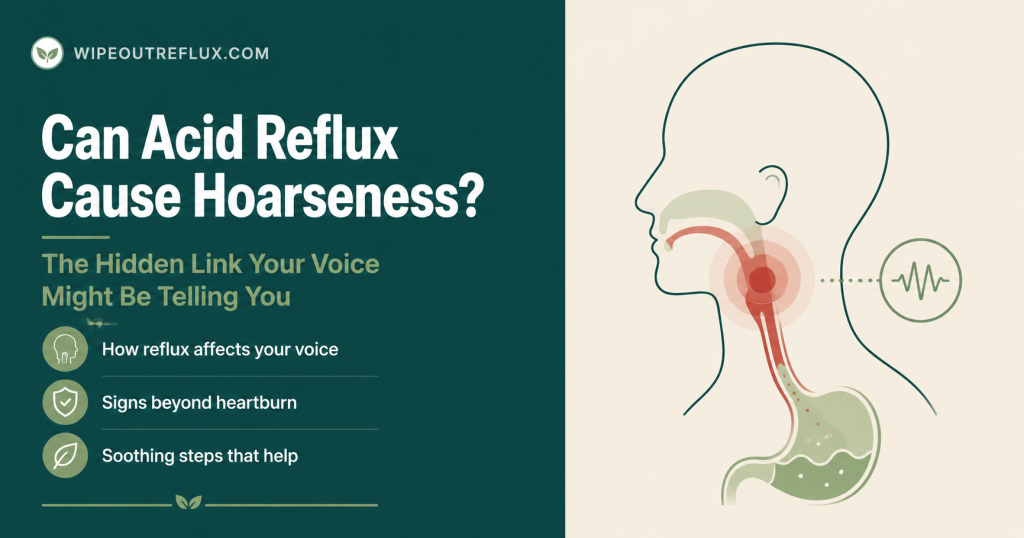
Yes — acid reflux can absolutely cause hoarseness. In fact, it’s one of the most common and frequently overlooked symptoms, particularly in people with laryngopharyngeal reflux (LPR), the type of reflux where stomach contents reach the throat and voice box rather than staying in the chest.
The hoarseness happens because stomach acid and a digestive enzyme called pepsin reach the delicate tissue of your larynx (voice box). Unlike the esophagus, which has some protection against acid, the larynx is extremely vulnerable to even small amounts of reflux exposure — and the damage adds up quickly with repeated episodes.
If you’ve noticed a rougher, raspier voice in the morning, or a voice that tires easily, reflux could well be the cause. The challenge is that many people with reflux-related hoarseness don’t have classic heartburn at all, which is why it often goes undiagnosed or misattributed to other causes like a lingering cold or vocal strain.
Key Takeaways
- Acid reflux — particularly LPR (silent reflux) — is a recognized cause of chronic hoarseness and voice changes.
- The larynx is far more sensitive to reflux damage than the esophagus, meaning even low-level reflux can cause voice problems.
- Pepsin, a digestive enzyme carried up with reflux, plays a major role in vocal cord inflammation and damage — often independently of acid.
- Hoarseness is typically worse in the morning due to nocturnal reflux pooling around the larynx during sleep.
- Up to 50–55% of people with unexplained hoarseness may have LPR as a contributing factor.
- Reflux can also cause vocal fold polyps, nodules, and contact ulcers — structural changes that cause persistent voice problems.
- PPIs alone often don’t fully resolve reflux-related hoarseness, and dietary and lifestyle changes are usually essential.
- Early identification and treatment gives the best chance of full voice recovery.
How Acid Reflux Causes Hoarseness
Your voice box — the larynx — sits at the top of your airway, just above the trachea. It contains your vocal cords (also called vocal folds), two thin strips of mucous membrane that vibrate together to produce sound. For your voice to sound clear and smooth, the vocal folds need to be free of irritation, inflammation, and swelling.
When reflux travels up past the upper esophageal sphincter (UES) and reaches the larynx, it deposits acid and pepsin directly onto this delicate tissue. The laryngeal mucosa has virtually none of the protective mechanisms that line the esophagus — it lacks the thick mucus layer and buffering capacity that the esophageal lining uses to cope with acid exposure.
The result is inflammation of the vocal folds and surrounding laryngeal tissue. Swollen, irritated vocal folds don’t vibrate normally. Instead of producing a clean, resonant sound, they produce a rough, breathy, or strained voice — what we recognise as hoarseness.
Even a small amount of reflux reaching the larynx — just two or three episodes per day — can cause significant irritation over time. This is very different from the esophagus, which can tolerate considerably more acid exposure before showing damage.
The Role of Pepsin: Why Acid Alone Isn’t the Whole Story
Most people assume it’s the stomach acid doing the damage. But research points strongly to pepsin — the digestive enzyme your stomach produces to break down proteins — as an equally important (and possibly more damaging) culprit in reflux-related hoarseness.
Pepsin travels upward with refluxate and embeds itself in laryngeal tissue. Critically, it can remain active in the throat for hours, waiting to be reactivated. If you eat or drink anything acidic — even something as mild as sparkling water or fruit juice — pepsin in the laryngeal tissue can be re-triggered, causing further damage without any additional reflux episode occurring.
Research has confirmed that laryngeal tissue is essentially resistant to damage at pH 4.0, but is significantly damaged when pepsin is present — meaning pepsin causes harm at acid levels that the larynx could otherwise tolerate [Axford et al., Laryngoscope, 2010].
Pepsin also triggers a chain of inflammatory processes in the larynx. Studies have shown it activates oxidative stress pathways and the NLRP3 inflammasome — essentially switching on an inflammatory cascade inside the laryngeal mucosa [Li et al., Laryngoscope, 2024]. This is why the irritation from reflux-related hoarseness can feel persistent and slow to resolve, even once the reflux itself is brought under better control.
You can read more about how pepsin drives throat symptoms in my detailed guide on how to neutralize pepsin in the throat.
LPR vs GERD: Which Type of Reflux Causes Hoarseness?
It’s worth being clear on this distinction, because a lot of people — and even some doctors — conflate the two.
Standard GERD (gastroesophageal reflux disease) involves acid refluxing into the esophagus and causing heartburn. Some GERD patients do get hoarseness, particularly if their reflux is severe enough to reach the throat. But the main driver of reflux-related hoarseness is LPR — laryngopharyngeal reflux.
LPR is defined by reflux reaching the larynx and pharynx. It’s sometimes called silent reflux because many people with LPR don’t have heartburn at all — the reflux travels upward rather than causing the classic burning sensation in the chest. Instead, LPR typically presents with a constellation of upper airway symptoms: chronic hoarseness, throat clearing, post-nasal drip, a feeling of a lump in the throat, chronic cough, and voice fatigue.
You can read a full breakdown of the differences in my guide on GERD vs LPR, but for hoarseness specifically, LPR is the more frequent culprit — and it’s the one that tends to be missed most often.
What Does Reflux-Related Hoarseness Feel Like?
Reflux hoarseness has a fairly recognisable pattern once you know what to look for. The voice often sounds:
- Raspy or gravelly — a rough quality even when you’re not shouting or straining
- Weaker than normal — lower volume, less projection
- Breathy — a leaky, airy quality to the sound
- Inconsistent — worse at certain times of day, then improving
- Prone to cracking or breaking, especially when speaking for extended periods
Voice fatigue is also a hallmark symptom — the voice may start the day sounding reasonably normal but deteriorates with use, or vice versa (worse in the morning and gradually improving through the day).
Many people also notice associated symptoms like constant throat clearing, a sensation of mucus or something stuck in the throat, or mild throat soreness — particularly in the morning. These often overlap with the broader LPR symptom picture.
Why Is Hoarseness Often Worse in the Morning?
Morning hoarseness is a classic sign of reflux involvement. When you lie flat during sleep, stomach contents are far more likely to migrate upward toward the larynx. There’s no gravity working in your favour, and swallowing — which normally helps clear refluxate from the esophagus — happens far less frequently during sleep.
The result is that the larynx can be exposed to prolonged low-level acid and pepsin contact overnight, and the tissue wakes up inflamed and irritated. As the morning progresses, the inflammation settles slightly and the voice improves — though it may not return fully to normal if the underlying reflux is ongoing.
This is one of the reasons elevating the head of your bed can make a meaningful difference for reflux-related hoarseness. My article on the best sleeping position for silent reflux covers this in more detail.
Can Reflux Cause Permanent Voice Damage?
If reflux-related hoarseness is left untreated for a long time, it can lead to structural changes in the vocal folds. These include:
- Vocal fold polyps — fluid-filled or fibrous growths on the vocal cords. Research has found significantly higher pepsin expression in vocal fold polyp tissue compared to healthy controls (75% vs 31.25%), strongly suggesting LPR as a causative factor [Ding et al., Otolaryngology–Head and Neck Surgery, 2017].
- Vocal fold nodules — callous-like thickenings on the vocal cords caused by repeated trauma.
- Contact ulcers and granulomas — irritation-induced lesions on the posterior larynx.
- Laryngeal inflammation — generalised redness and oedema that impairs normal vocal fold function.
Pepsin has also been found to cause oxidative DNA damage in laryngeal epithelial cells, with patients who have vocal fold polyps showing significantly higher levels of this damage when pepsin is present [Li et al., Journal of Voice, 2021]. This is a reminder that the damage isn’t just surface-level irritation — it can affect the cellular integrity of the vocal fold tissue itself.
The good news is that most reflux-related hoarseness is reversible with appropriate treatment, particularly when caught before significant structural changes have developed. Polyps and nodules, if severe, may require surgical intervention — but dietary and lifestyle changes alongside proper acid suppression can prevent things from reaching that point.
How Is Reflux-Related Hoarseness Diagnosed?
Diagnosing reflux as the cause of hoarseness is genuinely tricky, because many other things — including vocal strain, respiratory infections, postnasal drip, and thyroid issues — can cause similar voice changes. Doctors can be too quick to prescribe PPIs empirically without proper investigation, and conversely, reflux can be missed entirely when other causes are assumed. Vocal cord dysfunction is another mimic worth excluding, particularly if breathing feels tight alongside the voice change.
A proper diagnostic workup typically includes:
- Laryngoscopy — an ENT or laryngologist examines the vocal folds and laryngeal structures directly. Signs of LPR include redness, swelling of the posterior larynx, and changes to the interarytenoid area.
- Reflux Symptom Index (RSI) — a validated questionnaire covering the nine most common LPR symptoms. A score above 13 is considered suggestive of LPR.
- 24-hour pH monitoring — considered the most objective test for confirming reflux reaching the laryngeal area.
- Pepsin testing — saliva or throat swab testing for pepsin is an emerging diagnostic approach.
A study tracking over 260 patients referred for persistent hoarseness found that 56% had already been prescribed PPIs before the voice clinic assessment — and 70% of those on PPIs still had persistent hoarseness and throat symptoms despite ongoing treatment [Reulbach et al., Otolaryngology–Head and Neck Surgery, 2007]. This highlights how complex reflux-related hoarseness can be, and why medication alone is rarely enough.
If you’re trying to understand whether you might have LPR specifically, the complete guide to LPR covers the full diagnostic picture.
How to Treat Hoarseness Caused by Acid Reflux
Treatment for reflux-related hoarseness is multi-layered. There’s no single magic fix — it usually takes a combination of approaches, particularly because pepsin-driven damage requires a different management strategy to acid alone.
Diet Changes
Diet is one of the most effective levers for reducing laryngeal irritation. Acidic foods and drinks are particularly problematic because they can reactivate pepsin already embedded in the throat tissue. The main priorities are:
- Avoiding high-acid foods: citrus, tomatoes, vinegar, fizzy drinks, alcohol
- Reducing fatty, fried, and processed foods that relax the lower esophageal sphincter
- Eating smaller meals and avoiding eating within 3 hours of lying down
- Favouring alkaline-leaning foods that help buffer pepsin activity
My LPR foods to avoid guide covers the main dietary triggers in detail, and the LPR foods to eat article covers safe options. The Wipeout Diet Plan pulls all of it into one structured programme, in far more depth — built around LPR, though it works just as well for GERD and heartburn.
Acid Suppression
PPIs (omeprazole, lansoprazole) and H2 blockers (famotidine) are commonly prescribed for reflux-related hoarseness. They reduce gastric acid production, which lowers the acidity of any refluxate that does reach the larynx. However, evidence for PPIs specifically resolving hoarseness is mixed, and they work less effectively against non-acid reflux and pepsin-driven damage.
If your medication isn’t resolving your symptoms, my article on acid reflux medication not working goes into why this happens and what to do about it.
Alginate Therapy (Gaviscon Advance)
Gaviscon Advance forms a physical raft on top of stomach contents, physically preventing reflux from reaching the esophagus and throat. For LPR specifically, this mechanical approach can be more effective than acid suppressants alone for hoarseness and other throat symptoms. I cover this in detail in my Gaviscon Advance guide.
Lifestyle Modifications
- Elevate the head of the bed 15–20cm
- Avoid lying down for 3 hours after eating
- Lose weight if excess weight is contributing to abdominal pressure
- Avoid tight clothing around the abdomen
- Stop smoking — smoking weakens both esophageal sphincters and dries out laryngeal mucosa
Voice Rest and Therapy
If hoarseness has persisted, some voice rest can help reduce additional mechanical irritation to already-inflamed vocal folds. For patients who have developed compensatory habits (like speaking more forcefully to overcome the hoarseness), speech therapy may be needed to address muscle tension patterns that can persist even after the reflux is managed.
Conclusion
Reflux-related hoarseness is one of the most frustrating symptoms to deal with — not least because it’s so often dismissed, misdiagnosed, or treated inadequately. The connection between acid reflux (particularly LPR) and voice changes is well-established in the research, even if it remains underappreciated in general practice.
The key insight is that this isn’t just about acid. Pepsin — the digestive enzyme that travels with reflux into the throat — is a powerful driver of vocal fold inflammation and damage, and it can continue causing harm long after a reflux episode has passed, each time it’s reactivated by anything acidic. That’s why managing your diet carefully is so central to recovery, not just a secondary consideration.
If your voice has been hoarse for more than a few weeks, and particularly if it’s worse in the mornings or accompanied by throat-clearing, a lump sensation, or post-nasal drip, it’s worth taking LPR seriously as a possible cause. An ENT assessment and proper dietary changes can make a significant difference.
If you’re looking for a structured approach to diet for LPR and reflux-related symptoms, the Wipeout Food Reference Guide is a practical starting point — it covers which foods and drinks are safe for acid reflux and LPR, along with their pH values, so you can make confident choices straight away. For a deeper, more comprehensive approach to tackling LPR and reflux from every angle, the Wipeout Diet Plan covers the full picture — from mechanism to management — in far greater detail.
Your voice matters. The sooner you treat the root cause, the better your chances of getting it back.
Frequently Asked Questions
How long does hoarseness from acid reflux last?
It depends on how long the laryngeal tissue has been exposed and whether the underlying reflux is adequately managed. For many people, voice improvements are noticeable within 4–8 weeks of consistent dietary changes and appropriate treatment. In more longstanding cases, full resolution can take several months, particularly if there has been structural change to the vocal folds.
Can GERD cause voice loss?
Complete voice loss (aphonia) from GERD alone is uncommon, but significant reflux — especially LPR — can cause severe enough laryngeal inflammation that the voice becomes very weak or breathy. More commonly, reflux causes partial hoarseness rather than total loss of voice. If hoarseness is severe or rapidly worsening, it warrants prompt ENT assessment to rule out other causes.
Why is my voice hoarse in the morning from acid reflux?
Lying flat during sleep allows reflux to pool near the larynx without gravity helping to clear it. The vocal folds then wake up swollen and irritated from overnight acid and pepsin exposure. Voice often improves gradually as the day progresses and swallowing clears the throat — but this morning-hoarseness pattern is a classic indicator that nighttime reflux is the driver.
Is reflux hoarseness the same as laryngitis?
Reflux-related hoarseness often causes a condition called reflux laryngitis — inflammation of the larynx driven by acid and pepsin exposure. It shares symptoms with laryngitis from other causes (like viral infections), which is part of why it’s often misdiagnosed. The key difference is that reflux laryngitis is chronic or recurring rather than a short-lived episode tied to illness.
Can hoarseness from reflux go away on its own?
If the trigger is a short-term reflux flare, some improvement may happen naturally. But for most people with chronic reflux-related hoarseness, the problem will persist or worsen without active dietary and lifestyle changes. The larynx keeps getting re-exposed with every reflux episode, making spontaneous resolution unlikely without addressing the root cause.
Do PPIs fix reflux hoarseness?
PPIs can help by reducing the acidity of refluxate, but they don’t stop non-acid reflux, and they don’t eliminate pepsin — which, as we’ve seen, is a major driver of laryngeal damage. Research shows that a substantial proportion of patients with reflux-related hoarseness continue to have symptoms even while on PPI therapy. A comprehensive approach including diet, alginate therapy, and lifestyle changes is usually needed.
Should I see an ENT or a gastroenterologist for reflux hoarseness?
Ideally, both. An ENT (otolaryngologist) or laryngologist can assess the vocal folds directly and identify signs of laryngeal irritation. A gastroenterologist can investigate the underlying reflux mechanism more thoroughly with pH monitoring or endoscopy. In many cases, starting with an ENT for direct laryngoscopy is the most direct path to an answer.
Research Sources
1. Laryngeal tissue sensitivity to acid and pepsin was directly compared in an excised tissue model. The study found that laryngeal mucosa is largely resistant to acid at pH 4.0 but is significantly damaged when pepsin is also present, establishing pepsin as a primary driver of laryngeal injury in LPR [Axford et al., Laryngoscope, 2010].
2. This review estimated that up to 55% of patients presenting with unexplained hoarseness have laryngopharyngeal reflux as a contributing factor. It evaluated the evidence for anti-reflux therapy in treating hoarseness and noted the need for higher quality trials [Hopkins et al., Cochrane Database of Systematic Reviews, 2006].
3. Pepsin was found to trigger inflammatory injury in the laryngeal mucosa via the ROS/NLRP3/IL-1β signalling pathway. The paper noted that approximately 50% of hoarseness cases are related to LPR, and proposed targeting this inflammasome pathway as a potential therapeutic approach [Li et al., Laryngoscope, 2024].
4. A retrospective review of over 260 voice clinic patients found that 56% had been prescribed PPIs for hoarseness, but 70% of those on PPIs continued to experience persistent hoarseness and throat symptoms — highlighting the limitations of PPI monotherapy for reflux-related voice disorders [Reulbach et al., Otolaryngology–Head and Neck Surgery, 2007].
5. Pepsin expression was significantly higher in vocal fold polyp tissue compared to healthy controls (75% vs 31.25%), supporting the role of LPR and pepsin in the development of structural vocal fold lesions [Ding et al., Otolaryngology–Head and Neck Surgery, 2017].
6. Oxidative DNA damage was found to be significantly higher in vocal fold polyp tissue from patients with detectable pepsin in their saliva, and pepsin directly caused DNA damage in laryngeal epithelial cell cultures — suggesting a mechanism for pepsin-driven long-term vocal fold injury [Li et al., Journal of Voice, 2021].
7. A review of the role of pepsin in LPR described how pepsin damages upper respiratory tract cells by disrupting carbonate anhydrase (CAIII) and the Sep 70 protective protein, initiating inflammatory changes in the larynx, nasopharynx, and nasal cavity [Kosztyła-Hojna et al., Polish Journal of Otorhinolaryngology, 2017].
8. This NIH StatPearls resource provides a comprehensive clinical overview of LPR, including its presentation with hoarseness, dysphonia, and globus sensation, and the role of acid and pepsin in damaging laryngeal mucosa and impairing mucociliary clearance [Lechien et al., StatPearls — NCBI Bookshelf, 2025].

David Gray
12 years living with LPR · Consultant & researcher
I've lived with LPR for twelve years — the misdiagnoses, the PPI courses that did nothing, the slow work of figuring out what actually helps. Wipeout Reflux is where I translate the research into plain terms for people stuck in the same place. Every claim here is sourced to peer-reviewed work, and I consult one-to-one with LPR sufferers.