
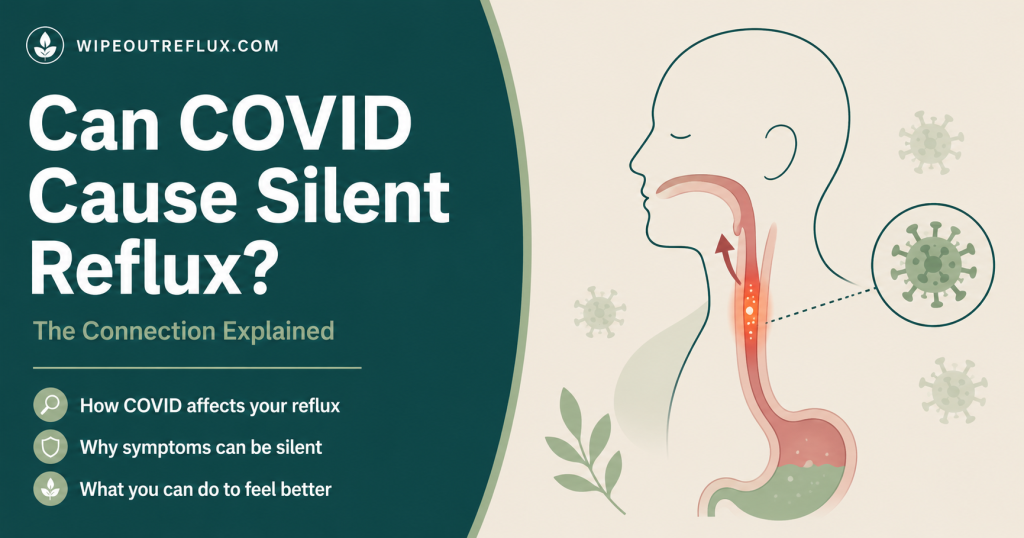
If your silent reflux symptoms started after a bout of COVID — the throat clearing, the lump-in-throat feeling, the nagging cough that just won’t quit — you’re not imagining a connection. It’s one of the most common questions I get asked, and patient forums are full of people describing exactly this pattern. The honest answer involves some genuinely fascinating biology, and also some important caveats, because the science here is still emerging rather than settled.
Let me walk you through what we actually know, where the strong mechanisms are, and what tends to help.
Can COVID cause silent reflux? A direct answer
Yes, COVID can plausibly trigger or worsen silent reflux (laryngopharyngeal reflux, or LPR) in some people, and a growing body of evidence links COVID and long COVID to new or worsening reflux symptoms. The most credible mechanism isn’t COVID magically creating acid — it’s that the virus can irritate and dysregulate the vagus nerve, which controls the valves and sensation of your throat and upper gut.
That said, it’s worth being clear-eyed: this is an area where mechanisms are well-reasoned and observational data is accumulating, but large, definitive causal studies are still catching up. What I can tell you is that the pattern you’re experiencing is real, recognised, and — importantly — not actually new to medicine. Viruses were known to trigger this kind of throat dysfunction long before COVID existed.
Key Takeaways
- COVID can plausibly trigger silent reflux, most likely by irritating the vagus nerve that controls throat valves and sensation.
- This isn’t unique to COVID. Post-viral vagal neuropathy from colds and flu has been recognised since 2001 — COVID is just a high-profile trigger.
- Long COVID involves digestive symptoms in a sizeable minority, with reflux reported in close to a third of patients at six months in some data.
- The vagus nerve is the key link. A damaged or sensitised vagus can cause chronic cough, throat clearing, globus, and reflux-like symptoms.
- Gut dysbiosis may play a role too. COVID disrupts the gut microbiome via ACE2 receptors, which could contribute to digestive symptoms.
- Post-COVID reflux often improves over months, as the nerve irritation settles — though it can be stubborn.
- Treatment focuses on calming the system: reflux management, nerve-related approaches, and time.
This isn’t new: viruses have always done this
Before we get to COVID specifically, here’s the context that makes everything else make sense — and that most articles miss.
Back in 2001, laryngologists Amin and Koufman described a condition called post-viral vagal neuropathy (PVVN). They noticed that some patients developed a cluster of stubborn throat symptoms — chronic cough, throat clearing, a breathy or tired voice, globus sensation, and yes, laryngopharyngeal reflux — that began after an upper respiratory infection and lingered long after the infection itself had cleared [[Amin & Koufman, American Journal of Otolaryngology, 2001]].
The name to note there is Koufman — the same researcher whose work underpins much of how we understand LPR today. The key insight was that a respiratory virus can either trigger or directly cause vocal fold weakness, laryngopharyngeal reflux, and neuropathic throat pain. In other words, “reflux symptoms that started after I was ill” is a pattern doctors have recognised for over two decades. COVID didn’t invent it — it just gave it a name everyone now knows, and a great many more cases.
So if you’ve had reflux symptoms since a cold or flu rather than COVID specifically, the same logic applies. I’ve written more on that broader question in can a cold cause acid reflux.
The vagus nerve: the heart of the COVID–reflux connection
To understand why a respiratory virus can leave you with reflux, you need to know one piece of anatomy: the vagus nerve.
The vagus is the long, wandering nerve that connects your brain to your throat, voice box, heart, and digestive tract. Among many other jobs, it controls the muscles and valves of your upper digestive system and carries sensation from your throat and larynx. When it works properly, it coordinates swallowing, keeps the sphincters closed when they should be, and keeps your throat’s “alarm system” appropriately calibrated.
When a virus irritates or inflames the vagus nerve, two things can go wrong. The sensory branches can become hypersensitive — firing off cough, throat clearing, tickle, and globus sensations at the slightest provocation. And the motor branches can weaken — potentially affecting how well the valves that keep stomach contents down are working. Either way, you can end up with exactly the symptom picture of silent reflux.
This isn’t hand-waving. A 2023 study using laryngeal electromyography in patients with chronic cough after COVID found objective evidence of vagus nerve neuropathy, supporting the idea that post-COVID throat symptoms can stem from genuine nerve dysfunction [[Reyes-Lillo et al., PLOS ONE, 2023]]. SARS-CoV-2 is known to be neurotropic — it can affect nerve tissue — which makes the vagus a very plausible casualty.
If your dominant symptom is throat-related rather than classic heartburn, this nerve angle is probably the most useful lens. I’ve covered the broader picture in laryngeal sensory neuropathy.
What the long COVID data actually shows
Let me give you the honest state of the evidence, because this matters.
Digestive symptoms are now well recognised as part of long COVID. Reviews consistently find that a meaningful proportion of long COVID patients experience persistent gastrointestinal symptoms, and some cohort data suggests reflux-type symptoms affect close to a third of patients in the months following infection. Larger database studies have reported that people with long COVID have an increased risk of being diagnosed with GERD and related conditions compared with matched controls.
At the same time, I want to be straight with you: the direct, high-quality causal evidence linking COVID specifically to silent reflux is still developing. Much of what exists is observational, and reflux symptoms overlap heavily with other long COVID features like cough and throat irritation, which makes clean attribution tricky. What we have is a strong, biologically coherent mechanism plus accumulating real-world data — not yet a closed case. I’d rather tell you that honestly than oversell it.
The gut microbiome angle
There’s a second mechanism worth understanding, and it ties into something I write about often: the gut.
SARS-CoV-2 enters cells by latching onto ACE2 receptors, and these receptors are densely expressed in the gastrointestinal tract — particularly the small intestine. This is why COVID causes digestive symptoms like nausea and diarrhoea in many people even early on. The relevant point for reflux is what happens afterwards: infection and the loss of normal ACE2 function can shift the gut microbiome toward dysbiosis — a depletion of beneficial bacteria and an overgrowth of less helpful ones — and this disruption can persist for months [[Clapp et al. (review), Cureus, 2024]].
Why might that matter for reflux? A disrupted gut can mean more fermentation, gas, bloating, and pressure — all of which can aggravate reflux mechanically — and there’s an established link between bacterial overgrowth and reflux symptoms. It’s a plausible contributing thread rather than the main event, but for people whose post-COVID picture includes a lot of bloating alongside the throat symptoms, it’s worth knowing about. I’ve explored the overgrowth connection in my guide to SIBO and acid reflux.
The specific symptoms people report after COVID
The post-COVID throat picture is remarkably consistent, and it maps almost perfectly onto both LPR and post-viral vagal neuropathy. People describe:
- A chronic, nagging cough that long outlasts the infection — often dry and triggered by talking, laughing, or temperature changes.
- Constant throat clearing and a feeling of something stuck.
- Globus sensation — the persistent lump-in-throat feeling.
- Excess mucus or phlegm and post-nasal drip sensations.
- Sore or raw throat without an active infection.
- Voice changes — hoarseness or vocal fatigue.
If several of these sound familiar, you’re in very common company. Each one has a deeper write-up if you want it: constant throat clearing, the globus lump-in-throat sensation, and silent reflux and post-nasal drip. The cough in particular has a strong neuropathic component after a virus — it’s often the sensitised vagus nerve firing, not just acid.
How long does post-COVID reflux last?
This is the question everyone really wants answered, and I’ll be honest that it varies a lot.
The encouraging news is that post-viral throat symptoms often improve over weeks to months as the nerve irritation gradually settles and the tissue recovers. Many people see meaningful improvement within three to six months. The frustrating news is that for some, post-viral vagal neuropathy can be stubborn and persist longer, sometimes requiring more targeted treatment.
What seems to make the difference is not letting a vicious cycle establish itself. A sensitised throat coughs and clears more, which irritates the tissue further, which sensitises it more. Breaking that loop — while also reducing any genuine reflux that’s adding to the irritation — is the practical goal.
What actually helps
Because post-COVID reflux usually involves both a nerve component and a reflux component, the most effective approach tends to address both.
Reduce genuine reflux. Even if nerve sensitisation is the main driver, any real reflux reaching your already-irritated throat will make things worse. The standard LPR toolkit applies: avoid eating within about three hours of lying down, elevate the head of your bed, reduce acidic and fatty trigger foods, and eat smaller meals. My complete guide to LPR walks through this in detail.
Calm the throat, break the cough cycle. Reducing throat clearing (sip water or swallow instead), staying well hydrated, and avoiding throat irritants gives the sensitised tissue a chance to settle.
Consider the nerve angle with a professional. For persistent neuropathic cough and throat symptoms after a virus, laryngologists sometimes use neuromodulator medications and speech therapy specifically aimed at the sensitised nerve. This is genuinely a doctor-led area, and worth raising with an ENT if symptoms are stubborn. I’m not a doctor and this isn’t medical advice — but it’s a conversation worth having.
Support gut recovery. Where bloating and digestive upset are prominent, giving your gut microbiome time and the right conditions to recover is reasonable, ideally guided by a professional.
Give it time. This is hard to hear when you’re miserable, but a great deal of post-viral throat dysfunction does resolve with patience as the nerve recalibrates.
Could it be something else?
One honest caveat. Not every throat symptom after COVID is reflux. The same symptoms can come from the lingering airway inflammation of the infection itself, from anxiety (which genuinely affects throat tension and reflux perception — see can LPR be caused by anxiety), or from straightforward post-viral cough. And persistent symptoms always deserve a proper assessment to rule out other causes. If your symptoms are severe, include difficulty swallowing or breathing, or aren’t improving, please see a doctor rather than self-managing indefinitely.
Frequently Asked Questions
Can COVID cause acid reflux that wasn’t there before?
It can contribute to new reflux symptoms, most plausibly by irritating the vagus nerve that controls your throat valves and sensation, and possibly through gut microbiome disruption. The evidence is still emerging, but the pattern of new reflux symptoms after a viral illness is well recognised and predates COVID.
Why do I have a cough and throat clearing months after COVID?
This is often post-viral vagal neuropathy — a sensitised vagus nerve firing off cough and throat-clearing reflexes long after the infection has cleared. It overlaps heavily with silent reflux, and the two often coexist. A sensitised throat tends to perpetuate its own irritation, which is why these symptoms can linger.
How long does post-COVID reflux usually last?
It varies widely. Many people improve over three to six months as the nerve irritation settles, but for some it’s more stubborn and benefits from targeted treatment. Breaking the cough-and-clear cycle and reducing genuine reflux both help speed recovery.
Does COVID damage the vagus nerve permanently?
Usually not permanently. Post-viral vagal irritation tends to be a dysfunction that recalibrates over time rather than permanent damage, which is why most people improve. Persistent cases can often be helped with professional treatment aimed at the nerve.
Can long COVID cause digestive symptoms beyond reflux?
Yes. Long COVID is associated with a range of digestive symptoms including nausea, abdominal discomfort, bloating, and altered bowel habits, thought to relate to the gut’s high ACE2 expression and resulting microbiome disruption. Reflux is one part of a broader gut picture for some people.
Is post-COVID reflux the same as regular silent reflux?
The symptoms overlap almost completely, but the driver can differ. Regular LPR is primarily about refluxate reaching the throat, whereas post-COVID symptoms often have a larger nerve-sensitisation component. The practical management overlaps a lot, but the nerve angle is more prominent after a virus.
Conclusion
So, can COVID cause silent reflux? The honest answer is: yes, plausibly, and you’re far from alone in experiencing it. The most credible explanation isn’t that COVID floods your stomach with acid, but that it can irritate and sensitise the vagus nerve that governs your throat’s valves and sensation — producing the cough, throat clearing, globus, and reflux symptoms that so many people report afterwards. This phenomenon isn’t even new: post-viral vagal neuropathy has been recognised since 2001, and COVID is simply a very common, very high-profile trigger of it. The evidence is still maturing, but the mechanism is sound and the pattern is real.
The genuinely reassuring part is that post-viral throat symptoms often improve with time as the nerve recalibrates, especially if you avoid letting the cough-and-clear cycle entrench itself and you reduce any genuine reflux that’s adding fuel. That combination — calming the nerve, calming the reflux, and giving your body time — is where recovery usually lives.
If reducing reflux is part of your path back, that’s exactly what I built the Wipeout Diet Plan to help with: a mechanism-first, step-by-step approach to calming LPR and reflux at the root rather than just masking symptoms — which matters even more when your throat is already sensitised. Because so much of it comes down to keeping acidic, reflux-triggering foods and drinks off your plate while your throat heals, it pairs naturally with the Wipeout Food Reference Guide — an essential, at-a-glance reference of which foods and drinks are safe for acid reflux and LPR, along with their pH values. Think of the Food Reference Guide as your everyday lookup tool and the Wipeout Diet Plan as the deeper, complete roadmap.
Be patient with yourself. A sensitised throat after a virus is a recovering throat — and most of the time, recover is exactly what it does.
Research Sources
- [Amin & Koufman, American Journal of Otolaryngology, 2001] — The foundational description of post-viral vagal neuropathy, showing that respiratory infection can trigger or cause vocal fold paresis, laryngopharyngeal reflux, and neuropathic throat symptoms lasting well beyond the acute illness.
- [Reyes-Lillo et al., PLOS ONE, 2023] — Used laryngeal electromyography to find objective evidence of vagus nerve neuropathy in patients with chronic cough after COVID, supporting a neurological basis for post-COVID throat symptoms.
- [Bastian et al., Otolaryngology–Head and Neck Surgery, 2006] — Describes chronic cough and throat clearing as manifestations of laryngeal sensory neuropathy, often triggered by viral illness, reinforcing the nerve-sensitisation mechanism.
- [Clapp et al. (review), Cureus, 2024] — Reviews how SARS-CoV-2 uses ACE2 receptors in the gastrointestinal tract, driving inflammation and long-term gut microbiome dysbiosis that can contribute to persistent digestive symptoms.
- [Zhang et al., Frontiers review, 2023] — Summarises the development and management of long-term gastrointestinal symptoms in COVID-19, identifying gut dysbiosis and persistent digestive symptoms as common features of long COVID.

David Gray
12 years living with LPR · Consultant & researcher
I've lived with LPR for twelve years — the misdiagnoses, the PPI courses that did nothing, the slow work of figuring out what actually helps. Wipeout Reflux is where I translate the research into plain terms for people stuck in the same place. Every claim here is sourced to peer-reviewed work, and I consult one-to-one with LPR sufferers.