
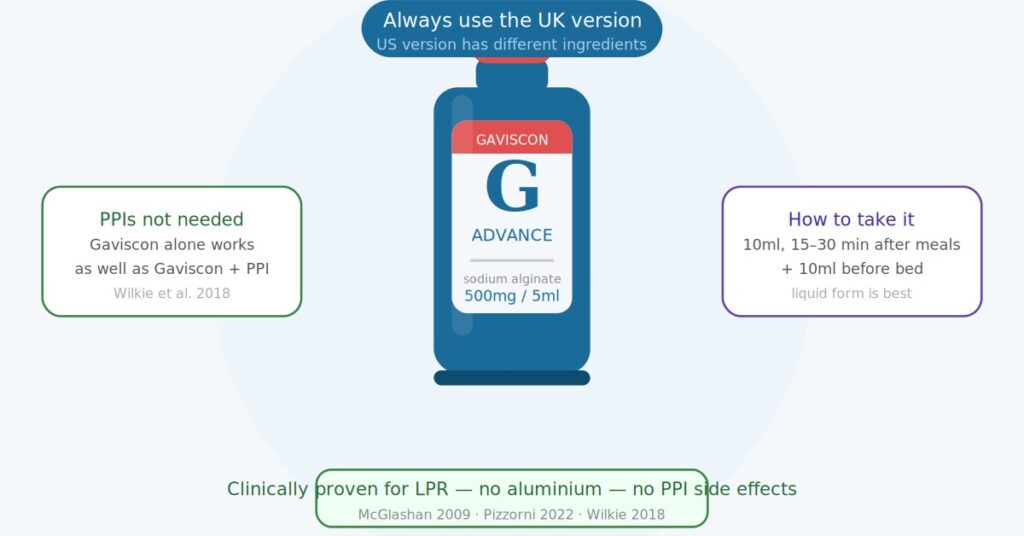
If you have LPR or silent reflux and you’re looking for a medication that actually helps — this is it. Gaviscon Advance, specifically the UK version, is the best medication you can take for LPR and the one I personally recommend to everyone I work with. It works nothing like the PPIs most doctors hand out. Instead of trying to reduce your stomach acid it creates a physical barrier that stops reflux from reaching your throat in the first place. For LPR that makes all the difference.
This guide covers everything you need to know — how it works, why the UK version specifically matters, what the clinical evidence shows, how to take it correctly, and where to get it if you’re not in the UK.
Key Takeaways:
- Gaviscon Advance (UK version) is the most effective medication for LPR — it works by creating a physical alginate raft, not by reducing acid
- The UK version contains 1000mg of sodium alginate per 10ml dose — the US version contains a fraction of this and works completely differently
- A randomised controlled trial (McGlashan et al.) showed significant improvements in LPR symptom scores at both 2 and 6 months
- A 2018 clinical study (Wilkie et al.) confirmed Gaviscon Advance alone is as effective as Gaviscon Advance plus a PPI — adding a PPI on top of it provides no additional benefit for LPR
- Alginate has been shown to be non-inferior to PPIs for LPR in a randomised controlled trial
- Take it 15–30 minutes after each meal and before bed for best results
Why Gaviscon Advance Is Different From Regular Gaviscon
Most people hear “Gaviscon” and think of a standard antacid you take when you get heartburn. Gaviscon Advance is a genuinely different product — it works through a completely different mechanism and it’s this difference that makes it so effective for LPR specifically.
Standard antacids neutralise stomach acid after it has already refluxed. Gaviscon Advance works by preventing the reflux from reaching your throat in the first place. It does this through something called an alginate raft — a foam-like gel layer that sits on top of your stomach contents and acts as a physical seal.
The key ingredient is sodium alginate, a completely natural extract from seaweed. When sodium alginate hits stomach acid it reacts and forms a thick gel that rises to the top of the stomach contents. This raft then physically blocks reflux from getting up through the lower oesophageal sphincter. It also displaces the postprandial acid pocket — the pool of highly acidic material that collects on top of stomach contents after meals, which is one of the main triggers of reflux episodes.
For LPR patients there’s something else the alginate does that’s really important — it binds to pepsin and bile that have already reached your throat, neutralises them and washes them back down into the stomach where they belong. This is the part that no PPI can do. PPIs reduce acid production but they can’t do anything about the pepsin already sitting in your throat cells causing damage. Gaviscon Advance can. You can read more about why pepsin matters so much in my complete LPR guide.
The UK Version vs the US Version — This Is Important
Here’s something that trips a lot of people up — and it genuinely matters so let me be clear about it.
The UK and US versions of Gaviscon are not the same product. Not even close. I get asked about this constantly and it’s the reason a lot of people in the US try “Gaviscon” for their LPR and say it did nothing. They used the wrong version.
The UK version has sodium alginate as its main active ingredient. That’s what creates the protective raft. The US version uses aluminium hydroxide instead — which is a standard antacid. It doesn’t form a raft, it doesn’t bind pepsin, it just neutralises a bit of acid. It’s a completely different product with the same brand name on the label.
| Gaviscon Advance (UK version) | Gaviscon (US version) | |
|---|---|---|
| Active ingredient | Sodium alginate 500mg / Potassium bicarbonate 100mg per 5ml | Aluminium hydroxide / Magnesium carbonate |
| Sodium alginate per 10ml dose | 1000mg | Negligible — listed as inactive ingredient only |
| Mechanism | Forms alginate raft, binds pepsin, displaces acid pocket | Standard antacid — neutralises acid only |
| Contains aluminium | No | Yes |
| Effective for LPR | Yes — clinically proven | No — wrong mechanism |
You need the UK version specifically. The good news is it’s easy to get on Amazon even if you’re outside the UK — it ships internationally without any issues.
The Clinical Evidence for Gaviscon Advance
I always back up what I recommend with the research and Gaviscon Advance is no exception. Here’s what the studies actually show.
For LPR (Silent Reflux)
The main study is the randomised controlled trial by McGlashan et al., published in the Journal of Laryngology and Otology. They took 49 LPR patients and split them into two groups — one taking Gaviscon Advance four times daily, one getting no treatment. At both 2 months and 6 months the Gaviscon group showed significant improvements in their Reflux Symptom Index scores and in the objective laryngeal signs visible on laryngoscopy. The control group showed no meaningful improvement. That was the first proper trial to demonstrate Gaviscon Advance works specifically for LPR.
A prospective study by Wilkie et al. (2018) followed 100 consecutive LPR patients all taking Gaviscon Advance — some also on a PPI, some not. The key finding: adding a PPI to the Gaviscon Advance made no difference to outcomes. Gaviscon Advance alone was just as effective. Which again confirms that for LPR, the alginate is the important part — PPIs add nothing useful on top of it.
A non-inferiority randomised controlled trial (Pizzorni et al., 2022) compared alginate directly against omeprazole in 50 LPR patients. Both groups saw significant improvements over 2 months and the alginate performed at least as well as the PPI. Around 90% of patients in both groups saw meaningful symptom reduction. Not bad for something that works mechanically rather than pharmacologically.
There’s also a large-scale trial called TALGiTS (BMJ Open 2025) currently underway — the biggest trial of Gaviscon Advance for throat symptoms ever conducted. The fact that a trial of this scale exists reflects how strongly the evidence is pointing in alginate’s direction.
For GERD
For GERD the evidence is also solid. A randomised clinical trial (Reimer et al., 2016) found that adding Gaviscon Advance to a PPI in GERD patients who still had symptoms despite the PPI produced significant additional improvement. And a systematic review and meta-analysis confirmed alginate therapy provides superior benefit over placebo and standard antacids for GERD symptoms overall.
How Gaviscon Advance Works — The Three Mechanisms
It’s worth understanding exactly what Gaviscon Advance is doing once you take it. There are three things happening simultaneously:
1. The alginate raft — sodium alginate reacts with stomach acid to form a thick gel that rises to sit on top of your stomach contents. This raft physically prevents reflux from escaping upward, acting as a seal rather than relying on any chemical effect.
2. Displacement of the acid pocket — after meals a pool of highly acidic material collects near the top of your stomach close to the oesophageal junction. This is called the acid pocket and it’s one of the main sources of postprandial reflux. The alginate raft pushes this pocket downward and away from the junction, making it far less likely to reflux upward.
3. Binding of pepsin and bile — the alginate binds to pepsin and bile salts that have already reached the oesophagus or throat, neutralising them and clearing them back down into the stomach. For LPR patients this is particularly important because pepsin — not just acid — is responsible for most of the tissue damage causing your LPR symptoms.
How to Take Gaviscon Advance Correctly
This is something most people get wrong initially — including me when I first started using it. The timing matters more than most people realise.
Take it 15 to 30 minutes after eating, not immediately after. The reason is that 15 to 30 minutes post-meal is when digestion is most active and when the acid pocket is forming above your stomach contents. Taking Gaviscon Advance at this point means the raft forms at exactly the right moment to displace the acid pocket before reflux can occur. Taking it immediately after eating means it competes with food in the stomach and you get a weaker raft effect.
I used to take it straight after finishing a meal and wondered why it wasn’t helping as much as I expected. Once I shifted to waiting 20 minutes or so the difference was noticeable.
Recommended dosing for LPR:
- 10ml (2 teaspoons) of liquid, 15–30 minutes after each main meal
- 10ml before bed — really important for nighttime protection
- Try not to eat or drink for 30 to 45 minutes after taking it — eating too soon dilutes the raft
Liquid vs tablets: The liquid generally forms a more complete raft and is the better option day to day. The tablets are more convenient when you’re out and can’t carry liquid — same active ingredient, slightly less effective. I use liquid at home and keep tablets for when I’m travelling.
How Long Does Gaviscon Advance Last?
Gaviscon Advance typically provides protection for around 2 to 4 hours as the raft gradually breaks down and mixes with stomach contents.
This is why the bedtime dose matters. When you’re lying down for 7 or 8 hours gravity isn’t helping keep stomach contents in place and reflux risk is higher. The Gaviscon provides protection through the first few hours of sleep when the risk is greatest. If nighttime reflux is a problem for you, combining Gaviscon Advance before bed with a wedge pillow makes a real difference. For more on this check my article on acid reflux at night. Between doses, some people also find throat lozenges or hard candy useful for keeping saliva flowing and easing throat symptoms.
Gaviscon Advance Side Effects
One of the things I like most about Gaviscon Advance is how clean it is from a side effects perspective. Because it works physically rather than chemically it doesn’t interfere with your body’s chemistry the way PPIs do. No long-term risk to your kidneys, no impact on bone density, no interference with B12, magnesium or calcium absorption — all of which are concerns with long-term PPI use.
It also has no aluminium, unlike the US version. That’s worth knowing if you’re planning to take something regularly.
The main things to be aware of:
- It does contain sodium — worth knowing if you’re on a strict low-sodium diet, though the amount per dose is small
- The peppermint flavour version uses artificial peppermint flavouring, not real peppermint. Real peppermint relaxes the LES and makes reflux worse — but the artificial flavouring doesn’t have this effect, so either flavour is absolutely fine for LPR
- It manages reflux but doesn’t treat the root cause — more on this below
Where to Buy Gaviscon Advance (UK Version)
If you’re in the UK it’s available in any pharmacy and most supermarkets — just make sure the label says “Gaviscon Advance”, not plain Gaviscon or Gaviscon Double Action.
If you’re in the US, Canada or anywhere else the easiest option is to order the UK version directly from Amazon here. It ships internationally and arrives without any issues.
If for some reason you can’t get the UK version, look for any product that lists sodium alginate as an active ingredient — not as an inactive ingredient. The UK version has 500mg of sodium alginate per 5ml. If you can find a local alternative with at least 250mg per 5ml it will provide some benefit, though the UK version remains the gold standard. Check the label carefully because the same brand name can have completely different formulations in different countries — so look at the ingredients, not just the name on the box.
Does Gaviscon Advance Treat the Root Cause?
This is important to understand. Gaviscon Advance is an excellent tool for managing and reducing LPR symptoms but it’s not a standalone cure. It prevents reflux from reaching and damaging the throat but it doesn’t address whatever is causing the reflux in the first place.
For most people the root causes involve some combination of a weakened lower oesophageal sphincter, an acidic diet that keeps reactivating pepsin in the throat, eating too much at once, and eating too close to bedtime. Gaviscon Advance manages the symptoms — diet and lifestyle changes are what address the underlying causes. If you’re not certain which foods count as acidic, my food reference guide lists the pH of the common ones.
This is why I always recommend using it as part of a broader approach rather than relying on it alone. Combined with the low acid diet and the lifestyle changes covered in my silent reflux treatment guide it’s genuinely powerful. Used on its own without addressing diet and lifestyle, symptoms are likely to come back once you stop taking it.
For a complete structured diet plan check the Wipeout Diet Plan. And if you want tailored guidance on your specific situation consider a private consultation.
Frequently Asked Questions
Is Gaviscon Advance the best medication for LPR?
Yes — in my experience and based on the clinical evidence, Gaviscon Advance (UK version) is the best medication available for LPR. Multiple trials have confirmed its effectiveness and a 2018 study showed it works just as well with a PPI as without one — meaning PPIs add nothing for most LPR patients. If you have LPR and you’re on PPIs without much improvement, switching to Gaviscon Advance as your primary medication is worth doing.
Why does it have to be the UK version?
Because the UK and US versions have completely different formulations. The UK version contains sodium alginate as its main active ingredient — that’s what creates the protective raft. The US version uses aluminium hydroxide, which is a standard antacid and doesn’t form a raft at all. They’re essentially different products with the same name on the packaging.
How quickly does Gaviscon Advance work for LPR?
The raft forms within minutes of taking it so you may feel some immediate relief. In clinical trials, significant improvements in LPR symptoms were observed at 2 months. Most people notice a meaningful reduction in symptoms within 2 to 4 weeks of consistent use alongside dietary changes.
Can I take Gaviscon Advance while on PPIs?
Yes — for GERD patients adding Gaviscon Advance to a PPI has been shown in trials to provide additional improvement. For LPR specifically, the evidence shows the combination is no better than Gaviscon Advance alone. If you’re currently on PPIs and want to come off them, Gaviscon Advance is a great medication to have in place during the taper. Read my guide on getting off PPIs safely for how to do this without a bad rebound effect.
Can I take Gaviscon Advance long term?
Yes — it’s safe for long-term use. Unlike PPIs there’s no concern about nutrient absorption, gut microbiome disruption or the cardiovascular and kidney risks associated with long-term PPI use. Most people use it consistently through the healing phase — typically 3 to 6 months — and then reduce the frequency as symptoms resolve.
Is the peppermint flavour version safe for LPR?
Yes — the peppermint flavour uses artificial peppermint flavouring, not real peppermint extract. Real peppermint relaxes the LES and worsens reflux but the artificial flavouring doesn’t have this effect. Either flavour is fine — pick whichever you prefer the taste of.
Does Gaviscon Advance work for GERD as well as LPR?
Yes — it works well for both, though it’s particularly suited to LPR. For GERD it reduces the frequency and severity of reflux episodes and can be used alongside PPIs for additional relief. For LPR it’s the primary recommended medication over PPIs because it directly addresses pepsin as well as acid.
Conclusion
Gaviscon Advance (UK version) is in my view the most important medication for anyone with LPR or silent reflux. It’s the one thing that made a real difference for me when I was at my worst with it and it’s what I consistently see helping people who’ve been struggling for months or years.
The key points: always use the UK version, take it 15 to 30 minutes after meals and before bed, and use it as part of a proper treatment approach rather than on its own. Combined with the low acid diet it’s genuinely powerful.
For the complete treatment approach check my article on silent reflux treatment and my personal account of how I cured my silent reflux. For a structured diet plan check the Wipeout Diet Plan.
Related articles:
- Silent Reflux Treatment — What Actually Works for LPR
- The Complete Guide to LPR — Causes, Symptoms and Treatment
- LPR Diet — What to Eat, What to Avoid and What to Drink
- How I Cured My Silent Reflux
- Getting Off PPIs Safely — Acid Rebound Guide
- GERD vs LPR — What’s the Difference?
- Alkaline Water for LPR
- Acid Reflux at Night
- The Stomach Sphincter’s Role in LPR
References
- McGlashan JA et al. (2009) “The value of a liquid alginate suspension (Gaviscon Advance) in the management of laryngopharyngeal reflux.” Journal of Laryngology and Otology. PubMed
- Wilkie MD et al. (2018) “Gaviscon Advance alone versus co-prescription of Gaviscon Advance and proton pump inhibitors in the treatment of laryngopharyngeal reflux.” European Archives of Oto-Rhino-Laryngology, 275(10):2515-2521. PubMed
- Pizzorni N et al. (2022) “Magnesium alginate versus proton pump inhibitors for the treatment of laryngopharyngeal reflux: a non-inferiority randomized controlled trial.” European Archives of Oto-Rhino-Laryngology, 279(5):2533-2542. PMC
- Reimer C et al. (2016) “Randomised clinical trial: alginate (Gaviscon Advance) vs. placebo as add-on therapy in reflux patients with inadequate response to a once daily proton pump inhibitor.” Alimentary Pharmacology and Therapeutics, 43(8):899-909. PubMed
- O’Hara J et al. (2025) “Trial of alginates in throat symptoms (TALGiTS): protocol for a pragmatic, multicentre, placebo-controlled, double-blind, parallel, randomised controlled trial.” BMJ Open, 15(1):e087729. PMC
- Mazzoleni G et al. (2005) “An evaluation of the antireflux properties of sodium alginate by means of combined multichannel intraluminal impedance and pH-metry.” Alimentary Pharmacology and Therapeutics. PubMed
- Ours TM et al. (2017) “Alginate therapy is effective treatment for GERD symptoms: a systematic review and meta-analysis.” Diseases of the Esophagus, 30(5):1-9. Full text
- Gelardi M et al. (2025) “Efficacy of dietary modifications and mucosal protectors in the treatment of laryngopharyngeal reflux: a multicenter study.” Frontiers in Medicine, 12:1488323. PMC

David Gray
12 years living with LPR · Consultant & researcher
I've lived with LPR for twelve years — the misdiagnoses, the PPI courses that did nothing, the slow work of figuring out what actually helps. Wipeout Reflux is where I translate the research into plain terms for people stuck in the same place. Every claim here is sourced to peer-reviewed work, and I consult one-to-one with LPR sufferers.
Hi
Do you have the research to back up why GA should be taken 30 minutes after as opposed to straight away?
also if I am treating an LPR pt with GA, symptoms improve after 2-3 months, do you suggest a step down approach ?
Thanks
No I do not have research on that. Just if you think about digestion, it can last a longer period so delaying taking the Gaviscon may help offer protection longer if you delay taking it somewhat. I think yes try to gradually lower it until you notice symptoms coming back. For instance I used to take 10 teaspoons a day and now I can take about half that daily. Just slowly and gradually while monitoring how you are feeling.
Hello,
Through my searches I have found a Gaviscon Advance Aniseed and Gaviscon Advance. I cannot find the difference between the two.
Any ideas?
Thank you,
Actually, I did finally find out. Aniseed is just a flavor. 🙂
I just wanted to make sure that the one I am buying contains the algae extract. I guess they both do.
Perfect that makes sense.
Hi,
One may be from another country. Or perhaps they are the same thing, I would need to see the products in question to know for sure.
What a blessing you are! Thank you for helping so many of us get better.
I want to explain that dizziness can be cause by acid reflux reaching the ears causing vertigo and balancing issues.
I just learned that Gaviscon can help. I have Gaviscon liquid extra strength. Which is the best and more effective? My ears and dizziness are so bad n I just want to keep the acid from reaching all the way to my ears.
Thanks so much!
Hi Violet,
Yes I believe that to be the case. Gaviscon is a good choice yes. What you want to look for is ones with a higher alginate amount as this is really what makes biggest difference for creating a protective barrier on the top of the stomach contents.
Thank you 🙂
Hi David,
Thank you very much for your informative web page!
I had a question about the root cause of LPR. Is it LES or UES? I have read somewhere that the main problem in LPR (in contrast to the “normal” GERD) is UES. Is that the case? And if so, is there anything one can do to remedy the root cause of LPR, i.e., can UES ever get back to normal?
Hi Paulo,
There are more than a couple causes than just LES or UES. Though out of them 2 it’s more likely to be related to the LES. There are multiple potential causes for example relating to the pyloric value or even the vagus nerve. There are even more as well. The UES can get back to normal if the pepsin and acid stops coming up yes.
Hi David,
Any new thoughts re gaviscon advance vs reflux gourmet?
Trying to decide which to get.
Great site!
Thank you
Hi Gale,
Thank you. I think both are effective and good options. I suggest to go for the one that is most convenient/affordable for you. If you want to try them both you can and see which works better for you. In theory they should have a similar effect due to overlapping ingredients.
I have tried the caramel reflux gourmet. I think gaviscon works a bit better. Caramel is better taste but gets to be too sweet after a day of it. Also someone on amazon said the ingredients have changed but i can’t say.
Yeah some people prefer one over the other but for the most part they should have a relatively similar effect.
I have mucus in lungs, throat mostly overnight even I stop eating around 5Pm and go to bed 3,4 hours later and pain in hiatal hernia and severe bloating under rib cage after eating. Most foods cause pain in that region. My throat and tongue inflamed and feels like a lump in my throat. Does Tagament help? Been on it, maybe worked a little, but then I lift heavy stuff feels like something coming up my throat. I have been on diet off and on but no permanent cure. Does Gaviscan plus work? Ifeel maybe it makes it tight around hernia and uppers GI, it normal? Thank you.
Tagament is a H2 blocker and perhaps can help to a degree though it would not be something I would recommend usually. Gaviscon can help yes, though diet changes are most important. If you have a hernia consider the IQoro device.
Also, can vagus nerve cause LPR?
There is some correlation yes for certain people. Something to the effect of it malfunctioning.
I wake up in middle of night with mucous in lungs and throat. At time so sticky I cant even cough it u p. I am on Tagament, as cant take any other meds. I hardly have feeling of burning in throat or stimach, but have feelings of lump and tightness and inflammation in throat. Where I have hiatal hernia and under my breast bones always hurts after eating most foods ? Does Gaviscan P lus help? When can I see results? Does chiropractor help with H Hernia?
I would suggest considering the Iqoro device as I talked about here – Iqoro review. It’s been shown to help people with hernia particularly well. Yes the gaviscon I mentioned above definitely should help. If you take it, you should see results within a few days. I have heard chiropractor can help with a hernia though I haven’t seen an medical studies backing up this statement.
Are there Informations or studys out there if Gaviscon Advanced is Okay for permanent use?
There are some studies showing how Gaviscon advance can help LPR for example this study. In terms of permanent use not really any study on that. Though the main ingredients are quite good so I wouldn’t be too concerned if you had to take it longer term.
Thank you so much for this helpful post! I’ve been taking the Gaviscon Advance tablets–one after every meal and before bed. My main symptom used to be coughing, but it’s now a feeling like there’s something caught in my throat. It’s gotten much better, but I still have symptoms in the morning. I feel fine when I wake up, but as soon as I have a few sips of water, I almost immediately feel a lump in my throat. (I went to my ENT to make sure I don’t have a tumor or anything; they confirmed it’s LPR). Have you heard of people like this, who have the most amount of problem with drinking/eating in the morning? A friend suggested maybe taking a tablet in the morning when I wake up. Any thoughts about that?
Also, I just read about not taking medication within 2 hours of Gaviscon Advance. Is that for all medication? I take high blood pressure meds, but my blood pressure seems fine and I’ve been on Gaviscon Advance for a month. I also take very low dose adderall or modafinil for menopausal brain fog. Would that be affected by taking Gaviscon Advance?
Thank you so much again!
Always glad to be able to help Angela. Yeah I had a similar experience before when I had a lump in the throat. What tablet is your friend suggesting? Of course I recommend a low acid diet and alkaline water to really help things heal alongside the gaviscon.
That would just be for the Gaviscon, I think 2 hours is a bit much but ideally not eating or drinking within 1 hour after taking the gaviscon would be good. The Gaviscon shouldn’t affect the absorption of them medications no.
Yes, I drink alkaline water throughout the day. (And I’m going to try the alkaline water steam inhalation, a suggestion from an earlier commenter!) My friend was suggesting gaviscon advance tablet first thing in the morning, since I’m having most trouble drinking even alkaline water first thing in the morning. That’s when I get the uncomfortable lump/gagging sensation! Should I try gaviscon advance on an empty stomach first thing in the morning?
Yeah definitely let me know how the steam inhalation goes, I am interested to try it out myself soon. Before taking the gaviscon I would suggest to first eat your breakfast then afterwards take the Gaviscon. That makes the most sense to me. I often think eating actually helps if you are doing a natural and low acid diet. So firstly eating and then the Gaviscon afterwards.
Thank you so much, and I will definitely try the diet!
You are welcome, always here to help 🙂