
If you’ve tried to come off PPIs and felt dramatically worse — heartburn out of nowhere, acid refluxing constantly, symptoms that seem far worse than before you started the medication — that’s not your reflux getting worse. That’s acid rebound. And understanding what it actually is makes the whole experience much less frightening, and much more manageable.
I went through this myself. I stopped omeprazole abruptly after being on 40mg and ended up in A&E twice. I didn’t know what acid rebound was. Once I understood the mechanism and did it properly the second time — slowly, with the right support in place — it was a completely different experience.
This article covers exactly what acid rebound is, why it happens, how long it lasts, and the step-by-step method I recommend for coming off PPIs with the least disruption possible.
Key Takeaways:
- Acid rebound (rebound acid hypersecretion) is a well-documented physiological response to stopping PPIs — it is not your original condition getting worse
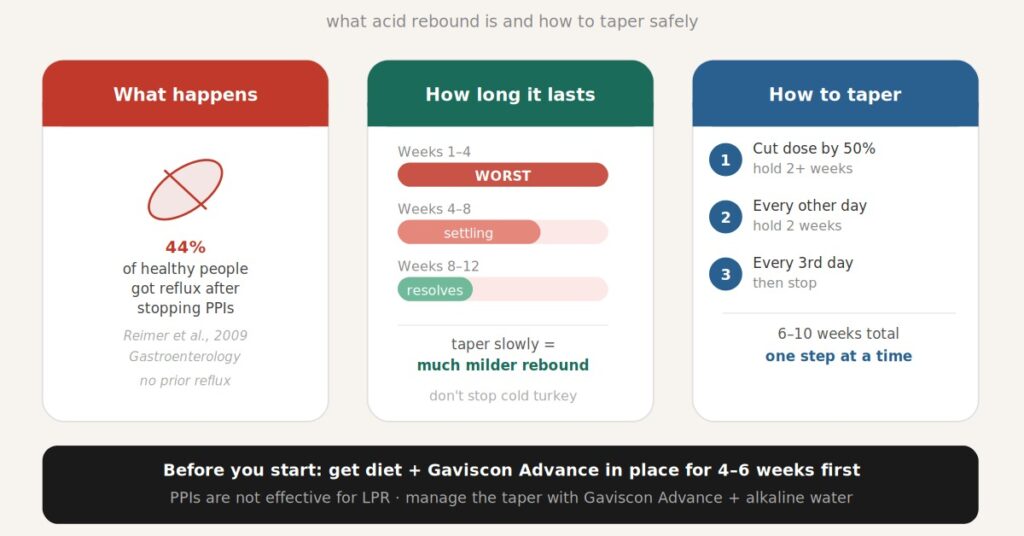
- 44% of healthy people with no prior reflux developed acid-related symptoms after stopping PPIs in a controlled trial — this effect is caused by the medication withdrawal, not by underlying disease
- Symptoms typically peak in weeks 1 to 4 after stopping and can last up to 8 to 12 weeks
- Tapering slowly over several weeks produces fewer symptoms than stopping abruptly — always taper rather than stopping cold turkey
- The best bridging agents during a taper are Gaviscon Advance (UK version) and H2 blockers like famotidine — used to manage symptoms while the stomach resets
- PPIs are largely ineffective for LPR — the evidence consistently shows they perform no better than placebo for throat symptoms
- Get the low acid diet in place for at least 4 to 6 weeks before starting your taper — this makes the process significantly easier
What Is Acid Rebound and Why Does It Happen?
Acid rebound — formally called rebound acid hypersecretion (RAHS) — happens because PPIs suppress stomach acid so effectively that the stomach adapts by upregulating its acid-producing capacity. When you stop the PPIs, that suppression is removed but the upregulated capacity remains — temporarily producing more acid than before you started.
Here’s the mechanism in plain terms. PPIs work by blocking proton pumps on the acid-producing cells in the stomach lining. When acid is persistently suppressed, the stomach responds by raising gastrin levels — a hormone that signals for more acid production. Elevated gastrin causes the acid-producing cells to multiply and become more active. So when the PPIs stop, you have a stomach that is now primed to produce significantly more acid than it was before you started the medication. That surge is rebound acid hypersecretion.
This is not your underlying condition getting worse. It is a temporary pharmacological withdrawal effect caused by the medication itself.
The most striking evidence for this comes from a 2009 controlled trial published in Gastroenterology by Reimer et al. Healthy volunteers with no history of reflux took esomeprazole 40mg daily for 8 weeks. After stopping, 44% developed acid-related symptoms including heartburn and regurgitation — compared to only 15% in the placebo group. These were people who had never had reflux in their lives. The medication caused the rebound, not any underlying disease.
A 2024 review published in the International Journal of Molecular Sciences (Namikawa & Björnsson) confirmed this mechanism is well-established and that rebound acid hypersecretion is one of the significant adverse effects of long-term PPI use that is still widely underappreciated by both patients and clinicians. PMID 38791497
PPIs and LPR: Why You Probably Shouldn’t Be on Them Long-Term
PPIs are not an effective treatment for LPR. This is one of the most important things I want people to understand — not just because of the rebound issue, but because staying on PPIs long-term for LPR means accepting side effects and dependency for a medication that isn’t doing what you think it’s doing.
The evidence is consistent: multiple studies have shown that PPIs perform no better than placebo for LPR symptoms. The reason is straightforward — LPR is primarily driven by pepsin reaching the throat, not by acid levels in the stomach. PPIs suppress acid but do nothing to stop pepsin from refluxing. The pepsin continues to reach the throat regardless, continues to cause inflammation, and the symptoms persist. For more on this see my silent reflux treatment guide.
So most people with LPR who are on PPIs are taking medication that isn’t treating their actual problem — and then going through a difficult rebound when they try to stop. The sooner you can come off them safely and shift to an approach that actually works for LPR, the better.
How Long Does Acid Rebound Last?
Acid rebound typically lasts between 4 and 12 weeks after stopping PPIs, depending on how long you were on them and at what dose. The symptoms are generally worst in the first 2 to 4 weeks and then gradually settle as the stomach’s acid-producing capacity returns to its pre-PPI baseline.
Based on the research and my own experience, here is what to expect:
- Weeks 1 to 4: This is typically the worst period. Heartburn, regurgitation and increased reflux are common. This is the peak of the rebound effect. Knowing this in advance makes it far more manageable — you’re not panicking that your condition has deteriorated, you’re waiting out a known, temporary pharmacological effect.
- Weeks 4 to 8: Symptoms generally begin to settle. For people who tapered slowly and have the diet and Gaviscon Advance in place, this period is often quite manageable.
- Weeks 8 to 12: For most people symptoms have returned to or below pre-PPI levels by this point. For some, particularly those who were on high doses for a long time, it can extend slightly beyond 12 weeks.
The key variable is whether you taper slowly or stop abruptly. Stopping cold turkey produces a sharper, more severe rebound. A gradual taper smooths out the curve significantly.
Before You Start: Get the Foundation in Place
The single most important thing you can do before starting a PPI taper is to get the low acid diet in place first. I recommend at least 4 to 6 weeks on the diet before you start reducing your dose. Here’s why this matters so much.
When you stop PPIs your stomach is temporarily producing more acid. If you’re also eating acidic foods and drinks during this period, you’re adding dietary acid on top of rebound acid — and it becomes very hard to manage. But if you’ve already significantly reduced dietary acid before starting the taper, the rebound effect hits a system that’s already in a much better baseline state.
Gaviscon Advance (UK version) should also be in place before you start. The sodium alginate in Gaviscon Advance creates a physical raft on top of stomach contents that mechanically prevents acid from reaching the throat — and this barrier protection is particularly valuable during the rebound period when acid production is elevated. More on how to use it in my Gaviscon Advance guide.
In short: sort the diet and Gaviscon first, then start the taper. Don’t try to do everything at once.
How to Taper Off PPIs: A Step-by-Step Approach
The safest way to stop PPIs is to reduce the dose gradually over several weeks, giving the stomach time to readjust at each step before reducing further. The clinical guidelines — including the 2022 AGA expert review and the Canadian deprescribing guidelines — both support a step-down approach, with options including dose reduction, increasing dosing interval, or switching to an H2 blocker as a bridge.
Here’s the approach I recommend based on the research and my own experience:
Step 1: Reduce dose by 50%
If you’re on 40mg, drop to 20mg. If you’re on 20mg, drop to 10mg (or take your 20mg every other day). Stay at this reduced dose for 2 weeks minimum — longer if you feel any significant increase in symptoms. The principle is: only move to the next step when you feel settled at the current one.
Step 2: Every other day dosing
Take your reduced dose every other day rather than daily. Do this for 2 weeks. This step can feel counterintuitive but it gives the stomach periodic days of adjustment without complete withdrawal.
Step 3: Every third day, then stop
Take your dose every third day for 1 to 2 weeks, then stop completely. By this point the stomach has been gradually adjusting for several weeks and the final step is much easier than cold turkey would have been.
The entire process typically takes 6 to 10 weeks depending on your starting dose and how your body responds. The longer you’ve been on PPIs and the higher the dose, the slower and more gradual the taper should be. There’s no prize for rushing it.
If you’re on a capsule PPI like omeprazole: Many omeprazole capsules contain small beads inside that can be separated — you can open the capsule and count out roughly half the beads to approximate a half dose. Ask your pharmacist about lower dose options in your country as some are available over the counter at 10mg or 20mg.
Managing Symptoms During the Taper
Even with a slow taper you’ll likely experience some increase in symptoms, particularly in the first few weeks. Here’s what actually helps:
Gaviscon Advance (UK version) — your main tool. Take it after every meal and before bed throughout the taper. This is doing the job the PPIs were doing — protecting the oesophagus and throat from acid reaching them — but through a physical barrier mechanism rather than acid suppression. It doesn’t cause rebound when you stop it. This is the key medication for managing the transition.
H2 blockers as a bridge. Famotidine (Pepcid) is a weaker acid suppressant than PPIs but can be useful during the taper to take the edge off rebound symptoms. Unlike PPIs, H2 blockers work differently and tolerance tends to develop quickly, so they’re most useful as a short-term bridge rather than a long-term substitute. Note: H2 blockers can also cause a milder rebound so ideally don’t become reliant on them either.
Alkaline water. Drinking alkaline water at pH 8.8 or above throughout the day helps neutralise pepsin in the throat and maintain an alkaline environment. During a PPI taper when acid production is elevated, this is particularly useful as a daily habit.
Meal timing and portion size. Don’t eat within 3 hours of bed. Keep portions moderate — overeating puts pressure on the lower oesophageal sphincter and increases reflux regardless of acid levels. These are basic principles but they matter more during the rebound period than at any other time.
Elevating the head of the bed. If night-time symptoms are a problem during the taper, raising the head of your bed by 15 to 20cm (6 to 8 inches) using bed risers under the legs reduces nocturnal reflux. This is particularly relevant for GERD symptoms during the rebound period.
Common Mistakes to Avoid
Stopping cold turkey. I did this and ended up in A&E twice. The rebound was severe because I went from full suppression to zero overnight. Don’t do it. Always taper.
Starting the taper before the diet is in place. If you’re still eating acidic foods when you stop PPIs, you’re fighting a losing battle. Get the diet right first, then taper — my food reference guide gives the pH of common foods and flags the usual triggers.
Mistaking rebound for your condition worsening. This is the most common reason people restart PPIs — they feel worse when they stop and conclude they need the medication. In many cases what they’re feeling is rebound, not underlying disease. If you know this in advance and have a plan for managing symptoms during the taper, you’re far less likely to be derailed by it.
Using H2 blockers long-term as a substitute. H2 blockers are a useful bridge during a taper but they’re not a long-term solution for LPR. The mechanism that causes LPR — pepsin reaching the throat — isn’t addressed by H2 blockers any more than it is by PPIs. Focus on diet and Gaviscon Advance as the sustainable long-term approach.
Frequently Asked Questions
Is acid rebound real or am I just imagining it?
Acid rebound is a well-documented, physiologically established phenomenon. A controlled trial in healthy volunteers with no prior reflux found that 44% developed acid-related symptoms after stopping PPIs — caused by the medication withdrawal, not any underlying disease. A 2024 review in the International Journal of Molecular Sciences confirmed the mechanism is well understood. It is real, it is common, and it is temporary.
How long does PPI rebound last?
Acid rebound typically peaks in the first 2 to 4 weeks after stopping PPIs and resolves within 8 to 12 weeks for most people. How severe and how long it lasts depends on how long you were on PPIs, the dose, and whether you tapered gradually or stopped abruptly. Tapering significantly reduces the severity and duration of rebound symptoms.
Can I stop PPIs if I have LPR?
Yes — and for most people with LPR, coming off PPIs is the right move because PPIs have not been shown to be effective for LPR in clinical trials. The approach is to taper slowly, get the low acid diet and Gaviscon Advance in place before starting, and manage rebound symptoms with the tools covered in this article. If you’re unsure about your specific situation consider a private consultation.
What can I take instead of PPIs for LPR?
The most effective approach for LPR is a combination of the low acid diet, Gaviscon Advance (UK version) after meals and before bed, and alkaline water as your main drink. This combination addresses pepsin directly — which PPIs do not — and has clinical evidence behind it. For the complete picture see my silent reflux treatment guide.
Do I need to tell my doctor before stopping PPIs?
If you’re on PPIs for a documented reason other than LPR — such as a confirmed peptic ulcer, Barrett’s oesophagus, or severe erosive oesophagitis — you should discuss stopping with your doctor first. For people who were prescribed PPIs for LPR or general reflux and are considering stopping, tapering with the approach described here is generally safe, but speaking to your GP about your intention is sensible.
Can rebound make my LPR permanently worse?
No. Rebound acid hypersecretion is temporary. Once it resolves — typically within 8 to 12 weeks — acid production returns to its pre-PPI baseline. The rebound doesn’t cause any permanent change to the stomach or oesophagus. The discomfort during the transition is real but the endpoint is a return to baseline, which for most people with LPR means symptoms that are much better managed with the right diet and medication approach than they ever were on PPIs.
Conclusion
Acid rebound is the main reason people struggle to come off PPIs and the main reason they go back on them unnecessarily. Understanding that it is a temporary, pharmacologically-caused withdrawal effect — not evidence that you need the medication — is the most important mindset shift you can make. Taper slowly, get the diet and Gaviscon Advance in place first, manage symptoms with the right tools during the transition, and give it 8 to 12 weeks. For most people the other side of that is significantly better than where they started.
If you want a complete structured plan for managing LPR without PPIs, check the Wipeout Diet Plan. For personalised guidance on your taper and your specific situation, I offer private consultations.
Related articles:
- The Complete Guide to LPR — Causes, Symptoms and Treatment
- Gaviscon Advance for LPR — Why It Works and How to Use It
- Silent Reflux Treatment — What Actually Works
- LPR Diet — What to Eat, What to Avoid
- Alkaline Water for LPR — Does It Help?
- How I Cured My Silent Reflux
References
- Reimer C, Sondergaard B, Hilsted L, Bytzer P. (2009) “Proton-pump inhibitor therapy induces acid-related symptoms in healthy volunteers after withdrawal of therapy.” Gastroenterology, 137(1):80-87. PubMed PMID 19362552
- Namikawa K, Björnsson ES. (2024) “Rebound Acid Hypersecretion after Withdrawal of Long-Term Proton Pump Inhibitor (PPI) Treatment — Are PPIs Addictive?” International Journal of Molecular Sciences, 25(10):5459. PubMed PMID 38791497
- Targownik LE, Fisher DA, Saini SD. (2022) “AGA Clinical Practice Update on De-Prescribing of Proton Pump Inhibitors: Expert Review.” Gastroenterology, 162(5):1334-1342. PubMed PMID 35183361
- Deprescribing.org / Canadian Deprescribing Network. (2017) “Deprescribing proton pump inhibitors: Evidence-based clinical practice guideline.” Canadian Family Physician, 63(5):354-364. PMC5429051
- Lechien JR et al. (2019) “Efficacy and safety of proton pump inhibitors for chronic laryngitis: A systematic review.” Laryngoscope, 130(5):1173-1189. PubMed PMID 31478201

David Gray
12 years living with LPR · Consultant & researcher
I've lived with LPR for twelve years — the misdiagnoses, the PPI courses that did nothing, the slow work of figuring out what actually helps. Wipeout Reflux is where I translate the research into plain terms for people stuck in the same place. Every claim here is sourced to peer-reviewed work, and I consult one-to-one with LPR sufferers.
Off PPI was on short term for Gastritis (endoscopy) after vomiting. History of poor diet and alcohol. Change my ways. DGL, Aloe, Slippery elm. Some Priobiotics zinc carnozine. Anyway I was on other drugs like Cymbalta-Hycomine for IBS. I learned how they were slowing my digestion etc and stopped. It has been 3 months now and I still have reflux. I am guessing its my LES not working? How long can it take for the gastrin to regulate. I am miserable help.
I think the endoscopy would have helped notice is the LES is loose whether from hernia or not. It could also be something else such as SIBO or other problems with motility or pylorus malfunction etc. Diet like my wipeout diet is what I would suggest. I don’t know how long you can take it for but if it isn’t helping after some weeks I assume its not the right medicine for you.
Is there acid rebound when you stop taking a h2 blocker?
It is possible yes but less likely than stopping a PPI. I would suggest to taper it as I have suggested just to be on the safe side.
Hi there,
I am pleased to have found this article. Doctors have not educated me at all on these medications and I believe it was the use of a previous medication for acne that caused my stomach problems to begin with.
Without giving you an essay on how I got here, I have been taking PPIs for 14 years and I am 35. At present I am on 40mg esomeprazole in the morning and 20mg Esomeprazole at night. The highest I was on was 40mg twice a day. I had never taken more than 40mg daily until last year. Since the increase I have had iron deficiency and I now have developed psoriasis. Today I decided to try 20mg am and 20mg pm.
These tablets are ruining my life but at the same time I did find relief from them as I have a lazy LES and a hiatus hernia. I’m pretty sure I fall into the category of LPR but doctors here in the UK don’t seem to talk about that!
If I could go back in time to when I first put my trust in doctors, I would give them a good slap the first time they offered me anything!
Other than acid rebound, can tapering off these tablets cause side effects like the way tapering off an SSRI or a pain tablet?
Thanks
Hi Ben,
Yeah I had a similar experience. Was doing PPIs for at least a few years and after a while they did much more harm than good. Tapering off these tablets can cause the side effects like the acid rebound but if you do my recommendations as I covered here it will drastically reduce the chances and severity of any side effects. In fact I would be willing to bet that you’ll start to feel better once you get off them for good. Best of luck!
Great information. I stayed on omeprazole 40 mg too long-about 7 months until December 1 of this year. I did the taper until December 1. Getting uncomfortable rebound I guess for the month of December so far.
Could rebound last longer the longer you are in the ppi? How long will it last?
At this point can I start to try gaviscon to see if it helps?
Anything else I might try besides gaviscon? Liquid or tablets?
Sorry for all the questions but thanks!!
Thank you! Yeah rebound I’d say is more prominent and likely if you have been on the PPI for longer. Yeah you can try the Gaviscon to make things easier, liquid would be best. Yeah other acid blockers may also help.
Hi David, I have been on ppi for over 10 years, and when I try to come off them my acid reflux tries to come back. I try to taper off as my doctor suggested, but it still comes back, especially if I eat certain food. Should I take pepsid ac or some other acid reducer to help.
Yeah you can try to taper off with a H2 blocker or even an alginate like gaviscon advance.
hello I would like to know is there anything that can strengthen the LES valve
to keep the acid down, I am so desperate in getting this acid under control, and the doctor cannot seam to help, just give you a bandage not a cure… I really get scared at times…I pray alot for God to heal me, but I know I have to do my part as well.
Does anyone know how to make the LES valve close better… I am also going to wean my self off these drugs
Hi Sandra,
Melatonin has been shown to improve the LES strength and tone, and has been proven to help people particularly with GERD which is backed on in studies. You can read more here – melatonin for acid reflux.
I suggest trying the IQuoro device. I have suffered for years with reflux, as I have a Hiatus Hernia.
I have used ppi and h2 blockers, but these only partly relieved my condition. For the last 4 months I have been using IQuoro in addition to ppi, and I have seen some improvement overall, but still take a reduced dose of ppi. I am about to attempt tapering off omeprazole, whilst using the IQuoro device. I am ever hopeful of finding relief! Tony
Great to hear you have seen some improvements!
I am thankful for your programme which I just discovered. I have been taking Famotidine 40 mg for about 8 years, and am slowly recovering from a bout of gastritis. My doctor told me I should stop cold turkey a week before he does an endoscopy. Though he and others have said Pepcid doesn’t cause rebound, it definitely does, especially if one has been using it everyday for 8 years. I have been trying to taper off, but I only have about a week and a half before the test. I have been having heartburn every afternoon, and am concerned that I won’t be able to completely stop an entire week before the test. I also want to have a Heidelberg test (which is extremely hard to find in the U.S.) which requires being off acid reducers at least 3 days before the test. I just purchased the Gaviscon Advance you recommended. Do you have any tips how I could attempt to stop completely in such a short time? Thank you!
Yeah so tapering as slow as you can considering your timeframe is important and also using the Gaviscon to make that transition easier is a good idea. Also I’d suggest to avoid the common acid reflux trigger foods/drinks which will also make the transition easier.
Hi David,
Thanks for your article. I have been on Lanzoprazole for 5 years and have bouts of chronic gastritis. Is it a good idea to wean of PPI when I have a flare-up of gastritis – it has been going on for months now.
Cheers.
Hi Veronica,
I think you can try and taper of the Lansoprazole as I have explained in this article. Ideally don’t start coming off it when you have a flare up. For me once I had finally tapered off them after about 2 months and I would say I was definitely feeling 20-30% better just from stopping them. At that time I was on them for around 3-5 years so a similar timeframe to yourself.
Hi David,
I am going to start your Wipeout Diet on Monday for my LPR symptoms. I wanted to ask your opinion on being able to drink brand FIX vodka on occasion. If you havent heard of it, check out their site. It is high alkaline (over a PH of 8) , distilled 10x with naturally high alkaline water, filtered 6x through coconut husk charcoal, naturally gluten-free, natural calcium and magnesium from mother nature, distilled from pesticide-free corn & completely vegan, free of citric acid and glycerin.
Also, am I able to incorporate popcorn in the diet? Vitamins? (D, C, B12)
PS I love the content and appreciate all the advice. Thanks for your time!
Hi Anthony,
I have tested a selection of vodkas, acidity levels and they tend to be not too acidic especially when compared with other alcoholic drinks. I didn’t test that one but there are some others that are allowed mentioned in the diet, but from their site it seems like a solid option. As I mentioned in the Diet it’s best to keep it in moderation and see how it goes with a small amount.
Popcorn is allowed as long as it’s not a trigger for you. Also only ones salted or plain are allowed. Them vitamins should be okay, though watch out for vitamin C it’s often derived from ascorbic acid which is highly acidic and should be avoided, so I would pass on the vitamin C myself.
Thank you Anthony, happy to help 🙂
Hi David,
I have a strange phenomenon–
I took pantoprazole 40mg for 16 months till November 11, 2021, because I was going to do the 24 hour pH testing on November 23. So from November 11-26, I was not on PPI and did not feel any rebound.
I resumed taking pantoprazole 40mg on November 27, 28, 29, 30. On November 30, my symptoms obviously worsened (hoarseness, throat irritation, globus sensation).
Then I read your post about tapering off of PPI, on December 1 I reduced the PPI dose to 20 mg. But following some YouTuber’s advice I drank a table spoon of apple cider vinegar without diluting it in water. My symptoms continued to worsen day after day.
On December 2, I continued to tape off of PPT by taking 20mg. On December 3, I stopped taking PPI and chose to taper off by switching to Pepcid 20mg following Dr. Jamie Koufman’s suggestion on her blog.
Do you think my worsening symptoms are an outcome of stopping PPI or the table spoon of apple cider vinegar?
Thank you. Wonderful posts you have written! I’m truly grateful.
Hi Maple,
When tapering off the PPIs it is common to see some sort of increased reflux or irritation during this time. Though the difference would be not too much especially if doing the transition steps like I suggest such as diet during it. The apple cider vinegar is very acidic and almost certainly worsened your symptoms. If you have LPR I would highly recommend not taking it. So from what you mentioned I would assume it’s more likely to be the apple cider vinegar but both could be correlated to some degree.
I didnt taper, I stopped abruptly. Should I reintroduce the PPIs?
I was prescribed PPI (2 * 20mg per day) for 14 days for my Gastritis diagnosis. They worked perfectly. Stomach pain disappeared in 10 days, and i felt normal again. Next doctor visit, they said to reduce down to 1*20mg per day for a week. I did that for 3 days and stopped as I felt ok and wanted to get off them.
Within 2 days after that I started getting acid reflux, which for me, was a very rare event prior to this. Now, fast forward 10 days from stopping PPI and I still get reflux after certain acidic foods (tomatos, coffee etc). I am managing it by diet changes avoiding trigger foods, I HOPE it will solve it in a few weeks.
Meanwhile I have started taking Vit B supplements and eating saurkraut everyday to reintroduce some good gut bacteria. any other tips?
I think based on what you said you can stay off them for as it seems your symptoms are not greatly aggravated. I would suggest to stop the common acid reflux trigger foods. Such as the tomatoes and coffee you mentioned for at least a few weeks. I imagine this will help get your symptoms under control and hopefully help you return to normal soon. Personally I wouldn’t recommend sauerkraut and some vitamin tablets especially higher dose ones can be irritable for some people so keep that in mind too.
Is regurgitation (like food coming up to esophagus especially when lying down) one of the symptoms of acid rebound? Can you give more example of acid rebound?
I believe regurgitation is possible yes for certain people. General symptoms of acid reflux and LPR are generally just heighted or worsened when you have a rebound effect. The secret is to do it slowly and aid yourself with diet and perhaps other meds to make the transition easier.
I have been taking these PPI’s for well over 10 years! (Esemoprozole 40mg) and have just stopped (cold turkey) taking these due to the side effect risks which my GP has never recognized. Almost 4 weeks in and managing with Peptac (Gaviscon) Trying to change almost everything I have done over the last number of years, as taking a tablet to allow me to eat the foods which worsen Reflux and consume coffee and alcohol certainly doesn’t now seem as important as negating the side effects. I had in the past tried to stop taking them but the doctor again never gave any indication of the Rebound symptoms and just advised to continue the 40mg daily dose…. The more I learn the more frustrated I am getting with my experience and the doctors dealing with this……
It’s good you are transitioning off them and know about the rebound affect. I think taking the peptac and doing a better diet will help with the transition. Yeah I think most people have had a similar experience with doctors not quite knowing how to deal with things appropriately unfortunately.