
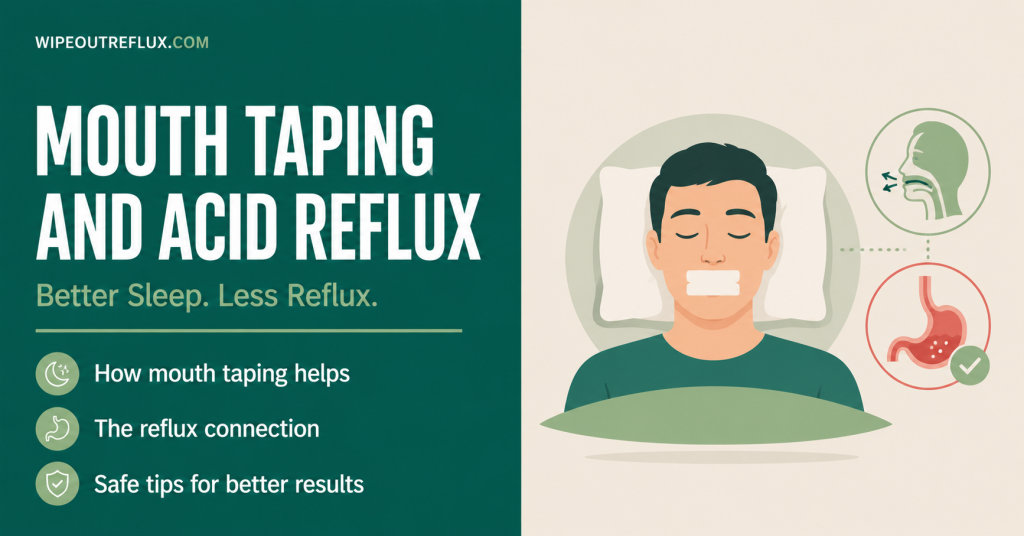
Mouth taping is one of those wellness trends that’s arrived with a lot of confidence and very little clinical evidence. The premise sounds reasonable — tape your mouth shut at night, force nasal breathing, sleep better. And nasal breathing genuinely does have real benefits. But if you have acid reflux or LPR, the question isn’t just whether mouth taping works. It’s whether it’s safe.
The honest verdict: for most people with GERD or LPR, mouth taping is not recommended. The evidence base is thin, the studies that do exist used very small populations, and taping your mouth shut during sleep while you have reflux introduces a genuine aspiration risk that doesn’t exist for the average healthy sleeper. More importantly, forcing the mouth closed doesn’t address why you’re mouth breathing in the first place — and that underlying reason is almost always something that needs proper evaluation, not a strip of tape.
That said, the nasal breathing goal behind mouth taping is legitimate and worth pursuing — just through safer routes. This article explains the mechanism, the real risks for reflux sufferers, the LPR-specific angle that almost no trend piece covers, and practical alternatives that get you the benefits of nasal breathing without the downsides.
Key Takeaways
- Mouth taping has a thin evidence base: a 2025 systematic review of 10 studies involving just 213 patients found “a potentially serious risk of harm for individuals indiscriminately practicing this trend,” with no strong clinical evidence of consistent benefit.
- For GERD sufferers, the specific risk is aspiration: if reflux occurs during the night, a taped mouth prevents the normal cough and oral clearance response, potentially allowing acid and pepsin to enter the airway.
- For LPR sufferers, the risk is compounded — the laryngeal tissue is already sensitised and inflamed, and anything that increases the likelihood of reflux reaching the throat overnight is a meaningful concern.
- Nasal breathing is genuinely beneficial: it humidifies incoming air, delivers nitric oxide to the lower airways, and keeps saliva production more stable than mouth breathing does — all of which matter for reflux management.
- Mouth breathing reduces saliva production, which reduces the bicarbonate buffering that protects oesophageal and throat tissue from acid damage — this is the real mechanistic link between mouth breathing and worsened reflux outcomes.
- The sleep apnoea angle is critical: OSA and LPR co-exist at high rates (studies show LPR positive in roughly 45% of OSA patients), and undiagnosed sleep apnoea is one of the most common underlying causes of mouth breathing — which mouth tape actively masks rather than addresses.
- The right approach isn’t taping the mouth shut — it’s identifying and treating the cause of mouth breathing (nasal congestion, allergies, deviated septum, apnoea) and using nasal-support strategies that don’t create aspiration risk.
- Diaphragmatic breathing exercises, nasal strips, saline rinses, and addressing the congestion driving mouth breathing are all safer ways to move toward nasal breathing without the risks that mouth tape carries for reflux patients.
Is Mouth Taping Safe? What the Evidence Actually Shows
Before getting to the reflux-specific angle, it’s worth understanding what the evidence actually says about mouth taping in general — because the gap between social media claims and clinical reality is substantial.
A 2025 systematic review published in PLOS One — the most comprehensive available analysis of the topic — reviewed 10 studies covering 213 patients examining mouth taping for mouth breathing, sleep-disordered breathing, and obstructive sleep apnoea. The conclusion was clear: there is a potentially serious risk of harm for those who practise this trend without proper clinical evaluation, and the evidence for benefit is inconsistent and methodologically weak across almost all the studies examined.
A parallel scoping review of the research landscape identified nine studies from a search of 177 publications. Most had 21 or fewer participants. Three had ten or fewer. The participant numbers across the entire body of mouth-taping research are small enough that a few individual outcomes can swing results dramatically — which is why findings vary so widely between studies.
What the current research does show with some consistency is this: for a subset of people who already breathe clearly through the nose, mouth taping may improve snoring metrics. But for anyone with underlying nasal obstruction, undiagnosed sleep apnoea, or a condition like GERD or LPR — mouth taping becomes actively counterproductive, and potentially dangerous.
One striking finding in the 2022 study data: 10 participants experienced “mouth puffing” — they continued trying to breathe through their mouths even while taped, fighting against the seal. This is exactly what you’d expect in someone with nasal obstruction. Forcing the mouth closed when the nose isn’t flowing freely doesn’t create nasal breathing — it creates partial airway obstruction.
Mouth Taping Dangers and Side Effects for Reflux Sufferers
The general risks of mouth taping — skin irritation, anxiety, breathing difficulty — are well documented. But for people with acid reflux or LPR, there is a specific and more serious concern: aspiration.
Reflux during sleep is different from daytime reflux. During the day, swallowing reflex is active, saliva is flowing, and if reflux occurs, the natural protective response — coughing, swallowing, clearing — is immediately available. During sleep, all of these protective responses are suppressed. The swallowing rate drops dramatically. Saliva production slows. The cough reflex is blunted. Esophageal clearance is reduced.
When reflux occurs during sleep in someone whose mouth is taped shut, there is no easy oral escape route. Stomach contents — including acid and pepsin — that reach the throat or vocal cords can be drawn into the airway. This microaspiration risk is not trivial for reflux patients; it’s one of the reasons acid reflux-related bronchitis and respiratory symptoms occur in the first place.
For LPR sufferers specifically, the threshold for damage is even lower. The laryngeal mucosa is already inflamed and sensitised. Any reflux event that reaches the throat overnight creates inflammation, and if that pathway is also partially obstructed by tape-forced mouth closure creating altered breathing mechanics, the aspiration risk becomes more pronounced.
The mouth also serves as a safety valve. If nasal breathing becomes difficult mid-sleep — due to congestion flaring, a change in position, or allergy response — the mouth is normally available as a backup airway. Tape eliminates that backup. For someone with reflux, where sleep quality is already disrupted and airway events are more likely, removing that safety valve is a meaningful risk.
The Saliva Connection: Why Mouth Breathing Genuinely Worsens Reflux
Here’s where the genuine mechanistic link between mouth breathing and acid reflux sits — and it’s more important than most people realise.
Saliva is one of the oesophagus’s primary defence mechanisms. It contains bicarbonate, which neutralises acid that reaches the oesophagus and throat during reflux events. Research has shown that salivary bicarbonate secretion increases significantly — by more than threefold — in response to acid and pepsin exposure in the upper oesophageal mucosa, suggesting it’s actively deployed as a protective response. A separate study found that swallowing saliva plays a critical role in oesophageal acid clearance: each swallow brings a slug of alkaline saliva that raises the pH of the oesophagus back toward neutral.
Mouth breathing disrupts this system in two ways. First, it causes the oral mucosa to dry out, reducing overall saliva production and the protective bicarbonate content of that saliva. Second, chronically dry mouth conditions reduce the available buffering capacity at exactly the moment it’s needed — overnight, when acid clearance mechanisms are already suppressed by sleep.
The implication is straightforward: if you’re already a mouth breather, you’re already compounding your reflux problem by reducing your own natural acid buffering system. This is one reason why people with mouth-breathing habits tend to have worse dental erosion alongside their reflux — the dry, low-saliva oral environment is more acidic, and what little acid does reach the mouth from reflux encounters less buffering protection.
The link to silent reflux and bad breath is relevant here too — the dry oral environment from mouth breathing creates conditions where bacteria thrive and volatile sulphur compounds are produced, compounding the halitosis that LPR sufferers often experience.
So yes: there’s a real reason to want to breathe through the nose. The problem is that taping your mouth shut is the wrong way to achieve it when you have reflux.
Nasal Breathing and Acid Reflux: The Legitimate Benefits
The case for nasal breathing isn’t just about avoiding the downsides of mouth breathing — there are genuine positive effects on the respiratory and digestive systems that matter for reflux sufferers.
The nose filters, humidifies, and warms incoming air before it reaches the airways. This makes a meaningful difference to airway health, particularly for people with LPR whose throat and laryngeal tissue is already sensitised and reactive to inhaled irritants.
Nasal breathing is also closely associated with nitric oxide delivery. Nitric oxide is produced in the nasal sinuses and is delivered to the lower respiratory tract when you breathe through the nose. Some research suggests that mouth breathing may reduce exhaled nitric oxide by around 50%, losing this delivery route entirely. Nitric oxide has vasodilatory, antimicrobial, and airway-regulatory effects — losing it at night is a meaningful trade-off.
Nasal breathing also tends to produce slower, more diaphragmatic breathing patterns compared to mouth breathing. Diaphragmatic breathing — where the diaphragm descends fully with each inhale — is specifically relevant to reflux, because a well-functioning diaphragm acts as an external support for the lower oesophageal sphincter. Shallow chest breathing, which is more common with mouth breathing, doesn’t provide that same support. The connection between diaphragm function and the oesophageal sphincter is an underappreciated part of reflux management.
All of these benefits are real and worth pursuing. The goal is to find them through means that don’t create aspiration risk, mask underlying sleep-disordered breathing, or dry out the very oral environment you’re trying to protect.
Mouth Taping and LPR (Silent Reflux): A Specific Caution
If standard GERD is a concern with mouth taping, LPR makes the calculus considerably more cautious. Here’s why the LPR angle is genuinely different — and why it’s almost never addressed in the general mouth-taping trend coverage.
LPR sufferers don’t just have acid refluxing into the oesophagus. They have pepsin — the protein-digesting enzyme — reaching the throat, larynx, and sometimes the nasal passages and even the middle ear. The laryngeal tissue is significantly more fragile and sensitive than oesophageal tissue, with no equivalent acid-protective mechanisms. Even weakly acidic or non-acidic reflux events can cause damage and inflammation when pepsin is the active irritant.
Sleep is already the highest-risk window for LPR events, because horizontal positioning, reduced swallowing, and blunted cough reflex all work together to allow reflux to dwell longer in the throat. Mouth taping during this window, in this population, adds to the risk in ways that matter.
But there’s a deeper issue that makes this truly LPR-specific: the relationship between sleep-disordered breathing and LPR is bidirectional and well-documented. A meta-analysis of 870 OSA patients found LPR present in approximately 45% of them. A study specifically examining males with OSA found the positive rate of LPR was 97.96% in OSA patients versus 75.68% in non-OSA controls, with significantly higher median LPR episode counts in the OSA group.
This matters for mouth taping in a very specific way. If someone is mouth breathing because of undiagnosed sleep apnoea — which is common, and which often presents as simply “snoring” or “restless sleep” — and they tape their mouth shut, they are partially obstructing the only available airway of someone whose upper airway is already collapsing periodically during sleep. The altered pressure dynamics during obstructed breathing events are among the proposed mechanisms that may worsen reflux in OSA patients. Mouth taping doesn’t fix the obstruction. It hides its most visible symptom while potentially making the breathing mechanics worse.
For anyone with sleep apnoea and acid reflux, the priority is always to get the sleep apnoea properly diagnosed and treated — not to experiment with mouth tape.
The throat symptoms of LPR — hoarseness, chronic throat clearing, the globus sensation, post-nasal drip — can all worsen significantly if aspiration risk is increased during sleep. Mouth taping that leads to even minor aspiration events overnight is exactly the kind of recurring low-level injury that makes LPR harder to manage and slower to heal.
Why You’re Mouth Breathing: What Actually Needs Addressing
The uncomfortable truth about mouth taping is this: if you’re mouth breathing at night, there’s a reason. Taping the mouth shut doesn’t fix that reason — it suppresses the most visible symptom while the underlying cause continues.
The most common causes of habitual mouth breathing include:
- Nasal congestion from allergies or rhinitis: Persistent nasal inflammation narrows the nasal passages and makes nasal breathing laborious or impossible, particularly at night when postural drainage reduces.
- Deviated nasal septum: Structural asymmetry in the nasal cavity can make one or both sides chronically restricted.
- Nasal polyps: Soft tissue growths in the nasal passages that obstruct airflow — often associated with chronic sinusitis or allergic rhinitis.
- Obstructive sleep apnoea: The upper airway collapses during sleep, and mouth breathing is both a symptom and a contributor. This is the critical one to rule out before attempting any mouth-tape intervention.
- Chronic sinusitis: Inflammation and blocked sinuses reduce nasal airflow capacity and are often underdiagnosed. Notably, acid reflux and sinus congestion are bidirectionally linked — LPR can itself contribute to chronic sinusitis by irritating the nasal passages with refluxed pepsin.
- Habitual mouth breathing: In some cases, particularly if mouth breathing started in childhood, it has become a deeply ingrained pattern even when the nose is now clear.
The right response to each of these is treatment of the underlying cause — antihistamines, nasal steroid sprays, septal surgery, CPAP for OSA — not a strip of tape that forces the mouth closed while the root problem remains unaddressed. And importantly, for reflux sufferers, treating any of these underlying causes will also reduce reflux events, because better nasal airflow, better sleep quality, and proper OSA management all improve reflux outcomes.
Safer Alternatives: How to Get the Benefits of Nasal Breathing Without the Risks
The goal is legitimate. Nasal breathing at night genuinely helps. Here are the evidence-informed ways to move toward it without the aspiration risk that mouth taping carries for reflux patients.
Nasal strips (external nasal dilators): These work by mechanically holding the nostrils open wider, increasing nasal airflow capacity without closing the mouth. They carry none of the aspiration risk of mouth tape, are well tolerated, and are particularly useful if narrowed nasal passages are contributing to mouth breathing. Some clinical research has included them alongside mouth-taping in multimodal snoring reduction protocols, where they work better than tape alone for this purpose.
Saline nasal rinse or spray before bed: Clearing the nasal passages of allergens, dried mucus, and irritants before sleep reduces the congestion that drives mouth breathing. A daily neti pot or saline spray routine — particularly for allergy-driven congestion — can meaningfully increase how comfortably you breathe through the nose overnight.
Nasal steroid spray (if you have rhinitis or allergies): These require a consistent 2–4 week use period before full effect, but for people whose mouth breathing is driven by allergic or inflammatory nasal congestion, they are far more effective at the root cause than any mechanical intervention at the mouth.
Address allergen exposure in the bedroom: Dust mite covers on pillows and mattresses, reducing pet dander in the sleep environment, and improving bedroom air quality all reduce the overnight allergen load that triggers nasal congestion and forces mouth breathing.
Left-side sleeping: Already recommended for reflux management, left-side sleeping also tends to reduce snoring and upper airway resistance in many people, and reduces the likelihood of reflux events reaching the throat. It’s a strategy that addresses both problems simultaneously.
Diaphragmatic breathing practice during waking hours: Regular diaphragmatic breathing exercises done while awake retrain the breathing pattern toward slower, deeper, nose-driven breaths and strengthen the diaphragm’s role in supporting the oesophageal sphincter. This is addressed in depth in the guide to natural remedies for LPR.
Evaluation for sleep apnoea: If you snore, wake unrefreshed despite adequate sleep time, or have been told your breathing stops during sleep, a proper sleep study is the most important step you can take — for both your airway health and your reflux. CPAP treatment for OSA is associated with improvements in subjective reflux symptoms in patients who have both conditions.
Humidifier in the bedroom: Low ambient humidity dries out the nasal passages, increasing congestion and resistance to nasal breathing. A bedroom humidifier kept at 50–55% relative humidity can meaningfully improve nasal breathing comfort overnight — particularly relevant in winter months with central heating.
Frequently Asked Questions
Can mouth taping make acid reflux worse?
Yes, it can — particularly for people with LPR or significant nocturnal GERD. Taping the mouth closed during sleep means that if reflux occurs, the normal oral clearance and cough response is impaired. Stomach contents — including pepsin — that reach the throat have more opportunity to dwell and cause damage. Mouth taping can also mask undiagnosed sleep apnoea, which independently worsens reflux through altered breathing mechanics and pressure dynamics.
Is nasal breathing good for acid reflux?
Yes — the goal of nasal breathing is a legitimate one. Nasal breathing maintains better saliva production than mouth breathing, which protects the oesophagus with bicarbonate buffering. It also promotes slower, more diaphragmatic breathing patterns that support the oesophageal sphincter’s function. The issue isn’t whether nasal breathing is beneficial — it’s whether mouth taping is a safe way to achieve it for reflux patients, and the answer there is no.
Why does mouth breathing make reflux symptoms worse?
Mouth breathing reduces saliva production and dries out the oral and pharyngeal environment. Since saliva contains bicarbonate — a key acid-neutralising agent — reduced saliva means less protection for the oesophagus and throat during and after reflux events. It also tends to be associated with shallower chest breathing, which provides less diaphragmatic support to the lower oesophageal sphincter.
Is mouth taping dangerous if you have silent reflux (LPR)?
For most people with LPR, mouth taping is not advisable. The laryngeal tissue in LPR is already sensitised and prone to damage from even brief, low-level reflux. Anything that increases the risk of reflux events reaching the throat during sleep — or that reduces the ability to cough and clear in response — is counterproductive to recovery. The connection between LPR and sleep-disordered breathing also means that mouth taping could mask undiagnosed OSA, which co-exists with LPR at high rates.
What should I do instead of mouth taping if I’m a mouth breather with reflux?
Start by identifying why you’re mouth breathing. If it’s congestion-driven, saline rinses, nasal strips, and nasal steroid sprays are effective and safe. If there’s any possibility of sleep apnoea — especially if you snore, feel unrefreshed after sleep, or have been told your breathing stops — get evaluated properly before trying any breathing intervention. Treating the underlying cause of mouth breathing will also improve your reflux, because better sleep quality and nasal airflow reduce the conditions that worsen overnight reflux.
What does the research say about mouth taping and GERD specifically?
There is currently no clinical research specifically examining mouth taping in people with GERD or LPR. The broader mouth-taping research is limited in scope and quality — a 2025 systematic review found only 10 eligible studies covering 213 patients across all indications. The absence of reflux-specific studies, combined with the known aspiration risks of taping the mouth during sleep when you have reflux, is why clinicians and specialists do not recommend this practice for reflux patients.
Can mouth breathing at night cause a sore throat from reflux?
Yes, indirectly. Mouth breathing dries out the pharyngeal mucosa, reducing its protective mucus coating and making it more vulnerable to irritation from even small amounts of acid or pepsin. People with LPR who also mouth breathe often find their morning throat symptoms are worse — hoarseness, rawness, and a feeling of mucus — because the overnight drying effect compounds the irritation from reflux events. This is one of the more practical reasons to work on improving nasal breathing through legitimate means.
Conclusion
The instinct behind mouth taping is sound. Nasal breathing is better than mouth breathing in almost every measurable way, and there’s a real mechanism linking mouth breathing, reduced saliva, and worsened reflux outcomes. If you have GERD or LPR and you’re a habitual mouth breather, addressing that is worth doing.
But mouth taping itself is the wrong tool for a reflux patient. The evidence base is thin and the populations studied are small. The aspiration risk is real. The risk of masking undiagnosed sleep apnoea — which co-exists with LPR at remarkably high rates — is significant. And it doesn’t address the underlying cause of mouth breathing; it just hides the symptom while the root problem continues.
The better path is to identify why you’re mouth breathing, treat that cause, and use nasal-support strategies that don’t create new risks. Nasal strips, saline rinses, allergen reduction, sleep apnoea evaluation, and proper nasal breathing habit retraining during waking hours are all safer and more effective routes to the same destination.
If you’re managing LPR and wondering how diet and lifestyle choices fit together with breathing and sleep quality, the LPR symptoms guide is a useful overview of the full picture, and the Wipeout Diet Plan covers the structured dietary approach that works alongside these lifestyle changes for long-term symptom management. For a comprehensive food-by-food reference covering pH values and reflux potential, the Wipeout Food Reference Guide is the essential companion — what’s safe for acid reflux and LPR, with the pH data to back it up.
Research Sources
[__Borgstrom et al., PLOS One, 2025__] — Systematic review of 10 studies (213 patients) on mouth taping for mouth breathing, sleep-disordered breathing, and OSA; concluded there is a potentially serious risk of harm for individuals practising this trend indiscriminately, with no strong or consistent evidence of clinical benefit across the studied populations.
[__Mattos et al., American Journal of Otolaryngology, 2025__] — Scoping review of nine clinical studies (most with 21 or fewer participants) and 50 TikTok videos promoting mouth taping; found very limited quality evidence for any claimed benefit, with most social media claims unsupported by the published literature.
[__Sarosiek et al., Digestive Diseases and Sciences, 2014__] — Demonstrated that salivary bicarbonate secretion is 3.1-fold higher during upper oesophageal mucosal exposure to acid and pepsin compared to lower oesophageal exposure, establishing saliva bicarbonate as a critical protective mechanism for the upper oesophagus and throat — the mechanism most disrupted by mouth-breathing-induced dry mouth.
[__Helm et al., Gut, 1995__] — Showed that oesophageal acid perfusion triggers a significant increase in both oesophageal and salivary bicarbonate secretion, confirming that the bicarbonate system is an active protective response to acid exposure that depends on adequate saliva production and flow.
[__Shepherd & Eastwood, Journal of Clinical Sleep Medicine, 2016__] — Reviewed the mechanism of nocturnal gastro-oesophageal reflux in OSA; while noting that the negative intrathoracic pressure hypothesis remains debated, confirmed that nocturnal GERD is common in OSA patients and that OSA, GERD, and obesity frequently co-exist with complex bidirectional interactions.
[__Lechien et al., European Archives of Oto-Rhino-Laryngology, 2019__] — Meta-analysis of 10 studies (870 OSA patients) finding LPR present in approximately 45.2% of OSA patients; established that LPR is a common co-morbidity in obstructive sleep apnoea, with the relationship between the two conditions likely involving shared anatomical and pressure-based mechanisms.
[__Valipour et al., European Archives of Oto-Rhino-Laryngology, 2012__] — Study of 44 patients with co-existing OSA and LPR showing that CPAP treatment for OSA significantly improved subjective LPR parameters including Reflux Symptom Index and Reflux Finding Score, supporting a clinically meaningful link between the two conditions and suggesting that treating OSA directly benefits LPR management.
[__Carneiro et al., PeerJ, 2022__] — Cross-sectional study of 64 subjects correlating LPR scores with OSA severity, contributing to the growing body of evidence documenting high co-prevalence of LPR and OSA and calling for routine screening of LPR in patients presenting with sleep-disordered breathing.
[__Ulualp et al., American Journal of Physiology, 2001__] — Demonstrated that chronic exposure of the oesophagus to acid and pepsin impairs the deglutition (swallowing) reflex via vagal pathways; confirmed that swallowing and salivary clearance are critical defence mechanisms against reflux oesophagitis, illustrating why anything that further suppresses the swallowing and oral clearance response during sleep — including mouth taping — adds to the risk for reflux patients.

David Gray
12 years living with LPR · Consultant & researcher
I've lived with LPR for twelve years — the misdiagnoses, the PPI courses that did nothing, the slow work of figuring out what actually helps. Wipeout Reflux is where I translate the research into plain terms for people stuck in the same place. Every claim here is sourced to peer-reviewed work, and I consult one-to-one with LPR sufferers.