
Soy sauce is one of the most widely used condiments in the world, and if you have acid reflux, GERD, or LPR, it’s natural to wonder whether it belongs in your diet. The acidity question is straightforward. The reflux question is a little more nuanced.
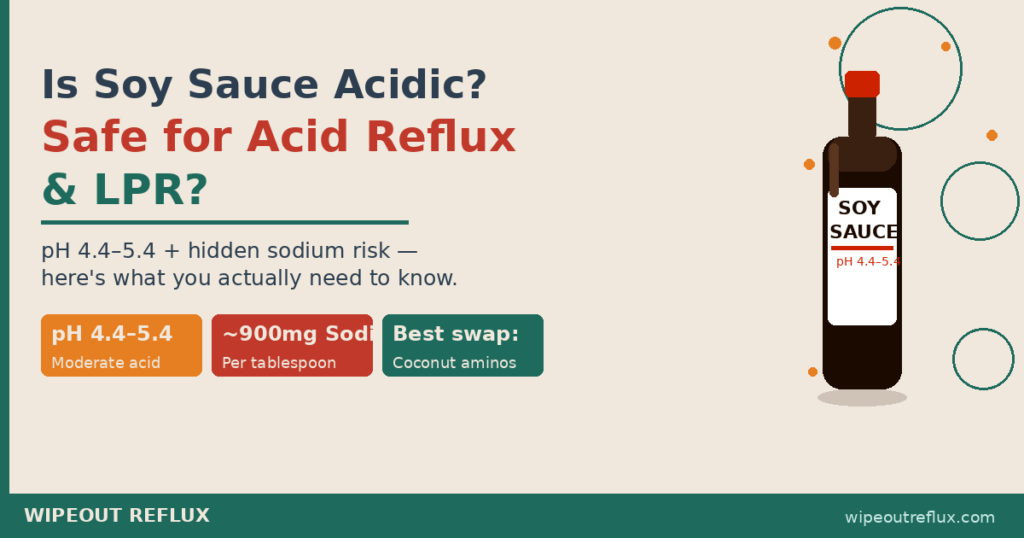
Yes, soy sauce is acidic — typically sitting at a pH of 4.4 to 5.4, depending on the variety and brand. That puts it in the moderately acidic range, less aggressive than vinegar, citrus, or tomato-based sauces, but still below the pH 5 threshold that LPR specialists often use as a cutoff for safe foods.
Whether that makes it a problem for you specifically depends on which type of reflux you have, how severe it is, how much you use, and critically — which soy sauce you choose. Not all soy sauces are equal, and the sodium content turns out to be as important a consideration as the pH.
Key Takeaways
- Soy sauce typically has a pH of 4.4–5.4, placing it in the moderately acidic range
- For GERD sufferers with mild to moderate symptoms, small amounts of a pure, traditionally brewed soy sauce are usually tolerable
- For LPR sufferers, soy sauce sits right at or below the pH 5 threshold that can reactivate pepsin in throat tissues — use with caution
- The sodium content of soy sauce (880–1,000mg per tablespoon) is a significant and often overlooked reflux concern — high salt intake is associated with increased GERD risk
- Chemically produced (hydrolysed) soy sauces tend to be more acidic and have more additives — avoid these
- Traditionally brewed, minimal-ingredient soy sauces (water, soy, wheat, salt) are the least problematic option
- Light and reduced-salt soy sauces are often more acidic than regular — counterintuitive but worth knowing
- Coconut aminos are the best soy sauce alternative for reflux — nearly pH-neutral, with around 70% less sodium per serving
Is Soy Sauce Acidic?
Yes — soy sauce is acidic, though its acidity is significantly less aggressive than most people assume. The pH range across commonly available varieties runs from approximately 4.4 to 5.4.
This acidity comes primarily from organic acids produced during fermentation — lactic acid and acetic acid develop naturally as soybeans and wheat ferment over months. These are the same kinds of organic acids found in yogurt and many fermented foods, and they give soy sauce its characteristic depth and tang alongside the umami flavour.
To put the pH in context: white vinegar sits around pH 2.4, lemon juice at pH 2–2.5, tomato sauce around pH 3.5–4, and Worcestershire sauce around pH 3.8. Soy sauce at pH 4.4–5.4 is meaningfully less acidic than most other common condiments, which is one of the reasons it tends to be better tolerated by reflux sufferers than many alternatives.
However, for LPR specifically, the relevant benchmark is different. The pH threshold at which pepsin deposited in throat tissues gets reactivated is around pH 4–5 — and soy sauce sits right in that zone for some varieties. This matters.
The Two Main Reflux Concerns with Soy Sauce
1. Acidity and LPR
For GERD patients, the moderate acidity of soy sauce is rarely a standalone issue in small quantities. The oesophagus tolerates intermittent contact with mildly acidic substances reasonably well, and a small splash of soy sauce on food doesn’t represent the same challenge as drinking citrus juice.
For LPR, the picture is more cautious. If pepsin from previous reflux events has deposited in your laryngeal or pharyngeal tissues — which is the core mechanism of LPR-related damage — then any acidic exposure at or below pH 5 can reactivate that enzyme and trigger fresh tissue damage. At the lower end of the soy sauce pH range (4.4–4.7), this is a real concern.
The practical implication: if you have active LPR symptoms, this is not the time to be liberal with soy sauce. If your LPR is well-controlled and you’re symptom-free, a small amount of a high-quality, higher-pH soy sauce (closer to 5–5.4) is likely tolerable for most people. For more on how pepsin reactivation works, see my complete guide to LPR.
2. The Sodium Problem
This is the aspect most articles on soy sauce and acid reflux completely miss, and it matters more than the pH for regular users.
A single tablespoon of standard soy sauce contains approximately 880–1,000mg of sodium — close to half the recommended daily limit in one small serving. High sodium intake has a documented association with increased GERD risk. A 2021 systematic review of 25 studies on dietary patterns and GERD found that salty foods were among the dietary factors consistently associated with higher reflux risk [Heidarzadeh-Esfahani et al., Preventive Nutrition and Food Science, 2021].
A Norwegian population study found that people who habitually added extra salt to food were 70% more likely to develop GERD than those who never did, and that eating salted fish or meat more than twice a month increased GERD risk by 50%. While soy sauce isn’t table salt, the sodium concentration per tablespoon is extremely high — and if you’re using soy sauce regularly across multiple meals, the cumulative sodium load is worth considering.
The mechanism likely involves high sodium intake reducing lower oesophageal sphincter pressure, as demonstrated in controlled studies — the same mechanism by which dietary fat and carbonated drinks worsen reflux. A more relaxed LES means more reflux events.
For more on how the LES functions and why its pressure matters, see my article on the stomach sphincter and LPR.
Not All Soy Sauces Are Equal
This is one of the most practically important things to understand. There’s a significant difference between a minimal-ingredient, traditionally brewed soy sauce and a cheaper, chemically produced alternative — both in terms of pH and ingredients.
Traditionally Brewed Soy Sauce (Best Option)
Traditionally brewed soy sauce is made from just four ingredients: water, soybeans, wheat, and salt. It’s fermented over months, which produces a complex flavour and a relatively stable pH in the upper range (closer to 5–5.4). The absence of added acidulants, preservatives, and flavour enhancers makes it the least irritating option for reflux sufferers.
Examples of this type include Kikkoman’s traditionally brewed soy sauce, which lists only water, soybeans, wheat, and salt on the label. This is the starting point I’d recommend for anyone with reflux who wants to include soy sauce in their diet.
Chemically Produced / Hydrolysed Soy Sauce (Avoid)
Many cheaper soy sauces are made through acid hydrolysis — a rapid chemical process that doesn’t involve natural fermentation. These products tend to have a lower pH, are more acidic, and often contain added ingredients like sugar, caramel colouring, citric acid, MSG, and sodium benzoate. From a reflux perspective, this combination of higher acidity and additional irritants makes chemically produced soy sauces a much worse choice.
If a soy sauce label lists citric acid, flavour enhancers, or acidity regulators — it’s a hydrolysed product. For more on how citric acid specifically affects reflux, I’ve covered it in a separate article.
Light and Reduced-Salt Soy Sauces
Here’s a counterintuitive point: light soy sauce and reduced-salt varieties are often more acidic than standard soy sauce, not less. Manufacturers compensate for reduced sodium by adding other flavour-enhancing ingredients, which can push the pH lower. Don’t assume “light” means safer for reflux — check the ingredients list.
How to Use Soy Sauce More Safely
If you want to continue using soy sauce and have acid reflux, here’s how to minimise the risk:
Use a small amount. A teaspoon diluted into a stir fry or broth is very different from a tablespoon used as a direct dipping sauce. The dilution effect significantly reduces both the acidity and the sodium load per mouthful.
Dilute it into cooking rather than serving it straight. When soy sauce cooks into a larger dish with other ingredients — vegetables, protein, broth — its acidity is diluted and buffered by the other components. Using it as a table condiment or dipping sauce means the full concentration contacts your oesophageal and throat tissue directly.
Choose traditionally brewed, minimal-ingredient varieties. As above — four ingredients maximum, no chemical additives.
Avoid soy sauce during active flares. If your symptoms are active, this isn’t the time to test your tolerance. Wait until things have settled before reintroducing it.
Start with one teaspoon and assess. Individual responses vary considerably. Some people with mild GERD tolerate soy sauce without any issue. Others with LPR find even small amounts problematic. The only way to know is to test carefully with a small amount and observe your response over the following hours.
The Best Soy Sauce Alternative for Acid Reflux: Coconut Aminos
If you want the umami depth of soy sauce without the acidity and sodium load, coconut aminos is the best option available.
Coconut aminos are made from fermented coconut palm sap and sea salt. They contain approximately 90–140mg of sodium per teaspoon — compared to around 280–350mg in the same amount of regular soy sauce — making them around 70% lower in sodium. They’re nearly pH-neutral (pH approximately 5.0–5.5), gluten-free, soy-free, and free of the chemical additives found in many commercial soy sauces.
The flavour is slightly sweeter and milder than soy sauce, but in cooked dishes the difference is minimal. For dipping, it can take a small adjustment but works well with most Asian-inspired food.
For people with significant reflux — particularly LPR — coconut aminos is comfortably the better choice. The lower sodium and higher pH make it meaningfully less likely to trigger symptoms.
Frequently Asked Questions
Is soy sauce high in acid?
Compared to most condiments, soy sauce is actually moderately acidic rather than highly acidic. Vinegar, citrus-based sauces, Worcestershire sauce, and tomato-based condiments are all significantly more acidic. The pH range of 4.4–5.4 places soy sauce below ideal for LPR but generally tolerable for GERD in small amounts.
Is soy sauce OK for GERD?
In small amounts, using a minimal-ingredient traditionally brewed variety, most GERD patients tolerate soy sauce without major issues — particularly when it’s cooked into a dish rather than used as a dipping sauce. The sodium content is the bigger ongoing concern. If you notice symptoms consistently following soy sauce use, stop and switch to coconut aminos instead.
Is soy sauce safe for LPR (silent reflux)?
With caution. The pH of some soy sauces (4.4–4.7) falls within the range that can reactivate pepsin in laryngeal tissues. During active LPR flares, avoid it. During stable, symptom-free periods, a very small amount of a high-quality, naturally brewed soy sauce with a higher pH may be tolerable for some people. Coconut aminos are a much safer everyday alternative.
Is soy OK for gastritis?
Generally yes — soy as a protein source (tofu, edamame) is not a gastritis trigger. The concern with soy sauce specifically is its high sodium content and moderate acidity, both of which can irritate an already-inflamed gastric lining. Plain soy in other forms is less likely to be problematic.
What is the pH of soy sauce?
Soy sauce pH ranges from approximately 4.4 to 5.4, depending on the brand and production method. Traditionally brewed soy sauces with minimal ingredients tend to sit in the higher end of this range (closer to 5–5.4). Chemically produced or heavily additive-laden varieties often sit lower (4.4–4.8).
Why is reduced-sodium soy sauce sometimes worse for reflux?
Reduced-sodium soy sauces often compensate for lower salt by adding flavour enhancers and acidulants, which can push the pH lower. Despite containing less sodium — which seems like a benefit — the additional acidic ingredients can make these varieties more irritating for reflux sufferers than standard minimal-ingredient soy sauce.
Related Articles
- Is Citric Acid Bad for Acid Reflux?
- Is Garlic Acidic or Alkaline?
- Is Salt Acidic or Alkaline?
- Best Salad Dressings for Acid Reflux
- The Complete Guide to LPR
- Stomach Sphincter and LPR
- The Acid Reflux Ultimate Guide
Conclusion
Soy sauce occupies a middle ground for reflux sufferers — not the most dangerous condiment on the shelf, but not one to use carelessly either. Its moderate acidity (pH 4.4–5.4) and extremely high sodium content make it worth approaching thoughtfully, particularly for LPR patients where the pepsin reactivation threshold is a real concern.
The practical take: if you want to keep soy sauce in your cooking, choose a traditionally brewed variety with minimal ingredients, use it sparingly in cooked dishes rather than as a dipping sauce, and monitor your response. If you find it consistently triggers symptoms, or if you want to simply remove the uncertainty, switching to coconut aminos solves both the acidity and sodium problems at once.
Managing reflux well is fundamentally about understanding which foods and condiments work with your system and which ones work against it — and building a consistent dietary approach around that knowledge. That’s exactly what the Wipeout Diet Plan is designed to help with. It goes well beyond individual food decisions and gives you the structured framework that actually produces lasting improvement in both GERD and LPR — including a full condiment and seasoning guide. If you’re still piecing things together trial and error, it’s worth exploring.
And for personalised guidance on your specific situation, I’m available for a one-to-one consultation.
Research Sources
A systematic review of 25 studies on dietary patterns and GERD found that salty foods were consistently associated with increased reflux risk across multiple study designs [Heidarzadeh-Esfahani et al., Preventive Nutrition and Food Science, 2021]. A case-control study of 268 newly diagnosed reflux esophagitis patients found high salt intake was independently associated with a significantly increased risk of reflux oesophagitis after adjustment for confounders [Zheng et al., PLOS ONE, 2013].
Soy sauce contains organic acids including lactic and acetic acid produced during fermentation, placing most varieties at pH 4.4–5.4 — moderately acidic and capable of reactivating pepsin in laryngeal tissues during exposure events in LPR patients [Johnston et al., Annals of Otology, Rhinology & Laryngology, 2010].

David Gray
12 years living with LPR · Consultant & researcher
I've lived with LPR for twelve years — the misdiagnoses, the PPI courses that did nothing, the slow work of figuring out what actually helps. Wipeout Reflux is where I translate the research into plain terms for people stuck in the same place. Every claim here is sourced to peer-reviewed work, and I consult one-to-one with LPR sufferers.