
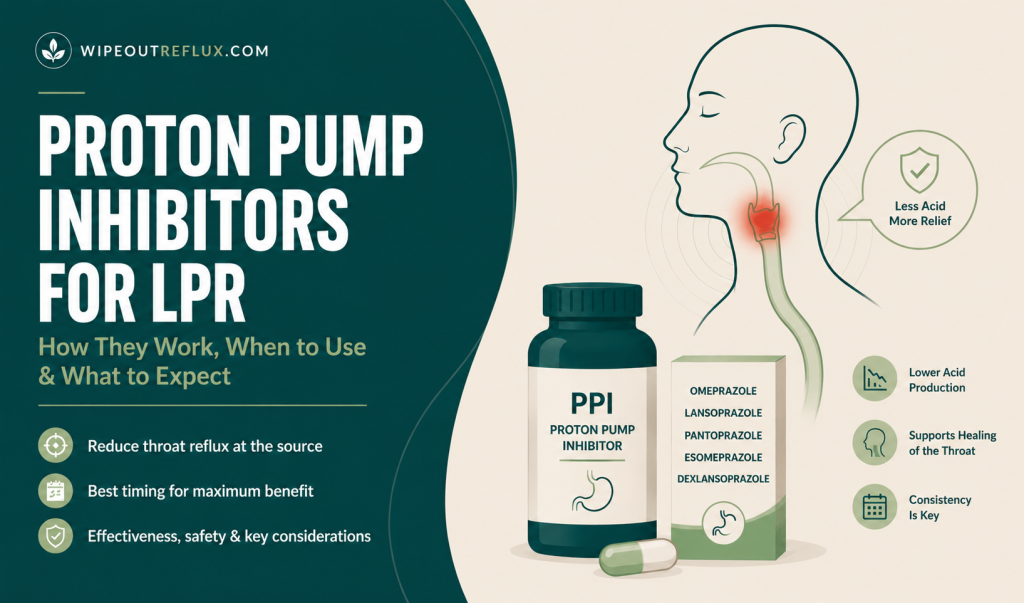
If you have been prescribed a proton pump inhibitor for LPR — omeprazole, lansoprazole, esomeprazole, pantoprazole — and it is not working, this article will explain exactly why. PPIs are the most commonly prescribed treatment for silent reflux worldwide. They are also, according to the best available clinical trial evidence, no better than placebo for the throat symptoms that define LPR. That is not a controversial statement anymore — it is where the evidence has landed, and it is what the 2024 international consensus on LPR now formally states.
That said, the full picture is more nuanced than “PPIs never help.” There are specific scenarios where they have a role. Understanding where they genuinely belong — and where they do not — is the difference between months of wasted treatment and an approach that actually moves your symptoms in the right direction. This article covers the mechanism, the evidence, the legitimate use cases, the risks of long-term use, and what to do if PPIs have not helped you.
Key Takeaways
- PPIs are designed to suppress gastric acid production — but LPR is primarily driven by pepsin, an enzyme that remains active and damaging even at pH levels PPIs routinely achieve.
- The TOPPITS trial (346 patients, 16 weeks, double-blind RCT) found lansoprazole was no better than placebo for persistent LPR throat symptoms.
- Multiple meta-analyses confirm PPIs do not significantly improve objective laryngeal findings (Reflux Finding Score) in LPR patients versus placebo.
- The 2024 IFOS international consensus formally states that acid suppression should not be first-line therapy for isolated LPR throat symptoms.
- PPIs can have a role in LPR when there is confirmed coexisting GERD, erosive esophagitis, or objective evidence of significant acid exposure.
- Long-term PPI use carries well-documented risks: vitamin B12 and magnesium deficiency, increased fracture risk, gut microbiome disruption, and a possible kidney disease association.
- Stopping PPIs abruptly can trigger rebound acid hypersecretion — a real physiological phenomenon that causes new symptoms and makes people think they still need the drug.
- Gaviscon Advance (UK alginate formulation) has stronger clinical evidence for LPR than PPIs, and works for non-acid and pepsin-driven reflux that PPIs cannot address.
What Are Proton Pump Inhibitors and How Do They Work?
Proton pump inhibitors work by irreversibly blocking the hydrogen-potassium ATPase enzyme (the proton pump) in the parietal cells of the stomach lining. This pump is responsible for secreting hydrochloric acid into the stomach. By inhibiting it, PPIs can reduce gastric acid output by 80–95%, raising intragastric pH from its natural range of 1–2 up to a range of 4–7 depending on the dose and individual response.
They are genuinely effective drugs for their intended purpose — treating erosive esophagitis, peptic ulcers, H. pylori eradication regimens, and Zollinger-Ellison syndrome. For classic GERD where acid in the esophagus is the dominant problem, PPIs have a clear and well-supported role. They reduce acid, reduce esophageal exposure to acid, and allow inflamed esophageal tissue to heal.
The problem is that LPR is not classic GERD. The mechanism, the anatomy of damage, and the primary culprit are fundamentally different — and understanding that difference is why most people on PPIs for LPR symptoms see little or no benefit.
Why Doctors Prescribe PPIs for LPR
PPIs became the standard empirical treatment for LPR largely by extension from GERD practice. When LPR was first being studied, the logical assumption was that — since reflux causes the symptoms, and PPIs reduce reflux acidity — PPIs should help. Clinical guidelines in many countries adopted this reasoning and recommended twice-daily high-dose PPI trials of three to six months as first-line therapy.
Most general practitioners and even many ENT specialists still follow this framework, not because the evidence supports it for LPR specifically, but because it is what they were trained to do and what existing guidelines recommend. The problem is that those guidelines were built on an incorrect mechanistic assumption, and the clinical trial data has consistently failed to validate them for isolated throat symptoms.
Understanding how LPR differs from GERD at a mechanistic level is the starting point for understanding why PPIs are the wrong tool for most people with silent reflux.
Do Proton Pump Inhibitors Work for LPR? What the Evidence Shows
The short answer is: not for isolated throat symptoms. Here is what the clinical trial evidence actually says.
The TOPPITS trial — a multicentre, double-blind, randomised, placebo-controlled study of 346 patients with persistent throat symptoms, funded by the NIHR and published in the BMJ — found no evidence of any benefit from lansoprazole over placebo for LPR throat symptoms after 16 weeks of treatment [O’Hara et al., BMJ / Health Technology Assessment, 2021]. This is the largest and most rigorous LPR-specific PPI trial ever conducted. Its conclusion was unambiguous.
Earlier meta-analyses told the same story. A 2016 meta-analysis of eight randomised controlled trials (370 patients) found no statistically significant difference between PPIs and placebo for overall LPR symptom improvement (RR 1.22, 95% CI 0.93–1.58) [Liu et al., Brazilian Journal of Medical and Biological Research, 2016]. A more recent meta-analysis of 14 RCTs found that while PPIs showed a modest statistical improvement in symptom scores (RSI), they produced no significant improvement in objective laryngeal findings (RFS — the clinical examination score that reflects actual tissue change) [Guo et al., Journal of Clinical Gastroenterology, 2016]. A drug that does not change objective findings is a drug whose apparent symptom effect may largely reflect placebo response and natural symptom fluctuation.
The 2024 IFOS international consensus — produced by 48 international experts in otolaryngology, gastroenterology, and surgery — formally concluded that acid suppression should not be considered first-line therapy for patients with isolated LPR symptoms without typical GERD findings [Lechien et al., The Laryngoscope, 2024]. This is now the position of the international scientific community, even if it has not yet filtered down to most clinical practice.
Why PPIs Struggle with Silent Reflux: The Pepsin Problem
The reason PPIs fail for LPR is not complicated once you understand the mechanism. LPR is not primarily an acid problem. It is a pepsin problem.
Pepsin is a proteolytic enzyme produced in the stomach alongside hydrochloric acid. In normal digestion it breaks down dietary proteins. In LPR, it travels upward with the refluxate and reaches the throat and larynx — tissues that have essentially no defence against it, unlike the esophagus which has layers of protective mechanisms. Pepsin can remain active at pH levels as high as 6.5 and can be reactivated by subsequent acid exposure even after it has been deposited on throat tissue. A PPI that raises intragastric pH from 1.5 to 4.5 has not deactivated the pepsin already in your throat.
Furthermore, PPIs do not prevent reflux events from occurring. They make the refluxate less acidic, but the stomach contents — including pepsin, bile, and other irritants — still travel upward during transient lower esophageal sphincter relaxations, which are the primary driver of most reflux events. For a condition like LPR where any reflux reaching the throat causes damage, reducing acidity while doing nothing about the reflux events themselves is an incomplete approach.
This is why the most effective medications for LPR are not acid suppressants but raft-formers — agents that physically prevent refluxate from reaching the throat in the first place, regardless of its pH. It is also why a low-acid diet works: by reducing the acidity of what is refluxed, you reduce pepsin’s ability to damage throat tissue even when reflux events do occur.
When PPIs Might Still Have a Role in LPR
I want to be fair here, because the evidence does not mean PPIs are useless in every LPR context. There are specific situations where they can contribute to management:
Confirmed coexisting GERD: If you have LPR alongside confirmed GERD — erosive esophagitis on endoscopy, Barrett’s esophagus, or objective evidence of significant acid overexposure via pH monitoring — PPIs address the GERD component and reduce the overall acid burden that pepsin travels with. In these cases, Gaviscon Advance and a PPI may be used together as the evidence on Gaviscon Advance confirms it is the more LPR-relevant treatment.
Short-term empirical trial with objective follow-up: Some specialists still use a two-to-three month twice-daily PPI trial as a diagnostic step, with the expectation of objective monitoring (pH testing, clinical scoring) to assess response rather than assuming treatment has worked. Twice-daily dosing (30 minutes before breakfast and dinner) is considered essential if PPIs are used for LPR, as once-daily dosing is inadequate to achieve sustained acid suppression — there is a well-documented phenomenon of nocturnal acid breakthrough on once-daily PPI therapy.
Bridging during dietary transition: Some people find that a short-term PPI course helps reduce the overall reflux burden while they implement significant dietary changes — buying time while the more durable interventions take effect. This is reasonable as long as there is a clear exit plan and the PPI is not continued indefinitely on the assumption it is the primary treatment.
If you have been taking PPIs for LPR and they have genuinely not helped, see my article on why acid reflux medication stops working — it covers both the mechanistic reasons and the next steps in more detail.
How Long Should You Take PPIs for LPR?
Standard ENT guidelines historically recommended a minimum of three to six months of twice-daily PPI therapy before concluding it has failed for LPR. This guidance pre-dates the TOPPITS trial and the IFOS consensus, and should be interpreted with that context in mind. Persisting on a treatment that the evidence does not support for your primary symptom type for six months is six months during which you could have been addressing the actual problem.
A more evidence-aligned approach would be: if you have been taking PPIs for LPR for eight to twelve weeks at twice-daily dosing with no meaningful improvement in your throat symptoms, they are very unlikely to work for you. The next step is not a higher dose or a different PPI — it is a different treatment strategy, specifically alginate therapy and a genuinely low-acid dietary approach targeting pepsin.
If your GP or ENT wants you to continue PPIs, a reasonable compromise is adding Gaviscon Advance to your existing PPI regimen while you review whether the PPI is adding anything — the Wilkie 2018 trial is worth discussing with them, as it showed Gaviscon Advance alone produced equivalent LPR outcomes to Gaviscon Advance plus twice-daily PPI [Wilkie et al., European Archives of Otorhinolaryngology, 2018].
The Risks of Long-Term PPI Use
This section matters particularly for LPR patients because, unlike GERD with confirmed erosive esophagitis (where the clinical justification for long-term PPIs is clearer), many LPR patients are on PPIs for months or years based on a diagnosis that did not warrant them. Being on any medication long-term without clear evidence of benefit requires an honest accounting of the risks.
Nutrient deficiencies: PPIs reduce gastric acid, which is required for the absorption of several key micronutrients. Vitamin B12 deficiency occurs in up to 20% of long-term PPI users, calcium and parathyroid hormone levels decline significantly over 12 months of use, and magnesium deficiency is well-documented (the FDA issued a specific safety warning on this). A systematic review found consistent evidence linking prolonged PPI therapy to reductions in B12 and calcium, with downstream risks including cognitive decline, bone fragility, and muscle weakness [Shahid et al., Cureus, 2025].
Fracture risk: A meta-analysis of data from over 2.7 million individuals found that PPI users had a 28% higher overall fracture incidence compared to non-users (OR 1.28, 95% CI 1.22–1.35), with fracture risk increasing with duration of use — from 29% higher for short-term to 62% higher for long-term users [Nassar et al., Journal of Bone Metabolism, 2018]. The mechanism is likely calcium malabsorption combined with altered gut microbiome function.
Gut microbiome disruption: By raising gastric pH, PPIs allow bacteria to survive the stomach’s normally hostile environment and colonise the small intestine in higher numbers. Long-term PPI use is associated with a measurable reduction in gut microbiome diversity and increased susceptibility to Clostridioides difficile infection, small intestinal bacterial overgrowth (SIBO), and other enteric infections. For those already dealing with LPR who may have gut dysbiosis as a contributing factor, this is a particularly relevant consideration — see my article on SIBO and acid reflux for more context.
Kidney disease: A systematic review found statistically significant associations between long-term PPI use and increased risk of chronic kidney disease, particularly in populations with other risk factors [Chaudhry et al., Cureus, 2025]. The evidence is largely observational and confounded by the fact that people prescribed long-term PPIs tend to have more comorbidities generally, but the association is consistent across multiple studies and warrants caution in patients with kidney risk factors.
None of these risks means PPIs are always inappropriate — for patients with Barrett’s esophagus or severe erosive GERD, the benefit clearly outweighs the risk. But for LPR patients taking PPIs without confirmed esophageal disease and without clear symptom benefit, these risks are worth taking seriously.
How to Come Off PPIs Safely
If you decide to stop PPIs after discussing it with your doctor, the critical thing to understand is that you should not stop suddenly. Abrupt PPI discontinuation triggers rebound acid hypersecretion (RAHS) — a physiological phenomenon where your stomach, which has upregulated its acid-secreting capacity in response to months of suppression, produces significantly more acid than normal when the PPI is removed. A placebo-controlled trial found that 44% of people who stopped PPIs after eight weeks developed new acid-related symptoms during the subsequent four weeks, compared to 15% of people who had never taken them [Namikawa & Björnsson, International Journal of Molecular Sciences, 2024]. This rebound is often misinterpreted as the underlying condition returning, which leads people back onto PPIs unnecessarily.
The approach I recommend — and that my dedicated PPI tapering guide covers in detail — is a gradual dose reduction over four to twelve weeks, transitioning to famotidine (an H2 blocker) as a bridge, then weaning off that too. Gaviscon Advance can be used throughout this transition to manage breakthrough symptoms mechanically.
What to Use Instead of PPIs for LPR
For most people with isolated LPR throat symptoms, the evidence-based approach looks like this:
Gaviscon Advance (UK sodium alginate formulation, 10ml after each meal and at bedtime) as the frontline medication. It works mechanically to prevent refluxate reaching the throat, is effective against acid and non-acid pepsin-containing reflux, has no systemic side effects, and has specific LPR clinical trial data. See my full Gaviscon Advance guide for sourcing the correct formulation.
Famotidine as an adjunct where there is a genuine acid component, particularly for nighttime symptoms. Unlike PPIs, it does not cause the same degree of rebound on cessation and is less disruptive to the gut microbiome. My article comparing Pepcid vs Gaviscon explains how these two options compare and when each is more appropriate.
A low-acid, low-pepsin diet targeting the foods that most strongly drive pepsin reactivation and increase reflux frequency. This is covered comprehensively in the LPR diet guide, and the overall management approach is outlined in the complete silent reflux treatment overview.
Frequently Asked Questions
Do PPIs work for LPR?
For isolated LPR throat symptoms — throat clearing, globus, hoarseness, postnasal drip, chronic cough — the evidence shows that PPIs are no better than placebo. The TOPPITS trial (346 patients, 16 weeks) found no benefit from lansoprazole over placebo, and multiple meta-analyses confirm that PPIs do not significantly improve objective laryngeal findings in LPR. Where PPIs can help is when LPR coexists with confirmed GERD — erosive esophagitis or objective evidence of significant acid overexposure.
Which PPI is best for LPR?
No PPI has been shown to be specifically superior to others for LPR. If a PPI is being used, twice-daily dosing (30 minutes before breakfast and before dinner) is essential — once-daily dosing leaves a window of nocturnal acid breakthrough that may be particularly relevant for LPR given that the throat is most vulnerable when lying flat. Esomeprazole and rabeprazole have slightly longer durations of action than omeprazole, but the clinical difference for LPR is not well-established. The honest answer is that the choice of PPI matters less than the question of whether a PPI is the right treatment at all.
Why did my LPR symptoms improve on PPIs?
Several explanations exist. LPR symptoms fluctuate naturally and tend to improve over weeks even without treatment, so improvement while on PPIs is not necessarily caused by them. There is also a well-documented placebo effect in LPR trials. If you also made dietary changes when you started PPIs — which many people do — the improvement may be attributable to those changes rather than the medication. Finally, if you have confirmed coexisting GERD, that component genuinely may have improved on PPIs.
Can I take PPIs and Gaviscon Advance together for LPR?
Yes, and some specialists do prescribe them together, particularly in cases with confirmed GERD alongside LPR. The key finding from the Wilkie 2018 trial, however, is that adding a PPI to Gaviscon Advance produced no additional benefit over Gaviscon Advance alone for LPR. If you are currently on both and reviewing your treatment, this is worth discussing with your prescriber — it may be appropriate to trial Gaviscon Advance alone before assuming the PPI is contributing.
What are the long-term side effects of PPIs for LPR?
The main well-documented concerns are vitamin B12 deficiency (occurs in up to 20% of long-term users), magnesium deficiency, calcium malabsorption and increased fracture risk (28% higher fracture risk in meta-analysis), reduced gut microbiome diversity with increased susceptibility to C. difficile and SIBO, and a possible association with kidney disease. The risk-benefit balance looks very different for someone with Barrett’s esophagus versus someone taking PPIs for unconfirmed LPR without symptom benefit.
What happens when I stop taking PPIs for LPR?
If you stop abruptly, you are likely to experience rebound acid hypersecretion — a period where your stomach produces significantly more acid than it did before you started PPIs, causing new heartburn and reflux symptoms. This is a physiological consequence of the stomach upregulating its acid-producing capacity during PPI therapy. It peaks in the first two weeks after stopping and typically resolves within four to eight weeks, but it can be severe enough that people restart PPIs unnecessarily. Always taper off gradually — my full guide to getting off PPIs covers the step-by-step approach.
My doctor says I need PPIs for LPR long-term — is that right?
This is a conversation worth having with your doctor armed with the evidence. The TOPPITS trial and the 2024 IFOS consensus are published in major peer-reviewed journals and represent the current scientific position on PPIs for isolated LPR throat symptoms. Long-term PPI use for a condition that trials have shown does not respond to PPIs — while carrying real risks of nutrient deficiency, fracture, and gut dysbiosis — does not represent best practice. You can ask your prescriber whether there is objective evidence of esophageal acid damage (endoscopy, pH testing) that justifies the ongoing prescription. If the answer is no, a trial of Gaviscon Advance with dietary changes is a reasonable alternative to discuss.
Conclusion
Proton pump inhibitors are genuinely useful drugs — for the right conditions. LPR, as an isolated throat symptom syndrome driven primarily by pepsin rather than acid, is not one of them. The clinical trial evidence is now clear and formally codified in international consensus: PPIs should not be first-line treatment for isolated LPR symptoms, and their long-term use for this indication carries risks that are not justified by a benefit that the evidence does not support.
If you are on PPIs for LPR and they have not helped, the answer is not a higher dose or a longer course — it is a different approach. Gaviscon Advance as the frontline medication, a low-acid diet that targets pepsin reactivation, and a careful taper off PPIs if you have been on them for any length of time. This is the approach the evidence supports, and it is the approach that actually gets results for most people with LPR.
The Wipeout Diet Plan is the most complete resource I have built for this — it covers the full dietary and lifestyle framework that addresses the root causes of LPR, not just the acid component. For a practical reference on foods and drinks — which ones drive pepsin reactivation, which are safe, and what their pH values are — the Wipeout Essential Reflux Food List is the companion resource designed for daily use alongside any treatment approach.
Research & References
The TOPPITS multicentre, double-blind, randomised placebo-controlled trial (346 patients, 16 weeks of lansoprazole vs placebo) found no evidence of any benefit from PPI therapy over placebo for persistent LPR throat symptoms, concluding that PPIs should not be prescribed for this indication. [O’Hara et al., BMJ / Health Technology Assessment, 2021]
An international consensus of 48 experts (the IFOS Dubai Consensus) formally stated that acid suppression should not be considered first-line therapy for patients with isolated LPR throat symptoms, and that LPR damage is caused not only by acid but by pepsin, bile salts, and trypsin. [Lechien et al., The Laryngoscope, 2024]
A meta-analysis of eight randomised controlled trials (370 patients) found no statistically significant difference between PPIs and placebo in overall LPR symptom improvement (RR 1.22, 95% CI 0.93–1.58, p=0.149) or in cough improvement. [Liu et al., Brazilian Journal of Medical and Biological Research, 2016]
A meta-analysis of 14 RCTs found that while PPIs modestly improved symptom index scores, they produced no significant improvement in objective Reflux Finding Score versus placebo — indicating no meaningful change in actual laryngeal tissue findings. [Guo et al., Journal of Clinical Gastroenterology, 2016]
A prospective study of 100 LPR patients found that Gaviscon Advance alone was equally effective to Gaviscon Advance co-prescribed with twice-daily high-dose PPI, with no additional LPR symptom benefit from adding the PPI. [Wilkie et al., European Archives of Otorhinolaryngology, 2018]
A systematic review of long-term PPI use found consistent evidence of reductions in vitamin B12 (deficiency in up to 20% of users) and calcium, with downstream risks including cognitive decline, bone fragility, and fracture, particularly in older and polypharmacy populations. [Shahid et al., Cureus, 2025]
A meta-analysis of over 2.7 million individuals found a 28% higher overall fracture incidence in PPI users versus non-users (OR 1.28, 95% CI 1.22–1.35), with fracture risk increasing with duration of use from 29% higher (short-term) to 62% higher (long-term). [Nassar et al., Journal of Bone Metabolism, 2018]
A review of rebound acid hypersecretion confirmed this as a well-established physiological phenomenon after PPI discontinuation, with randomised trial evidence showing 40–50% of PPI users developed new acid symptoms upon stopping versus controls, and recommending gradual tapering over abrupt cessation. [Namikawa & Björnsson, International Journal of Molecular Sciences, 2024]

David Gray
Content Researcher & Author
David Gray founded Wipeout Reflux to address a critical gap in reflux management. His research synthesizes over 100 peer-reviewed studies on laryngopharyngeal reflux (LPR), pepsin biology, and GERD pathophysiology. For LPR specifically—a condition most physicians misdiagnose—his work focuses on pepsin reactivation and why standard PPI therapy fails most patients. He develops evidence-based protocols targeting root causes of both LPR and GERD, integrating emerging research on sphincter dysfunction, dietary interventions, and newer clinical approaches. Wipeout Reflux represents practical application of clinical science for patients seeking real solutions.