
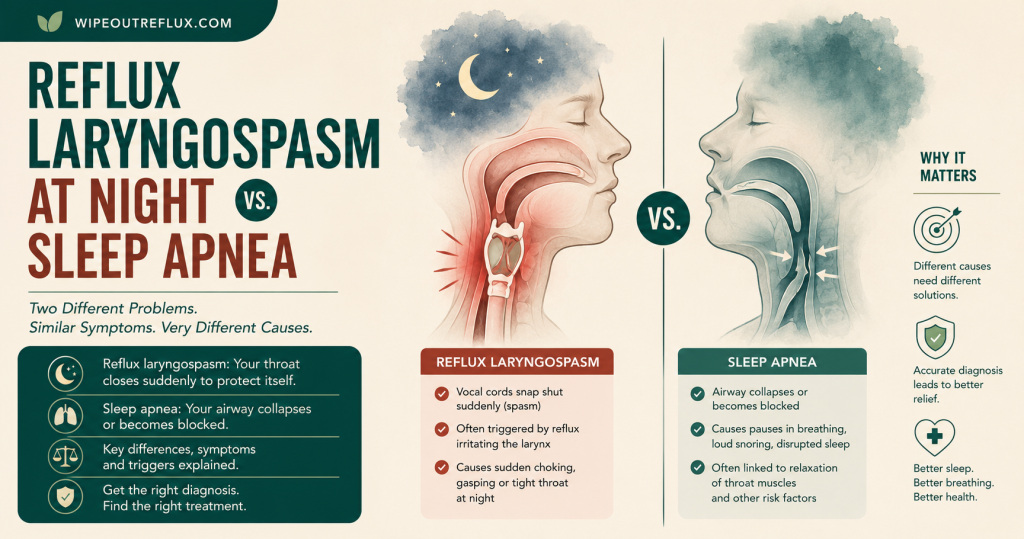
If you wake at night gasping or choking, it’s natural to want a name for what just happened. Two very different conditions are the usual suspects: reflux-triggered laryngospasm and obstructive sleep apnea. From the inside they can feel almost identical — a sudden, terrifying fight for air — yet they’re nearly opposite in what’s actually going on, and telling them apart genuinely matters.
Here’s the quick version. Reflux laryngospasm tends to wake you fully and instantly, with your throat clamped shut and often a high-pitched noise as you try to breathe in; it passes on its own within seconds to a couple of minutes and is usually triggered by acid reaching your voice box. Sleep apnea, by contrast, usually involves loud snoring and repeated pauses in breathing that you often don’t fully wake from — and it typically leaves you exhausted during the day, with a bed partner noticing it before you do.
The most important thing I can say up front: you can have both, and only a proper medical assessment (including a sleep study) can diagnose sleep apnea. This article will help you understand the differences, but please don’t use it to self-diagnose. I’m not a doctor, and this is background rather than medical advice.
Key takeaways
- Reflux laryngospasm and obstructive sleep apnea can both cause you to wake up gasping, but the mechanisms are almost opposite.
- In laryngospasm, the vocal cords actively clamp shut; in sleep apnea, the airway passively collapses.
- Laryngospasm wakes you fully and instantly, often with a high-pitched sound (stridor), and passes in seconds to minutes.
- Sleep apnea involves loud snoring and repeated pauses you may not fully wake from, plus daytime sleepiness.
- Laryngospasm is usually infrequent; sleep apnea happens repeatedly, all night, every night.
- The two conditions commonly coexist and can worsen each other.
- Sleep apnea is serious and needs proper diagnosis and treatment — never assume it’s “just reflux.”
- A sleep study is the gold standard for diagnosing sleep apnea; don’t self-diagnose.
Reflux laryngospasm vs sleep apnea at a glance
| Feature | Reflux laryngospasm | Obstructive sleep apnea |
|---|---|---|
| What happens | Vocal cords actively clamp shut (a reflex over-reaction) | Throat muscles relax and soft tissue collapses, blocking the airway |
| Waking | Sudden, fully wakes you instantly | Often doesn’t fully wake you; a partner may notice |
| Sound | High-pitched stridor as the cords reopen | Loud snoring, then a gasp or snort |
| Duration and frequency | Seconds to about two minutes; often infrequent | Repeated pauses every hour, throughout the night |
| Common trigger | Acid reaching the voice box, often after a late meal or alcohol | Airway anatomy, weight, muscle tone |
| Straight afterwards | Wide awake and frightened, voice may be hoarse | Breathing restored quickly; often no memory of it |
| During the day | Usually fine between episodes | Excessive sleepiness, morning headaches |
| What helps | Anti-reflux measures | CPAP, weight loss, positional therapy and other medical treatments |
The core difference: clamping shut vs collapsing
The single most useful thing to understand is that these two conditions are mechanical opposites. In laryngospasm, the muscles of the voice box contract too hard, actively slamming the vocal cords shut as a protective reflex. In obstructive sleep apnea, the muscles of the throat relax too much, so soft tissue and the tongue fall back and passively block the airway.
That one distinction — active clamping versus passive collapse — drives almost every difference in how the two feel and behave. It explains why laryngospasm wakes you with a jolt while apnea often doesn’t, why one makes a high-pitched sound and the other a snore, and why they respond to completely different treatments.
What reflux laryngospasm looks like
Reflux laryngospasm is dramatic and unmistakable once you know it. You wake abruptly and fully, with a sensation that your throat has sealed shut and you can’t draw breath. As the cords begin to reopen, air squeezing through the narrow gap often makes a harsh, high-pitched sound called stridor. The episode is short — typically seconds up to a couple of minutes — and then normal breathing returns, sometimes after a breath or two, often leaving your voice hoarse and you badly shaken.
In a classic series of these cases, patients described sudden awakening with acute suffocation and intense fear, a brief spasm followed by stridor, and breathing returning to normal within minutes — and 9 of the 10 had evidence of reflux [Thurnheer et al., European Respiratory Journal, 1997]. Crucially, these events tend to be infrequent, and you’re completely fine between them. The trigger is acid or pepsin reaching the voice box, which is why episodes often follow a large late meal or evening alcohol. I cover the breathing side of this in more depth in my guide to silent reflux and shortness of breath.
What obstructive sleep apnea looks like
Sleep apnea has a very different signature. Instead of a single dramatic event, it involves the airway repeatedly narrowing or collapsing throughout the night — often dozens of times an hour. The hallmark is loud, habitual snoring, punctuated by pauses in breathing and then a gasp or snort as breathing resumes.
The catch is that people with sleep apnea usually don’t fully wake up during these events, and don’t report the stridor or the conscious struggle for air that defines laryngospasm. Very often it’s a bed partner who notices the snoring and the pauses first. What the person themselves notices is the daytime fallout: heavy, unrefreshing sleep, excessive daytime sleepiness, morning headaches and poor concentration. Risk factors include excess weight, a larger neck, and increasing age, and untreated sleep apnea carries real cardiovascular risks — which is exactly why it needs proper diagnosis. My article on sleep apnea and acid reflux looks at how the two interact.
The tells that separate them
If you’re trying to work out which one fits your experience, a few features are especially telling. Point towards laryngospasm: waking fully and instantly, a high-pitched stridor sound, a brief single episode, feeling fine during the day, and a link to late meals or alcohol. Point towards sleep apnea: loud nightly snoring, pauses witnessed by a partner, repeated events, no stridor, and significant daytime sleepiness.
One well-established clinical distinction sums it up: people with sleep apnea will not generally wake themselves up and will not report stridor or difficulty breathing while awake, whereas those symptoms strongly suggest laryngospasm [O’Shea et al., Irish Journal of Medical Science, 2022]. That said, these are clues, not proof — which brings us to the crucial complication.
The overlap: you can have both
Here’s what many articles miss: reflux and sleep apnea frequently coexist, and they can feed each other. The pressure swings in the chest during apnea events can promote reflux, and reflux can inflame and irritate the upper airway. So it’s genuinely common to have both conditions at once, and the gasping episodes waking you might have more than one cause.
This is exactly why you shouldn’t settle on “it’s just my reflux” and skip a proper sleep assessment. Treating the reflux might reduce your laryngospasm episodes while leaving significant, untreated sleep apnea quietly doing damage in the background. The two need to be untangled by someone who can test for both.
Why getting it right matters — and how each is diagnosed
The stakes are different for each condition, which is what makes an accurate diagnosis so important. Reflux laryngospasm, while frightening, is self-limiting and responds very well to reflux control — across these studies, the great majority of patients stopped having episodes once their reflux was treated. Obstructive sleep apnea is a chronic condition with serious long-term health consequences if left untreated, and it requires its own management, most commonly CPAP.
Diagnosis differs too. Sleep apnea is diagnosed with a sleep study (polysomnography), which measures how often your breathing is interrupted overnight — this is the gold standard, and there’s no substitute for it. Reflux laryngospasm is diagnosed largely from the story you tell, sometimes supported by reflux testing or laryngoscopy, and by how well it responds to anti-reflux treatment. Because the two can look and feel so similar, and because they can overlap, this is not something to diagnose yourself. See your doctor, describe your episodes precisely, and ask about a sleep study if there’s any suggestion of apnea. Seek urgent help for breathing that doesn’t quickly resolve, blue lips, or throat swelling.
Conclusion
Waking up gasping is frightening whatever the cause, but the two most likely explanations couldn’t be more mechanically different. Reflux laryngospasm is your vocal cords clamping shut against acid — sudden, brief, self-limiting, and closely tied to what and when you ate the night before. Sleep apnea is your airway quietly collapsing over and over, marked by snoring and daytime exhaustion more than by dramatic middle-of-the-night awakenings. Knowing which pattern fits your nights is the first step towards the right help — and remembering that you can have both is what stops you treating half the problem.
Because sleep apnea carries serious health risks and needs proper medical treatment, the single most important move is to get assessed rather than guess. If your episodes point towards reflux, though, the good news is how well that side responds to controlling the acid reaching your throat — with careful evening habits, an elevated head, and a low-acid approach in the hours before bed. My guides to night-time reflux, the best sleeping position for silent reflux, and neutralising pepsin in the throat all help with that, as does an alginate like Gaviscon Advance before bed.
If you want a clear, structured way to bring that reflux under control, my Wipeout Diet Plan is the step-by-step programme I built to calm reflux at the source, going far deeper into the mechanisms and daily routine than any single article can. And to make everyday choices simple, the Wipeout Food Reference Guide is the essential companion, laying out the foods and drinks allowed on an acid reflux and LPR diet along with their pH values — so you can keep acid away from your throat, especially before bed. Just remember: the diet addresses the reflux side of the picture, so if sleep apnea is part of your story, it needs its own diagnosis and treatment alongside.
Frequently asked questions
How can I tell if I have reflux laryngospasm or sleep apnea?
The clearest clues are how you wake and what you notice. Laryngospasm wakes you fully and instantly with your throat clamped and often a high-pitched sound, lasts seconds to minutes, and leaves you fine during the day. Sleep apnea involves loud nightly snoring, repeated pauses often noticed by a partner rather than you, and significant daytime sleepiness. Only proper testing can confirm it, though.
Can you have both reflux laryngospasm and sleep apnea?
Yes, and it’s common. Reflux and sleep apnea frequently coexist and can worsen each other — apnea’s pressure changes can promote reflux, and reflux can irritate the airway. This is why you shouldn’t assume your gasping is “just reflux” and skip a sleep assessment, as untreated sleep apnea can be doing harm even if reflux is also present.
Does sleep apnea make a high-pitched sound like laryngospasm?
Not usually. The classic sound of sleep apnea is loud snoring followed by a gasp or snort as breathing resumes. The high-pitched, harsh sound called stridor — made as air squeezes past nearly closed vocal cords — is much more characteristic of laryngospasm. Stridor plus fully waking up is one of the more reliable pointers towards laryngospasm rather than apnea.
Is waking up gasping always sleep apnea?
No. While sleep apnea is a very common cause, waking up gasping can also be reflux laryngospasm, nocturnal asthma, anxiety, or occasionally other conditions. The pattern of your episodes helps point to the likely cause, but because the possibilities range from benign to serious, waking up gasping should always be assessed by a doctor.
How is each condition diagnosed?
Sleep apnea is diagnosed with a sleep study (polysomnography) that measures how often your breathing is interrupted overnight — this is the gold standard. Reflux laryngospasm is diagnosed mainly from your account of the episodes, sometimes with reflux testing or laryngoscopy, and confirmed by how well it responds to anti-reflux treatment. Because they overlap, testing for both may be needed.
Does treating reflux help sleep apnea?
Controlling reflux can modestly ease airway irritation and may help some people who have both conditions, but it is not a treatment for sleep apnea itself. Sleep apnea needs its own management, most often CPAP along with measures like weight loss. Treating reflux is worthwhile, but it should never replace proper sleep apnea treatment.
When should I see a doctor about waking up gasping?
Always get recurrent gasping episodes assessed, both to identify the cause and to rule out sleep apnea, which needs treatment. See your doctor promptly if episodes are frequent or distressing, if you snore heavily or feel very sleepy during the day, and seek emergency care for breathing that doesn’t quickly resolve, blue lips, or swelling of the lips, tongue or throat.
Research sources
- [Thurnheer et al., European Respiratory Journal, 1997] — A series of 10 patients with sleep-related laryngospasm who described sudden awakening with acute suffocation and intense fear, a brief spasm followed by stridor, and normal breathing within minutes; 9 of 10 had evidence of reflux and most improved with antireflux therapy.
- [O’Shea et al., Irish Journal of Medical Science, 2022] — Established sleep-related laryngospasm as a manifestation of LPR and noted the key distinction that sleep apnea patients do not generally wake themselves or report stridor or difficulty breathing while awake, so apnea must be excluded first.
- [Loughlin & Koufman, The Laryngoscope, 1996] — In patients with reflux-induced paroxysmal laryngospasm, only a third had heartburn, yet the great majority had evidence of reflux and all had complete cessation of episodes after antireflux treatment.

David Gray
12 years living with LPR · Consultant & researcher
I've lived with LPR for twelve years — the misdiagnoses, the PPI courses that did nothing, the slow work of figuring out what actually helps. Wipeout Reflux is where I translate the research into plain terms for people stuck in the same place. Every claim here is sourced to peer-reviewed work, and I consult one-to-one with LPR sufferers.