
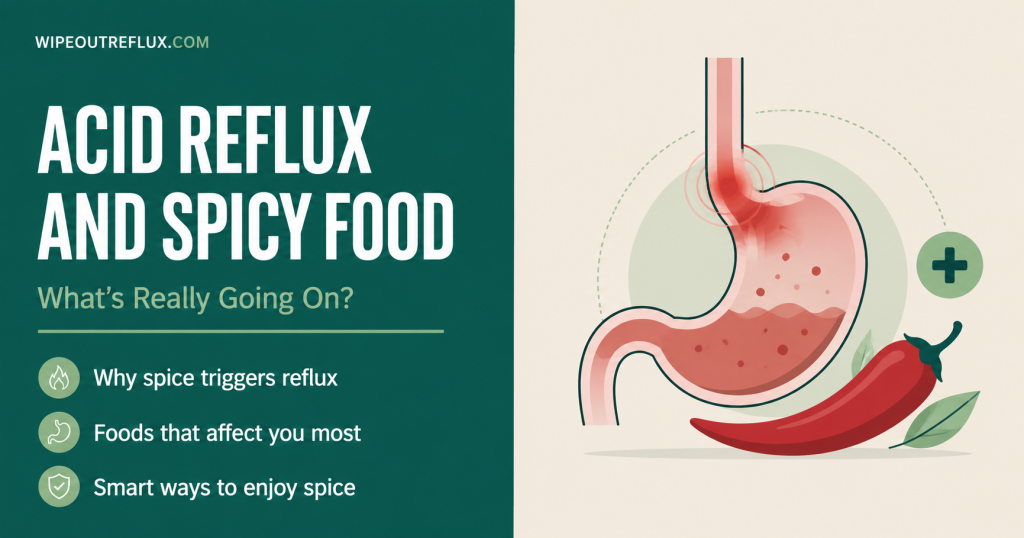
If you’ve ever reached for the antacids after a spicy meal, you’re not imagining things. Spicy food is one of the most commonly reported triggers for acid reflux and heartburn — but the actual mechanism behind why it causes problems is more interesting, and more nuanced, than most people realise.
The short answer is: spicy food — particularly capsaicin, the active compound in chilli peppers — doesn’t usually cause more acid or a weaker lower oesophageal sphincter. Instead, it sensitises the oesophageal lining, making you feel discomfort more intensely. That said, it can also delay gastric emptying in some people and directly irritate already inflamed tissue, which matters a lot if you have LPR (silent reflux).
In my own experience managing LPR for over eight years, spicy food was one of the first things I cut out — and one of the last things I tried reintroducing. Understanding the mechanism behind what’s happening helped me make smarter decisions than just blanket avoidance for life.
Key Takeaways
- Capsaicin — the compound that makes chilli peppers hot — activates TRPV1 receptors in the oesophagus, which amplifies burning and pain sensations without necessarily increasing acid production.
- Spicy food is positively correlated with both GERD and non-erosive reflux disease (NERD) across multiple studies.
- Capsaicin can delay gastric emptying, meaning food and acid sit in the stomach longer — increasing the chance of reflux.
- For LPR sufferers, spicy food presents an additional risk: it can directly irritate the already-sensitive throat and larynx tissue, making symptoms worse even when acid levels haven’t risen.
- People with existing reflux have higher densities of TRPV1 receptors in the oesophagus, which may explain why they’re more sensitive to spicy food than healthy individuals.
- Spicy food alone is unlikely to cause reflux in healthy people — but it significantly worsens symptoms in those who already have it.
- Long-term, low-dose capsaicin exposure may actually desensitise TRPV1 receptors — though this is a research-stage finding and not a practical management strategy for most people.
- Avoiding spicy food during the healing phase of an LPR or GERD dietary protocol is strongly recommended, with careful reintroduction possible once symptoms stabilise.
Why Spicy Food Triggers Acid Reflux Symptoms
The burning you feel after a vindaloo isn’t coming from nowhere — but it’s not always coming from acid either. The primary driver is a compound called capsaicin, which is found in chilli peppers and most spicy foods. Capsaicin binds to receptors in the gut and oesophagus called TRPV1 (transient receptor potential vanilloid 1) receptors — the same receptors that respond to heat and physical tissue damage.
When capsaicin activates TRPV1 in the oesophagus, it triggers what feels identical to a burning sensation — even if acid levels are normal. Think of it as turning up the volume on pain signals rather than generating new damage. That’s a critical distinction, because it means spicy food can make reflux feel much worse than it actually is, and can also cause symptoms in people who don’t have measurably elevated acid exposure.
What makes this more complicated for reflux sufferers specifically is that chronic acid exposure changes the oesophagus. Research has shown that people with non-erosive reflux disease have a higher density of TRPV1-positive nerve fibres in their oesophageal lining compared to healthy controls — meaning their oesophagus is already primed to over-react to capsaicin.
This is part of why reflux throat symptoms can persist even when acid production is brought under control. Sensitisation of the oesophageal lining doesn’t resolve overnight, and spicy food keeps firing those nerve signals while healing is still underway.
The TRPV1 Receptor Explained: Why Your Oesophagus Reacts to Spice
TRPV1 receptors are pain and heat sensors. They’re part of the body’s early warning system — designed to respond to temperatures above 43°C (roughly the threshold of tissue damage) and to certain chemical irritants. Capsaicin happens to fit neatly into the same binding pocket that heat activates, which is why eating spicy food literally feels like heat even when the food isn’t actually hot.
In a healthy oesophagus, TRPV1 receptors are present in relatively low numbers. But in people who’ve had chronic acid exposure — even at the low levels typical of LPR — these receptor populations expand. The oesophageal lining undergoes a kind of neuroplastic change that amplifies its sensitivity to irritants like capsaicin, temperature, and acid itself.
This is also one of the mechanisms behind laryngeal sensory neuropathy — where the larynx becomes hypersensitive to stimuli that wouldn’t normally cause symptoms. If that sensitisation process is already underway, adding capsaicin to the mix is essentially pouring petrol on the fire.
Spicy Food and LPR (Silent Reflux): A Different and Bigger Problem
If you have LPR (silent reflux), spicy food is an even greater concern than it is for standard GERD. Here’s why.
With GERD, the problem is mainly confined to the oesophagus. Even if capsaicin amplifies pain signals there, the tissue is relatively resilient. The throat and larynx are not. The vocal cords and laryngeal mucosa are far more sensitive to irritants — both chemical and thermal — than the oesophageal lining. Even a small amount of reflux reaching the throat is enough to cause significant inflammation.
Spicy foods cause two distinct problems for LPR sufferers. First, they can trigger more reflux events by slowing gastric emptying — meaning there’s more opportunity for stomach contents to migrate upward. Second, any capsaicin that does reach the throat via reflux — or even inhaled particles from steam during cooking — can directly irritate the laryngeal tissue and activate TRPV1 receptors there.
The throat doesn’t have the same protective mechanisms the oesophagus does. There’s no mucosal bicarbonate secretion, no protective mucous layer built for acid contact. That’s why even brief contact with irritants at the level of the throat can cause symptoms like hoarseness, throat clearing, and the classic globus sensation that LPR sufferers know all too well.
A clinical dietary study on LPR patients found that switching away from acidic, spicy, fermented, and fried foods — alongside standard PPI treatment — significantly reduced LPR symptoms and improved quality of life across all measured domains. Diet change wasn’t an optional add-on in that research: it was central to the improvement.
Does Spicy Food Actually Cause Reflux, or Just Make It Feel Worse?
This is an important distinction, and the science is genuinely a bit divided here. What the research consistently shows is that capsaicin doesn’t appear to significantly lower lower oesophageal sphincter (LES) pressure in the way that fatty foods, alcohol, or peppermint do. That means it’s not directly causing more acid to leak through the valve in the way those foods do.
What capsaicin does do reliably is make you feel the effects of reflux more intensely, and earlier. One controlled trial found that adding capsaicin to a meal significantly reduced the time to peak heartburn — meaning participants felt heartburn sooner after eating, even though the amount of acid reflux measured by pH monitoring wasn’t substantially different.
But there’s another side to this. Some studies, particularly looking at patients with NERD, show that capsaicin can trigger delayed gastric emptying. When food stays in the stomach longer than it should, pressure builds and the risk of reflux events increases. So while capsaicin may not directly weaken the sphincter, it can create the conditions where reflux is more likely to occur.
For LPR specifically, the distinction between “causing more acid” and “making existing reflux more damaging” matters less than you’d think. The throat tissue doesn’t distinguish between pepsin that arrived because the sphincter relaxed and pepsin that arrived because food sat too long in the stomach — it gets damaged either way.
If you’re still on PPIs and finding them aren’t working as expected, it’s worth reading about why acid reflux medication stops working — dietary factors like spicy food are often part of the equation.
The Gastric Emptying Factor
One of the less-discussed ways spicy food can worsen reflux is through its effect on gastric motility. Several studies have shown that capsaicin slows gastric emptying — the rate at which the stomach moves its contents into the small intestine.
When the stomach empties slowly, several things happen that are bad for reflux:
- Intra-gastric pressure rises, increasing the likelihood of the LES relaxing transiently.
- Stomach contents sit at a higher volume for longer, raising the chance they’ll reflux upward.
- There’s a longer window during which acid exposure is elevated in the stomach.
- Post-meal reflux events become more likely, particularly in the two-hour window after eating.
This is also one reason why the timing of spicy meals matters. Eating spicy food late in the evening — when you’re likely to lie down within a couple of hours — is particularly problematic. Slow gastric emptying combined with reduced gravity assistance when horizontal is a reliable recipe for a bad night.
The connection between delayed emptying and reflux is also relevant for anyone exploring SIBO and acid reflux — both conditions can compound each other through similar motility dysfunction.
Why Some People React More Strongly to Spicy Food Than Others
If you’ve ever eaten the same curry as someone else and ended up suffering while they feel fine, you’ll know that individual responses to spicy food vary enormously. There are several reasons for this.
Pre-existing oesophageal sensitisation: As mentioned above, people with chronic acid exposure have higher TRPV1 receptor densities. This means the same amount of capsaicin creates a stronger pain signal in someone with reflux than in someone without it.
Baseline LES function: People with a naturally weaker lower oesophageal sphincter are more likely to experience reflux in response to any food that raises intra-gastric pressure — spicy or not.
Stomach acid levels: Some people produce more acid than others, and capsaicin combined with high acid output creates a more potent irritant mix.
Frequency of exposure: Interestingly, research suggests that long-term regular consumption of capsaicin may actually desensitise TRPV1 receptors over time — which is why habitual chilli eaters often tolerate spice much better than occasional consumers. However, this desensitisation effect is not a reliable strategy for managing reflux and shouldn’t be pursued during the healing phase.
Whether LPR or GERD is the underlying issue: LPR sufferers tend to experience more significant symptom worsening from spicy food than classic GERD patients, because their throat tissue is the primary site of irritation and it has much lower tolerance for any irritant at all.
Which Spicy Foods Are Worst for Acid Reflux and LPR?
Not all spicy foods are equally problematic. The capsaicin content matters, but so does the acidity of the food it’s delivered in. This is where LPR sufferers need to be particularly vigilant.
The most problematic spicy foods for reflux are typically:
- Hot sauces: These combine high capsaicin with very low pH — most commercial hot sauces sit between pH 2.5 and 4.0, which is acidic enough to reactivate pepsin in the throat.
- Curries with tomato base: Tomatoes are both acidic and a known pepsin activator. Add capsaicin and you have a compounding irritant problem.
- Spicy fried foods: The combination of fat (which slows gastric emptying and lowers LES pressure) and capsaicin is particularly bad.
- Chilli-based sauces with vinegar: Vinegar is one of the most reliable pepsin activators at low pH — combining it with capsaicin creates a highly irritant mixture for LPR sufferers.
- Spicy snacks eaten late at night: Timing amplifies the problem significantly.
Plain red pepper flakes or freshly ground black pepper — with no acid-containing base — tend to be better tolerated by some people than the sauces above, though this varies individually. Understanding the pH of what you’re eating alongside spice is important; the Wipeout Food Reference Guide covers the pH values and reflux potential of hundreds of foods and drinks to help you make those calls more precisely.
Practical Steps for Managing Spicy Food and Reflux
If spicy food is a trigger for you, the approach I’d recommend is structured rather than permanent total elimination — unless your symptoms are severe or you have active LPR flare.
During the healing phase: Remove all spicy food for at least four weeks. This includes hot sauces, chilli, spicy curries, and anything with a noticeable capsaicin burn. You need to let the oesophageal and laryngeal tissue calm down before you can meaningfully test individual foods.
After stabilisation: Introduce mild heat carefully — a small amount of black pepper or a mildly spiced dish — and observe your response over 24–48 hours. Hot sauces, particularly acidic ones, should be the last things you try if at all.
Watch the combinations: Spicy food on its own is one thing. Spicy food combined with alcohol, a late meal, or a large portion size is a much bigger problem. The variables compound.
Don’t eat spicy food within 3 hours of bed: Gastric emptying is already slower at night. Add capsaicin-induced slowing on top of that and you’re creating the ideal conditions for overnight reflux. If nighttime reflux is an issue for you, this guide on managing acid reflux at night covers positioning and timing strategies in more detail.
Chew thoroughly and eat slowly: Larger, less-chewed particles slow gastric emptying further. Eating slowly also reduces air swallowing, which drives belching and reflux events.
Keep a food diary: Individual sensitivity to capsaicin varies. The only reliable way to understand your own threshold is to track symptoms methodically and compare against what you ate, when, and how much.
Can You Ever Eat Spicy Food Again With Reflux?
For many people, the answer is yes — but in a limited and mindful way, and only once the underlying reflux is properly managed. The goal isn’t to permanently give up every spicy dish forever. It’s to reduce the burden on an inflamed, sensitised system long enough for healing to occur, then carefully test your tolerance.
Some people find that once LPR or GERD is well-managed — through a combination of diet, lifestyle changes, and appropriate treatment — they can tolerate mild spice without significant symptoms. Others find that even mild chilli is reliably problematic and choose to avoid it long-term. Both outcomes are valid; what matters is having a systematic approach to finding out where you stand.
What I’d caution against is using spicy food as a way to “test” whether you’re better before your symptoms have genuinely stabilised. Capsaicin is one of the more provocative stimuli for the oesophageal TRPV1 system, and introducing it too early can set back the sensitisation process significantly.
The broader dietary framework for managing LPR and GERD — including which foods to prioritise and which to phase back in and when — is covered in the LPR diet guide, which is a solid starting point for structuring your approach.
Frequently Asked Questions
Does spicy food increase stomach acid?
Not directly in most cases. Capsaicin doesn’t appear to significantly increase gastric acid production. What it does do is sensitise the oesophageal lining through TRPV1 receptor activation, making you feel acid-related discomfort more intensely. Some research also suggests it can slow gastric emptying, which increases reflux risk indirectly.
Why does spicy food cause heartburn if it doesn’t produce more acid?
Because heartburn is partly a sensation created by sensitised nerve receptors in the oesophagus — not just a direct measure of how much acid is present. Capsaicin activates TRPV1 receptors in the oesophageal lining, creating a burning sensation. In people with chronic reflux, these receptors are more numerous and more reactive, amplifying the response further.
Is spicy food worse for LPR than for GERD?
Yes, generally speaking. With LPR, any irritant that reaches the throat — including capsaicin from reflux or even hot vapours from cooking — can inflame already-sensitive laryngeal tissue. The throat doesn’t have the same acid-protective mechanisms the oesophagus has, so the threshold for irritation is much lower.
Can eating spicy food cause a sore throat from reflux?
Yes, particularly in LPR. When capsaicin is part of a reflux event that reaches the throat, it can worsen laryngeal inflammation and contribute to throat soreness, hoarseness, and post-nasal drip-like symptoms. For more on the timeline of throat healing from reflux, see the article on acid reflux sore throat healing time.
How long after eating spicy food does acid reflux start?
Research shows that capsaicin reduces the time to peak heartburn — meaning symptoms tend to come on faster than with a non-spicy meal. In one study, peak heartburn occurred roughly two hours earlier after a capsaicin-containing meal compared to placebo. However, the gastric emptying effects can create delayed reflux symptoms two to three hours post-meal as well.
Are some spicy foods safer than others for reflux?
Yes. The acidity of the carrier matters as much as the capsaicin content. Hot sauces (which are typically pH 2–4) are among the worst options because they combine capsaicin with an acidic medium that can reactivate pepsin in the throat. Spices used in a low-acid, low-fat context — such as black pepper or a small amount of chilli in an otherwise alkaline dish — tend to be better tolerated by some people.
Can I build tolerance to spicy food if I have reflux?
There’s some evidence that long-term regular capsaicin exposure desensitises TRPV1 receptors over time. However, deliberately eating spicy food to build tolerance while you have active reflux is counterproductive — you’re repeatedly irritating already-inflamed tissue. Tolerance building, if ever appropriate, would only be relevant once symptoms are well-controlled and healing has occurred.
Conclusion
Spicy food and acid reflux is a relationship most of us with GERD or LPR learn about the hard way. The mechanism is more interesting than simple “acid production” — capsaicin sensitises the oesophageal lining through TRPV1 receptors, making every reflux event feel more intense than it would otherwise. Combined with the gastric emptying effects that increase reflux risk in the first place, and the particular vulnerability of the throat in LPR, spicy food is a meaningful dietary trigger worth taking seriously.
That doesn’t mean a life without spice forever. But it does mean that during the healing phase — especially for LPR where throat tissue is involved — removing spicy food entirely gives your system the best chance of calming down. Once symptoms are stable and managed, a careful and systematic reintroduction can tell you where your individual threshold actually lies.
For me, understanding the mechanism made all the difference. It changed spicy food from being something I avoided out of vague fear into something I understood and could navigate strategically. If you’re at the stage of restructuring your diet to manage reflux, the LPR foods to avoid guide is a useful companion alongside this article — it covers the full range of dietary triggers and explains the reasoning behind each one.
And if you’re looking for a complete structured approach to eating for reflux recovery — not just a list of dos and don’ts but an actual system — the Wipeout Diet Plan lays it all out in depth, including the phased reintroduction approach that makes long-term management practical rather than just restrictive. For a quick reference on food pH values and reflux potential, the Wipeout Food Reference Guide is an essential companion — it covers which foods and drinks are suitable for acid reflux and LPR, along with their pH values, so you’re never guessing.
Research Sources
[__Fang et al., Therapeutic Advances in Chronic Disease, 2021__] — Systematic review identifying spicy food as positively correlated with both GERD and non-erosive reflux disease; capsaicin found to increase LES pressure, oesophageal contraction, and transmission speed, with greater impact at higher spice concentrations.
[__Sethi & Richter, Frontiers in Physiology, 2017__] — Systematic review of 25 studies confirming that spicy, high-fat, carbonated, citrus, salty, and fried foods are associated with increased GERD risk across case-control and cross-sectional studies.
[__Katz et al., Experimental Biology and Medicine, 2024__] — Review noting that while spicy foods are commonly implicated in GERD exacerbation, they are postulated to act through direct mucosal irritation rather than confirmed LES pressure changes; high-fibre diets may improve GERD through LES resting pressure improvement.
[__Morrow et al., Laryngoscope Investigative Otolaryngology, 2024__] — First study demonstrating correlation between dietary habits and quality of life in LPR patients; switching from spicy, acidic, and fried foods to low-reflux-potential foods significantly reduced LPR symptom scores and improved patient-reported quality of life.
[__Sarkar et al., American Journal of Physiology – Gastrointestinal and Liver Physiology, 2016__] — Demonstrated that TRPV1 receptors are present throughout the oesophageal lamina propria and epithelial papillae; direct capsaicin injection activated these receptors to produce heartburn and chest pain, confirming TRPV1 as a key mediator of oesophageal burning symptoms.
[__Bhat et al., Alimentary Pharmacology and Therapeutics, 2006__] — Found that patients with non-erosive reflux disease have significantly higher densities of TRPV1-positive nerve fibres in the oesophageal mucosa compared to controls, with TRPV1 density correlating with total acid exposure time.
[__Rodriguez-Stanley et al., Alimentary Pharmacology and Therapeutics, 2000__] — Controlled trial showing that capsaicin significantly decreased time to peak heartburn (120 min vs 247 min) in heartburn sufferers without altering oesophageal pH or gastric emptying, supporting the mechanism of oesophageal sensory sensitisation rather than increased acid production.
[__Gonlachanvit et al., Nutrients, 2020__] — Demonstrated that NERD patients had delayed gastric emptying during the first hour after a capsaicin-containing meal and an increased number of acid reflux events in the second hour, with NERD patients showing higher TRPV1 receptor expression than healthy volunteers.
[__Guarino et al., World Journal of Gastroenterology, 2017__] — Found that capsaicin infusion in GERD patients significantly reduced the threshold volume for triggering secondary peristalsis and increased heartburn perception, suggesting capsaicin modulates oesophageal sensorimotor function and amplifies reflux sensitivity.
[__Holzer et al., Scandinavian Journal of Gastroenterology, 2009__] — Showed that capsaicin inhibited gastric acid secretion stimulated by vagal nerve activation, suggesting a complex and partially paradoxical relationship between capsaicin and acid output that is mediated through vagal nerve inactivation.

David Gray
12 years living with LPR · Consultant & researcher
I've lived with LPR for twelve years — the misdiagnoses, the PPI courses that did nothing, the slow work of figuring out what actually helps. Wipeout Reflux is where I translate the research into plain terms for people stuck in the same place. Every claim here is sourced to peer-reviewed work, and I consult one-to-one with LPR sufferers.