
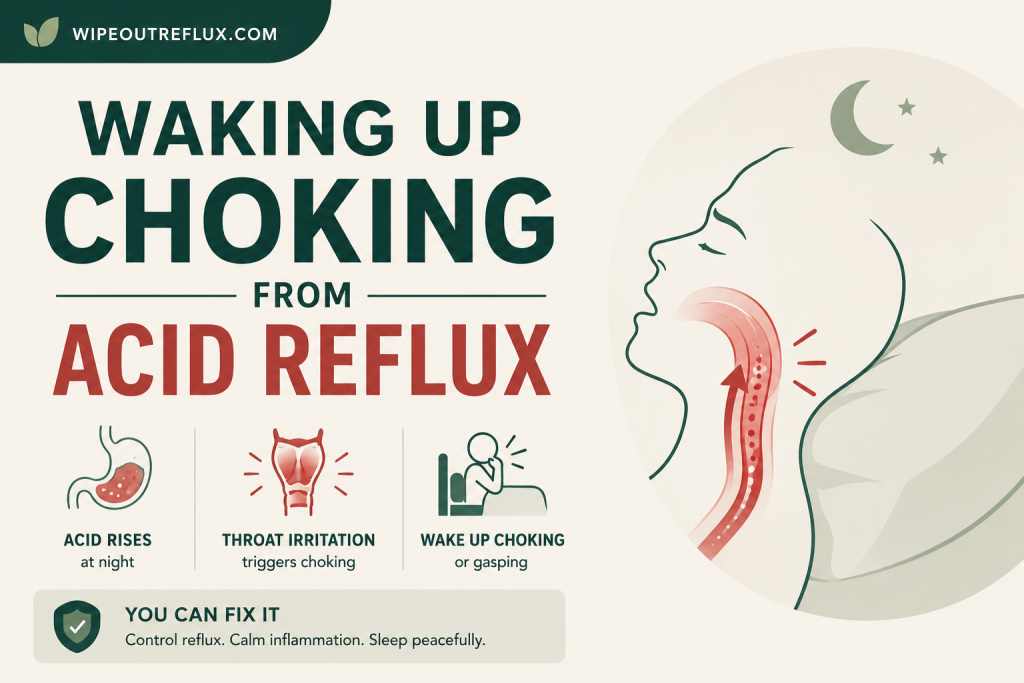
Jolting awake coughing and spluttering, with a sour or bitter fluid at the back of your throat and a desperate need to clear your airway — it’s a horrible way to wake up, and it frightened me the first few times it happened. What you’re experiencing is usually aspiration: refluxed stomach contents actually reaching your airway while you sleep, with your body coughing hard to expel them.
Here’s the reassuring short version. A small amount of acid and pepsin has got past your throat’s defences and into your airway, and the violent coughing is your protective reflex kicking in to clear it out and keep it away from your lungs. It feels alarming, but that cough is your body doing its job. For most people this is occasional and settles on its own — though because repeated aspiration carries a small risk to the lungs, recurring episodes do deserve medical attention.
It’s worth saying clearly up front that this is different from laryngospasm, where the vocal cords slam shut and you can’t breathe in at all. I’ll explain how to tell them apart below. I’m not a doctor, and this article is background to help you understand what’s happening, not medical advice.
Key takeaways
- Waking up choking from reflux is usually aspiration — refluxed material reaching your airway, which your cough reflex then clears.
- The violent coughing is protective: it’s your body expelling the material to keep it out of your lungs.
- It’s different from laryngospasm, where the vocal cords clamp shut and you can’t breathe in at all.
- It happens at night because lying flat, weakened defences and reduced protective reflexes during sleep let refluxate reach the airway.
- Occasional episodes are usually harmless, because your protective reflexes do their job — even healthy people aspirate tiny amounts in sleep.
- Repeated aspiration can irritate the airway and, rarely, lead to chest infections, so recurring episodes need assessment.
- Prevention centres on reducing night-time reflux: earlier meals, an elevated head, and a low-acid approach.
- See a doctor for recurrent choking, a persistent cough, wheeze, or any chest infection following an episode.
What aspiration actually is
Aspiration simply means inhaling something into your airway or lungs that shouldn’t be there — in this case, refluxed stomach contents, or the acid and pepsin they carry. Normally your body has an impressive set of defences to stop this happening: competent valves that keep stomach contents down, an oesophagus that clears refluxed material, a reflex that closes the top of the airway when needed, and the powerful cough reflex as a last line of defence [Journal of Personalized Medicine, 2022].
Here’s a fact that surprised me and might reassure you: around half of healthy people aspirate tiny amounts of secretions during sleep without any harm at all, precisely because these protective reflexes handle it so efficiently [Cureus, 2024]. Problems arise when there’s simply too much reflux reaching the throat, or when those defences are overwhelmed — and that’s when you wake up choking.
Choking (aspiration) vs laryngospasm: the key difference
This distinction matters, because the two are often confused, and they feel different in an important way.
In laryngospasm, your vocal cords clamp tightly shut as a protective reflex, and you find you can’t breathe in at all for a few seconds — no air moves, often with a high-pitched sound as the spasm releases. Nothing has actually entered your lungs; the closure is what keeps it out.
In aspiration, by contrast, material has got into the airway, so air is still moving — and you cough and splutter forcefully to expel it. You can usually feel or taste the acidic fluid, and it feels like something has “gone down the wrong way.” In other words, these are two sides of the same protective system: closing the airway and coughing are both your body’s ways of keeping your lungs clear. Sometimes they even happen together. If your episodes are more about your throat sealing shut than about coughing, my guide to silent reflux and shortness of breath covers that side in more detail.
Why it happens at night
Aspiration from reflux is far more likely during sleep, and several things line up to make the small hours the danger zone. Lying flat removes the help of gravity, so refluxed material can pool at throat level rather than draining back down. At the same time, the valve at the top of your stomach relaxes during sleep, your oesophagus clears acid more slowly, and you swallow far less — so there’s little saliva washing acid away. My article on why reflux is worse at night goes through these in detail.
Crucially, your protective airway reflexes are also dampened while you sleep. So refluxate can creep up to the throat and slip towards the airway before your defences react — and when they do, the cough reflex fires hard, jolting you awake mid-splutter. That’s the moment of waking up choking.
What it feels like
The experience is fairly distinctive: sudden waking with coughing or gagging, often a sour, bitter or acidic taste and a burning sensation in the throat, and sometimes fluid you can actually feel at the back of your mouth. A coughing fit usually follows as your body clears the airway, and you may be left with a wheeze, a hoarse voice, or a raw throat afterwards. It can take a minute or two to fully settle, and it’s understandably frightening — but the coughing itself is a sign your protective reflexes are working.
What to do in the moment
If you wake up choking, a few simple things help — offered as general self-help rather than medical advice:
- Sit up and lean slightly forward. This uses gravity to help clear your airway and stops more refluxate coming up.
- Let yourself cough. Don’t fight it — coughing is exactly what clears the aspirated material, so allow it to do its work rather than suppressing it.
- Sip water once the coughing eases, to help wash away lingering acid and soothe the throat.
- Stay upright for a little while before lying back down, and consider raising your head higher for the rest of the night.
Can it harm your lungs? An honest answer
This is the worry that keeps people up, so let me be straight about it. Occasional aspiration is usually harmless, because your cough reflex and other defences clear the material before it can do damage. But it’s not something to ignore if it keeps happening.
Repeated microaspiration can irritate and inflame the airway over time, since acid and pepsin are genuinely damaging to airway tissue, and this can contribute to a chronic cough, a hoarse voice, or worsening asthma. More rarely, aspiration can lead to a chest infection such as aspiration pneumonia, a risk that’s higher in older adults and people with swallowing difficulties. It’s also worth knowing that not every reflux-related cough is caused by aspiration at all — often reflux lower down triggers a cough through a nerve reflex without anything reaching the lungs, and acid-suppressing drugs don’t necessarily stop the non-acid material refluxing either [Annals of the American Thoracic Society, 2019]. The practical message is simple: an occasional episode is usually fine, but a recurring pattern deserves a proper look. If a nagging cough or throat-clearing is part of your picture, my guide on stopping constant throat clearing from reflux may help, and the overlap with breathing conditions is covered in acid reflux misdiagnosed as asthma.
How to stop waking up choking
Since the trigger is refluxed material reaching your airway at night, prevention is all about keeping reflux down and away from your throat while you sleep. The most effective steps are the night-time fundamentals: leave a three to four hour gap between your last meal and bed, and be strict about large late meals and evening alcohol, both of which drive night-time reflux.
Elevating the head of your bed is especially valuable here, because gravity is what keeps refluxate away from your airway — I explain the practical set-up, along with left-side sleeping, in my guide to the best sleeping position for silent reflux. Keeping your diet low in acid reduces the acid and pepsin load on your throat, the reasoning for which is in my article on neutralising pepsin in the throat. And an alginate such as Gaviscon Advance before bed forms a physical raft that helps keep reflux from rising while you’re lying down.
When to see a doctor
While an occasional episode is usually nothing to worry about, waking up choking should be assessed if it becomes a pattern. See your doctor if episodes are recurrent, if you have a persistent cough or wheeze, if you develop repeated chest infections, or if you notice breathlessness or bring up discoloured phlegm. A fever, a productive cough or chest pain in the days after an episode can point to a chest infection and should be checked promptly.
Some people should have a lower threshold to seek help, particularly older adults and anyone with swallowing difficulties or neurological conditions, as the risk of significant aspiration is higher. And treat it as an emergency if you can’t clear your airway and continue to struggle to breathe, if your lips turn blue, or if you have severe breathlessness. Getting a proper assessment — which might involve your GP, an ENT specialist, or a respiratory or gastro clinic — is the way to both confirm reflux is the cause and rule out anything else.
Conclusion
Waking up choking is a genuinely frightening experience, but understanding it makes it far less so. What’s happening is aspiration — a little refluxed acid and pepsin reaching your airway overnight, and your cough reflex firing hard to clear it out and protect your lungs. It’s different from laryngospasm, where the cords simply clamp shut, and in most people it’s an occasional event that your body handles exactly as it’s designed to. The coughing that wakes you is, in a real sense, good news: it’s your defences working.
That said, this is a symptom worth taking seriously if it recurs, both because repeated aspiration can irritate the airway and, rarely, affect the lungs, and because getting it assessed brings peace of mind. The genuinely encouraging part is how much you can do to prevent it — keeping reflux down and away from your airway at night, through earlier meals, an elevated head, left-side sleeping and a low-acid approach, addresses the problem right at its source.
If you’d like a clear, structured way to bring that night-time reflux under control, my Wipeout Diet Plan is the step-by-step programme I built to calm reflux at the source, going far deeper into the mechanisms and daily routine than any single article can. And to make everyday choices simple, the Wipeout Food Reference Guide is the essential companion, laying out the foods and drinks allowed on an acid reflux and LPR diet along with their pH values — so you can keep acid away from your throat and airway, especially in the hours before bed. Together they turn the science on this page into a plan that helps you sleep more safely and soundly.
Frequently asked questions
What does aspiration from acid reflux feel like?
It typically feels like suddenly waking up coughing or gagging, often with a sour, bitter or acidic taste and a burning sensation in the throat, and sometimes fluid you can feel at the back of your mouth. A coughing fit usually follows as your body clears the airway, and you may be left with a wheeze, a hoarse voice or a raw throat afterwards.
Is waking up choking from reflux dangerous?
An occasional episode is usually harmless, because your cough reflex and other defences clear the material before it can harm your lungs. However, repeated aspiration can irritate the airway and, rarely, lead to a chest infection, so recurring episodes should be assessed by a doctor. The risk is higher in older adults and those with swallowing difficulties.
What’s the difference between choking on reflux and laryngospasm?
In laryngospasm, the vocal cords clamp shut and you can’t breathe in at all for a few seconds, but nothing enters your lungs. In aspiration, refluxed material actually gets into the airway, so air is still moving and you cough forcefully to expel it, often tasting the acidic fluid. Both are protective responses aimed at keeping your lungs clear.
Why does reflux aspiration happen at night?
Lying flat lets refluxed material pool at throat level instead of draining away, while sleep relaxes the valve above your stomach, slows acid clearance and reduces the saliva that washes acid down. Your protective airway reflexes are also dampened during sleep, so refluxate can reach the airway before your defences react — triggering the cough that wakes you.
Can acid reflux aspiration cause lung problems?
Repeated microaspiration can irritate the airway and contribute to a chronic cough, hoarseness or worsening asthma, since acid and pepsin damage airway tissue, and rarely it can cause aspiration pneumonia. That said, many reflux-related coughs are actually caused by a nerve reflex rather than material reaching the lungs. Recurring symptoms are worth investigating to find the true cause.
How do I stop waking up choking from reflux?
Focus on reducing night-time reflux: leave a three to four hour gap before bed, avoid large late meals and evening alcohol, elevate the head of your bed, sleep on your left side, keep your diet low in acid, and consider an alginate before bed. Elevating the head is particularly important, as gravity helps keep refluxate away from your airway.
When should I see a doctor about waking up choking?
See your doctor if episodes are recurrent, or if you have a persistent cough, wheeze, repeated chest infections, breathlessness or discoloured phlegm. A fever or productive cough in the days after an episode may indicate a chest infection and needs prompt attention. Seek emergency care if you can’t clear your airway, your lips turn blue, or you’re severely breathless.
Research sources
- [Journal of Personalized Medicine, 2022] — A review of pepsin and micro-aspiration outlining the protective mechanisms that normally keep refluxate out of the airway (competent sphincters, oesophageal clearance and the airway-closure reflex) and the use of pepsin as a marker of aspiration into the respiratory tract.
- [Cureus, 2024] — Notes that around half of healthy people aspirate small amounts during sleep without harm thanks to protective reflexes such as coughing and airway closure, and that aspirated acid and pepsin are cytotoxic to airway and lung tissue.
- [Annals of the American Thoracic Society, 2019] — A review of reflux-aspiration in chronic lung disease, noting that acid-suppressing drugs neutralise acidity but don’t stop the reflux of other harmful gastric contents, while cautioning that aspiration is not always the dominant mechanism behind reflux-related respiratory symptoms.

David Gray
12 years living with LPR · Consultant & researcher
I've lived with LPR for twelve years — the misdiagnoses, the PPI courses that did nothing, the slow work of figuring out what actually helps. Wipeout Reflux is where I translate the research into plain terms for people stuck in the same place. Every claim here is sourced to peer-reviewed work, and I consult one-to-one with LPR sufferers.