
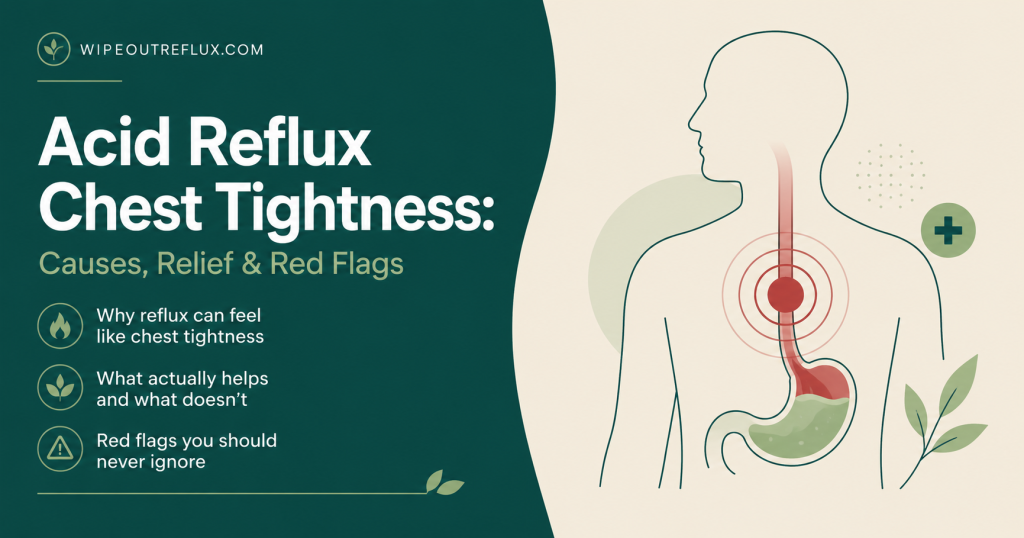
Yes — acid reflux really can cause chest tightness, and it can feel genuinely alarming the first time it happens. The sensation ranges from a dull pressure behind the breastbone to a squeezing tightness that makes you wonder whether something serious is going on. The good news is that once you understand exactly why it happens, it becomes far less frightening and far easier to manage.
The medical term for recurrent chest pain that is not coming from the heart is non-cardiac chest pain (NCCP), and gastroesophageal reflux disease (GERD) is its most common identified cause. Research estimates that reflux accounts for roughly 50% of all NCCP cases, and studies using 24-hour pH monitoring have confirmed reflux as a likely cause in around 40% of NCCP patients [Drossman et al., Gastroenterology & Hepatology, 2024]. If you have been dealing with unexplained chest tightness and doctors have cleared your heart, reflux is genuinely the most logical next place to look.
In this article I will walk you through the three main mechanisms that drive reflux chest tightness, how to distinguish it from cardiac pain, why people with silent reflux (LPR) can experience chest symptoms without any heartburn, and — most importantly — what you can actually do about it.
Key Takeaways
- Acid reflux is the single most common cause of non-cardiac chest pain, accounting for approximately half of all cases.
- Chest tightness from reflux is caused by three overlapping mechanisms: direct esophageal irritation, muscle spasms, and esophageal hypersensitivity (a sensitised nerve response).
- The esophagus and heart share similar pain pathways, which is why reflux chest tightness can convincingly mimic cardiac pain.
- People with LPR (silent reflux) can experience chest tightness without any burning or heartburn at all.
- Key distinguishing features: reflux chest pain often worsens after meals and when lying flat, and typically improves when you sit upright or take an antacid.
- Anxiety and reflux create a mutual feedback loop — anxiety worsens reflux, and the chest sensations then worsen anxiety.
- If chest pain radiates to the arm or jaw, comes on during physical exertion, or is accompanied by sweating and breathlessness, get immediate medical attention.
- Dietary changes, positioning habits, and reducing stomach pressure can significantly reduce reflux chest tightness without medication alone.
Why Acid Reflux Causes Chest Tightness
To understand the chest tightness, you first need to appreciate the anatomy. Your esophagus runs directly behind your sternum (breastbone), sitting immediately alongside your heart. They also share overlapping nerve pathways through the vagus nerve and thoracic spinal roots, which is why your brain can struggle to pinpoint exactly where pain signals are coming from. This shared wiring is not a design flaw — it is simply how the chest cavity is organised — but it does mean esophageal pain is genuinely easy to confuse with cardiac pain.
When stomach acid and pepsin repeatedly enter the esophagus — particularly if reflux reaches higher up — they cause a cascade of responses in the esophageal tissue that can produce significant chest discomfort. Understanding the three separate mechanisms helps you make sense of why the symptoms can feel so different from one episode to the next.
The Three Mechanisms Behind Reflux Chest Tightness
1. Esophageal Irritation and Inflammation
The most direct mechanism is chemical irritation. Every time stomach acid and pepsin wash back into the esophagus, they aggravate the mucosal lining. Unlike the stomach, the esophagus has no protective mucus layer designed for acid exposure. Repeated contact causes inflammation and micro-damage that generates a sustained burning or pressure sensation felt centrally in the chest.
The longer the acid stays in contact with the esophageal wall — measured clinically as acid clearance time — the more pronounced the chest symptoms tend to be. Studies using impedance pH monitoring have shown that the reflux episodes most likely to cause chest pain are those with a higher acid volume, lower nadir pH, and longer contact duration [Smits et al., Alimentary Pharmacology & Therapeutics, 2017].
2. Esophageal Muscle Spasms
The second mechanism is esophageal muscle spasm. The esophagus is a muscular tube, and when its lining is repeatedly irritated by acid, the smooth muscle can contract irregularly and intensely. These spasms are sometimes called distal esophageal spasms and they can produce a chest tightness or pressure that is severe enough to wake you from sleep and feel indistinguishable from a cardiac event.
Spasms are more likely when you swallow very hot or very cold liquids, when stress is high, or when the esophageal muscle has already been sensitised by chronic acid exposure. The fact that impaired esophageal motility (reduced muscle coordination) also slows reflux clearance means spasm and prolonged acid contact often reinforce each other [Savarino et al., Neurogastroenterology & Motility, 2016].
3. Esophageal Hypersensitivity
This third mechanism is the most underexplained and arguably the most important for people with persistent symptoms. After repeated acid exposure, the sensory nerves in the esophageal wall can become sensitised — meaning they fire pain signals in response to stimuli that would normally be completely painless, like a mild stretch from swallowing or even weakly acidic reflux that does not reach a pH level that would typically cause symptoms.
This is known as visceral hypersensitivity or reflux hypersensitivity, and it is now formally classified under the Rome IV diagnostic criteria as a functional esophageal disorder [Khan & Gonlachanvit, Gastroenterology Clinics of North America, 2021]. Research from 2024 found that anxiety was among the strongest independent risk factors for reflux hypersensitivity (odds ratio 17.3), which points to a significant nervous system component driving chest symptoms in many people [He et al., Frontiers in Medicine, 2024].
Pepsin also plays a role here. This digestive enzyme reaches the esophagus alongside acid and can remain active even at the slightly higher pH levels found in the upper esophagus and throat. Understanding how pepsin affects esophageal and throat tissue is an important piece of the puzzle if your chest tightness is accompanied by throat symptoms.
Chest Tightness from Reflux vs. Heart Pain: How to Tell the Difference
This question causes enormous anxiety, and rightly so — the overlap is real. That said, there are meaningful differences that can help guide your thinking. These clues are not a substitute for medical assessment, but they are genuinely useful for context.
Timing and triggers: Reflux chest tightness tends to appear or worsen after eating (particularly large or fatty meals), when lying flat, when bending forward, or when wearing tight clothing around the abdomen. Cardiac chest pain more typically appears during physical exertion or emotional stress and tends to persist regardless of body position or food intake.
Character of the sensation: Reflux pain is commonly described as burning, sharp, or pressure-like and sits behind the breastbone. Cardiac pain is more often described as crushing, heavy, or squeezing — “like an elephant sitting on my chest” — and is more likely to radiate to the left arm, jaw, neck, or shoulder.
Response to antacids or position: One of the more reliable clinical clues is response to sitting upright or taking an antacid. If your chest tightness noticeably improves within 15–20 minutes of standing up or taking Gaviscon Advance, reflux is a very likely contributor. Cardiac pain does not respond to position or antacids in the same way.
Breathing: Reflux chest tightness can temporarily worsen when you take a deep breath (because thoracic expansion stretches the esophagus). Cardiac pain intensity does not typically change with respiration. For more on breathing-related symptoms, see my article on silent reflux and shortness of breath.
What About Silent Reflux and LPR?
One thing that surprises many people is that you can have significant chest tightness from reflux without any heartburn at all. This is particularly common in laryngopharyngeal reflux (LPR), often called silent reflux.
In LPR, acid and pepsin travel all the way up beyond the esophagus into the throat and larynx. The esophagus is actually more tolerant of acid than the throat — so while the stomach contents pass through relatively quickly, they can still sensitise the esophageal wall and the lower esophageal sphincter region along the way, producing a chest pressure or tightening sensation. Because there is often no classic heartburn, many LPR sufferers are genuinely baffled by chest symptoms that do not fit the typical reflux picture.
If your chest tightness comes alongside symptoms like persistent throat clearing, a lump-in-the-throat feeling, morning hoarseness, or sinus congestion, LPR is a very real possibility. My complete guide to LPR covers this in much more depth.
What Triggers Reflux Chest Tightness?
Most triggers work by either increasing stomach acid production, relaxing the lower esophageal sphincter (LES), or increasing abdominal pressure — all of which push more reflux material into the esophagus.
- Large meals — distend the stomach and increase reflux volume significantly
- High-fat foods — delay gastric emptying and relax the LES
- Caffeine and alcohol — both relax the LES and stimulate acid secretion
- Chocolate — contains theobromine which relaxes the LES; more detail in my article on chocolate and acid reflux
- Carbonated drinks — increase gastric pressure
- Lying down within 2–3 hours of eating — removes gravity’s protective effect on reflux clearance
- Tight waistbands and clothing — compress the abdomen and push acid upward
- Stress and anxiety — heighten esophageal sensitivity and increase acid production via cortisol pathways
- Certain medications — including some blood pressure drugs, muscle relaxants, and anti-inflammatory painkillers
If you want a comprehensive resource on which foods and drinks are safe versus problematic, the Wipeout Essential Reflux Food List is a practical reference that covers pH values and reflux safety across a wide range of foods and drinks.
How to Relieve Acid Reflux Chest Tightness
Reducing reflux chest tightness comes down to two things working together: reducing the amount and frequency of reflux episodes, and calming the sensitised esophageal response that makes existing reflux feel more intense.
Dietary adjustments: Moving toward a low-acid, low-fat diet is the single most effective long-term strategy. This means reducing or eliminating alcohol, coffee, carbonated drinks, fried foods, and chocolate while building meals around lean proteins, non-citrus vegetables, complex carbohydrates, and alkaline-leaning foods. Eating smaller, more frequent meals rather than large ones is particularly important for reducing the distension that drives reflux.
Positional changes: Do not lie down within two to three hours of eating. When sleeping, elevate the head of the bed by 15–20cm (6–8 inches) using bed risers or a wedge pillow — not just extra pillows under your head. Research consistently shows this reduces nocturnal acid exposure significantly. For more detail see my article on the best sleeping positions for silent reflux.
Gaviscon Advance: For many people with GERD and LPR, Gaviscon Advance (the alginate-based formulation, not standard Gaviscon) forms a physical raft over stomach contents that prevents them from reaching the esophagus. This can be particularly effective for chest symptoms triggered by meals.
Stress reduction: Given how strongly the nervous system drives esophageal hypersensitivity, addressing stress and anxiety is not optional — it is part of the treatment. Techniques like diaphragmatic breathing, mindfulness, and structured cognitive behavioural approaches have shown meaningful benefit in clinical trials for functional esophageal disorders.
Weight management: Excess abdominal weight increases intra-abdominal pressure and is one of the strongest modifiable drivers of both GERD and LPR. Even modest weight loss of 5–10% has been shown to significantly reduce reflux frequency.
Red Flags: When Chest Pain Needs Immediate Medical Attention
I want to be very direct here. While reflux chest tightness is common and generally not dangerous, some chest pain symptoms must be assessed as a medical emergency without delay. Do not try to self-diagnose in these situations.
Seek emergency care immediately if chest pain:
- Radiates to your left arm, jaw, neck, or back
- Comes on during physical activity or exercise
- Is accompanied by sweating, nausea, or lightheadedness
- Feels like crushing pressure rather than burning or squeezing
- Is accompanied by shortness of breath at rest
- Does not improve within 15–20 minutes of resting and taking antacid
- Is sudden, severe, and unlike any previous episode
Even if you have a confirmed reflux diagnosis, these symptoms warrant urgent evaluation to rule out a cardiac cause. There is no downside to getting checked out — and it is always better to know.
Conclusion
Acid reflux chest tightness is one of those symptoms that is easy to catastrophise because the chest always feels high-stakes. But once you understand the mechanisms — acid irritation, esophageal muscle spasm, and nerve hypersensitivity — and once a cardiac cause has been properly ruled out, you have a solid framework for actually doing something about it.
The relief I personally experienced came through a combination of dietary change, improved meal timing, positional adjustments, and treating the underlying reflux condition more seriously rather than just reaching for antacids. The pattern of symptoms — what triggers them, how long they last, and what makes them better — tells you a great deal about which mechanism is dominant in your case.
If you are at the early stages of tackling reflux chest tightness and want a structured, evidence-based starting point, the Wipeout Diet Plan is the most comprehensive resource I have built. It lays out the exact dietary framework, meal timing strategies, and management principles that address all three drivers of reflux chest symptoms — not just the acid component. For a quick, practical reference on which foods are safe and which ones tend to trigger chest tightness episodes, the Wipeout Essential Reflux Food List covers the full range of foods and drinks with their pH values and reflux ratings.
Take the symptoms seriously, get properly assessed, then build a plan that addresses the root causes rather than just the flare-ups. Your esophagus — and your peace of mind — will thank you for it.
Frequently Asked Questions
Can acid reflux cause chest tightness without heartburn?
Yes, absolutely. Particularly in LPR (silent reflux), chest tightness can occur without any burning sensation because the reflux passes through the esophagus quickly without causing classic heartburn, while still irritating the esophageal wall enough to produce pressure or tightness. Esophageal hypersensitivity can also cause chest tightness in response to weakly acidic or even non-acidic reflux events that would not trigger heartburn in most people.
How long does chest tightness from acid reflux last?
It varies considerably. Reflux-related chest tightness can last anywhere from a few minutes to several hours, depending on how much acid is involved, how quickly the esophagus clears it, and how sensitised your esophageal nerves are at that point. Episodes triggered by a large meal may persist until the stomach has emptied. Persistent or daily tightness is a sign that your reflux needs more structured management.
Can GERD cause chest tightness on the left side?
Yes — because the esophagus runs slightly to the left of centre behind the sternum, some people feel reflux chest tightness predominantly on the left side, which understandably raises cardiac concerns. However, if the tightness is associated with meals, position, or acid exposure rather than exertion, and there are no other cardiac warning signs, reflux remains the more likely explanation. Always get left-sided chest pain checked by a doctor if you are uncertain.
Can chest tightness from reflux trigger anxiety?
Very commonly, yes. The sensation of unexpected chest tightness is naturally alarming, and anxiety follows almost automatically. This creates a problematic cycle: anxiety heightens esophageal nerve sensitivity, which makes existing reflux symptoms feel more intense, which worsens anxiety. Breaking this cycle — through a combination of dietary changes, reassurance from a confirmed diagnosis, and stress management techniques — is an important part of recovery. My article on whether LPR can be caused by anxiety explores this link in more detail.
Will PPIs help with reflux chest tightness?
Often yes, particularly if acid-driven irritation or inflammation is the main mechanism. The standard diagnostic approach is a two-week trial of twice-daily proton pump inhibitors (PPIs) — if chest symptoms improve significantly, this is taken as strong evidence that reflux is the cause. However, PPIs do not address esophageal spasm, hypersensitivity, or non-acid reflux, which is why some people have persistent chest tightness despite acid suppression. In those cases, additional approaches like neuromodulators, dietary changes, or Gaviscon Advance may be needed.
Can reflux cause chest tightness after eating?
This is one of the most common patterns. Eating — particularly a large, fatty, or acidic meal — increases stomach distension and acid production, relaxes the lower esophageal sphincter, and creates the conditions for significant reflux. Chest tightness that comes on 20–60 minutes after eating and improves when you stand upright is a classic reflux presentation. Eating smaller meals more slowly, avoiding known trigger foods, and not lying down after eating are among the most effective adjustments.
Is acid reflux chest tightness dangerous?
Chest tightness caused by acid reflux is not in itself dangerous, though it is uncomfortable and can significantly affect quality of life. The more important concern is ensuring the pain is genuinely coming from reflux and not from the heart. Once cardiac causes have been properly excluded, reflux chest tightness — while unpleasant — is a manageable condition. The key is getting a proper assessment, following an evidence-based dietary and lifestyle plan, and addressing the underlying reflux rather than just masking symptoms with antacids long-term.
Research & References
Noncardiac chest pain occurs in an estimated 13% of the general population; GERD is its most common esophageal cause and affects at least half of all NCCP patients, who frequently also have anxiety or depression as comorbidities. [Drossman et al., Gastroenterology & Hepatology, 2024]
In a study using 24-hour impedance-pH monitoring, 40% of NCCP patients were confirmed to have reflux as a likely cause of their chest pain; acid reflux episodes associated with chest pain had significantly longer contact duration and lower nadir pH than those without chest pain. [Smits et al., Alimentary Pharmacology & Therapeutics, 2017]
Mixed reflux episodes containing both acid and gas are disproportionately associated with non-cardiac chest pain, and impaired esophageal motility with delayed clearance prolongs contact between refluxate and the mucosal lining. [Savarino et al., Neurogastroenterology & Motility, 2016]
Functional chest pain, functional heartburn, and reflux hypersensitivity are formally defined under the Rome IV criteria; psychological and behavioural interventions including cognitive behavioural therapy and hypnotherapy show substantial benefit alongside acid suppression and neuromodulation. [Khan & Gonlachanvit, Gastroenterology Clinics of North America, 2021]
A multicenter retrospective study of 109 reflux hypersensitivity patients found anxiety to be among the strongest independent risk factors for the condition (odds ratio 17.3), with hiatal hernia and older age also significantly implicated. [He et al., Frontiers in Medicine, 2024]
A comprehensive review of treatment options for esophageal non-cardiac chest pain found that PPI therapy is effective for GERD-related cases, while esophageal spasm and hypersensitivity require additional management strategies including neuromodulators and behavioural approaches. [Yamasaki et al., World Journal of Gastroenterology, 2014]

David Gray
12 years living with LPR · Consultant & researcher
I've lived with LPR for twelve years — the misdiagnoses, the PPI courses that did nothing, the slow work of figuring out what actually helps. Wipeout Reflux is where I translate the research into plain terms for people stuck in the same place. Every claim here is sourced to peer-reviewed work, and I consult one-to-one with LPR sufferers.