
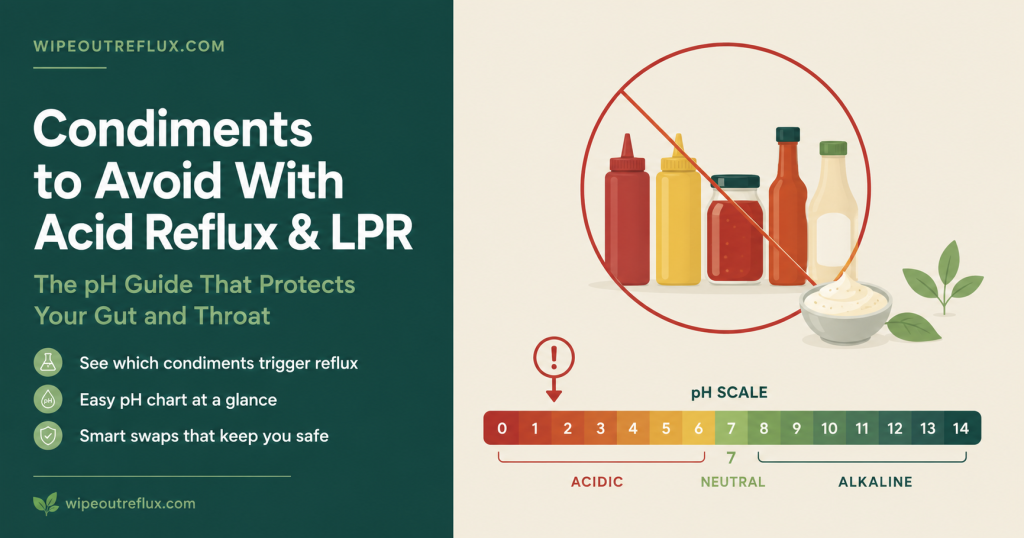
Most condiments are far more acidic than people expect. The majority of popular sauces and dressings — ketchup, mayonnaise, mustard, hot sauce, Worcestershire and almost every bottled dressing — sit below pH 4, and the most acidic of all, hot sauces like Tabasco, can drop to around pH 2.5.
For ordinary heartburn, that mostly means more burning. But if you have silent reflux (LPR), pH 4 is the number that matters most, because below it the enzyme pepsin sitting in your throat tissue gets switched back on.
This guide ranks common condiments by pH, explains why that pH 4 threshold is the real dividing line for reflux rather than just “acidic = bad,” and shows you which low-acid options are still safe to keep on the table.
Key Takeaways
- Almost every bottled condiment is acidic — the majority measure below pH 4.
- Hot sauces are the worst offenders: Tabasco can sit as low as pH 2.5, and Texas Pete around 3.1.
- Ketchup, mayonnaise and Worcestershire sauce all cluster around pH 3.4–4.
- Yellow and brown mustard land around pH 3.2.
- For LPR and silent reflux, anything below pH 4 can reactivate pepsin already lodged in the throat — that’s the real danger line, not heartburn alone.
- It’s not all bad news: black olives are near-neutral (about pH 7.3), and gluten-free tamari is milder at around pH 4.8.
- Bottled condiments are often deliberately acidified below pH 4.6 for shelf-stability, which is why homemade versions can sometimes be made gentler.
- Reliable low-acid go-tos: olive oil, fresh herbs, and the better options in the chart below.
Condiment pH Chart: How Acidic Are Common Condiments?
Here’s the data first, because it’s the part most people come looking for. The values below are approximate — brand, recipe and ripeness all shift the number — but the pattern is remarkably consistent. I’ve added a reflux rating based on the pH 4 and pH 5 thresholds that matter for LPR (explained in the next section).
| Condiment | Approx. pH | Reflux / LPR rating |
|---|---|---|
| Hot sauce (Tabasco) | 2.5 | Avoid |
| Vinegar (base ingredient) | 2.4–3.4 | Avoid |
| Hot sauce (Texas Pete) | 3.1 | Avoid |
| Chili sauce | 2.8–3.7 | Avoid |
| Mustard (yellow / brown) | 3.2 | Avoid |
| Steak sauce (A1 / Heinz 57) | 3.2–3.3 | Avoid |
| Ketchup | 3.4–3.9 | Avoid |
| Mayonnaise | 3.4–4.0 | Avoid |
| Worcestershire sauce | 3.4–4.0 | Avoid |
| Barbecue sauce | 3.4–3.7 | Avoid |
| Thousand Island / Russian dressing | 3.6–3.8 | Avoid |
| Mustard (Dijon) | 3.6 | Avoid |
| Ranch dressing | 3.8–3.9 | Avoid |
| Salsa | 3.7–4.1 | Caution |
| Honey | 3.7–4.2 | Caution |
| Soy sauce (gluten-free tamari) | 4.8 | Caution |
| Soy sauce (regular) | 4.4–5.4 | Caution |
| Italian dressing | 5.2 | Caution |
| Horseradish (freshly ground) | 5.3–5.4 | Better |
| Olive oil | Essentially non-acidic | Best |
| Black olives (pitted) | 6.0–7.3 | Best |
The takeaway is stark: of every condiment in that list, only a handful clear pH 5, and the great majority sit below pH 4. If you’re used to thinking of citrus and tomatoes as “the acidic foods,” your condiment shelf is quietly more aggressive than your fruit bowl. For the fruit side of that picture, my acidity of fruits chart is the companion reference — the two together cover most of what ends up on a plate.
Why pH 4 Is the Line That Matters for Silent Reflux (LPR)
This is where almost every other “condiment pH” page stops short. They give you the numbers and move on. But a number on its own doesn’t tell you why it matters — and for LPR, the mechanism changes how you should read the whole chart.
Here’s the short version. In silent reflux, the problem isn’t only stomach acid splashing up. It’s pepsin — a digestive enzyme that travels up with reflux and binds to the delicate tissue of your throat and voice box. At the normal pH of the throat (around 6.8), that pepsin is dormant and harmless. The trouble starts when something acidic arrives.
Lab work on human pepsin found that the enzyme stays stable and dormant at a neutral throat pH, but is reactivated when the local pH drops — with activity climbing sharply once you fall below about pH 4 [Johnston et al., The Laryngoscope, 2007]. In other words, every time you swallow something below that threshold, you can switch pepsin back on and let it resume digesting your throat tissue — no new reflux event required.
That’s the insight that reframes the chart. A condiment at pH 3.4 isn’t just “a bit acidic.” For someone with LPR, it’s a direct trigger that can reactivate pepsin that’s already there. This is the whole reason I keep coming back to the idea that you have to neutralise pepsin in the throat rather than only chase stomach acid — and it’s why I draw the line for condiments at pH 4, not at “spicy” or “tomato-based.”
If you mainly get classic heartburn rather than throat symptoms, the threshold is less absolute — but acidic condiments still loosen the lower oesophageal sphincter and add to the burn, so the chart is worth heeding either way.
The Most Acidic Condiments to Avoid With Acid Reflux
If you want a simple rule, start at the bottom of the pH scale and work up. These are the condiments to drop first.
Hot sauce tops the list and it isn’t close. Tabasco measures around pH 2.5 — more acidic than many sodas — and even milder versions like Texas Pete sit near 3.1. The capsaicin heat is a separate irritant on top of the acidity, so hot sauce is a double hit for a reflux-sensitive throat.
After that come the vinegar- and tomato-based staples: steak sauces, chili sauce, barbecue sauce, ketchup, mayonnaise and Worcestershire sauce, all clustered between roughly pH 3.2 and 4. Most creamy bottled dressings — ranch, Thousand Island, Russian, blue cheese — live in the same band, because vinegar or lemon juice is usually doing the flavour work. For a fuller list of trigger foods that go beyond the condiment shelf, see my guide to LPR foods to avoid.
Is Ketchup, Mustard, Mayonnaise or Soy Sauce Bad for Acid Reflux?
These are the four I get asked about most, so here’s a quick verdict on each.
Is ketchup bad for acid reflux?
Yes, generally. Ketchup measures around pH 3.4–3.9 — well below the pH 4 line — because it combines acidic tomato with added vinegar and often sugar. For LPR it’s a reliable trigger. A small amount of a low-sugar, lower-acid tomato relish is a gentler swap, but standard ketchup is one to limit.
Is mustard bad for acid reflux?
Usually, yes. Yellow and brown mustard sit around pH 3.2, and Dijon around 3.6 — among the more acidic condiments on the shelf, thanks to vinegar and the mustard seed itself. If you’re after a flavour kick, a honey-mustard style made at home with more honey and less vinegar is milder than the jarred version, though still not neutral.
Is mayonnaise bad for acid reflux?
It’s more nuanced. Commercial mayonnaise measures around pH 3.4–4 because it’s acidified with vinegar or lemon for food safety, so it sits in the “avoid” band on pH alone. It’s also high in fat, which slows stomach emptying. A homemade mayo with minimal added acid is meaningfully less aggressive — one of the clearer cases where making your own pays off.
Is soy sauce bad for acid reflux?
It’s one of the better options, surprisingly. Soy sauce typically lands around pH 4.4–5.4, and gluten-free tamari is milder still at about 4.8 — above the pH 4 reactivation line. The bigger concern with soy sauce is its salt load rather than its acidity, so use it sparingly but don’t treat it like ketchup.
Least Acidic and Reflux-Friendly Condiments for Acid Reflux
Now the reassuring flip side. A surprising amount survives the cut once you sort by pH:
- Black olives — near-neutral at around pH 7.3, making them one of the few genuinely safe jarred options. (Green, fermented olives are far more acidic, so the colour matters here — more in my piece on whether olives are acidic or alkaline.)
- Olive oil — a fat, not an acid, so it has no meaningful pH. Oil-and-herb dressings are the single best base to build flavour on.
- Fresh herbs — basil, parsley, coriander, dill, chives. Flavour without acid, and the easiest upgrade to any meal.
- Gluten-free tamari — at about pH 4.8 it clears the danger line; use it for umami instead of a vinegar-heavy sauce.
- Fresh horseradish — freshly ground sits around pH 5.3, far gentler than the vinegary jarred creams.
Build dressings from olive oil and herbs rather than vinegar or citrus, and you sidestep the problem entirely. My round-up of the best salad dressings for acid reflux goes deeper on this, and the broader LPR foods to eat list shows how condiments fit into a full low-acid plate.
Why Are Store-Bought Condiments So Acidic?
This part is rarely explained, and it’s genuinely useful to understand. Bottled condiments aren’t acidic by accident — many are acidified on purpose.
Under food-safety rules, a food with an equilibrium pH of 4.6 or below counts as “high-acid,” and that acidity is what stops dangerous bacteria like Clostridium botulinum from growing in a sealed jar at room temperature [FDA, 21 CFR Part 114, Acidified Foods]. So manufacturers add vinegar, lemon juice or citric acid to push products under that line — it’s what makes a jar of mayo or a bottle of dressing shelf-stable for months.
That single fact explains why your condiment shelf is so consistently sub-pH-4: shelf-stability and a reflux-friendly pH are pulling in opposite directions. It also points to a practical workaround. A homemade condiment doesn’t need months of shelf life, so you can make it with far less added acid — more olive oil, more herbs, a touch of honey instead of a slug of vinegar — and keep it in the fridge for a few days. DIY low-acid versions of mayo, dressings and even a mild relish are one of the highest-impact swaps you can make. The Wipeout Diet Plan takes that same principle across the whole diet — built around LPR and silent reflux, though it works just as well for GERD and heartburn.
Frequently Asked Questions
What is the most acidic condiment?
Hot sauce, specifically Tabasco, at around pH 2.5 — more acidic than most fizzy drinks. Vinegar as a standalone ingredient is similarly low (pH 2.4–3.4), which is why vinegar-based condiments dominate the acidic end of the chart.
Which condiments are safe for silent reflux?
The ones that clear pH 5: black olives, olive oil, fresh herbs, gluten-free tamari and fresh horseradish. Anything below pH 4 — which is most bottled sauces — can reactivate pepsin in the throat and is best limited.
Is mayonnaise or ketchup worse for reflux?
They’re close, both around pH 3.4–4. Ketchup adds acidic tomato and sugar; mayonnaise adds a heavy fat load that slows stomach emptying. Neither is ideal, but a homemade, low-acid version of either is a real improvement over the bottled product.
Does hot sauce cause acid reflux?
It can trigger symptoms on two fronts: its very low pH (around 2.5) plus capsaicin, which directly irritates an already-sensitive throat and oesophagus. For LPR, hot sauce is one of the first condiments worth cutting.
Can I make condiments less acidic at home?
Yes — that’s one of the best swaps available. Because homemade condiments don’t need long shelf-stability, you can use far less vinegar, lemon or citric acid and lean on olive oil, herbs and a little honey instead. Keep them refrigerated and use within a few days.
Conclusion
The single most useful thing the condiment chart shows is that “acidic” isn’t an abstract label — it’s a measurable line, and for silent reflux that line sits at pH 4. Below it, you risk reactivating the pepsin that’s quietly doing the damage in your throat. Almost every bottled sauce and dressing falls under that line, which is exactly why condiments are such an under-appreciated reflux trigger. The good news is that you don’t have to eat bland food to stay above it: olive oil, fresh herbs, black olives, tamari and a few homemade swaps cover most of what you’d miss.
If you want the pH and reflux rating of individual foods and drinks at a glance — not just condiments — the Wipeout Food Reference Guide is the essential companion. It lists what’s allowed on a reflux and LPR diet alongside the pH values, so you can check a food in seconds rather than hunting through charts.
And if you want the full system rather than a lookup — the dietary and lifestyle framework that addresses reflux at the source, with the pepsin biology translated into a structured day-to-day plan — that’s what the Wipeout Diet Plan is built for. It’s the deeper, more complete guide that the food reference sits inside. Getting your condiments under pH 4 is a fast, high-impact first step; the plan is how you make the rest of your diet work the same way.
Research Sources
- Johnston et al., The Laryngoscope, 2007 — Found that human pepsin is stable but dormant at the throat’s neutral pH and is reactivated by a drop in pH, with activity rising sharply below about pH 4. This is the mechanistic basis for the pH 4 threshold in LPR.
- FDA, 21 CFR Part 114, Acidified Foods — Defines a finished equilibrium pH of 4.6 or below as the “high-acid” threshold used to keep sealed foods shelf-stable, explaining why so many condiments are deliberately acidified.
- FDA Bacteriological Analytical Manual, Approximate pH of Foods — Reference dataset of approximate pH values for common foods and condiments, the basis for the general ranges used in the chart above.

David Gray
12 years living with LPR · Consultant & researcher
I've lived with LPR for twelve years — the misdiagnoses, the PPI courses that did nothing, the slow work of figuring out what actually helps. Wipeout Reflux is where I translate the research into plain terms for people stuck in the same place. Every claim here is sourced to peer-reviewed work, and I consult one-to-one with LPR sufferers.