
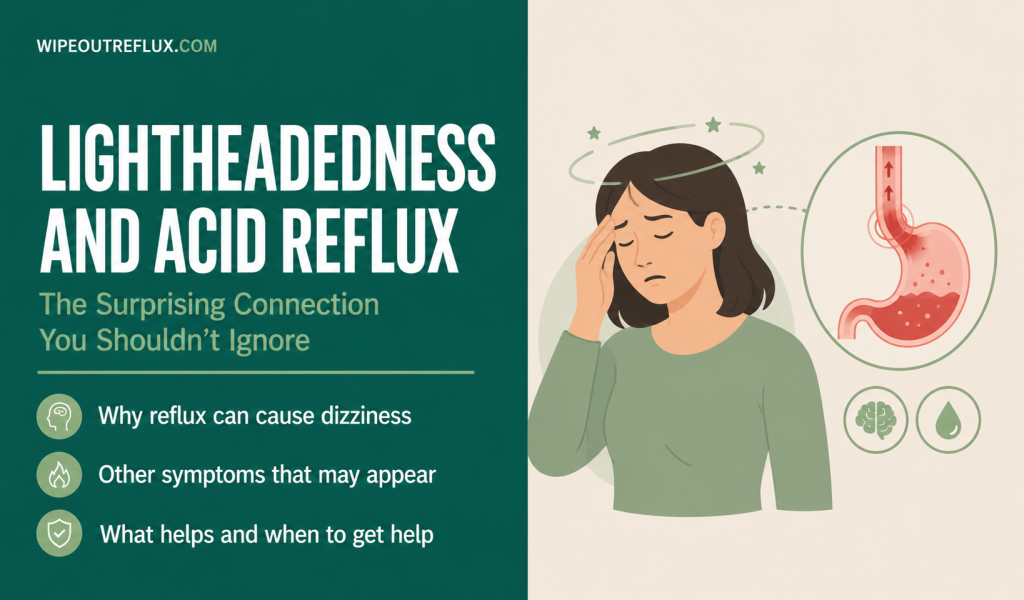
Feeling lightheaded or dizzy on top of acid reflux symptoms can be unsettling — and it’s one of those combinations that tends to get dismissed or written off as unrelated. But the two conditions share more biological territory than most people realise. There are several distinct mechanisms through which reflux — particularly LPR (silent reflux) — can contribute to lightheadedness, dizziness, and balance disturbances, and understanding which one applies to you is the key to addressing it.
The honest answer is that acid reflux doesn’t cause lightheadedness through one simple, direct pathway. Instead, there are multiple indirect routes: vagal nerve stimulation from oesophageal acid exposure, inner ear disruption via LPR reaching the Eustachian tube, postprandial blood pressure drops that share the same post-meal triggers as reflux, autonomic nervous system disturbances documented in GERD patients, and — importantly — the dizziness that is a listed side effect of long-term PPI medication use.
This article works through each mechanism clearly, explains what the research actually shows versus what’s speculative, and tells you what to do about it — including the warning signs that mean lightheadedness alongside reflux needs prompt medical evaluation.
Key Takeaways
- Acid reflux can contribute to lightheadedness through several distinct mechanisms — none of them a simple direct cause, but each with a documented biological basis.
- The vagus nerve runs alongside the oesophagus and connects the digestive tract to the heart and brain. Oesophageal acid stimulation can trigger a vagally-mediated reflex that temporarily lowers heart rate and blood pressure, causing lightheadedness.
- In LPR (silent reflux), pepsin and acid reaching the nasopharynx can travel via the Eustachian tube to the middle ear, disrupting the pressure-balance system and causing dizziness or vertigo.
- Postprandial hypotension — a blood pressure drop after eating — shares the same triggers as reflux (large meals, high-carbohydrate foods, lying down post-eating) and is a significant and underdiagnosed cause of post-meal lightheadedness.
- GERD is associated with measurable disturbances in parasympathetic nervous system function (assessed via heart rate variability), which may contribute to blood pressure and circulation instability.
- Studies have found high rates of GERD among patients presenting with peripheral vertigo — in one study, 78.4% of 153 peripheral vertigo patients also had GERD.
- Long-term PPI use can cause hypomagnesaemia (low magnesium), which produces symptoms including dizziness and nausea in a significant proportion of affected patients.
- Lightheadedness accompanied by chest pain, fainting, severe or sudden-onset vertigo, one-sided weakness, or visual disturbance always requires urgent medical assessment — these symptoms are not explained by reflux alone.
The Vagus Nerve: The Main Bridge Between Reflux and Lightheadedness
The vagus nerve is the primary biological connection between acid reflux and the cardiovascular symptoms — including lightheadedness — that some reflux sufferers experience. Understanding how this nerve works in the context of reflux explains why the connection exists without requiring any direct physical pathway between the stomach and the head.
The vagus nerve is the longest cranial nerve in the body, running from the brainstem down through the neck, chest, and abdomen. It carries signals in both directions — brain to organs and organs to brain — and plays a central role in regulating heart rate, blood pressure, breathing, and digestive function. Crucially for reflux sufferers, the oesophagus is densely innervated by vagal sensory fibres. Every reflux event that brings acid into the oesophagus stimulates these fibres.
When the vagus nerve is activated by oesophageal acid exposure, several things can happen. The first is increased parasympathetic tone — the “rest and digest” signal that, when triggered inappropriately, can slow the heart rate and lower blood pressure. Studies using oesophageal acid perfusion have demonstrated that acid stimulation of the distal oesophagus produces measurable increases in parasympathetic activity. A significant drop in heart rate and blood pressure — even a brief one — is immediately perceived as lightheadedness, and can in more pronounced cases cause near-fainting (presyncope) or actual vasovagal syncope.
This is the same mechanism behind vasovagal syncope from other triggers (pain, anxiety, heat) — the vagus nerve overreacts, the cardiovascular system temporarily undershoots, and the brain registers insufficient blood flow as a dizzy or fainting sensation. In the reflux context, the trigger is acid irritating the oesophagus rather than a needle or a shock, but the neural pathway is the same.
The vagal connection in reflux also explains some of the heart palpitations that GERD patients report — a topic covered separately in the article on acid reflux and heart palpitations. Lightheadedness and palpitations often occur together when vagal activation is the driving mechanism, because both heart rate and vascular tone are affected simultaneously.
LPR, the Eustachian Tube, and Balance Disruption
For people with LPR specifically, there is a second and more anatomically direct route by which reflux can cause dizziness — through the inner ear, via the Eustachian tube.
The Eustachian tube connects the nasopharynx (the back of the nose and throat) to the middle ear. Its job is to equalise pressure between the middle ear and the outside environment. When LPR events carry pepsin and acid into the nasopharynx — which happens regularly in silent reflux, particularly during sleep — this material is in close proximity to the Eustachian tube openings. Research has confirmed that LPR is a significant driver of Eustachian tube dysfunction, with LPR severity (measured by Reflux Symptom Index score) being significantly associated with impaired Eustachian tube function in patients with middle ear effusion.
When the Eustachian tube becomes inflamed or obstructed — whether from LPR-related irritation, mucosal oedema, or pepsin-driven tissue damage — the pressure balance in the middle ear is disrupted. The inner ear contains the vestibular system, which provides the brain with information about position, balance, and spatial orientation. Pressure changes and inflammation in the middle ear can directly interfere with this system, producing vertigo, balance instability, and dizziness that can range from mild swaying sensations to frank rotational vertigo.
Pepsin has also been detected in middle ear fluid in patients with otitis media with effusion, with research confirming that gastric reflux reaches the middle ear through the nasopharynx and Eustachian tube. The same anatomical pathway that carries pepsin to the tear film (discussed in the eye article) applies here — pepsin is a one-source biomarker, and when it’s found in the middle ear, LPR is the only plausible origin.
One important clinical implication: dizziness or balance problems alongside the classic LPR symptoms of throat clearing, hoarseness, and globus sensation should prompt consideration of Eustachian tube involvement. This is a treatable situation — addressing the underlying LPR reduces the reflux events that drive Eustachian tube inflammation, often improving ear-related symptoms alongside the throat ones.
Postprandial Hypotension: Why Meals Trigger Both Reflux and Dizziness
Postprandial hypotension — a significant drop in blood pressure after eating — is one of the most common and most underappreciated causes of post-meal lightheadedness, and it shares its primary triggers almost exactly with acid reflux. This makes the two conditions easy to confuse and easy to conflate when they occur together.
After a meal, blood flow is redirected to the digestive system to absorb nutrients. The cardiovascular system normally compensates by increasing heart rate and constricting peripheral blood vessels, keeping overall blood pressure stable. In postprandial hypotension, this compensation fails — blood pressure drops by 20 mmHg or more in the 30–60 minutes after eating, producing symptoms including lightheadedness, weakness, nausea, and in severe cases near-fainting or actual syncope.
Postprandial hypotension is defined as a drop of 20 mmHg or more in systolic blood pressure within two hours of eating, and research has identified it as a potential cause of syncope, falls, dizziness, weakness, and other cerebral ischaemic symptoms — particularly in older adults, where it affects roughly 40% of people in the 65–86 age range.
The overlap with reflux triggers is striking:
- Large meals trigger both — they increase intra-gastric pressure (worsening reflux) and demand more digestive blood flow (increasing hypotension risk)
- High-carbohydrate and sugary meals worsen both conditions through vasodilatory gut peptide release
- Lying down after eating worsens reflux through positional acid exposure, and worsens postprandial hypotension by removing gravitational support for blood pressure
- Eating quickly worsens both — it increases meal volume and swallowing air for reflux, and delivers a faster glucose load for the hypotension response
This means that if you feel lightheaded after meals alongside your reflux symptoms, you may be experiencing two separate but co-triggered conditions rather than one causing the other. The practical overlap, however, is helpful: the dietary strategies that reduce reflux — smaller meals, slower eating, avoiding lying down after eating — also significantly reduce the severity of postprandial hypotension.
Autonomic Dysfunction in GERD: When the Nervous System Is Consistently Disturbed
Beyond acute vagal triggering during individual reflux events, research has documented longer-term disturbances of the autonomic nervous system in GERD patients. This matters because sustained autonomic dysregulation — not just moment-to-moment vagal responses — can affect cardiovascular stability and blood pressure regulation in ways that contribute to chronic or recurrent lightheadedness.
Studies using heart rate variability analysis — a sensitive measure of autonomic nervous system function — have found measurable disturbances in parasympathetic activity in GERD patients, with the degree of disturbance correlating with the severity of reflux and oesophageal mucosal injury. The research has raised the question of whether these parasympathetic disturbances are primary to GERD pathogenesis (meaning autonomic dysfunction helps cause reflux by impairing lower oesophageal sphincter function) or secondary (meaning chronic acid exposure damages vagal function over time). The answer may be both — a bidirectional relationship where each makes the other worse.
Research in LPR has also shown that LPR severity scores (RSI) correlate significantly with autonomic function measures, including the LF/HF ratio in heart rate variability — an index of sympathovagal balance. A study evaluating vagus nerve stimulation as a treatment for LPR found that LPR patients had measurably impaired autonomic function at baseline, and that treating the reflux improved these autonomic parameters alongside symptom scores.
For patients who experience persistent background lightheadedness, faintness on standing, or exercise intolerance alongside their reflux symptoms — rather than symptoms tied to specific meals or reflux episodes — autonomic dysfunction is the most plausible linking mechanism and warrants discussion with a doctor. This presentation also overlaps with some aspects of anxiety and LPR, where the autonomic system is dysregulated through a different but interacting pathway.
What Studies Show About Reflux and Dizziness/Vertigo
The clinical research on this topic is not extensive, but what exists points consistently in the same direction: there is a meaningful co-occurrence of GERD and balance-related symptoms that exceeds what you’d expect from chance alone.
One study examined 153 patients presenting with peripheral vertigo — dizziness originating from the inner ear or vestibular pathways rather than the central nervous system. In that group, 120 patients (78.4%) also had GERD based on diagnostic criteria. The researchers proposed two mechanisms: direct irritation of the respiratory mucosa by refluxed acid, and reflux-driven H. pylori infection reaching the upper respiratory tract and causing local inflammation and tympanosclerosis (hardening of ossicular structures in the middle ear). A separate study of patients with peripheral vertigo confirmed the hypothesis that GERD may be one of the causes, with prevalence of GERD significantly higher in the vertigo group than in controls (75.89% vs. controls, p < 0.05).
It’s important to be honest about the limitations here. These are association studies, not randomised controlled trials, and GERD is common enough in the general population that co-occurrence with vertigo patients doesn’t automatically establish causation. The more mechanistically compelling evidence — pepsin in middle ear fluid, LPR-driven Eustachian tube dysfunction — provides the biological plausibility these association studies need to be interpretable.
What can be said with reasonable confidence is this: if you have known LPR or GERD and develop dizziness or balance problems that your ENT or GP can’t otherwise explain, reflux is a legitimate candidate mechanism worth investigating — particularly if you also have ear pressure, tinnitus, or other ear-related symptoms alongside your reflux presentation.
The connection between acid reflux and ear symptoms is covered in more detail in the dedicated article on that topic, which addresses how pepsin reaches the ear and what it does when it gets there.
Could Your Reflux Medication Be Causing the Dizziness?
This is a possibility that many people don’t consider, but it’s clinically important — particularly for anyone who has been on long-term PPI therapy.
Dizziness and lightheadedness are listed as common side effects (occurring in 1–10% of patients) of omeprazole and other PPIs, with vertigo and lightheadedness listed as uncommon (0.1–1%) effects. This alone warrants attention from anyone on PPIs who also experiences dizziness.
More significantly, long-term PPI use — typically defined as more than a year — is associated with hypomagnesaemia: abnormally low magnesium levels caused by impaired intestinal magnesium absorption. Magnesium plays a critical role in neuromuscular function, cardiovascular regulation, and blood pressure stability. PPI-induced hypomagnesaemia can cause a range of symptoms, and clinical case series have identified dizziness and nausea in approximately 36% of patients presenting with PPI-related low magnesium. Other symptoms include muscle cramps, tremors, weakness, palpitations, and in severe cases, cardiac arrhythmia and seizures.
This matters practically in two ways. First, if you’ve been on PPIs for more than a year and experience new or worsening dizziness, hypomagnesaemia is worth checking with a blood test. Second, the magnesium depletion may compound other mechanisms driving lightheadedness — low magnesium impairs the cardiovascular regulation that normally compensates for blood pressure drops, potentially making postprandial hypotension worse.
If you’re exploring whether long-term PPI use is appropriate for your situation, the article on getting off PPIs and managing acid rebound is a useful starting point.
Anxiety, Reflux, and Lightheadedness: The Three-Way Loop
Anxiety, reflux, and lightheadedness form a mutually reinforcing loop that can be difficult to untangle — and all three are more closely linked than they’re usually presented as being.
The mechanisms connecting anxiety and reflux are well-established: anxiety activates the autonomic nervous system in ways that reduce oesophageal sphincter function, increase acid production, and heighten visceral sensitivity (making the same amount of acid feel more painful). Conversely, the chronic discomfort and unpredictability of reflux symptoms — particularly LPR, where symptoms are diffuse and often misattributed — contributes to the development of health anxiety in many patients.
Lightheadedness enters this loop because anxiety itself is a reliable trigger for lightheadedness through hyperventilation. When people breathe too fast or shallowly in response to anxiety — even subclinically, without obvious breathlessness — they exhale too much carbon dioxide, which causes cerebral vasodilation (paradoxically reducing effective brain perfusion) and produces a characteristic light, dizzy, slightly detached sensation. This hyperventilation-driven lightheadedness is extremely common in people with health anxiety and chronic illness anxiety, both of which are more prevalent in people managing difficult, unpredictable conditions like LPR.
The practical implication: if your lightheadedness feels more like a floaty detachment or a sensation that comes on with anxiety or stress rather than being tied to specific meals or lying down, the anxiety-hyperventilation mechanism may be more relevant than a direct reflux-dizziness pathway. Addressing both the anxiety and the reflux together — rather than treating them as competing diagnoses — tends to produce better results than managing either in isolation.
Warning Signs: When Lightheadedness With Reflux Needs Urgent Attention
Most lightheadedness in the context of reflux is genuinely benign — uncomfortable and disruptive, but not dangerous. However, certain accompanying symptoms require prompt medical evaluation and should never be attributed to reflux without excluding more serious causes.
Seek urgent medical attention if lightheadedness or dizziness occurs alongside:
- Chest pain — reflux-like chest discomfort and cardiac chest pain can be difficult to distinguish. Chest pain with dizziness is a red-flag combination until cardiac causes have been excluded
- Fainting or loss of consciousness — a vasovagal episode may be benign, but syncope with cardiac causes needs to be ruled out, especially with concurrent chest symptoms
- Sudden, severe, or “thunderclap” vertigo — sudden-onset severe vertigo (particularly with headache, vomiting, or neurological symptoms) suggests a central cause requiring emergency evaluation
- One-sided weakness, facial drooping, or speech difficulty — these are stroke symptoms; dizziness can accompany posterior circulation strokes, and these warrant immediate emergency care
- Shortness of breath or palpitations — dizziness with breathing difficulty or heart rhythm changes suggests cardiovascular causes that need assessment
- Severe or persistent headache alongside dizziness
- Lightheadedness that is new, rapidly worsening, or not clearly related to meals or reflux events
None of these presentations should be attributed to reflux without proper investigation. The starting point for managing reflux-related lightheadedness is confirming that no other cause is present.
Practical Steps to Reduce Both Reflux and Lightheadedness
Fortunately, the lifestyle strategies that most effectively reduce reflux also directly address the most common mechanisms driving reflux-related lightheadedness.
Eat smaller, more frequent meals. This reduces intra-gastric pressure (fewer reflux events), reduces the blood flow demand on the digestive system per sitting (reducing postprandial hypotension risk), and stabilises blood glucose in a way that supports cardiovascular regulation. It’s the single change most likely to help both issues simultaneously.
Sit or stay upright for at least 2–3 hours after eating. This uses gravity to keep stomach contents where they belong (reducing reflux) and helps maintain blood pressure after meals (the most effective non-pharmacological intervention for postprandial hypotension). Side sleeping and elevation at night address the nighttime component — covered in the guide to managing acid reflux at night.
Stay well hydrated. Dehydration is an independent cause of lightheadedness and worsens both postprandial hypotension and vagal instability. Drinking water before meals temporarily increases blood volume and reduces the severity of the post-meal blood pressure drop. Aim to be well hydrated before eating rather than drinking large amounts during the meal itself, which can worsen reflux.
Avoid alcohol. Alcohol relaxes the lower oesophageal sphincter (worsening reflux), is a vasodilator (worsening blood pressure drops), and dehydrates — making it a triple hit for both conditions.
Address the foods driving both problems. Fatty foods, large carbohydrate meals, and alcohol are the most reliably problematic for both reflux and postprandial lightheadedness. Reducing these is the most efficient dietary change for people affected by both. The LPR foods to avoid guide covers the dietary triggers in depth.
Check your medication if on long-term PPIs. Ask your doctor to check your magnesium level if you’ve been on PPIs for more than a year and are experiencing dizziness, muscle cramps, or fatigue. This is a simple blood test that may reveal a correctable cause.
Manage nasal congestion if you have LPR. Keeping the nasal passages clear reduces the frequency with which reflux material reaches the nasopharynx and from there the Eustachian tube. Saline nasal rinses and allergen management have a role here alongside the dietary approach.
Frequently Asked Questions
Can acid reflux cause lightheadedness?
Yes — through several mechanisms. The most direct is vagal nerve stimulation from oesophageal acid exposure, which can trigger a temporary drop in heart rate and blood pressure producing lightheadedness. Postprandial hypotension (blood pressure dropping after meals) shares triggers with reflux. In LPR, Eustachian tube disruption from reflux reaching the ear can cause balance problems. And long-term PPI use can cause low magnesium, which produces dizziness in a proportion of patients.
Why do I feel dizzy after eating if I have acid reflux?
Post-meal dizziness in reflux sufferers is most often driven by postprandial hypotension — a blood pressure drop after eating that shares its triggers (large meals, high-carbohydrate foods, lying down after eating) with acid reflux. The same meal that triggers reflux is likely to cause blood to pool in the digestive system, reducing the pressure available to the brain. Eating smaller, more frequent meals and remaining upright after eating helps both problems.
Can LPR (silent reflux) cause dizziness?
Yes, and the LPR-specific mechanism is more direct than for standard GERD. LPR events that carry pepsin and acid into the nasopharynx can reach the Eustachian tube, disrupting middle ear pressure and interfering with the vestibular (balance) system. Pepsin has been confirmed in middle ear fluid, establishing a direct biological pathway. People with LPR who also have ear fullness, tinnitus, or hearing changes alongside dizziness should have the LPR-Eustachian tube connection investigated.
Can PPIs cause dizziness?
Yes. Dizziness is a listed common side effect (1–10%) of PPI medications. More significantly, long-term PPI use can cause hypomagnesaemia (low magnesium), which produces dizziness and nausea in a meaningful proportion of affected patients. If you’ve been on PPIs for over a year and experience new or worsening dizziness, a magnesium blood level check is warranted.
Is the dizziness from acid reflux dangerous?
The mechanisms described above are generally not dangerous in themselves, but they can coexist with more serious conditions that need to be excluded. Lightheadedness with reflux that is accompanied by chest pain, fainting, severe sudden-onset vertigo, one-sided weakness, speech difficulty, or breathing problems requires urgent medical evaluation, as these combinations can indicate cardiac or neurological causes that need ruling out.
Why do I feel lightheaded when I have heartburn?
During a heartburn episode, the vagus nerve — which runs alongside the oesophagus — is stimulated by acid contact with the oesophageal lining. This can trigger an increase in parasympathetic tone, temporarily lowering heart rate and blood pressure in a way that produces lightheadedness. The more severe the reflux event and the more sensitive the oesophagus (which becomes more reactive with chronic acid exposure), the more pronounced this response tends to be.
What tests might my doctor run to investigate dizziness with reflux?
Depending on your symptom pattern, tests might include: standard cardiac ECG to rule out arrhythmia; blood pressure monitoring in sitting and standing positions (orthostatic hypotension) or before and after a meal (postprandial hypotension); blood tests including magnesium, full blood count (for anaemia), and thyroid function; audiometry and tympanometry if ear-related symptoms are present; Holter monitoring if palpitations accompany the dizziness; and pH monitoring or endoscopy to characterise the reflux if this hasn’t already been done. The combination of tests depends on which mechanism is most suspected clinically.
Conclusion
Lightheadedness and acid reflux aren’t unrelated annoyances that happen to coincide — there are real, documented pathways connecting the two. The vagus nerve provides the most direct bridge, with acid-stimulated oesophageal nerve activity capable of triggering transient cardiovascular changes that register as lightheadedness. The Eustachian tube route is the most anatomically specific for LPR sufferers, with pepsin now confirmed in middle ear fluid and Eustachian tube dysfunction well-documented as a consequence of reflux reaching the nasopharynx. Postprandial hypotension provides the most practically significant connection, given how completely it overlaps with the dietary triggers for reflux.
The good news is that the practical approach to improving both conditions points in the same direction: smaller meals, staying upright after eating, managing dietary triggers, and addressing the underlying reflux through a structured dietary approach. Reducing reflux events reduces vagal stimulation, reduces the material reaching the Eustachian tube, and reduces the meal size that drives postprandial blood pressure drops — all at once.
If you’re working on the dietary side of reflux management, the LPR diet guide and the Wipeout Diet Plan provide the structured framework for doing this systematically rather than through trial and error. The Wipeout Food Reference Guide is the essential companion for checking individual foods and drinks — including their pH values and reflux potential — so you’re making informed choices rather than guessing.
Research Sources
[__Gaude et al., North American Journal of Medical Sciences, 2013__] — Acid perfusion of the distal oesophagus in asthmatic patients produced significant increases in parasympathetic (vagal) activity as measured by heart rate variability; confirmed the existence of a vagally-mediated oesophago-bronchial reflex and demonstrated that oesophageal acid stimulation causes measurable autonomic responses including increased parasympathetic tone, providing the mechanistic basis for vagal-mediated lightheadedness during reflux events.
[__Zhang et al., Frontiers in Surgery, 2022__] — Study of 105 adult patients with otitis media with effusion finding that LPR symptom severity (RSI score) was significantly associated with Eustachian tube function measured by tubomanometry (P < 0.001); established that LPR is a plausible and significant contributor to Eustachian tube dysfunction in adults, with implications for balance and dizziness in LPR patients.
[__Heavner et al., Laryngoscope, 2009__] — Demonstrated that gastric reflux reaches the middle ear through the nasopharynx and Eustachian tube by detecting pepsinogen in both adenoid tissue and middle ear effusion fluid from children with otitis media with effusion; established the biological pathway by which LPR material disrupts middle ear function.
[__Kuhn et al., Medical Hypotheses, 2015__] — Proposed and explored the association between peripheral vertigo and GERD; in a study group of patients with peripheral vertigo, 78.4% also had GERD; identified two plausible mechanisms — direct mucosal irritation by refluxate reaching the upper respiratory tract, and H. pylori infection reaching the middle ear via reflux, with potential for tympanosclerosis and ossicular disruption.
[__Gupta et al., International Journal of Otorhinolaryngology and Head and Neck Surgery, 2021__] — Descriptive study of patients with peripheral vertigo in an outpatient setting; found GERD in 75.89% of peripheral vertigo patients (p < 0.05); confirmed the hypothesis that GERD may be one of the peripheral vertigo causes through mechanisms including gastric acid irritation of the mucosa and local infection.
[__Jansen et al., Annals of Internal Medicine, 1995__] — Comprehensive review establishing postprandial hypotension as a distinct clinical entity; defined as ≥20 mmHg systolic drop within two hours of eating; documented causes including inadequate sympathetic compensation for meal-induced splanchnic blood pooling and impaired baroreflex function; noted particular prevalence in older hypertensive patients and importance for evaluating syncope, falls, and dizziness.
[__Tougas et al., Alimentary Pharmacology and Therapeutics, 2005__] — Assessed parasympathetic nervous system function in GERD patients using heart rate variability; found disturbances in the parasympathetic branch of the autonomic nervous system in both erosive and non-erosive GERD patients; raised the question of whether these disturbances are primary (contributing to GERD pathogenesis) or secondary to chronic oesophageal acid exposure.
[__Huang et al., Frontiers in Neuroscience, 2024__] — Randomised controlled trial of vagus nerve stimulation for LPR (n=44); confirmed that LPR severity scores correlate significantly with LF/HF ratio in heart rate variability (r=0.619, p < 0.001), demonstrating measurable autonomic dysfunction in LPR patients; treatment-associated improvements in autonomic function paralleled symptom score improvements.
[__Danziger et al., International Journal of Clinical Practice, 2015__] — Case series and literature review of PPI-induced hypomagnesaemia; documented that dizziness and nausea occur in approximately 36% of patients with this condition; comprehensive description of the range of symptoms including tremor, muscle cramps, weakness, cardiac arrhythmia, and seizures in more severe cases; underscored the importance of monitoring magnesium in long-term PPI users.
[__Kim et al., Cureus, 2023__] — Case report documenting alternobaric vertigo caused by Eustachian tube dysfunction in a patient with confirmed LPR signs on laryngoscopy; Eustachian tube catheterisation immediately resolved all symptoms including vertigo, tinnitus, and chest discomfort; illustrates the clinical presentation and resolution of LPR-driven Eustachian tube dysfunction with balance consequences.

David Gray
12 years living with LPR · Consultant & researcher
I've lived with LPR for twelve years — the misdiagnoses, the PPI courses that did nothing, the slow work of figuring out what actually helps. Wipeout Reflux is where I translate the research into plain terms for people stuck in the same place. Every claim here is sourced to peer-reviewed work, and I consult one-to-one with LPR sufferers.