
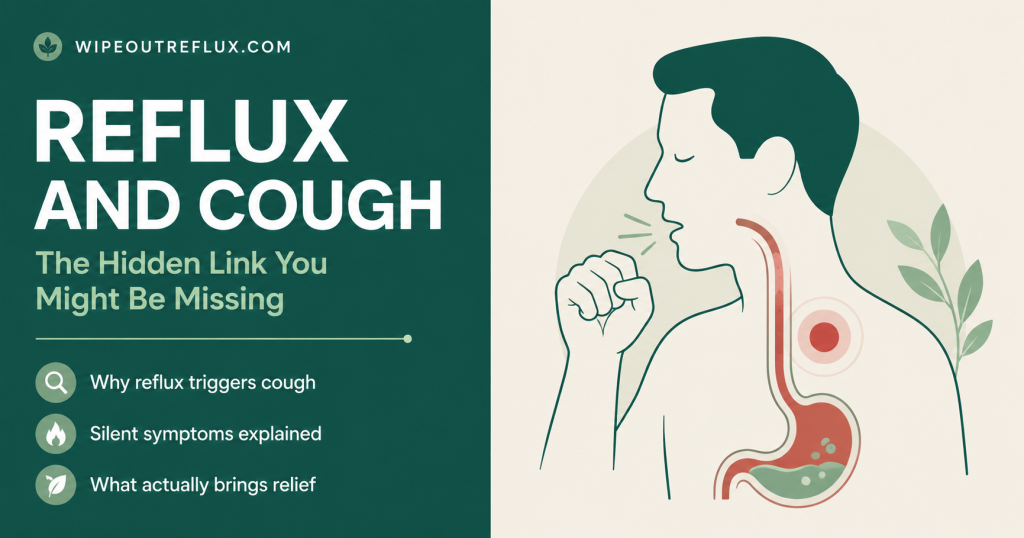
If you have a cough that won’t go away and you’re not sure why, acid reflux could be the reason — even if you’ve never felt a single moment of heartburn. A reflux cough is one of the most common yet misunderstood symptoms of both GERD and laryngopharyngeal reflux (LPR). It’s often mistaken for asthma, a post-viral cough, or chronic sinusitis, which means people spend months on the wrong treatments before the real cause is identified.
The short answer is yes — acid reflux can absolutely cause a chronic cough. In fact, some research estimates that reflux accounts for between 10% and 40% of all chronic cough cases. When reflux reaches the throat and airways, it triggers a cough reflex through one of two distinct pathways. Understanding which one is driving your cough is key to treating it effectively.
In this article I’m going to walk you through exactly how reflux causes coughing, why it so often happens without any chest burning, the specific role pepsin plays in keeping the cough cycle going, and what you can do to finally get it under control.
Key Takeaways
- Acid reflux and LPR are among the most common — and most overlooked — causes of chronic cough.
- A reflux cough often occurs without heartburn, especially in LPR, which is sometimes called silent reflux.
- There are two mechanisms: micro-aspiration of stomach contents into the airways, and a vagal reflex triggered by acid in the lower oesophagus.
- Pepsin, the digestive enzyme that travels up with reflux, can remain in throat tissue and cause ongoing irritation even when the cough seems out of proportion to symptoms.
- A reflux cough is typically dry, persistent, and often worse after meals, when lying down, or in the morning.
- Diet and lifestyle changes are the essential foundation of treatment — medications alone are frequently insufficient, particularly for LPR-driven cough.
- Most reflux coughs can improve significantly within 8–12 weeks with the right approach, though some cases take longer.
- Getting the diagnosis right matters: LPR-related cough responds differently to treatment than GERD-related cough.
What Is a Reflux Cough?
A reflux cough is a chronic, persistent cough caused by stomach acid (and often stomach enzymes) travelling upward into the oesophagus and beyond. Unlike the kind of cough you get with a cold, a reflux cough tends to be dry and non-productive — meaning there’s nothing being brought up. It doesn’t respond to antihistamines or cold remedies, which is often the first clue that something else is going on.
The cough typically persists for more than eight weeks, which is how clinicians define a “chronic” cough. It’s often worse after eating, when bending forward, at night, or first thing in the morning. Some people also notice it flares after coffee, carbonated drinks, or a heavy meal.
There are two main reflux conditions that cause this kind of cough. GERD (gastro-oesophageal reflux disease) involves acid backing up into the oesophagus, and the cough is usually one symptom among several that includes heartburn. LPR (laryngopharyngeal reflux), on the other hand, is where stomach contents travel all the way up into the throat and larynx — and this is where coughing without heartburn becomes very common. I cover the key differences in more depth in my guide on GERD vs LPR.
The Two Mechanisms Behind Reflux-Induced Cough
One thing that often surprises people is that reflux doesn’t have to physically reach the lungs to cause coughing. Research has identified two distinct pathways — one direct, one indirect — and both can be active at the same time.
Micro-Aspiration: The Direct Route
The first mechanism is micro-aspiration. This is where tiny droplets of stomach acid or gastric enzymes are inhaled into the lower airways. When this happens, the sensitive tissues lining the trachea and bronchi become inflamed and irritated, activating the cough receptors directly. The body responds by trying to clear the airways — resulting in the familiar dry, repetitive cough.
Pepsin, the main digestive enzyme in stomach acid, is increasingly recognised as a key player here. When pepsin reaches the airways, it can cause direct tissue damage and sustain local inflammation. Studies examining fluid from the lungs of patients with chronic respiratory symptoms have found pepsin present in concentrations high enough to cause harm, pointing to aspiration as a real and ongoing process in many of these patients Iov et al., Journal of Personalized Medicine, 2022.
The Vagal Reflex: The Indirect Route
The second mechanism is subtler and, arguably, more important for the majority of people with reflux cough. It doesn’t require acid to reach the throat at all.
The oesophagus and the airways (trachea and bronchi) both originate from the same embryonic tissue and share nerve supply via the vagus nerve. When acid irritates the lower oesophagus, vagal sensory neurons carry that signal to the brainstem, where it can cross-talk with the cough centre. The result is a cough reflex triggered from below, not from above.
This oesophageal-tracheobronchial reflex explains why some people cough persistently even when reflux isn’t reaching the throat — and why treating the lower oesophageal source of irritation is essential for resolving the cough Zhang et al., Journal of Thoracic Disease, 2023. The vagus nerve, in essence, acts as a shared alarm system for both the gut and the airways.
The Role of Pepsin: Why LPR Makes Coughing Worse
If you have laryngopharyngeal reflux, pepsin adds an extra layer of complexity to the cough problem that most people — and unfortunately many doctors — don’t know about.
When stomach contents reach the throat, pepsin gets deposited on the mucosal lining of the larynx and pharynx. Unlike acid, which is quickly neutralised and cleared, pepsin can bind to tissue and linger. Here’s the important part: pepsin remains enzymatically active up to a pH of around 6.5. So even after the initial reflux episode has passed, anything that drops the local pH — acidic food, carbonated drinks, coffee, even a respiratory infection — can reactivate the pepsin already sitting in your throat tissue.
This reactivation triggers fresh inflammation and irritation, feeding the cough reflex long after the original reflux event. It’s one of the reasons why a reflux cough can feel persistent and self-sustaining. I go into much more detail on this process in my article on how to neutralise pepsin in the throat, which is essential reading if you’re dealing with LPR-driven cough. Research has also shown that LPR can induce laryngeal hyper-responsiveness — a state of heightened sensitivity in the voice box that makes the cough reflex far easier to trigger Rees et al., Clinical Otolaryngology, 2015.
Reflux Cough Without Heartburn — The LPR Problem
This is the detail that catches most people out. When cough is the main — or only — symptom, reflux is rarely the first thing a GP thinks of. And it makes sense why: most people associate acid reflux with a burning sensation in the chest. But in LPR, heartburn is often absent entirely.
More than 75% of patients with extraoesophageal symptoms (like cough) don’t suffer from typical GERD symptoms like heartburn or regurgitation, and may even have a negative endoscopy. This is because the larynx and throat are far more sensitive to low levels of acid and pepsin than the oesophagus — small amounts of reflux that wouldn’t bother the oesophagus at all can cause significant inflammation higher up Hránková et al., Frontiers in Medicine, 2024.
This is one of the reasons I always frame LPR as genuinely different from standard GERD — not just a more severe version of it. You can read more about the distinctions and the full range of LPR symptoms if you’re trying to work out whether this fits your picture.
How to Tell If Your Cough Is From Reflux
There’s no single definitive test you can do at home, but there are patterns that make a reflux cause more likely. A reflux cough typically:
- Is dry and non-productive (nothing comes up)
- Has lasted longer than eight weeks
- Is worse after meals, especially large or fatty ones
- Flares at night or in the early morning
- Is aggravated by coffee, carbonated drinks, spicy food, or alcohol
- Is often accompanied by other throat symptoms like throat clearing, hoarseness, or a feeling of something stuck in the throat
- Doesn’t respond to antihistamines, decongestants, or standard cough medicine
If you’re waking up coughing at night, it’s worth reading my article on acid reflux at night, as nocturnal reflux has its own dynamics and management approach. Clinically, a diagnosis is usually made through pH-impedance monitoring or laryngoscopy (where a doctor looks directly at the throat for signs of inflammation consistent with LPR).
One study tracking patients who presented with unexplained chronic cough found that all 28 patients had findings consistent with LPR on examination — even though none had been previously diagnosed with or treated for reflux. After treatment with reflux medications and lifestyle changes, 60.7% reported a meaningful reduction in cough symptoms Sataloff et al., American Journal of Otolaryngology, 2021.
How to Treat a Reflux Cough
Treatment needs to address the root cause — which means reducing reflux at the source, not just suppressing the cough symptom itself. Here’s how to approach it.
Diet and Lifestyle Changes
For LPR-related cough especially, dietary and lifestyle changes aren’t optional extras — they’re the foundation. Medications alone frequently under-deliver when the diet is working against you.
The key principles are: avoid food and drink that relax the lower oesophageal sphincter (alcohol, chocolate, fatty meals, peppermint), reduce acidic triggers that reactivate pepsin in the throat (coffee, citrus, carbonated drinks, vinegar), eat smaller meals, and leave at least three hours between your last meal and lying down. A full breakdown of what to cut first is in my LPR foods to avoid guide. For the structured version of all this, the Wipeout Diet Plan goes into far more depth — it was built around LPR, though it works just as well for GERD and heartburn.
Elevating the head of your bed by 6–8 inches (not just using extra pillows, which can worsen pressure) reduces nocturnal reflux significantly. Body weight also plays a direct role — excess abdominal fat increases intra-abdominal pressure, pushing stomach contents upward more readily.
Medications
Proton pump inhibitors (PPIs) are the most commonly prescribed medication for reflux cough. They work by reducing acid production, which lowers the harm potential of any refluxate that does escape. For LPR-related cough, PPIs are usually prescribed at higher doses for a longer duration than for standard heartburn — often twice daily for at least 8–12 weeks before reassessment.
Gaviscon Advance (the alginate-based formulation) can be particularly useful alongside PPIs for LPR cough, as it forms a physical raft on top of stomach contents to physically block reflux rather than just altering acid levels. I’ve written about this in depth in my Gaviscon Advance review.
It’s worth knowing that PPIs don’t neutralise pepsin already deposited in throat tissue — they only reduce new acid production. This is why diet and alkaline water (which can help denature pepsin) are particularly important when the throat and larynx are involved. For a broader look at your options, including natural approaches, see my article on natural remedies for LPR.
When Medication Isn’t Enough
Some people with reflux cough don’t respond well to PPIs alone, particularly those where the vagal reflex hypersensitivity has become established. In these cases, neuromodulator medications (such as gabapentin or baclofen) are sometimes used as add-on therapy to dampen the sensitised cough reflex. This is an area where working with a specialist — ideally a respiratory physician or ENT with an interest in LPR — makes a significant difference. If you’re struggling to get anywhere with standard reflux medication, it’s worth pushing for a referral rather than simply increasing the PPI dose.
How Long Does a Reflux Cough Last?
This is one of the most common questions I hear, and the honest answer is: it depends on how well the underlying reflux is controlled and how quickly the throat irritation can settle down.
For many people, meaningful improvement in cough begins within four to six weeks of consistent dietary changes and medication. Full resolution, however, often takes three to six months — particularly in LPR, where throat tissue that has been repeatedly inflamed takes time to heal. The key phrase there is “consistent.” Intermittent adherence to the diet usually means the improvement is slow and patchy.
If your cough isn’t improving after 8–12 weeks of properly managed reflux treatment, it’s worth reassessing — either the diagnosis (could there be a concurrent cause like asthma or post-nasal drip?) or the treatment approach. Two mimics worth ruling out are vocal cord dysfunction, often mistaken for asthma, and an ACE inhibitor cough if you take blood pressure medication. Chronic cough is rarely a single-cause problem, and sometimes multiple contributing factors need addressing at once.
You can also explore my wider guide on stopping constant throat clearing from reflux, which shares a lot of overlap with cough management, as both symptoms often have the same root cause.
Frequently Asked Questions
Can acid reflux cause a cough without any heartburn?
Yes — this is actually very common, particularly with LPR (laryngopharyngeal reflux). Because the throat and larynx are more sensitive to acid than the oesophagus, even small amounts of reflux can cause significant coughing without producing any burning sensation in the chest. This is why reflux is so often missed as the cause of a chronic cough.
What does a reflux cough feel like?
A reflux cough is typically dry, persistent, and non-productive — nothing comes up. It often feels like a tickle or irritation at the back of the throat that won’t go away. Many people describe it as a constant need to clear their throat, and it’s usually worse after meals, in the evening, or first thing in the morning. It doesn’t respond to standard cough medicine or antihistamines.
Does acid reflux cough get worse at night?
Yes, frequently. When you lie flat, stomach contents can move more easily towards the throat and airway without gravity working against them. Nocturnal reflux also tends to cause more laryngeal irritation because swallowing (which helps clear acid from the oesophagus) slows significantly during sleep. Elevating the head of the bed and avoiding late meals can both help significantly.
How is a reflux cough diagnosed?
Diagnosis is usually clinical at first — a GP or specialist will look at the pattern of cough and associated symptoms. Formal testing includes 24-hour pH impedance monitoring (which tracks reflux episodes and correlates them with cough) and laryngoscopy (where an ENT examines the throat for inflammation consistent with LPR). A Reflux Symptom Index (RSI) questionnaire is also commonly used as a screening tool.
Can a reflux cough cause chest pain?
Yes, persistent coughing from any cause — including reflux — can cause musculoskeletal chest soreness from the strain on intercostal muscles. Reflux itself can also cause chest discomfort through oesophageal spasm or irritation. If you’re experiencing chest pain, it should always be evaluated medically to rule out cardiac causes before attributing it to reflux.
Is a reflux cough contagious?
No. A reflux cough is caused by internal irritation from stomach acid and digestive enzymes — it has nothing to do with infection and cannot be passed to anyone else. That said, if you’ve had a respiratory infection that’s since resolved, the viral irritation can sometimes trigger or worsen underlying reflux-related cough, creating a cycle that’s hard to break.
Why isn’t my cough improving on PPIs?
There are a few possible reasons. PPIs reduce acid production but don’t address pepsin already deposited in throat tissue, and they don’t physically stop reflux from reaching the throat. If the diet isn’t supporting treatment, reflux episodes can continue. Some people also metabolise PPIs quickly, meaning standard dosing isn’t sufficient. In LPR, twice-daily dosing is often needed. Additionally, some chronic cough cases have a neuropathic element — a sensitised cough reflex that requires a different treatment approach altogether.
Conclusion
A reflux cough is often one of the most disruptive symptoms people deal with — it’s tiring, socially embarrassing, and frustratingly hard to pin down when you don’t know what’s causing it. But once you understand the mechanics behind it, the path forward becomes clearer.
The critical thing to grasp is that reflux cough — especially LPR-driven cough — isn’t just about acid. Pepsin, the vagal reflex, and laryngeal hypersensitivity all play a role, which is why a pill alone rarely solves the problem. The diet has to come first. Cutting the foods and drinks that either trigger reflux episodes or reactivate pepsin in the throat is non-negotiable if you want lasting results.
If you’re ready to get serious about it, the Wipeout Diet Plan is the most comprehensive resource I’ve put together for managing acid reflux and LPR through food. It covers not just what to avoid, but what to eat, how to structure your meals, and the specific lifestyle adjustments that make a real difference. For a practical quick-reference on which foods and drinks are reflux-friendly — along with their pH values — the Wipeout Food Reference Guide is an essential companion.
The cough can improve. For most people, with the right approach, it does. But you have to treat the whole picture — the reflux, the diet, the lifestyle — not just the symptom.
Research & References
Hránková et al., Frontiers in Medicine, 2024 — A comprehensive narrative review of the relationship between chronic cough and LPR, concluding that LPR is found in up to 20% of patients with chronic cough and that more than 75% of patients with extraoesophageal symptoms lack typical GERD signs. Recommends dietary and lifestyle changes as the first step in treatment.
Zhang et al., Journal of Thoracic Disease, 2023 — A narrative review summarising the pathogenesis and management of GERD-associated cough. Details both the oesophageal-tracheobronchial reflex (vagal pathway) and micro-aspiration as the two main mechanisms underlying reflux-induced cough, and outlines the role of TRPV1 signalling in sensitising the cough reflex.
Iov et al., Journal of Personalized Medicine, 2022 — A review examining the role of pepsin as a biomarker and causative agent in GERD-related respiratory manifestations. Found pepsin detectable in bronchoalveolar fluid in patients with chronic cough and respiratory symptoms, supporting the micro-aspiration pathway as clinically significant.
Sataloff et al., American Journal of Otolaryngology, 2021 — A retrospective chart review of 28 patients presenting with unexplained chronic cough, all of whom had LPR findings on examination. After treatment with reflux medications and lifestyle modification, 60.7% reported subjective improvement in cough, with the reflux finding score improving significantly.
Rees et al., Clinical Otolaryngology, 2015 — Investigated LPR as a cause of laryngeal hyper-responsiveness in patients with chronic cough and vocal cord dysfunction. Found salivary pepsin to be a useful screening tool alongside the Reflux Symptom Index, supporting pepsin’s role in sustaining laryngeal irritation.

David Gray
12 years living with LPR · Consultant & researcher
I've lived with LPR for twelve years — the misdiagnoses, the PPI courses that did nothing, the slow work of figuring out what actually helps. Wipeout Reflux is where I translate the research into plain terms for people stuck in the same place. Every claim here is sourced to peer-reviewed work, and I consult one-to-one with LPR sufferers.