
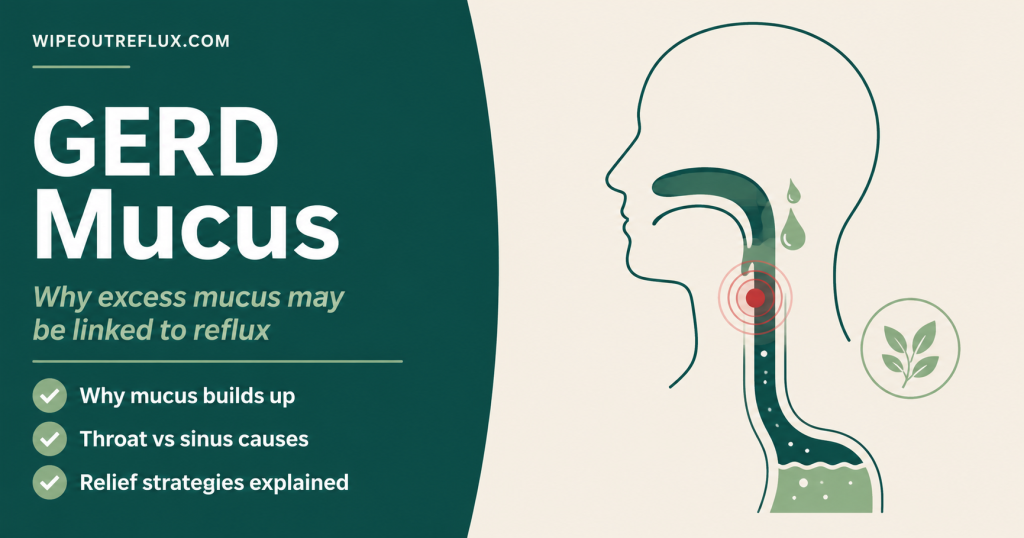
If you feel like you are constantly swallowing, clearing your throat, or fighting a wad of phlegm that never quite goes away, GERD could be the reason. Yes, acid reflux can cause excess mucus. When stomach contents wash up into the esophagus and throat, the tissues there respond by producing more mucus to protect themselves — and that mucus is exactly what you feel sitting at the back of your throat.
I dealt with this for years before I understood what was actually happening. The mucus was one of my most stubborn symptoms, and it never responded to the usual cold or allergy remedies because it was never a cold or an allergy. It was reflux.
In this article I will walk through why GERD produces mucus in the first place, how to tell reflux mucus apart from postnasal drip, and the practical steps that actually reduced it for me.
Key Takeaways
- GERD and acid reflux can trigger excess mucus and phlegm in the throat as a protective response to irritation.
- Excess throat mucus and postnasal drip are formally recognized symptoms of reflux on the validated Reflux Symptom Index.
- Reflux raises mucus through three routes: direct acid irritation, a vagal nerve reflex in the airways, and pepsin acting on throat tissue.
- Pepsin is the key reason silent reflux (LPR) causes mucus even when you have no heartburn at all.
- Reflux mucus is often worse in the morning, after meals, and when lying down.
- Diet, meal timing, weight management, and alginate therapy reduce mucus more reliably than constant throat clearing, which only makes irritation worse.
- A plant-based, lower-acid diet performed as well as PPI medication for laryngeal reflux symptoms in clinical research.
Why GERD Makes You Produce More Mucus
Mucus is not a flaw. Your throat, sinuses, and airways produce around a liter or more of it every single day, and normally you swallow it without ever noticing. The problem with reflux is not that your body suddenly starts making mucus — it is that reflux pushes mucus production into overdrive and changes how that mucus feels.
There are three mechanisms behind this, and understanding them makes the treatment far easier to follow.
1. Direct acid irritation and the protective response
The lining of your throat and esophagus is far more delicate than the lining of your stomach. When acidic stomach contents reach these tissues, they cause irritation and inflammation. The body’s defense is to secrete more mucus to coat and shield the surface. So the thick, sticky feeling you notice is your throat trying to protect itself from acid that should never have been there in the first place. You can read more about how reflux affects throat tissue in my guide to the effects of acid reflux on the throat.
2. The vagal nerve reflex
Here is the part most people miss: acid does not even have to physically reach your airways to cause mucus. When acid irritates the lower esophagus, it can activate the vagus nerve, which then triggers a reflex response in the airways and increases mucus secretion higher up. This is why a single area of irritation low down can produce symptoms you feel in your throat and chest. In a large community study of nearly 10,000 people, GERD was an independent risk factor for chronic sputum production, even after accounting for smoking and other usual causes [Morimoto et al., Respiratory Research, 2021].
3. Pepsin — the overlooked driver
Pepsin is a digestive enzyme that comes up with the refluxate and sticks to the tissues of your throat and airways. It is the reason silent reflux (LPR) can cause so much trouble without classic heartburn. Laboratory research has shown that pepsin can switch on mucus-producing genes in airway cells even in a non-acidic environment, increasing MUC5AC — one of the main components of thick airway mucus [Choi et al., International Forum of Allergy & Rhinology, 2021].
That single finding explains a lot. It means reflux mucus is not only about acid burning your throat in the moment — it is also about an enzyme that lingers and keeps the irritation going for hours. A broader review of reflux substances confirmed that pepsin, along with acid and bile, drives airway mucus hypersecretion in laryngopharyngeal reflux [Lechien et al., European Archives of Oto-Rhino-Laryngology, 2021]. If pepsin is your main issue, my article on how to neutralize pepsin in the throat goes much deeper on this.
Is It GERD Mucus, Postnasal Drip, or LPR?
This is where a lot of people get misdiagnosed for years. The symptoms overlap heavily, and reflux mucus is very commonly mistaken for postnasal drip or chronic sinus issues.
The clinical reality is that excess throat mucus and postnasal drip are formally listed as core reflux symptoms. The Reflux Symptom Index — the standard nine-item questionnaire doctors use to screen for laryngopharyngeal reflux — specifically includes “excess throat mucus or postnasal drip” as one of its items [Belafsky et al., Journal of Voice, 2002].
A few practical clues that point toward reflux rather than allergies or a sinus problem:
- The mucus is worse in the morning, after eating, or when you lie down.
- You have other throat symptoms like a lump-in-the-throat sensation, hoarseness, or a need to clear your throat constantly.
- Antihistamines and decongestants do not help.
- You have no itchy eyes, sneezing, or other classic allergy signs.
If you want a fuller breakdown of how these conditions differ, I cover it in silent reflux and post-nasal drip and GERD vs LPR.
What GERD Mucus Actually Feels Like
Reflux mucus has a particular character. For most people it shows up as one or more of the following:
- A constant feeling of phlegm sitting at the back of the throat that will not clear.
- The urge to clear your throat repeatedly, often without producing much.
- Thick or sticky mucus, especially first thing in the morning.
- A cough that brings up small amounts of mucus.
- A sensation of something stuck or a tightness when swallowing.
One thing worth knowing: interestingly, in long-standing laryngeal reflux the tissue can actually become depleted of its normal protective mucins over time, which leaves the surface less protected and the mucus that remains feeling thicker and stickier rather than smooth and clearing. The throat ends up irritated, dry in places, and gummy in others — which is exactly the maddening combination so many reflux sufferers describe.
How to Reduce GERD-Related Mucus
The goal is simple: reduce reflux events, reduce the acid and pepsin reaching your throat, and stop irritating the tissue further. Here is what actually moved the needle for me, in order of impact.
Address the reflux itself with diet
This is the foundation. If you stop the reflux, the mucus follows. A landmark study found that a plant-based, Mediterranean-style diet combined with alkaline water and standard reflux precautions produced symptom improvement comparable to PPI medication in people with laryngeal reflux [Zalvan et al., JAMA Otolaryngology–Head & Neck Surgery, 2017]. That is a striking result, because it shows diet alone can be as powerful as medication for throat-based reflux symptoms like mucus. A structured lower-acid approach is the core of what I teach in the Wipeout Diet — built around LPR, but it works just as well for GERD.
Fix your meal timing
Stop eating at least three hours before lying down. Reflux that happens overnight is a major reason the mucus is so bad in the morning, because acid and pepsin pool in the throat for hours while you sleep. Raising the head of your bed helps too — see my guide to the best sleeping position for silent reflux.
Use alginate therapy
An alginate raft like Gaviscon Advance forms a physical barrier on top of the stomach contents, which helps block both acid and pepsin from reaching the throat after meals and at bedtime. For mucus specifically, this is one of the more useful over-the-counter tools because it targets the pepsin problem as well as the acid.
Break the throat-clearing habit
This one is counterintuitive but important. Forceful throat clearing feels like it helps, but it irritates the tissue, which prompts more mucus, which makes you want to clear again. It is a self-feeding loop. Swallowing or a small sip of water is gentler and breaks the cycle. I cover the technique in detail in how to stop constant throat clearing from reflux.
Stay hydrated and consider alkaline water
Sipping water through the day keeps mucus thinner and easier to clear, and it helps rinse pepsin and acid from the throat. Alkaline water was part of the dietary protocol that matched medication in the research above, and I discuss the evidence in alkaline water for LPR.
When to See a Doctor
Most reflux mucus is uncomfortable rather than dangerous, but you should get checked if you have persistent symptoms that do not improve with diet and lifestyle changes, difficulty swallowing, unexplained weight loss, coughing up blood, a hoarse voice lasting more than a few weeks, or any sensation of food sticking. These warrant a proper evaluation to rule out other causes and confirm reflux is the culprit. Mucus is one symptom among many, and it is always worth having a clinician look at the bigger picture.
Frequently Asked Questions
Can acid reflux cause thick mucus in the throat?
Yes. Acid and pepsin irritate the throat lining, which responds by producing more mucus, and reflux can also activate a nerve reflex that increases mucus in the airways. Over time the mucus often becomes thicker and stickier rather than thin and clearing.
Why is my reflux mucus worse in the morning?
When you lie down to sleep, gravity no longer keeps stomach contents down, so acid and pepsin can pool in the throat for hours. That overnight exposure is why the phlegm and throat clearing are usually at their worst when you first wake up. Not eating for three hours before bed and elevating the head of the bed both help.
Can silent reflux cause mucus without any heartburn?
Absolutely. This is the defining feature of laryngopharyngeal reflux. Pepsin can drive mucus production in the throat and airways even without the burning sensation of classic GERD, which is why so many people with silent reflux are mistakenly treated for allergies or sinus problems for years.
What foods make reflux mucus worse?
Common triggers include coffee, alcohol, fried and fatty foods, chocolate, carbonated drinks, and highly acidic foods. These either relax the valve at the top of the stomach or directly irritate the throat. A structured lower-acid diet is the most reliable way to identify and remove your personal triggers.
Does drinking water help with GERD mucus?
It helps in two ways: it keeps mucus thinner and easier to clear, and small sips rinse acid and pepsin off the throat tissue. It is not a cure on its own, but staying hydrated through the day is a simple, low-effort habit that genuinely reduces the stuck feeling.
Should I keep clearing my throat to get rid of the mucus?
No. Forceful throat clearing irritates the tissue and prompts even more mucus, creating a loop that keeps the problem going. Swallowing or taking a small sip of water is far gentler and is one of the most effective habit changes you can make.
How long does it take for reflux mucus to clear up?
It varies. Once reflux is genuinely under control through diet and lifestyle, many people notice mucus easing within a few weeks, though throat tissue that has been irritated for a long time can take longer to settle fully. Consistency matters more than speed — the mucus improves as the underlying reflux improves.
Conclusion
If excess mucus has been one of your most frustrating and persistent symptoms, I understand completely — it was one of mine, and it is one of the hardest to connect to reflux because it masquerades so convincingly as a cold, an allergy, or a sinus problem. But once you understand that acid irritation, a vagal nerve reflex, and lingering pepsin are all working together to keep your throat producing mucus, the path forward becomes clear. You are not fighting endless phlegm; you are managing reflux, and the mucus is downstream of that.
The encouraging part is how much control you actually have. The research is clear that targeting the reflux itself — through diet, meal timing, alginate therapy, and breaking the throat-clearing habit — reduces these throat symptoms, and a structured lower-acid diet has held up against medication in clinical studies. The key is consistency and getting the details right.
That is exactly why I built the Wipeout Diet Plan. It is the complete, in-depth system I used to bring my own reflux — mucus included — under control, walking you through the mechanisms and the day-to-day practice of healing rather than just handing you a list of rules. To support it, the Wipeout Food Reference Guide is the essential companion that covers which foods and drinks are safe for acid reflux and LPR along with their pH values, so you always know what is on and off the table at a glance. Together they give you the mechanism and the practical detail you need to finally get ahead of the mucus instead of just clearing your throat all day.
Research Sources
- Belafsky et al., Journal of Voice, 2002 — Validated the Reflux Symptom Index, which formally includes excess throat mucus and postnasal drip as a core symptom of laryngopharyngeal reflux.
- Morimoto et al., Respiratory Research, 2021 — In a community cohort of nearly 10,000 people, GERD was an independent risk factor for chronic sputum production (odds ratio 1.92).
- Choi et al., International Forum of Allergy & Rhinology, 2021 — Showed pepsin upregulates the mucus gene MUC5AC in human airway cells even in non-acidic conditions, via MMP9 and NF-κB pathways.
- Lechien et al., European Archives of Oto-Rhino-Laryngology, 2021 — Review of how acid, pepsin, bile acids, and trypsin contribute to laryngopharyngeal reflux, including airway mucus hypersecretion.
- Zalvan et al., JAMA Otolaryngology–Head & Neck Surgery, 2017 — Found a plant-based, Mediterranean-style diet with alkaline water produced symptom improvement comparable to PPI therapy in laryngopharyngeal reflux.

David Gray
12 years living with LPR · Consultant & researcher
I've lived with LPR for twelve years — the misdiagnoses, the PPI courses that did nothing, the slow work of figuring out what actually helps. Wipeout Reflux is where I translate the research into plain terms for people stuck in the same place. Every claim here is sourced to peer-reviewed work, and I consult one-to-one with LPR sufferers.