
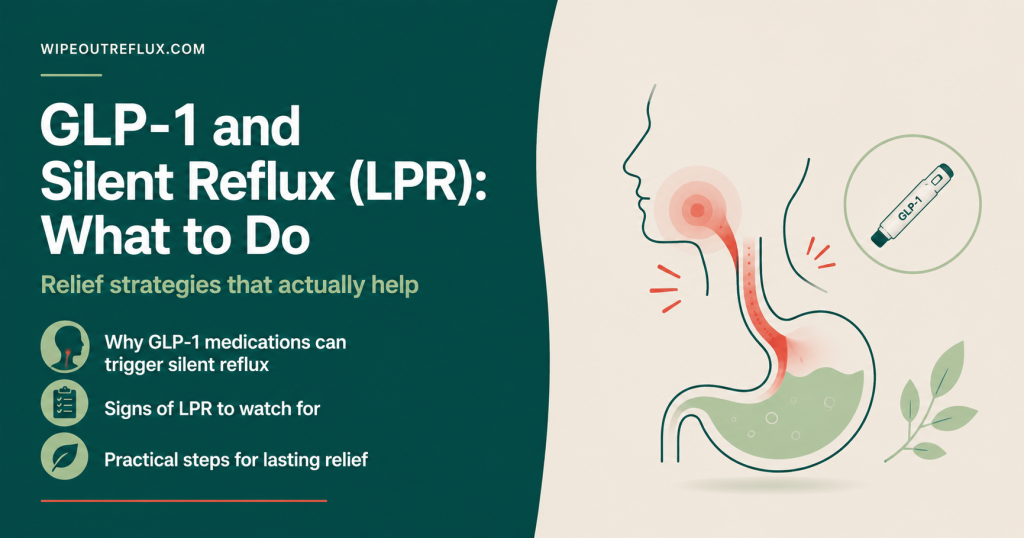
If you’re on a GLP-1 drug — Ozempic, Wegovy, Mounjaro, Zepbound and the rest — and you’ve started clearing your throat constantly, feeling a lump when you swallow, or noticing a hoarse voice and a nagging cough, that may not be a cold or allergies. It can be silent reflux, also called laryngopharyngeal reflux (LPR): reflux that reaches your throat and voice box instead of giving you classic heartburn.
Here’s the honest headline. The GLP-1 trials record “GERD” and “indigestion,” but they don’t track LPR at all — and neither does the FDA’s adverse-event database. So silent reflux on these drugs is genuinely under-recognized rather than rare. The good news is that the same mechanism causing it also points to what actually helps.
I’ve managed my own silent reflux for over eight years, and LPR is the whole reason this site exists. So this is the guide I’d want a friend starting a GLP-1 to read: why it happens, how to spot it early, and exactly what to do.
Key Takeaways
- Silent reflux (LPR) is different from heartburn. It shows up in the throat — hoarseness, throat clearing, a lump sensation, cough, post-nasal drip — often with no burning in the chest.
- GLP-1 drugs can plausibly trigger it, mainly by delaying gastric emptying, which raises stomach pressure and gives refluxate more chances to travel upward.
- LPR is invisible in the drug data. Trials and the FAERS database record GERD, not LPR, so the true rate on GLP-1s is likely under-counted.
- The throat is far more vulnerable than the esophagus. Even small amounts of refluxate carrying pepsin can irritate delicate laryngeal tissue.
- Acid isn’t the whole story. LPR is often weakly-acidic or non-acid reflux, which is why acid-only thinking (and PPIs alone) frequently underperforms here.
- Symptoms cluster at the start and after dose increases, because the stomach-slowing effect is strongest early and eases as your body adapts.
- Most of it is manageable with the right dose pacing, meal mechanics, an alginate that blocks pepsin, and pH-aware food choices — rarely a reason to stop.
- Weight loss cuts LPR risk long-term, so the net effect over time can actually favor your throat, even if the early weeks are rough.
Why Silent Reflux Is a Different Problem From Heartburn
This distinction matters more than almost anything else in this article, so it’s worth getting right.
Classic GERD is acid refluxing into the esophagus, and it usually announces itself with heartburn. LPR is different: the refluxate travels higher, past the upper esophageal sphincter, and reaches the larynx and throat. Because the throat lacks the esophagus’s protective lining, it takes far less to cause trouble — and it often does so silently, with no chest burning at all. That’s why so many people chase allergy, sinus or infection diagnoses for months before anyone mentions reflux.
If you’re not sure which camp you’re in, my breakdown of GERD vs LPR lays out the differences clearly, and the full list of LPR symptoms will help you recognize the sneakier throat-based signs. For the complete picture, my complete guide to LPR is the deeper reference.
Can GLP-1 Drugs Actually Cause Silent Reflux?
Short answer: plausibly yes — but the evidence is indirect, because nobody has been measuring LPR specifically.
A large analysis of the FDA’s adverse-event database looked at throat and voice-box side effects across five GLP-1 drugs. The oropharynx and larynx turned out to be the most affected region, with GERD the single most-reported event and a strong, statistically significant signal across every drug in the class. Crucially, the authors flagged that the dysphonia (hoarse-voice) signals point toward a possible increased risk of laryngopharyngeal reflux — something that hasn’t been formally characterized for GLP-1s, partly because the database doesn’t even have a category for LPR [Khan et al., The Laryngoscope, 2025].
Read that again, because it’s the key point: LPR isn’t “rare” on GLP-1s so much as unmeasured. When the tracking systems only look for heartburn and GERD, silent reflux slips through the cracks — even though the throat signals are lighting up.
This plays out across the whole class. I’ve written drug-specific guides on whether Ozempic causes heartburn, reflux and LPR, whether Mounjaro (tirzepatide) causes acid reflux, and whether Wegovy causes heartburn — and the throat-symptom pattern rhymes across all of them.
The Mechanism: Why LPR May Be the Sneakier Risk
GLP-1 drugs slow gastric emptying — that’s a core part of how they curb appetite. When food sits in the stomach longer, pressure builds, and that pressure can push contents up past the lower esophageal sphincter. For classic GERD, that means acid in the esophagus. For LPR, it means something a bit more insidious.
Two things make the throat especially exposed here:
- Pepsin does the damage, and it doesn’t need much acid. Refluxate carries pepsin, a digestive enzyme that clings to laryngeal tissue and can be reactivated by later acid exposure — even from acidic food and drink. So a small amount reaching the throat can cause outsized irritation.
- LPR is often weakly-acidic or non-acid. Interestingly, studies that measured the esophagus directly found that despite clearly delayed gastric emptying on GLP-1 therapy, reflux episodes and sphincter function didn’t change significantly, and stomach acid output even dropped slightly [Quast et al., Diabetes Care, 2020]. That sounds reassuring for heartburn — but it’s cold comfort for the throat, because pepsin can still be along for the ride whether or not the refluxate is strongly acidic.
In other words, the “it’s not very acidic” finding that partly protects the esophagus doesn’t protect the larynx. That’s exactly why an acid-only strategy so often disappoints in silent reflux — and why the fixes below focus on pepsin and mechanics, not just acid. If you want the deeper science, I go into it in how to neutralize pepsin in the throat.
Silent Reflux Symptoms to Watch For on a GLP-1
Because LPR hides, knowing the tell-tale signs is half the battle. On a GLP-1, keep an eye out for:
- Frequent throat clearing, especially after meals
- A lump-in-the-throat (globus) sensation
- Hoarseness or a tired, croaky voice, particularly later in the day
- A persistent dry or tickly cough with no obvious cause
- The feeling of post-nasal drip or mucus you can’t clear
- Mild difficulty swallowing, or food feeling like it catches
These tend to appear or worsen in the first few weeks and after each dose step-up — the same window when GLP-1 gastrointestinal effects generally peak before settling, since the stomach-slowing effect is strongest early and eases with continued use [Garvey et al., Nature Medicine, 2022].
What to Do About Silent Reflux on a GLP-1
Here’s the practical core. Because the root issue is a slow-emptying, higher-pressure stomach sending pepsin-laden refluxate toward a vulnerable throat, the winning strategies target exactly that.
1. Catch it early and track it
Start a simple log: note your symptoms, the timing relative to meals, and where you are in your dose schedule. Patterns emerge fast, and that record is gold when you talk to your prescriber. Early recognition also means you protect your throat before irritation becomes established.
2. Get the dose and titration right
GLP-1 side effects are dose-related and closely tied to how fast you escalate. If throat symptoms flare, your prescriber may hold you at a lower dose for longer before stepping up, which often improves tolerability. Don’t adjust the dose yourself — but do raise it, because pace is one of the biggest levers you have.
3. Fix your meal mechanics
This is where you win most of the battle. Eat smaller, lower-fat meals — large or fatty meals slow emptying even further and stack the pressure. Finish eating at least three hours before lying down. Stay upright and gently active after meals rather than slumping on the sofa. Since a GLP-1 shrinks your appetite anyway, smaller portions usually come naturally. My list of LPR foods to avoid is a good place to trim the worst triggers.
4. Think pepsin, not just acid
This is the LPR-specific move most people miss. An alginate such as Gaviscon Advance forms a physical raft that sits on top of the stomach contents and blocks reflux mechanically — including the pepsin that damages your throat, not just acid. Taken after meals and at bedtime, it’s a natural fit for a pressure-and-pepsin problem. I explain the how and why in my Gaviscon Advance guide. It’s also worth knowing that PPIs, the default for heartburn, tend to underperform in LPR because so much of the reflux is weakly-acidic — and if you’re already on one, don’t stop abruptly, as that can cause rebound acid.
5. Protect your throat from acidic triggers
Because pepsin stuck to your throat can be reactivated by acid, keeping acidic foods and drinks in check genuinely helps calm silent reflux. This is where knowing the pH of what you eat and drink pays off — and it’s exactly what the Wipeout Food Reference Guide is built for. My roundups of natural remedies for LPR and what to drink with reflux cover throat-friendly choices in more detail.
6. Optimize your nights
Nighttime reflux is especially damaging in LPR because anything that comes up while you’re flat has a clear run at your throat. Raise the head of your bed, avoid late meals, and consider your sleep position — I cover the specifics in the best sleeping position for silent reflux.
When to See a Doctor or ENT
Most silent reflux on a GLP-1 responds to the steps above, but see your doctor — and ideally an ENT — if you have persistent hoarseness lasting more than a couple of weeks, difficulty or pain swallowing, unexplained weight changes beyond what the medication accounts for, a lump you can feel, or symptoms that keep worsening rather than settling. Persistent laryngeal symptoms deserve a proper look with a scope, both to confirm reflux and to rule out other causes. Bring your symptom log.
The Bigger Picture: Weight Loss and LPR
It would be a mistake to leave you thinking GLP-1s are simply bad for silent reflux. Excess weight is one of the strongest drivers of reflux of all kinds, and the weight loss these drugs produce is a genuinely effective long-term way to reduce it. So there’s a real tension worth naming: the early weeks of slowed emptying may aggravate your throat, while the weight you lose over the following months can leave you with less reflux than you started with.
The goal, then, isn’t to avoid the medication — it’s to protect your throat through the rough early window so you can stay on treatment long enough to reach the payoff. That’s entirely doable with the right approach.
Frequently Asked Questions
Can GLP-1 drugs cause silent reflux even without heartburn?
Yes — that’s the defining feature of LPR. The refluxate reaches your throat and voice box rather than causing chest burning, so you can have throat clearing, hoarseness or a cough with no heartburn at all. That’s exactly why it’s so often missed.
Why isn’t silent reflux listed as a GLP-1 side effect?
Because the trials and the FDA’s adverse-event database record GERD and indigestion, not LPR — there isn’t even a category for it. Throat and voice-box signals do show up strongly in the data, which suggests LPR is under-recognized rather than genuinely uncommon.
Will a PPI fix silent reflux on a GLP-1?
Often only partially. LPR frequently involves weakly-acidic or non-acid reflux, and PPIs suppress acid, so they tend to underperform compared with their effect on classic heartburn. An alginate that blocks pepsin mechanically, plus meal and pH changes, usually does more of the heavy lifting.
How long do silent reflux symptoms last on a GLP-1?
They’re usually worst in the first few weeks and after dose increases, then ease as your body adapts, because the stomach-slowing effect fades over time. If throat symptoms persist beyond a couple of months, get them assessed rather than pushing through.
Should I stop my GLP-1 if I get silent reflux?
Rarely necessary. Most cases respond to dose pacing, meal mechanics, an alginate and pH-aware eating. Any decision to pause, lower or stop should be made with your prescriber — and remember the long-term weight loss usually works in your throat’s favor.
Is silent reflux worse on some GLP-1 drugs than others?
Symptoms track with dose and how fast you titrate more than with the specific drug. Higher-dose regimens tend to produce more gastrointestinal effects, so the throat signals often follow the same pattern. The mechanism is shared across the class.
Can the cough from a GLP-1 be silent reflux?
It can. A persistent dry cough with no clear cause is a classic LPR symptom, and reflux-related cough has been described in people on GLP-1s. If your cough is worse after meals or when lying down, silent reflux is worth considering.
Conclusion
So, what should you do about silent reflux on a GLP-1? First, recognize it — throat clearing, hoarseness, a lump sensation and a nagging cough are the tells, and they’re easy to misread as allergies. Second, understand that this is a pepsin-and-pressure problem reaching a vulnerable throat, which is why acid-only fixes underwhelm and why LPR barely registers in the drug data despite the throat signals being real. Third, act on the mechanism: get your dose pacing right with your prescriber, eat smaller and earlier, use an alginate that blocks pepsin, keep acidic triggers in check, and protect your nights. And keep the bigger picture in view — the weight loss itself is one of the best long-term things you can do for silent reflux.
If you want a structured way to calm LPR while your treatment does its work, the Wipeout Diet Plan is the in-depth roadmap I built around exactly these principles — the food and lifestyle changes that genuinely settle silent reflux, and a perfect match for the smaller appetite a GLP-1 gives you. And because so much of managing LPR comes down to knowing which foods and drinks are throat-friendly and where they sit on the pH scale, the Wipeout Food Reference Guide is the essential companion to keep on hand — it takes the guesswork out of the pepsin-reactivation problem at the heart of silent reflux. Together they give you the deeper plan and the quick daily reference to get through the rough early window and reach the point where your treatment is working for your throat, not against it. For more on getting symptoms under control, my guide to silent reflux treatment pulls the wider approach together.
Research Sources
- Khan et al., The Laryngoscope, 2025 — A FAERS analysis found the oropharynx and larynx were the most affected region for GLP-1 side effects, with GERD the most-reported event across all five drugs; the authors note the dysphonia signals suggest a possible, previously uncharacterized link to laryngopharyngeal reflux (LPR), which the database does not specifically track.
- Quast et al., Diabetes Care, 2020 — Despite clearly delayed gastric emptying on GLP-1 therapy, reflux episodes and lower esophageal sphincter function did not change significantly, and gastric acid secretion appeared slightly reduced — a finding that reassures for classic heartburn but not for the pepsin-driven throat irritation of LPR.
- Garvey et al., Nature Medicine, 2022 — In the two-year STEP 5 trial of semaglutide 2.4 mg, gastrointestinal side effects were the most common adverse events but were mostly mild to moderate, transient, and concentrated during the dose-escalation period.

David Gray
12 years living with LPR · Consultant & researcher
I've lived with LPR for twelve years — the misdiagnoses, the PPI courses that did nothing, the slow work of figuring out what actually helps. Wipeout Reflux is where I translate the research into plain terms for people stuck in the same place. Every claim here is sourced to peer-reviewed work, and I consult one-to-one with LPR sufferers.