
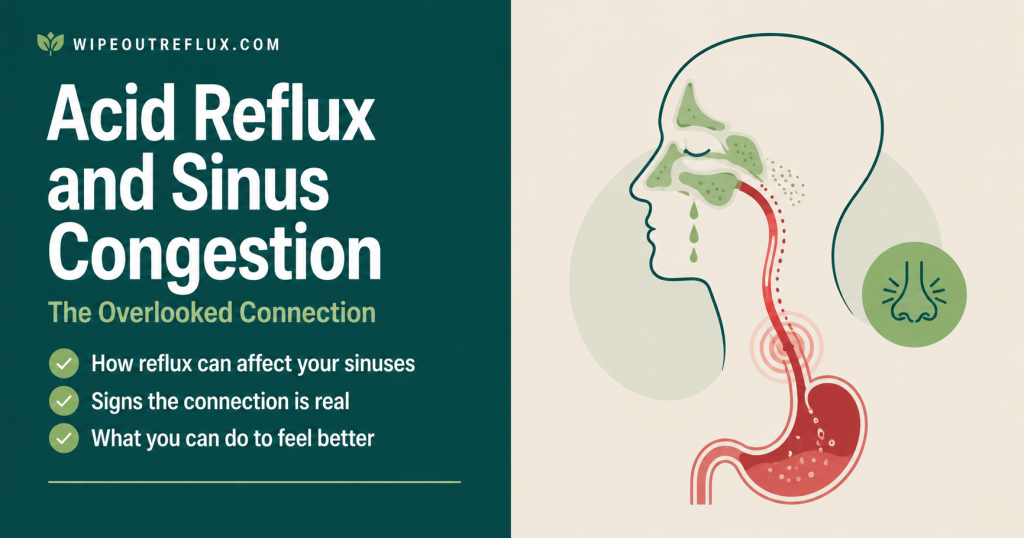
This page answers one question: can acid reflux cause sinus congestion and a blocked, stuffy or runny nose? The short answer is yes — reflux, and especially the silent, throat-based form (LPR), is a recognised and plausible cause of nasal congestion that won’t clear with the usual allergy treatments. I’ll be straight about the strength of the evidence as we go: the reflux-to-sinus link is well supported and increasingly accepted, but it isn’t yet nailed down as definitively as, say, reflux and heartburn. What’s clear is that for a lot of people, a stuffy nose that no antihistamine touches turns out to be a reflux problem, not a nose problem.
The reason is anatomy. When stomach contents travel up past the throat and reach the back of the nose, the acid and the enzyme pepsin they carry can inflame and swell the delicate nasal and sinus lining, thicken your mucus, and clog up the drainage — leaving you blocked, dripping, or both.
Two closely related questions sit just outside this page. If you’re asking whether reflux causes actual sinus infections or recurring sinusitis, that’s covered separately in can acid reflux cause sinus infections. And if you’re wondering whether it works the other way — sinus drainage triggering reflux — see does sinus drainage cause acid reflux. This page stays on reflux causing nasal congestion and blockage.
Key Takeaways
- Acid reflux — particularly LPR (silent reflux) — is a recognised cause of sinus congestion and a blocked, stuffy or runny nose.
- The link is well supported but not definitively proven; it’s most convincing in people whose congestion resists allergy and sinus treatment.
- The mechanism runs through reflux reaching the nasopharynx, where acid and pepsin inflame and swell the nasal lining and thicken mucus.
- Reflux can both block the nose (swelling) and cause a runny nose (a reflex that ramps up mucus).
- Because it isn’t driven by histamine, reflux congestion typically doesn’t respond to antihistamines or decongestants.
- Symptoms are often worst at night and first thing in the morning, when reflux reaches the nose most easily.
- Treating the reflux at its source — low-acid eating and anti-reflux habits — is what tends to clear stubborn, reflux-driven congestion.
Can acid reflux cause a stuffy or blocked nose?
Yes. A stuffy, blocked nose is one of the most common ways reflux shows up above the throat — and it’s the classic “GERD nose block” that puzzles people because their nose feels congested with no cold or obvious allergy behind it. When reflux reaches the back of the nose, the acid and pepsin irritate the mucosa (the lining of your nasal passages and sinuses). That lining responds the way irritated tissue always does: it swells. Swollen tissue narrows the nasal airway, and you feel it as a blocked, stuffy nose.
The tell-tale sign that a blocked nose is reflux-related rather than allergic is that it doesn’t follow the usual rules — there’s no clear allergen, allergy testing is often normal, and antihistamines don’t shift it. If your nose blocks up after meals, when you lie down, or in the morning, and it comes alongside throat symptoms like clearing or hoarseness, reflux moves up the list of suspects considerably.
Can acid reflux cause a runny nose?
It can — and “runny nose GERD” is a real pattern, even though it seems to contradict the blocked-nose story. The two go together because reflux irritates the nasal lining in two ways at once: it swells the tissue (blockage) and it prompts the lining to pump out more mucus (a runny nose and post-nasal drip). Your body produces that extra mucus as a protective response, trying to wash away an irritant — but the result is a nose that runs, drips down the back of your throat, or feels congested with thin secretions.
So depending on the day and the person, reflux can leave you blocked, running, or swinging between the two. If you’ve been treating a persistent runny nose or post-nasal drip as an allergy without success, reflux is worth considering — it’s one of the more overlooked causes of chronic reflux-related mucus.
The mechanism, explained
Before any advice, it’s worth understanding how reflux reaches and affects your nose, because it makes everything else make sense. There are a few steps.
Refluxate reaches the nasopharynx. In silent reflux (LPR), stomach contents escape the oesophagus entirely and travel up into the throat and the nasopharynx — the space behind the nose where the sinuses drain. Researchers using a pH probe at the back of the nose have found that people with stubborn, treatment-resistant sinus disease have more acid reaching this area than healthy controls, which points to reflux as a contributing factor in those refractory cases DelGaudio, The Laryngoscope, 2005. It’s worth being honest here: how often acid travels all the way to the nose is still debated, and it’s likely more relevant in difficult, treatment-resistant cases than in every stuffy nose.
Acid and pepsin inflame and swell the lining. Once refluxate reaches the nasal and sinus mucosa, it irritates tissue that — unlike your oesophagus — has no real protection against it. The enzyme pepsin is a big part of this: laboratory work has shown that pepsin damages the cells of the nasal lining and switches on the same inflammatory signals seen in chronic sinus disease Southwood et al., Annals of Otology, Rhinology & Laryngology, 2015. That inflammation is what swells the lining and blocks the nose.
Mucociliary clearance is impaired. Your nose and sinuses stay healthy by constantly sweeping mucus and debris out through tiny hair-like cilia. Reflux-driven inflammation gums up this “mucociliary clearance,” so mucus that should drain away instead pools and thickens — adding to the congestion and the feeling of drip.
The Eustachian tubes can get caught up too. The same nasopharynx is where your Eustachian tubes open — the channels that ventilate your middle ears. When reflux inflames this area, it can swell the tissue around those openings, which is why reflux is linked to Eustachian tube dysfunction and the ear fullness and ear discomfort that often travel with reflux-related congestion.
It’s likely that more than one of these acts at once — some direct acid and pepsin contact, plus a nerve reflex from the irritated oesophagus that tells the nose to make more mucus. Researchers don’t yet agree on the exact balance, which is part of why this link is described as plausible and well-supported rather than fully settled. A recent review of post-nasal drip put it honestly: it’s often a symptom of reflux, yet its precise mechanism still isn’t definitively established Smallwood et al., Journal of Allergy and Clinical Immunology: In Practice, 2024.
Why antihistamines and decongestants don’t fix it
Here’s the practical payoff of understanding the mechanism. Reflux-driven congestion isn’t caused by histamine (the target of antihistamines) or by simple blood-vessel dilation (the target of decongestants) — it’s caused by acid-and-pepsin irritation and the mucus reflex that follows. That’s why so many people cycle through allergy sprays, tablets and decongestants with little lasting effect: those medicines are aimed at the wrong mechanism. It’s also why reflux-related congestion is so often mistaken for stubborn allergies, a distinction I dig into in LPR vs allergies.
Why is my nose blocked at night?
If your nose blocks up worst in bed or first thing in the morning, that timing is a strong clue it’s reflux. Lying down removes gravity’s help, so stomach contents travel upward far more easily and can pool at the back of the nose for hours while you sleep. The result is a nose that’s most congested overnight and on waking, then eases as the day goes on and you’re upright again. This is the same reason reflux symptoms in general flare at night, which I cover in acid reflux at night. Simple steps like elevating the head of your bed and leaving three hours between your last meal and lying down often take the edge off nocturnal nasal blockage.
How to relieve reflux-related nasal congestion
Because the congestion comes from reflux, the lasting fix is to stop the reflux reaching your nose — not to keep treating the nose itself.
Low-acid eating comes first. Cutting acidic foods and drinks reduces both the reflux events and the pepsin activity that inflame your nasal lining. A strict low-acid diet produced dramatic symptom improvement in patients with stubborn silent reflux Koufman, Annals of Otology, Rhinology & Laryngology, 2011, and it’s the foundation of my Wipeout Diet Plan.
Anti-reflux habits give your nose time to heal. Elevate the head of your bed, stop eating three to four hours before lying down, eat smaller meals, avoid tight waistbands, and cut smoking and excess alcohol — all reduce how much reflux reaches your throat and nose.
Neutralising pepsin can help symptoms. Some people find relief from an alkaline nasal rinse, which aims to deactivate pepsin sitting in the nasal lining; I explain the approach in how to neutralise pepsin in the throat. It’s a symptom aid rather than a cure, and it’s worth running any nasal rinse routine past your doctor first.
Know what usually won’t work. If your congestion is genuinely reflux-driven, antihistamines and decongestants tend to disappoint — a useful diagnostic clue in itself. If you’re unsure, or symptoms are persistent or severe, it’s worth seeing an ENT who’s familiar with reflux, especially if congestion comes with hoarseness, chronic cough or throat clearing.
Conclusion
So, can acid reflux cause sinus congestion and a blocked, stuffy or runny nose? Yes — and while the science isn’t as ironclad as it is for heartburn, the link is well supported and, for a great many people, the missing explanation for a nose that never fully clears. Reflux reaches the back of the nose, inflames and swells the lining, thickens mucus and slows drainage, leaving you blocked, running, or both — and doing it worst at night. The clue is congestion that ignores every allergy treatment you throw at it.
The lasting answer isn’t another nasal spray — it’s calming the reflux at its source so acid and pepsin stop reaching your nose in the first place. That’s exactly what my Wipeout Diet Plan is built to do: the complete, in-depth system for getting reflux under control for good. I designed it first and foremost around LPR, the stubborn throat-based kind that’s hardest to treat — and the kind most likely to be reaching your nose — but because it works on the same underlying reflux mechanisms, it’s just as effective for GERD, heartburn and everyday acid reflux.
And to make it easy day to day, the Wipeout Food Reference Guide is the essential companion — it lays out the real pH values of foods and drinks for acid reflux and LPR, so you can cut the acid that’s keeping your nose inflamed. Calm the reflux, and the congestion that wouldn’t budge for antihistamines often finally clears.
Frequently Asked Questions
Can acid reflux cause a stuffy or blocked nose?
Yes. When reflux reaches the back of the nose, acid and pepsin inflame and swell the nasal lining, narrowing the airway and leaving you stuffy or blocked — the “GERD nose block” many people notice with no cold or clear allergy. A key clue is that it doesn’t respond to antihistamines and is often worse after meals or when lying down.
Can acid reflux cause a runny nose?
It can. As well as swelling the lining, reflux irritation prompts the nose to produce more mucus as a protective response, causing a runny nose and post-nasal drip. This “runny nose GERD” pattern often coexists with blockage, so people swing between a stuffy and a running nose.
Why is my nose blocked at night?
Lying down lets stomach contents travel up to the nose far more easily, so reflux-related congestion is typically worst overnight and on waking. Elevating the head of your bed and not eating within three to four hours of lying down usually helps reduce nocturnal nasal blockage.
Can acid reflux cause sinus congestion even with normal allergy tests?
Yes — and normal allergy testing with persistent congestion is actually a classic sign of reflux-driven sinus congestion. Because the problem is acid and pepsin rather than histamine, allergy tests come back clear and allergy medicines don’t help, while the congestion continues until the reflux is addressed.
Why don’t decongestants or antihistamines clear my blocked nose?
Because reflux congestion isn’t caused by histamine or simple blood-vessel dilation — the targets of those medicines. It’s caused by acid-and-pepsin irritation and a mucus reflex, so the usual allergy and cold remedies aim at the wrong mechanism. Reflux-focused treatment is what tends to work.
Can reflux congestion affect my ears?
Yes. The back of the nose is where the Eustachian tubes open to ventilate the middle ears, so reflux inflammation there can cause ear fullness and discomfort alongside the congestion. As the reflux settles, Eustachian tube symptoms often improve too.
Research & References
- Using a pH probe placed at the nasopharynx, patients with refractory chronic rhinosinusitis had significantly more acid reflux reaching the back of the nose than controls, supporting reflux as a contributing factor in stubborn sinus and nasal disease — while noting this is most relevant in treatment-resistant cases DelGaudio, The Laryngoscope, 2005.
- Laboratory research showed that pepsin — the reflux enzyme — damages human nasal lining cells and triggers the inflammatory signals associated with chronic sinus disease, providing a direct mechanism by which reflux can inflame and congest the nose Southwood et al., Annals of Otology, Rhinology & Laryngology, 2015.
- A recent review of postnasal drip concluded it may occur without sinonasal disease and is often a symptom of laryngopharyngeal reflux, while candidly noting there is no definitive evidence of its exact mechanism — an honest reflection of how this link stands Smallwood et al., Journal of Allergy and Clinical Immunology: In Practice, 2024.
- A strict low-acid diet produced dramatic symptom improvement in patients with stubborn laryngopharyngeal reflux, supporting a dietary approach to reducing the acid and pepsin that reach and inflame the nasal passages Koufman, Annals of Otology, Rhinology & Laryngology, 2011.

David Gray
12 years living with LPR · Consultant & researcher
I've lived with LPR for twelve years — the misdiagnoses, the PPI courses that did nothing, the slow work of figuring out what actually helps. Wipeout Reflux is where I translate the research into plain terms for people stuck in the same place. Every claim here is sourced to peer-reviewed work, and I consult one-to-one with LPR sufferers.
Super congested with major stomach issues. Better with your protocol. One question. Have you discovered the connection to snoring? Definite connection between ear, nose and throat, aware of that! I think it all must all be related. Thank you so much for your work. So many people will be helped.
Yes — there’s *definitely* a connection between LPR and snoring, and it’s more common than people realise.
When reflux reaches the throat/nasal area it can cause **swelling, mucus, and inflammation**, which narrows the airway. A narrower airway = more vibration = more snoring. On top of that, post-nasal drip and throat irritation can make you mouth-breathe at night, which also increases snoring. It can become a vicious cycle too, because snoring (and the pressure changes from obstructed breathing) may actually encourage reflux episodes.
So you’re not imagining it — ear/nose/throat symptoms and snoring can absolutely be part of the same LPR picture, and when the inflammation settles down, snoring often improves as well.