
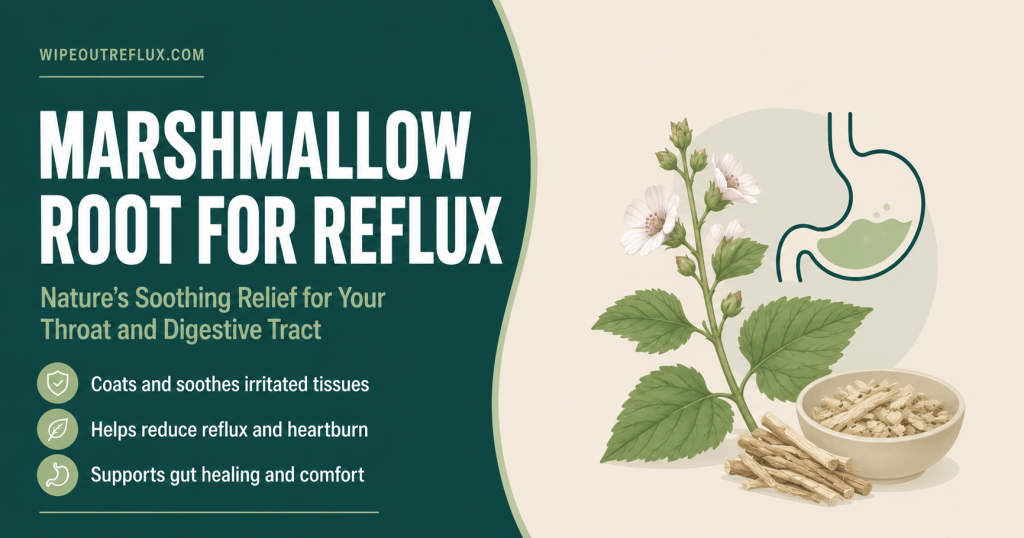
Marshmallow root is the sweet-sounding herb behind a lot of “gut-soothing” teas, and it comes up constantly in reflux circles. Having managed LPR myself for over eight years, I wanted to separate the genuine science from the wellness gloss — because marshmallow root actually has more official backing than most herbal remedies people try for reflux.
The honest short answer: marshmallow root is packed with a fibre called mucilage that forms a slippery, bioadhesive film over irritated mucous membranes. European regulators formally recognise it as a traditional herbal medicine for soothing irritated throats and mild gastric irritation, and there is some animal and laboratory evidence that it protects and helps repair the gut lining. What is still missing is a proper human trial in reflux or LPR — so I rate it as a well-founded soother, not a proven treatment.
Here is how it works, what the evidence really shows, and the one preparation detail most people get wrong.
Key Takeaways
- Marshmallow root (Althaea officinalis) is rich in mucilage — polysaccharides that swell into a slippery gel in water.
- That gel is bioadhesive: it sticks to and forms a protective, mucin-like film over irritated mucous membranes.
- It is recognised by the European Medicines Agency (EMA), ESCOP and Commission E as a traditional herbal medicine for throat irritation and mild gastric complaints.
- Laboratory and animal studies suggest it also stimulates the lining’s own repair and has anti-inflammatory and antioxidant effects — and it protected against ulcers in rats.
- Direct human trials in GERD or LPR are still lacking, so it is best used as a supportive soother alongside diet and lifestyle work.
- Preparation matters: marshmallow is traditionally made as a cold infusion, because heat degrades the mucilage.
- Like all demulcents, it can slow the absorption of medicines — space it apart from tablets like PPIs and thyroid medication.
What Is Marshmallow Root?
Marshmallow root comes from Althaea officinalis, a flowering plant native to Europe, western Asia and North Africa. Yes, it is the plant the original confectionery was once made from — but the medicinal part is the root, not the campfire treat.
The root is loaded with mucilage: high-molecular-weight polysaccharides (mostly rhamnogalacturonans) that absorb water and turn into a thick, slippery gel. Alongside the mucilage it contains pectins, flavonoids, tannins and other compounds. That gel is the active principle, and it is why marshmallow has been used for centuries to calm irritated throats, coughs and digestive discomfort.
How Marshmallow Root Works
I always want the mechanism before the marketing, and marshmallow’s is largely physical — with a couple of interesting biological extras.
1. It forms a bioadhesive protective film
This is the headline. Marshmallow’s polysaccharides are bioadhesive, meaning they physically stick to irritated tissue and form a mucin-like layer on top of it [Deters et al., Journal of Ethnopharmacology, 2010]. Applied to the mouth and throat, marshmallow root extract produces an immediate protective film over inflamed mucosa, and that soothing layer reduces irritation while the tissue recovers [Deep et al., Frontiers in Pharmacology, 2020]. In plain terms: it coats, and it clings.
2. It nudges the lining to repair itself
Unlike a purely inert coating, marshmallow root extract appears to actively stimulate the physiology of epithelial cells — the cells that make up your linings — supporting their viability and regeneration [Deters et al., Journal of Ethnopharmacology, 2010]. Later work found it also improves the migratory capacity of cells involved in healing, so its benefit is not only mechanical protection but some genuine support for tissue repair [Phytohustil/REA endothelial study, Frontiers in Pharmacology, 2022].
3. It calms inflammation and oxidative stress
Marshmallow root extract has shown anti-inflammatory and antioxidant effects in immune cells [Deep et al., Frontiers in Pharmacology, 2020]. Since inflamed, acid- and pepsin-exposed tissue generates a lot of oxidative stress, this is a useful bonus on top of the physical coating.
Why It Might Help Acid Reflux and LPR
The rationale maps neatly onto how reflux hurts you. In GERD, acid irritates the oesophagus; in LPR (silent reflux), it is largely pepsin carried up with the refluxate that inflames the throat and voice box — tissues with almost none of the stomach’s built-in defences. A bioadhesive demulcent that lays a clinging, mucus-like film over those raw surfaces is exactly the kind of thing that should, in theory, provide relief.
Marshmallow also has an anti-ulcer track record in the lab: in rats, Althaea officinalis protected against stomach ulceration, partly by supporting mucus and the mucosal defence system and reducing oxidative damage [Zaghlool et al., 2019]. That is animal data, not proof for humans, but it points in a reassuring direction for anyone whose lining is inflamed.
I file it with the other coating and barrier approaches I rate. It works on similar “physical protection” logic to a raft barrier like Gaviscon Advance, and sits alongside other soothing options such as aloe vera juice and chamomile tea. If your worst symptom is throat irritation, the coating rationale is especially relevant — something I dig into in my guide on neutralising pepsin in the throat.
The LPR and throat angle
Marshmallow’s most established use is precisely for irritation of the laryngopharyngeal mucosa — the throat and voice-box region where LPR does its damage. That makes it one of the more sensible demulcents to try if you are battling constant throat-clearing, a raw throat or a persistent tickle. I would frame it honestly as symptomatic comfort: it can genuinely take the edge off a sore throat, which matters when you are dealing with constant throat-clearing from reflux. It will not fix the underlying reflux, though — for that, the fundamentals in my complete guide to LPR matter far more.
What the Research Actually Shows
Marshmallow sits in an unusual spot: better official recognition than most herbs, but still short on direct reflux trials.
Regulatory recognition. The European Medicines Agency recognises marshmallow root as a traditional herbal medicinal product — a demulcent for the symptomatic treatment of oral and pharyngeal irritation and associated dry cough, with traditional use also extending to mild irritation of the gastric mucosa [EMA/HMPC Assessment Report on Althaea officinalis L., radix]. That is a meaningful step above “someone on a forum said it worked.”
Mechanistic and animal evidence. The bioadhesion and epithelial-stimulation work [Deters et al., 2010] and the rat anti-ulcer data [Zaghlool et al., 2019] give it a more substantial mechanistic dossier than many “gut-soothing” herbs.
What’s missing. There is no solid, placebo-controlled human trial of marshmallow root specifically for GERD or LPR symptom relief. Most of the direct human evidence is for cough and throat irritation, not reflux, and much of the gut evidence is in vitro or in animals. So the fair summary is: strong traditional and regulatory backing, plausible mechanism, promising preclinical data — but the reflux-specific human proof isn’t there yet. I would rather you know that than be sold certainty.
How to Take Marshmallow Root for Reflux
The detail most people get wrong: use a cold infusion. Mucilage is degraded by heat, so brewing marshmallow root like a normal hot tea wastes much of what makes it useful. Instead, steep roughly 1–2 teaspoons of dried root (about 3–5 g) in a mug of cold water for several hours or overnight, then strain and drink. You will end up with a slightly viscous, silky liquid — that is the mucilage you want.
Dose. European traditional-use guidance for adults centres on roughly 6 g of dried root per day, and up to around 10–15 g total depending on the preparation [EMA/HMPC Assessment Report on Althaea officinalis L., radix]. Capsules and lozenges are also available; lozenges are handy for throat symptoms because they prolong contact time, while capsules are convenient but form their gel lower down.
Timing. Because the goal is to coat the lining, take it after meals and, especially, before bed — overnight is when the reflux-damaged lining gets its longest uninterrupted exposure. That is the same logic behind a night-time raft barrier, and marshmallow complements rather than replaces it.
The rule you must not skip. The same mucilage that soothes your throat can also coat and delay the absorption of medications. Take any prescription drugs — your PPI, and thyroid medication in particular — well apart from marshmallow: at least 2 hours for most, and around 4 hours for levothyroxine. This is the single most important practical point.
Keep expectations realistic. Mucosal healing is slow whatever you use — my article on how long a reflux sore throat takes to heal explains why comfort measures like this buy relief while the real healing happens over weeks.
Marshmallow Root vs Slippery Elm
People often ask which is better, since both are mucilage demulcents that coat the gut. Honestly, they are close cousins and largely interchangeable as soothers. The practical differences: marshmallow root has stronger formal recognition from European regulators (including a traditional indication for the gastric mucosa) and is best prepared as a cold infusion, while slippery elm is the North American counterpart, is recognised by the FDA as a sore-throat demulcent, and is usually taken as a thick gruel or lozenge. If anything, I lean towards marshmallow for its slightly deeper mechanistic and regulatory dossier — but there is no need to overthink it. Either can serve as your soothing layer.
Safety, Side Effects and Who Should Be Careful
Marshmallow root has an excellent safety record — it is food-grade and very well tolerated. The points worth keeping in mind:
- Medication absorption. As above, its gel can reduce how well other medicines are absorbed. Space it apart from anything else you take (2 hours generally, ~4 hours for thyroid medication).
- Blood sugar. As a soluble fibre it can modestly slow glucose absorption, so keep an eye on levels if you are on diabetes medication.
- Pregnancy and breastfeeding. Robust safety data is limited, so use only with medical advice.
- It’s a fibre. Large amounts can cause bloating or loosen stools in some people. Start small.
None of this is medical advice — it is general information from someone who has lived with reflux for a long time, not a clinician. If you take prescription medication or have a health condition, check with your doctor or pharmacist first.
Frequently Asked Questions
Does marshmallow root help acid reflux?
It can soothe symptoms by forming a bioadhesive, mucus-like film over the irritated throat and oesophagus, and it has regulatory recognition as a demulcent plus supportive animal evidence. But there is no strong human reflux trial, so use it as symptomatic relief alongside diet and lifestyle changes rather than a cure.
How do you prepare marshmallow root for reflux?
Make a cold infusion: steep 1–2 teaspoons of dried root in cold water for several hours or overnight, then strain and drink. Heat degrades the mucilage, so avoid brewing it like a hot tea. Capsules and lozenges are alternatives.
When should I take marshmallow root — before or after meals?
After meals and before bed works best, since the aim is to coat and protect the lining, and overnight is when reflux exposure lasts longest.
Can I take marshmallow root with omeprazole or thyroid medication?
Yes, but separate them. Its mucilage can reduce absorption of other drugs, so leave at least 2 hours between marshmallow and most medications, and around 4 hours for levothyroxine.
Is marshmallow root good for silent reflux (LPR)?
Its most established traditional use is soothing throat and laryngopharyngeal irritation — exactly the area LPR affects. It can ease a raw, tickly throat temporarily, though it does not treat the underlying reflux.
Marshmallow root or slippery elm — which is better for reflux?
Both are mucilage demulcents that coat and soothe, and they are largely interchangeable. Marshmallow has slightly stronger regulatory recognition and is taken as a cold infusion; slippery elm is usually a gruel or lozenge. Choose whichever suits you.
How long does it take to work, and can I take it long-term?
The soothing effect is fairly immediate but temporary, lasting while the coating is present. It is fine for regular symptomatic use, but treat it as one comfort tool within a bigger plan rather than something that resolves reflux on its own.
Conclusion
After more than eight years managing LPR, my honest take on marshmallow root is that it is one of the better-founded soothers you can reach for. It does something simple and genuinely useful: it forms a clinging, protective film over an irritated throat and gullet, and there is real mechanistic, regulatory and animal evidence behind that, plus some early signs it helps the lining repair itself. What it doesn’t have — yet — is a solid human trial proving it treats reflux or LPR, so I would never sell it to you as a cure.
Where it earns its place is as symptomatic relief while you do the work that actually changes things: reducing reflux at its source through what and when you eat. That is the part that moved the needle for me, and it is where the real, lasting improvement comes from.
If you want a structured way to tackle that, my Wipeout Diet Plan is the in-depth, step-by-step programme I built from everything that worked for me — it goes far beyond a food list into the full approach for calming reflux and LPR. And if you simply want a fast, reliable reference for which foods and drinks are safe, along with their pH values, the Wipeout Food Reference Guide is the essential companion to keep on your phone while shopping and cooking. Use a demulcent like marshmallow root for comfort, build a genuinely reflux-friendly diet around it, and you give your throat and oesophagus the best possible chance to settle. For more on building that diet, see my guide to the LPR diet.
Research Sources
- EMA/HMPC Assessment Report on Althaea officinalis L., radix. European Medicines Agency review recognising marshmallow root as a traditional herbal demulcent for oral and pharyngeal irritation and dry cough, with traditional use also covering mild irritation of the gastric mucosa.
- Deters A, et al. Journal of Ethnopharmacology, 2010. Found marshmallow root’s bioadhesive polysaccharides form a mucin-like protective layer on irritated tissue and stimulate the physiology and regeneration of human epithelial cells in vitro.
- Zaghlool S, et al. 2019. Showed Althaea officinalis had gastro-protective and antioxidant effects against indomethacin/pyloric-ligation-induced gastric ulceration in rats, supporting mucosal defence.
- Deep A, et al. Frontiers in Pharmacology, 2020. Reported that marshmallow root extract forms a protective film on inflamed mucosa and has anti-inflammatory and antioxidant effects that support mucosal cell viability.
- Phytohustil/REA endothelial study. Frontiers in Pharmacology, 2022. Found marshmallow root extract has pro-migratory, anti-inflammatory and antioxidant properties that support repair of injured mucosal tissue, beyond mechanical protection alone.

David Gray
12 years living with LPR · Consultant & researcher
I've lived with LPR for twelve years — the misdiagnoses, the PPI courses that did nothing, the slow work of figuring out what actually helps. Wipeout Reflux is where I translate the research into plain terms for people stuck in the same place. Every claim here is sourced to peer-reviewed work, and I consult one-to-one with LPR sufferers.