
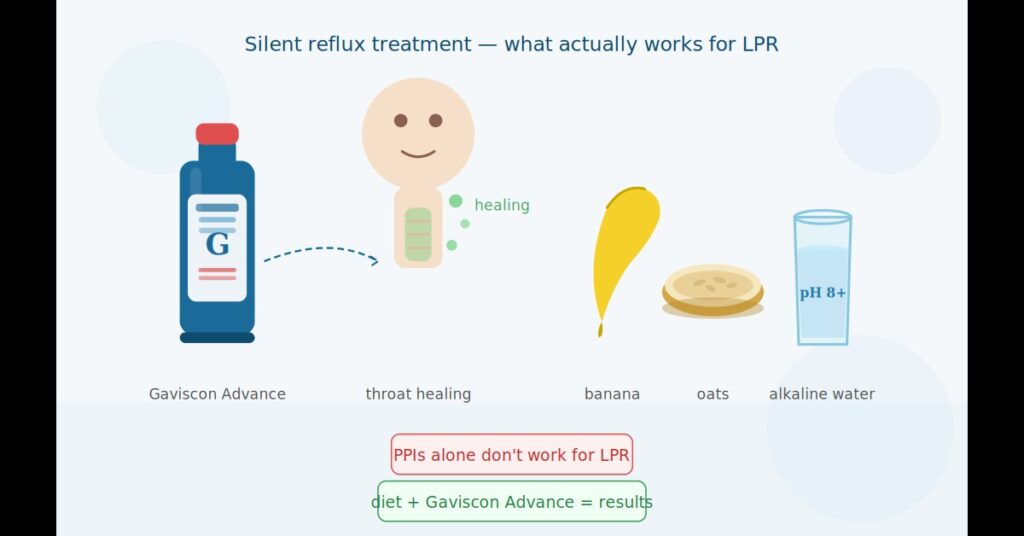
If you have silent reflux (LPR) you have almost certainly already been prescribed PPIs by a doctor, taken them for weeks or months, and seen little to no improvement. That is not your fault — it is a failure of how LPR is typically treated. Most doctors prescribe the same medication they use for standard acid reflux and GERD, and for the majority of silent reflux patients it simply does not work.
The good news is there are treatments that genuinely do work for LPR, and this guide will walk you through all of them. I will cover why PPIs fail, what actually helps, and how to put together a proper treatment plan that gives you the best chance of recovering as quickly as possible.
Key Takeaways:
- PPIs have been proven in clinical trials to be no better than placebo for silent reflux — multiple studies and the 2024 IFOS international consensus confirm this
- Gaviscon Advance (UK version) is the most effective medication for LPR and has clinical trial evidence to support it
- A low acid diet targeting pepsin reactivation is the most powerful long-term treatment
- Alkaline water with a pH of 8 or above directly deactivates pepsin in the throat
- Lifestyle changes — particularly meal timing and portion size — are essential alongside everything else
Why Most Silent Reflux Treatment Fails
Before getting into what works it’s important to understand why the typical treatment doesn’t. This matters because a lot of people give up on recovering from LPR thinking nothing will help them, when in reality they just haven’t been pointed in the right direction.
The standard treatment for silent reflux is PPIs — proton pump inhibitors like omeprazole, lansoprazole or esomeprazole. These work by reducing the amount of acid the stomach produces. For regular acid reflux and GERD they can be effective. For LPR they generally are not, and the research is very clear on this.
The reason PPIs don’t work for LPR comes down to pepsin. The main driver of silent reflux symptoms is not acid — it’s pepsin, a digestive enzyme that travels up from the stomach into the throat where it causes inflammation and tissue damage. Pepsin can cause damage even in weakly acidic or non-acidic conditions, which means reducing stomach acid with PPIs does almost nothing to address the actual problem. You can read much more about this in my complete LPR guide.
This isn’t just a theory. A major review of clinical trials found that PPI therapy offered no significant benefit over placebo for patients with LPR symptoms. The landmark TOPPITS randomised controlled trial published in the BMJ (O’Hara et al., 2021) — the largest study of its kind with 346 patients — confirmed that lansoprazole was no better than placebo for persistent throat symptoms. And the 2024 IFOS international consensus now formally states that acid suppression should not be considered first-line therapy for patients with isolated LPR symptoms.
Most doctors are still catching up with this evidence. If you have been prescribed PPIs for LPR and they haven’t helped, that is completely normal and expected.
If You Are Currently Taking PPIs — Stop Them Slowly
If PPIs aren’t helping you, stopping them is the right move — but you must taper off them slowly. Do not stop suddenly. When you take PPIs your stomach adapts by trying to produce more acid to compensate. If you stop abruptly, this excess acid production continues temporarily and you will get a significant rebound reflux effect that can be very unpleasant.
This rebound is so powerful that studies have shown it happens even in healthy people who never had reflux — they develop reflux symptoms simply from stopping PPIs. I learned this the hard way myself going from 40mg straight to zero which resulted in some of the worst reflux I ever experienced.
Taper your dose slowly over 4 to 6 weeks, reducing in small steps. For a complete guide on how to do this check my article on acid rebound and getting off PPIs.
The Most Effective Silent Reflux Treatments
Now for what actually works. The most effective approach for treating LPR combines several things — Gaviscon Advance as immediate medication, a proper low acid diet as the main long-term treatment, and a few supportive lifestyle changes. Let me cover each one.
#1 Gaviscon Advance (UK Version)
Gaviscon Advance (UK version) is the most effective medication available for silent reflux and it works completely differently to PPIs. Rather than reducing acid it creates a physical barrier. The key ingredient is sodium alginate, extracted from seaweed, which forms a foam-like raft on top of the stomach contents after you take it. This raft acts as a barrier that physically prevents reflux from reaching the throat.
What makes it particularly effective for LPR is that this alginate raft also filters out pepsin and bile — the main damaging agents in silent reflux — rather than just blocking acid. It also helps bind to and neutralise pepsin that is already present in the throat.
The clinical evidence for it is solid. A randomised controlled trial by McGlashan et al. published in the Journal of Laryngology and Otology found that Gaviscon Advance produced significant improvements in both LPR symptom scores and laryngeal findings at 2 and 6 months compared to no treatment. A separate study published in European Archives of Oto-Rhino-Laryngology (Wilkie et al., 2018) found that Gaviscon Advance alone was effective in treating LPR symptoms and that adding a high dose PPI on top of it provided no additional benefit — further confirming that PPIs add nothing for most LPR patients. And a 2025 multicenter randomised trial (Gelardi et al.) confirmed that combining dietary changes with mucosal protectors like alginates produced the greatest reduction in both symptoms and measurable pepsin concentrations.
It is essential that you use the UK version, not the US version. They have completely different formulations. The UK version contains sodium alginate as the active ingredient. The US version does not and is significantly less effective for LPR. You can order the UK version on Amazon here. If you are in the US, Reflux Gourmet is an alternative with similar ingredients available here.
Take Gaviscon Advance 15 to 30 minutes after meals, when stomach enzymes and digestion are most active. You can also take it before bedtime if you have nighttime reflux. For more detail check my article on why Gaviscon Advance is the best option for LPR.
#2 The Low Acid Diet — The Most Important Long-Term Treatment
Diet is the single most powerful long-term treatment for silent reflux and for most people it is the closest thing to a cure. While Gaviscon Advance helps manage your symptoms, the diet tackles the root cause.
The LPR diet is built around one core principle — keeping the pH of the food and drink you consume above 5. This is because pepsin in the throat becomes significantly reactivated by anything with a pH of 5 or below. When you eat or drink something that acidic, it reactivates dormant pepsin in the throat and triggers your symptoms — even if you haven’t refluxed. Avoiding these foods stops that reactivation cycle and gives your throat the chance to heal. Keeping food and drink above pH 5 only works if you know what the pH actually is, which is why I made the Wipeout Food Reference Guide — a reference listing common foods and drinks with their pH values and whether each one is reflux-safe or a known trigger.
The evidence for the low acid diet is strong. A prospective study by Dr Jamie Koufman — one of the leading LPR researchers in the world — found that a strict low acid diet improved symptoms in 95% of patients, including those who had failed twice-daily PPI treatment. A cross-over study in The Laryngoscope (Lechien et al., 2022) confirmed that a low-fat, alkaline, high-protein diet was an effective standalone treatment for LPR. And a 2025 prospective study (Lechien et al.) found that diet and lifestyle changes alone significantly reduced LPR symptoms and physical findings over 6-12 weeks.
What to Avoid
- All soft drinks, alcohol, fruit juice and coffee
- All spicy food
- Citrus fruits — oranges, lemons, limes, grapefruit
- Tomatoes, raw onions and garlic
- Fatty and deep fried foods
- Processed foods
- Chocolate
- Most condiments, dressings and sauces (particularly anything containing vinegar)
- Mint and peppermint
What to Eat and Drink
The best food choices include oats, rice, lean proteins like chicken and fish, most vegetables (particularly cucumber, celery, broccoli and courgette), bananas, melon and watermelon. For drinks, water is best — particularly alkaline water with a pH of 8 or above which I cover in the next section. Chamomile tea and marshmallow root tea are also good options.
For a complete breakdown of foods check my articles on the LPR diet, LPR foods to eat and LPR foods to avoid. For a complete tailored plan check the Wipeout Diet Plan.
#3 Alkaline Water
Alkaline water is one of the most useful things you can use alongside the diet for treating silent reflux. Water with a pH of 8 or above has been shown in studies to directly deactivate pepsin in the throat. So every time you drink alkaline water it is actively working to neutralise the pepsin causing your symptoms.
Regular water is of course fine too and staying well hydrated is important. But if you can get alkaline water with a pH of 8 or higher it gives you an additional edge. The best way is to find a naturally sourced water with a higher pH. If that’s not easy to access you can also use pH drops added to regular water to raise the alkalinity.
For more information check my article on alkaline water for LPR.
#4 Lifestyle Changes That Make a Real Difference
The diet and Gaviscon are the two most important things but there are several lifestyle changes that can significantly speed up your recovery and reduce the frequency of reflux episodes.
Don’t Eat Within 3 Hours of Bedtime
When you lie down, gravity no longer helps keep stomach contents in place and the risk of reflux increases significantly. Leaving at least 3 hours between your last meal and going to bed makes a big difference. If you do reflux at night and aren’t aware of it, the pepsin can sit in your throat causing damage while you sleep.
Sleeping with your head elevated using a wedge pillow is also worth considering. Raising the head by around 6-8 inches uses gravity to help prevent reflux while you sleep. For more advice check my article on nighttime acid reflux.
Eat Smaller Meals
Large meals put too much pressure on the lower esophageal sphincter (LES) — the valve above the stomach that is supposed to keep everything in. When the stomach is overloaded it’s much harder for the LES to stay closed, which leads to more reflux. Eating the equivalent of a fist-sized portion at any one time and spreading food across more meals throughout the day reduces this pressure considerably.
Manage Stress
Stress and anxiety genuinely make LPR worse. A 2026 review in European Archives of Oto-Rhino-Laryngology confirmed that anxiety and stress levels are significantly higher in LPR patients compared to healthy controls and directly impact symptom severity. Daily meditation, chamomile tea and getting enough sleep all help. For more on this check my article on LPR and anxiety.
Lose Weight if Needed
Excess body fat, particularly around the stomach area, increases abdominal pressure which pushes against the LES and increases the frequency of reflux. Losing even a modest amount of weight can noticeably reduce symptoms for people who are overweight.
#5 Melatonin — Worth Considering
Melatonin is worth mentioning as a supplement option for silent reflux. Most people know it as a sleep aid but it also plays a role in gastrointestinal health. Research has shown that melatonin can increase LES pressure which means the valve above the stomach closes more effectively, reducing the frequency of reflux episodes. It also has anti-inflammatory properties that can help protect the esophageal and throat lining.
3mg taken at bedtime is the dose most commonly used in studies. It’s a gentle option with a low side effect profile and worth considering as an add-on to the main treatments. For more information check my article on melatonin for acid reflux.
#6 Natural Remedies for Additional Relief
Alongside the main treatment approach there are some natural options that can help provide relief and support healing:
- Chamomile tea — anti-inflammatory properties help soothe the throat and digestive tract. One of the best drink alternatives to water for LPR. Read more in my article on chamomile tea and acid reflux.
- Marshmallow root tea — coats the throat and digestive tract with a protective layer. Helps promote healing and soothes irritated tissue.
- Cooling foods — cucumber, celery and watermelon all have a naturally cooling and soothing effect on the throat. They are also very low in acid making them ideal snack choices.
- Baking soda spray — some people find that gargling or spraying a small amount of baking soda mixed with water helps neutralise pepsin in the throat directly. It’s alkaline so it has a similar effect to alkaline water.
For more ideas check my article on natural remedies for LPR.
What About Surgery for Silent Reflux?
Surgery is available for LPR but should only be considered as a last resort after all other options have been tried and failed. The main surgical options are Nissen fundoplication, Linx and Stretta. Each works differently to tighten the LES area and reduce reflux.
Surgery comes with risks and is not guaranteed to resolve LPR symptoms — particularly since pepsin damage can continue even when acid reflux is reduced. Most people who follow the dietary and lifestyle approach properly do not need to go down this route. For complete information on all options check my article on LPR surgery.
How Long Does Silent Reflux Take to Heal?
This is something I get asked a lot. The honest answer is it varies from person to person but most people following the treatment approach I have described here start to notice improvement within 1 to 2 weeks. Physical changes in the larynx — the redness, swelling and granulation — tend to resolve more slowly than the subjective symptoms like throat clearing and soreness. If hoarseness and constant throat clearing are still hanging around once the reflux itself is under control, voice therapy with a speech and language therapist can help retrain the habits that keep the larynx irritated.
From my own experience, I noticed a clear improvement within a couple of weeks of following the diet properly and it took around 6 months to get back to normal. Research supports continuing treatment for at least 6 months to allow full resolution of physical findings. Don’t be discouraged if things feel slow — progress is happening even if it doesn’t feel obvious day to day.
The key is consistency. One or two days of eating acidic food or forgetting Gaviscon can set you back noticeably because of how pepsin works. The more consistently you follow the approach the faster you will heal.
Frequently Asked Questions
Can silent reflux be cured permanently?
For many people yes. Following a strict low acid diet alongside Gaviscon Advance resolves symptoms completely for the majority of people. Some can eventually return to a normal diet once fully healed. Others may need to maintain dietary changes long term to keep symptoms under control. For more on this check my article on how I cured my silent reflux.
What is the best medication for silent reflux?
Gaviscon Advance (UK version) is the most effective medication for LPR. It works completely differently to PPIs — rather than reducing acid it creates a physical barrier that prevents reflux from reaching the throat and filters pepsin. PPIs have been shown in multiple clinical trials to be no better than placebo for LPR.
How do you treat silent reflux naturally?
The most effective natural treatments are a low acid diet (avoiding foods with a pH below 5), alkaline water with a pH of 8 or above, chamomile and marshmallow root teas, not eating within 3 hours of bedtime, eating smaller meals and managing stress. Combined these address the root cause of LPR naturally without relying on medication.
Does silent reflux go away on its own?
Occasionally it can improve without treatment but for most people it persists or worsens without the right approach. The good news is that with the right diet and Gaviscon Advance most people do recover. Check my article on LPR symptoms for more on what to look out for.
How long should I take Gaviscon Advance for?
There is no set time limit. Most people take it after every meal and before bed during the healing phase — typically for several months. Once symptoms are well controlled you can try reducing it gradually. The key is not to stop suddenly when you still have significant symptoms.
Conclusion
Silent reflux is frustrating largely because most people are pointed in the wrong direction at the start — prescribed PPIs that don’t work and told to wait it out. But with the right treatment approach most people do recover.
The core of that approach is straightforward — Gaviscon Advance (UK version) after meals, a strict low acid diet avoiding foods with a pH below 5, alkaline water, not eating close to bedtime and eating smaller portions. Stay consistent with these and you give your throat the best possible chance to heal.
If you want a complete, structured diet plan that takes the guesswork out of the food side of things check my Wipeout Diet Plan. And if you want tailored advice on your specific situation consider a private consultation.
Stay positive — LPR can absolutely be brought under control. I have been there myself and so have hundreds of people I have helped since.
Related articles:
- The Complete Guide to LPR — Causes, Symptoms and Treatment
- LPR Symptoms — A Complete Guide
- LPR Diet — What to Eat, What to Avoid and What to Drink
- Why Gaviscon Advance is the Best Option for LPR
- Acid Rebound and Getting Off PPIs
- Alkaline Water for LPR
- Natural Remedies for LPR
- LPR Surgery — All the Options Explained
References
- McGlashan JA et al. (2009) “The value of a liquid alginate suspension (Gaviscon Advance) in the management of laryngopharyngeal reflux.” Journal of Laryngology and Otology. PubMed
- O’Hara J et al. (2021) “Use of proton pump inhibitors to treat persistent throat symptoms: multicentre, double blind, randomised, placebo-controlled trial.” BMJ, 372:m4903. BMJ
- Lechien JR et al. (2024) “The Dubai definition and diagnostic criteria of laryngopharyngeal reflux: the IFOS consensus.” The Laryngoscope, 134(4):1614-1624. PubMed
- Wilkie MD et al. (2018) “Gaviscon Advance alone versus co-prescription of Gaviscon Advance and proton pump inhibitors in the treatment of laryngopharyngeal reflux.” European Archives of Oto-Rhino-Laryngology, 275(10):2515-2521. PubMed
- Gelardi M et al. (2025) “Efficacy of dietary modifications and mucosal protectors in the treatment of laryngopharyngeal reflux: a multicenter study.” Frontiers in Medicine, 12:1488323. PMC
- Koufman JA. (2011) “Low-acid diet for recalcitrant laryngopharyngeal reflux: therapeutic benefits and their implications.” Annals of Otology, Rhinology and Laryngology, 120(5):281-287. PubMed
- Lechien JR et al. (2022) “Is Diet Sufficient as Laryngopharyngeal Reflux Treatment?” The Laryngoscope, 132:1916-1923. PubMed
- Lechien JR et al. (2025) “Effectiveness of Diet and Lifestyle Changes for the Treatment of Laryngopharyngeal Reflux Disease.” Journal of Voice. PubMed
- Reiter RJ et al. (2010) “The potential therapeutic effect of melatonin in gastro-esophageal reflux disease.” Journal of Pineal Research. PMC

David Gray
12 years living with LPR · Consultant & researcher
I've lived with LPR for twelve years — the misdiagnoses, the PPI courses that did nothing, the slow work of figuring out what actually helps. Wipeout Reflux is where I translate the research into plain terms for people stuck in the same place. Every claim here is sourced to peer-reviewed work, and I consult one-to-one with LPR sufferers.
Does having your gall badder removed increase the reflux symptoms?
Yes, it can. After gallbladder removal, bile is no longer stored and released in a controlled way, so it can drip continuously into the digestive tract and sometimes reflux back into the stomach and even up toward the throat, which can worsen reflux or LPR symptoms.
Some people notice symptoms don’t respond well to PPIs because it may involve **bile reflux** (or mixed reflux), not just acid. That said, not everyone gets worse, but it’s definitely a common trigger in reflux-prone people.
Thank you so much for the info, I am going to order my Gaviscon immediately, and I did see the foods to avoid in another article so I am already doing that
Of course glad to be able to help.
Hi, I am wondering, with the diet – is it ever possible to lighten up, or do you have to maintain it forever? I have certain food allergies and sensitivities that make it extremely difficult to follow highly be restrictive diets long term, but I can do them for a while with proper planning.
Hi Toby,
Yes it is possible to start to allow foods not on the diet and it is encouraged usually after an initial healing phase of typically 1-3 months time as explained in my own diet – the wipeout diet plan. I think just when starting out with the diet for the best healing chance it makes more sense to be more precise.
Helpful article! I take gaviscon advance (am based in uk), a steroid nasal spray and a PPI But my LPR is very functional as I have a connective tissue disorder (EDS) treatment hasn’t made any difference really. I have a wet / productive cough everytime I eat which is badly impacting headaches I have from a csf leak (also thanks to EDS!) I am due to have a patch repair at the end of March, any other recommendations to stop the coughing?! Am desperate to NOT blow this patch as am stuck in bed a LOT thanks to it!
Thank you Victoria. Apart from the Gaviscon, diet is the most important thing. Avoiding trigger foods and ideally following a low acid diet like the one I created is my best advice. Also try drinking some chamomile tea it can help ease and soothe the throat.
I’ve been taking Somac 20mg daily for awhile and lapsed for like a week, maybe more and it’s been nearly two weeks (1 week back on them) and man did I suffer first few or more days. Aggravated tinnitus on and off in one ear, just about drowning with a thick throat constantly swallowing ect. It subsided a tad but the tinnitus and throat congestion is still flairing up on and off.
You mentioned having gone through a rough period doing what I did? How long did it take to subside more? I also frequently take hot showers for the steam, nasal spray and periactin in the absence of not really knowing what else to do. I have a GP appointment in a few weeks.
Maybe worth mentioning the reflux became an issue the bigger I became. I’m 5ft and around size 18 and I’m in the works to remedy that.
Yes a low acid diet is the most reliable way to stop symptoms. Also as you mentioned loosing some weight could be the reason of your acid reflux so definitely work towards improving that as you already mentioned.
I’ve been taking 20mg omeprazole once a day for 7 days. As it’s only been a short time would it be ok to just stop taking them?
Yes it would be okay to stop if you have only been taking them for 1 week. If you have been taking them for a longer period (1 month+) I would highly recommend slowly stopping them over 2-4 weeks time.
Hi- Is there anywhere else to get the UK Gaviscon? The shipping time is quoted as a couple of weeks and I’d like to get started on this right away.
Thanks so much for the information!
Hi Mary,
Most people tend to order it over amazon, unfortunately I don’t know any alternatives at the moment.