
Yes — silent reflux can be cured. I know because I did it myself after three years of symptoms, misdiagnoses, and treatments that made no difference. On this page I am going to walk you through exactly what I did to recover, why each step works, and what the clinical research says to back it up.
This is not generic advice. This is the specific approach that worked for me and has since helped hundreds of people who have come to me through consultations and this site. Most people who follow this correctly start seeing improvement within one to two weeks.
Key Takeaways:
- Silent reflux (LPR) can be cured or significantly improved in the majority of cases
- The two most important steps are a strict low acid diet and Gaviscon Advance (UK version) after meals
- PPIs are the most commonly prescribed treatment for LPR and have been proven in clinical trials to be no better than placebo — stopping them (slowly) is often part of recovery
- A 2025 prospective clinical study confirmed that diet and lifestyle changes alone significantly reduced LPR symptoms and physical findings
- Most people see meaningful improvement within 1–2 weeks of following the right approach consistently
- Full recovery typically takes 2–6 months depending on severity
My Story — Three Years of Getting It Wrong Before Getting It Right
I developed LPR (Laryngopharyngeal Reflux) without knowing what it was. The sore throat that never went away. The constant need to clear my throat. The hoarseness. The feeling of something stuck. I went to my GP, was referred to a specialist, had tests — and came away with PPIs and very little else.
The PPIs did nothing. The symptoms kept building. I tried different medications, different supplements, different approaches — most of which made no difference and some of which made things worse. What frustrated me most wasn’t the discomfort. It was the total absence of useful information. Nobody I saw seemed to understand what LPR actually was or how it actually needed to be treated.
So I started researching everything I could find. I read the clinical studies, traced the research back to primary sources, and slowly built a picture of what was actually happening and what would actually help. I implemented the approach I am going to describe below. Within two weeks I noticed a clear improvement. Within six months I was fully recovered.
That was eight years ago. I have not had a significant LPR flare since.
Why Most LPR Treatment Fails — The PPI Problem
Before covering what works it is important to understand why what most people are given does not work — because this is the reason so many people are stuck.
The standard medical response to LPR is to prescribe PPIs (proton pump inhibitors like omeprazole or lansoprazole). These drugs reduce stomach acid production. For regular acid reflux and GERD they can be effective. For LPR they are not — and the research is definitive on this point.
The reason PPIs fail for LPR is that the primary driver of LPR symptoms is not acid — it is pepsin, a digestive enzyme that travels up from the stomach into the throat during reflux episodes. Pepsin causes direct tissue damage and inflammation in the throat even in weakly acidic or non-acidic conditions. Reducing stomach acid with PPIs does not stop pepsin from causing damage. It addresses the wrong thing entirely.
The TOPPITS randomised controlled trial published in the BMJ (O’Hara et al., 2021) — the largest study of its kind — confirmed that PPIs were no better than placebo for persistent throat symptoms. The 2024 IFOS international consensus now formally states that acid suppression should not be considered first-line therapy for isolated LPR symptoms.
If you are currently on PPIs and they are not helping, this is exactly why. And if you want to stop them, you cannot do it suddenly — there is a severe rebound acid effect. Read my guide on getting off PPIs safely before you stop.
How I Cured My Silent Reflux — The Exact Steps
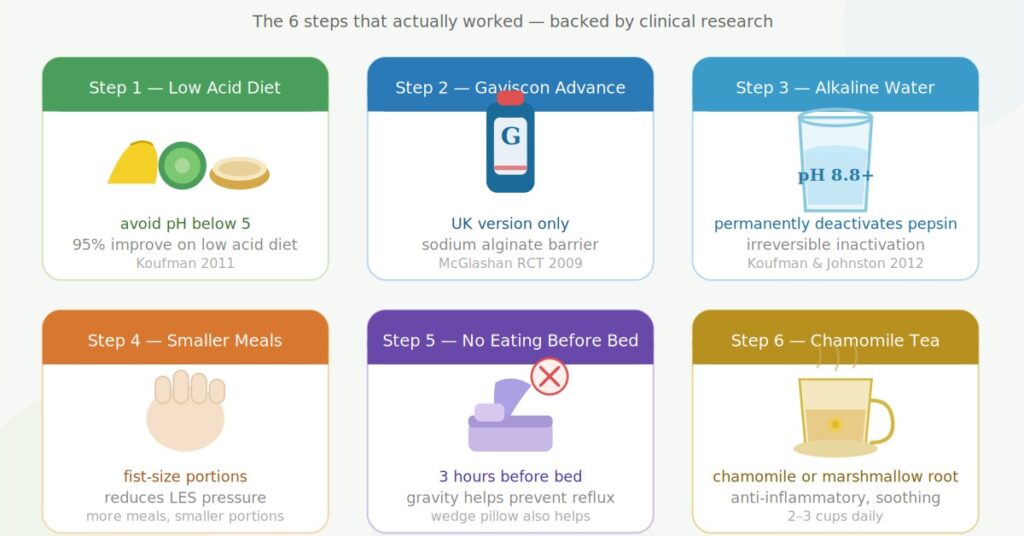
These are the six things that made the difference for me, in order of importance. I am not going to bury the most important ones at the bottom — the diet and Gaviscon Advance are what actually moved the needle. Everything else is supportive.
Step 1: The Low Acid Diet — The Single Most Important Thing

The low acid diet is the most powerful treatment available for LPR. I cannot overstate how much of a difference this made for me — within a week of following it strictly my symptoms started to noticeably reduce for the first time in years.
The diet works because of how pepsin behaves. After a reflux episode, pepsin deposits itself in the cells of the throat where it can sit dormant for 24 to 48 hours. If you eat or drink anything with a pH of 5 or below during that time, the pepsin gets reactivated and your symptoms flare — even if you haven’t refluxed again. The diet breaks this cycle by keeping the pH of your food and drink above 5, preventing reactivation and giving your throat the opportunity to heal. Knowing where things actually sit on that scale is the hard part — my food reference guide lists the pH of common foods and drinks.
The clinical evidence for this is strong. A prospective study by Dr Jamie Koufman found that 95% of LPR patients improved on a strict low acid diet — including patients who had already failed twice-daily PPI treatment. A cross-over study published in The Laryngoscope (Lechien et al., 2022) confirmed a low-fat, high-protein, alkaline, plant-based diet was an effective standalone treatment for LPR. And a 2025 prospective study (Lechien et al.) confirmed that diet and lifestyle changes alone significantly reduced both LPR symptoms and objective laryngeal findings over 6 to 12 weeks.
A 2025 systematic review of diet recommendations for LPR covering 868 patients found that diet adherence led to significant symptom reduction in 54% to 83% of untreated patients — comparable to medication effectiveness.
What I cut out completely
- All soft drinks, carbonated drinks, fruit juice and alcohol — these are some of the most acidic things you can consume
- Coffee — even decaf is acidic enough to reactivate pepsin
- All citrus fruits and juices
- Tomatoes and tomato-based products
- Spicy food
- Fatty and fried foods — these slow gastric emptying and worsen reflux
- Chocolate
- Processed foods
- Mint
What I ate instead
Oats, rice, lean chicken and fish, most vegetables (particularly cucumber, celery, broccoli and courgette), bananas, melon, watermelon, almonds, chamomile tea and alkaline water. Simple, whole food, low acid eating.
For a complete food and drink guide check my LPR diet article, my foods to eat guide and my foods to avoid guide. If you want a fully structured plan with everything laid out check the Wipeout Diet Plan — I created it specifically for people with LPR and GERD based on the same approach that healed me.
Step 2: Gaviscon Advance (UK Version) — The Right Medication
Gaviscon Advance (UK version) was the only medication that made a genuine difference for me and it is the one I recommend to everyone with LPR. It works completely differently to PPIs. Rather than reducing stomach acid it creates a physical alginate raft on top of the stomach contents that acts as a barrier, preventing reflux from reaching the throat and filtering pepsin before it can do damage.
The key ingredient is sodium alginate — derived from seaweed — which forms this protective raft when it hits stomach acid. It also helps neutralise and remove any pepsin already present in the throat, actively working to reduce existing damage rather than just preventing new damage.
The clinical evidence is solid. A randomised controlled trial by McGlashan et al. found Gaviscon Advance produced significant improvements in LPR symptom scores at both 2 and 6 months compared to no treatment. A study by Wilkie et al. (2018) found Gaviscon Advance alone was effective for LPR and that adding a PPI on top of it provided no additional benefit whatsoever.
The most important thing: you must use the UK version. The US version of Gaviscon has completely different ingredients and does not contain sodium alginate. It will not work for LPR. The UK version is available on Amazon here if you are outside the UK.
Take it 15 to 30 minutes after every meal and before bed. For everything you need to know about it check my article on Gaviscon Advance for LPR.
Step 3: Alkaline Water
Drinking alkaline water with a pH of 8 or above was something I added after reading the research and it made a noticeable difference, particularly in the mornings when symptoms were often at their worst.
A study by Koufman and Johnston published in the Annals of Otology, Rhinology and Laryngology (2012) found that water with a pH of 8.8 permanently deactivates pepsin — not just suppresses it, but destroys it. Regular tap and bottled water (typically pH 6.7 to 7.4) has no effect on pepsin. Alkaline water above pH 8.8 irreversibly inactivates it.
Aim to drink alkaline water throughout the day — particularly first thing in the morning, after meals and whenever you feel symptoms flaring. For more detail check my article on alkaline water for LPR.
Step 4: Smaller Meals More Frequently
This was one of those changes I underestimated at first but it made a bigger difference than I expected. Large meals overfill the stomach and put excessive pressure on the lower oesophageal sphincter (LES) — the valve above the stomach that is supposed to keep everything in place. When the stomach is overloaded the LES cannot maintain its seal and reflux occurs much more easily.
The fix is simple: eat roughly a fist-sized portion at any one sitting and spread your food intake across more meals throughout the day rather than two or three large ones. You are not eating less overall — just distributing it differently. For more on how the sphincter works check my article on the stomach sphincter’s role in LPR.
Step 5: No Eating Within 3 Hours of Bedtime
This was non-negotiable for my recovery. When you lie down, gravity no longer helps keep stomach contents in place. If you have eaten recently, the risk of reflux is dramatically increased — and nighttime reflux is particularly damaging because the pepsin sits in your throat for hours without being cleared.
I set a hard rule: nothing to eat or drink other than water after 7pm. It was difficult for the first week and became automatic after that. Alongside this I used a wedge pillow to elevate my head by around 6 to 8 inches which uses gravity to further reduce nighttime reflux. For more advice on this check my article on acid reflux at night.
Step 6: Chamomile and Marshmallow Root Tea
I tried many things to soothe my throat symptoms while healing — lozenges, throat sprays, various supplements. Most made no meaningful difference and some irritated things further. The two things that genuinely helped were chamomile tea and marshmallow root tea.
Chamomile is anti-inflammatory, naturally alkaline and genuinely soothing on inflamed throat tissue. I drank two to three cups a day throughout recovery. Marshmallow root creates a mucilaginous coating on the throat that helps protect and soothe irritated tissue. Both are excellent drink alternatives to water for people with LPR. For more on this check my article on chamomile tea and acid reflux.
How Long Does It Take to Cure Silent Reflux?
Most people following this approach notice meaningful improvement within 1 to 2 weeks. That does not mean full recovery — it means a clear and noticeable reduction in symptoms that tells you the approach is working.
Full recovery typically takes 2 to 6 months depending on how long you have had LPR and how severe it has been. For me it took 6 months to be completely symptom-free, but I had been symptomatic for several years and was in a fairly advanced state. People who catch it earlier tend to heal faster.
The physical healing of laryngeal tissue — the redness, swelling and granulation that an ENT can see on laryngoscopy — lags behind how you feel. Your symptoms will improve before the visible signs resolve. Research supports continuing the treatment approach for at least 6 months to allow full resolution of physical findings even if you feel significantly better before then.
The most important factor is consistency. One or two days of eating acidic food or drinking coffee can set you back noticeably because of how pepsin reactivation works. The stricter you are in the first 6 to 8 weeks, the faster you will heal.
Can Silent Reflux Come Back After Being Cured?
Yes it can — if you go back to the diet and lifestyle that triggered it in the first place. For me, returning to drinking alcohol and coffee regularly would almost certainly bring symptoms back. Most people who have had LPR find they have a lower threshold for trigger foods than they did before, and need to be mindful of this long term.
That said, the majority of people do not need to follow the strict acute-phase diet permanently. Once fully healed most people can reintroduce a wider range of foods and drinks while keeping the obvious high-acidity triggers in check. It is about finding your personal threshold rather than following the acute diet indefinitely.
What If the Diet and Gaviscon Aren’t Working?
If you have followed the diet strictly for 3 to 4 weeks and taken Gaviscon Advance after every meal and still see no improvement, the most likely reasons are:
- You are still consuming something acidic without realising it — coffee, certain herbal teas, fizzy water, most condiments and many processed foods are all acidic enough to reactivate pepsin
- You have an underlying issue driving the LPR — SIBO (small intestinal bacterial overgrowth) is a surprisingly common root cause that doesn’t respond to dietary changes alone until it is addressed
- You need more targeted guidance based on your specific situation
If you want personalised help figuring out what is going on and what needs to change, a private consultation is the most direct way to get there. I’ll go through your symptoms, your diet, what you have tried and what the right next steps are for your situation specifically. 86% of people who follow the recommendations from a consultation see meaningful improvement within two weeks.
Frequently Asked Questions
Can silent reflux be cured permanently?
Yes — for the majority of people silent reflux can be fully resolved with the right approach. A strict low acid diet combined with Gaviscon Advance (UK version) is the core treatment. Most people achieve full recovery within 2 to 6 months. Some people need to maintain dietary changes long term to prevent recurrence, but the acute symptoms resolve completely for most who follow the approach consistently.
How do you cure LPR naturally without medication?
The most effective natural treatments for LPR are a strict low acid diet avoiding foods and drinks with a pH below 5, alkaline water with a pH of 8 or above (which permanently deactivates pepsin), eating smaller portions, not eating within 3 hours of bedtime, and chamomile or marshmallow root tea. A 2025 clinical study confirmed diet and lifestyle changes alone significantly reduced LPR symptoms without medication.
How long does LPR take to heal?
Most people following the correct treatment approach notice improvement within 1 to 2 weeks. Full healing typically takes 2 to 6 months depending on severity and how long the condition has been present. Laryngeal tissue damage visible on laryngoscopy takes longer to resolve than subjective symptoms. Consistency with the diet is the biggest determinant of how quickly you heal.
What is the fastest way to cure LPR?
The fastest path to LPR recovery is to combine all of the steps simultaneously from day one: strict low acid diet, Gaviscon Advance (UK version) after every meal, alkaline water throughout the day, smaller meals, no eating within 3 hours of bedtime and stopping PPIs slowly if you are currently on them. Doing all of these consistently from the start gives the best chance of rapid improvement. Most people who are strict with all of these report noticeable improvement within 7 to 14 days.
Is LPR curable or just manageable?
For most people LPR is fully curable rather than just manageable. The distinction matters — management implies permanent ongoing treatment, whereas cure means the underlying condition resolves and you return to normal function. The majority of people who follow the right treatment approach do not need to remain on ongoing treatment indefinitely. Some need long-term dietary adjustments, but the active symptomatic phase resolves completely.
Can stress cause silent reflux to come back?
Yes — stress and anxiety directly worsen LPR through multiple mechanisms. Stress increases gastric acid production, affects gut motility, and lowers the threshold at which the LES relaxes inappropriately. Research has confirmed that anxiety and stress levels are significantly higher in LPR patients and that psychological stress directly impacts symptom severity. If you are going through a stressful period you may notice a flare even while following the diet well. For more on this check my article on LPR and anxiety.
What should I do first if I think I have LPR?
Take the RSI (Reflux Symptom Index) test — it is the most reliable self-assessment tool for LPR and takes two minutes. If your score suggests LPR, read my silent reflux treatment guide and LPR diet guide and start the low acid diet and Gaviscon Advance immediately. The sooner you start the right approach the faster you will recover.
Conclusion
Silent reflux can be cured. I know this from personal experience — and from watching hundreds of people go through the same process I did and come out the other side.
The approach that works is not complicated: a strict low acid diet that keeps food and drink above pH 5, Gaviscon Advance (UK version) after every meal, alkaline water, smaller portions, no eating before bed and stopping the PPIs that are making no difference. Done consistently over 2 to 6 months this resolves LPR for the vast majority of people.
The Wipeout Diet Plan covers the diet side of this in complete detail — everything you need to know about what to eat, what to avoid, what to drink, and how to structure your meals. You can check it out here: Wipeout Diet Plan.
And if you want personalised guidance on your specific situation — particularly if you have been struggling for a while without improvement — a private consultation is the most direct route to answers.
You can get better. The right information and the right approach make all the difference.
Related articles:
- The Complete Guide to LPR — Causes, Symptoms and Treatment
- Silent Reflux Treatment — What Actually Works
- LPR Diet — What to Eat, What to Avoid and What to Drink
- LPR Symptoms — The Complete Guide
- Gaviscon Advance for LPR — Why the UK Version Matters
- Alkaline Water for LPR
- Getting Off PPIs Safely
- RSI Test — Do You Have LPR?
- LPR Foods to Avoid
- Acid Reflux at Night
References
- Koufman JA. (2011) “Low-acid diet for recalcitrant laryngopharyngeal reflux: therapeutic benefits and their implications.” Annals of Otology, Rhinology and Laryngology, 120(5):281-287. PubMed
- O’Hara J et al. (2021) “Use of proton pump inhibitors to treat persistent throat symptoms: multicentre, double blind, randomised, placebo-controlled trial.” BMJ, 372:m4903. BMJ
- Lechien JR et al. (2024) “The Dubai definition and diagnostic criteria of laryngopharyngeal reflux: the IFOS consensus.” The Laryngoscope, 134(4):1614-1624. PubMed
- Lechien JR et al. (2022) “Is Diet Sufficient as Laryngopharyngeal Reflux Treatment?” The Laryngoscope, 132:1916-1923. PubMed
- Lechien JR et al. (2025) “Effectiveness of Diet and Lifestyle Changes for the Treatment of Laryngopharyngeal Reflux Disease.” Journal of Voice. PubMed
- Gelardi M et al. (2025) “Efficacy of dietary modifications and mucosal protectors in the treatment of laryngopharyngeal reflux: a multicenter study.” Frontiers in Medicine, 12:1488323. PMC
- Lechien JR et al. (2025) “Effectiveness of Diet Recommendations for Laryngopharyngeal Reflux Disease: A Systematic Review.” Journal of Voice. ScienceDirect
- McGlashan JA et al. (2009) “The value of a liquid alginate suspension (Gaviscon Advance) in the management of laryngopharyngeal reflux.” Journal of Laryngology and Otology. PubMed
- Wilkie MD et al. (2018) “Gaviscon Advance alone versus co-prescription of Gaviscon Advance and proton pump inhibitors in the treatment of laryngopharyngeal reflux.” European Archives of Oto-Rhino-Laryngology, 275(10):2515-2521. PubMed
- Koufman JA, Johnston N. (2012) “Potential Benefits of pH 8.8 Alkaline Drinking Water as an Adjunct in the Treatment of Reflux Disease.” Annals of Otology, Rhinology and Laryngology, 121(7):431-434. PubMed

David Gray
12 years living with LPR · Consultant & researcher
I've lived with LPR for twelve years — the misdiagnoses, the PPI courses that did nothing, the slow work of figuring out what actually helps. Wipeout Reflux is where I translate the research into plain terms for people stuck in the same place. Every claim here is sourced to peer-reviewed work, and I consult one-to-one with LPR sufferers.
Respected David,
Which Fruits are Allowed in LPR?
What are you doing for the protection of teeth and gums?
In a few days later i am going to buy your book which is very ideal for me and other people with lpr.
You are a true person who is saving the people from further damage.
Thank you so much for helping people.
God Bless you.
There are many fruits but to name a few banana, watermelon, papaya & dragon fruit.
Using toothpaste with baking soda as main ingredient and rinsing mouth with alkaline water mixed with baking soda twice per day.
Thank you Harry, that’s much appreciated. You can always email me if you have any further questions.
Respected David,
Can we use Almond Butter in silent reflux?..can we eat Trident Bubble gum watermelon flavour suger free?
Hi Tom,
Yes almond butter is allowed just make sure to get one without additives. One with just almonds included is perfect. I suggest to avoid any gum because of the ingredients included are not natural. I find it can help because you are constantly swallowing but I actually think it makes things worse because some of the ingredients in the gum will irritate the throat if even slightly. So you can a short term benefit but long term I think it’s worse.
Dear David,
Which surgery is best for LPR?
Can a person Drink low Fat Cow,s milk 5 hours later after food?..or can you Eat Apples?
Hi Romeo,
From my knowledge I would say Stretta is the best option. You can have low fat milk yes, anytime is fine. Apples not allowed, because they are too acidic for someone with LPR typically.
Dear David Sir,
Please write about Your present condition and symptoms after following the strict Diet.
Or Are you totally symptoms free these days?
Are you still feeling A mild pain in your ears or throat tightness ,dry mouth sometimes?
Are you not Afraid of Developing cancer without having Surgery?
I’m about 80% better. While not perfect I’m much better now. Of the things you mentioned I occasionally have dry mouth though not the others.
I try not to overthink it and do what I can today to keep my symptoms away, that helps keep my mind at peace.
Hi David
Are you healed Now? Could you resume your normal Lifestyle? For Howe Long i ha e to take gaviscon?
This came out of the Blue for me.
Hi Greta,
I am about 80% improved. Not perfect but much better. I can eat things that I couldn’t have before yes. Though I try to stick to the similar diet I recommend most of the time, with occasional treats without downside. It’s hard to say how long you may need to take it, some people can take it just for 1 month others may need to take it longer term to help keep symptoms away.
Hi David
I want to ask that how to stop a bitter fluid coming up in mouth during night sleep?..me sleeping on a high pillow but the fluid is still coming in night sleep..plz help
I think don’t eat soon before bed, ideally 3-4 hours at least. It’s also a good idea to not drink too much within 1 hour before bed, try to only drink a little water during that time. It may also be a good idea to take a medicine like gaviscon advance before bedtime or reflux gourmet if you can access it.
Dear David
Tell me About multi vitamins which are compulsory in Lpr and how to take them.in which quantity..i am following your instructions very much you are my teacher.At present i am taking only 20 mg omeprazol in morning 30 mints before food and following alkaline diet i m feeling better but soon i will quit taking Omeprazol.I am from Pakistan.Kindly guide me ..Thank you
Hi Ali,
You really shouldn’t need any multi-vitamins, in fact I actually think it’s better without as some of them can irritate certain people. I think keep on the diet and look to taper off the PPI’s slowly in your case.
Hey David! How you cured your silent Reflux?
There are many small adjustments that helped me but the main ones are a low acid and natural diet like my wipeout diet plan and Gaviscon Advance the UK version.
Hello,
Bought your manual for an LPR diet. Hope it does me well. I’ve also begun to take Gaviscon Advanced—tablets till liquid arrives. To effectively use GA, I take the stuff 15-30 mins following a meal, and am good for 3-4 hrs. Am I not to have anything (snacks, water) for next 3-4 hrs lest I break up the barrier? Another question re belching, having read what you say about it, does gas always carry up pepsin from stomach? I’ve become quite weary of any burp at all. Does Gaviscon keep burps from carrying up pepsin?
Hi Ken,
Ideally for 1 hour after takin the Gaviscon it would be better to not take any liquid or food as it would break the barrier as you mentioned. I think 1 hour is fine, because after that it just isn’t practical for most people and the benefit of the gaviscon would have lowering returns as time goes on anyway. Yes it almost is always gaseous reflux that brings up the pepsin. The gaviscon should help with preventing the pepsin from coming up though its not a perfect fix.
Hi David,
I am suffering from both burping issues & Sinusitis (sinus infection) since 2 months. ENT has ordered CT scan & found out my sinus infection just a week ago.
But my main problem is severe burping & mucus in throat. Now i have an irritated throat, making it hard for me to even burp. Till now my Nexium did help me. Now my situation is worse. Due to this irritation in my throat, it is causing me difficulty to breathe some times.
I am on antibiotics for my sinus infection. not sure, if my LPR will go away once my sinus infection goes away. I follow very good healthy food diet, almost 0 processed food with more of foods. Only thing is I eat very less in the evenings, which might have caused my reflux (just gas or gurgurling in my stomach).
Can you suggest me something for my irritated throat. is there any over the counter medication. Please help me with the situation.
Thanks in advance.
Hi Ramadevi,
To help the throat, of course diet is important as you seem to know. Stopping the acid with diet and things like gaviscon advance after eating is important. For relief you can get alkaline water (250ml) and mix with baking soda (half a teaspoon) and put it into a nasal spray bottle. Then after eating spray the throat this will deactivate the pepsin in the throat which should help ease symptoms.
David, your solution here is 1/2 tsp to 250 ml. I watched the video on this topic and the solution there is 2T to 1000ml, which would equal 1/2 T to 250 ml. So, which is it – teaspoons or tablespoon?
Yeah I have basically matched up what he has suggested and lowered it to make a smaller amount as you wouldn’t need as much as 1 liter to do this. To clarify I mean teaspoons.