
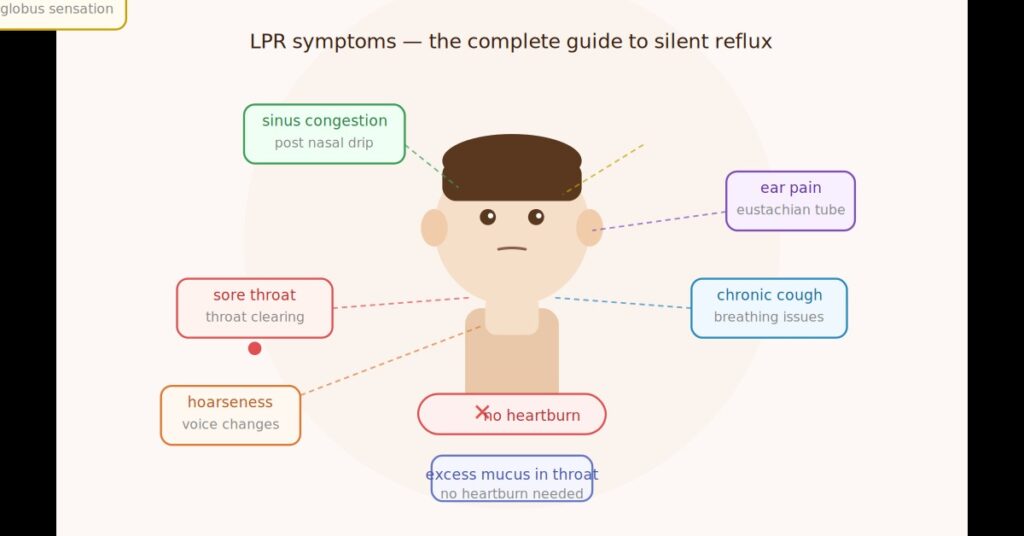
LPR (Laryngopharyngeal Reflux), also known as silent reflux, is one of the most commonly misdiagnosed conditions there is. That’s because unlike regular acid reflux or GERD, the symptoms don’t show up in your chest — they show up in your throat, sinuses, ears and voice. And because most doctors aren’t looking for them in those places, people often spend months or years going from appointment to appointment without a clear answer.
If you are reading this, there is a good chance you have noticed something off about your throat or voice and you’re trying to figure out what’s going on. This article covers every LPR symptom in detail — what causes it, why it happens, and what you can do about it — so you can finally make sense of what your body is telling you.
Key Takeaways:
- Silent reflux symptoms appear in the throat, sinuses and ears — not the chest
- The main driver of symptoms is pepsin, a digestive enzyme — not just acid
- Over 50% of people with chronic hoarseness have LPR as the underlying cause
- You can have LPR without ever experiencing heartburn — that’s what makes it silent
- Having 2-3 or more of the symptoms below makes LPR significantly more likely
- The RSI (Reflux Symptom Index) is the most reliable self-assessment tool — take the test here
Why LPR Symptoms Are Different From Regular Acid Reflux
The reason LPR symptoms are so different from GERD is because the reflux travels further. In regular acid reflux, stomach contents come up into the oesophagus and you feel it as heartburn in the chest. In LPR, the reflux travels all the way up through the upper oesophageal sphincter and into the throat, larynx, sinuses and sometimes even the ears.
The larynx — your voice box — is far more sensitive to damage than the oesophagus. The oesophagus has a degree of natural protection against acid. The throat and larynx have almost none. So even a small amount of reflux reaching the throat can cause significant inflammation and a wide range of symptoms.
And critically, the main culprit isn’t just acid — it’s pepsin. Pepsin is a digestive enzyme that travels up from the stomach alongside acid during a reflux episode. Once it reaches the throat it causes direct tissue damage and inflammation, and it can remain dormant in the throat cells for 24 to 48 hours. If you eat or drink anything acidic during that time, the pepsin gets reactivated and your symptoms flare again — even if you didn’t reflux. This is why LPR symptoms can persist even when acid seems under control. A 2024 study published in Cytokine (Tan et al.) confirmed that pepsin triggers an inflammatory cascade in the larynx even in conditions that are only mildly acidic, explaining why acid-reducing medication so often fails to help.
According to StatPearls (updated 2025), LPR affects around 10% of all patients seen in ear, nose and throat clinics, and the condition is responsible for a significant and growing proportion of consultations in otolaryngology. Many of these patients have already been misdiagnosed or inadequately treated before reaching a specialist.
LPR Symptoms — Full List
#1 Sore or Irritated Throat
A persistent sore or irritated throat is the most common symptom of LPR and the one most people notice first. This isn’t the kind of sore throat that comes with a cold — it tends to be a background irritation that doesn’t go away and doesn’t respond to standard treatments like lozenges or gargling.
The soreness is caused by pepsin and acid directly damaging the delicate tissue of the throat. Because the throat has no natural protective barrier against these substances, even small amounts of reflux cause real tissue-level inflammation. The soreness tends to be worse in the morning when you first wake up, after eating, or after lying down. Some people also see the inflammation rather than just feel it — a swollen uvula is a common visible sign that reflux is reaching the back of the throat.
If you have a sore throat that has persisted for more than a few weeks without a clear cause like infection, LPR should be high on your list of things to investigate.
#2 Constant Throat Clearing
The persistent need to clear your throat is one of the most recognisable and frustrating symptoms of LPR. Most people with this symptom find themselves doing it dozens of times a day without even realising it.
It happens because the inflammation and excess mucus in the throat creates a sensation of something being stuck or coating the throat. The body’s instinct is to clear it. The problem is that constant throat clearing actually makes things worse — it creates additional friction and irritation on already inflamed tissue.
If you find yourself clearing your throat repeatedly throughout the day, try replacing it with a small sip of water instead. Over time this helps break the habit and reduces further irritation. The 2023 study by Haworth et al. found that throat clearing was one of the three symptoms most specifically and significantly associated with LPR in patients who tested positive for SIBO alongside their reflux, reinforcing how central it is to the LPR symptom picture.
#3 Excess Mucus in the Throat
Feeling like there is constantly too much mucus in your throat — sometimes described as a coating, thickness or phlegm that won’t shift — is extremely common with LPR. A lot of people mistake this for post-nasal drip or a persistent cold.
The mucus is actually the body’s protective response to inflammation. When the throat is damaged and irritated, it produces extra mucus to try to lubricate and protect the tissue. It’s a form of self-defence. While it’s an understandable response, it becomes a source of ongoing discomfort in itself.
The best approach is to sip water regularly throughout the day which helps keep the throat clear without irritating it further. Avoiding dairy can also help some people as dairy is known to increase mucus production in certain individuals.
#4 Chronic Cough
LPR is one of the leading causes of a chronic cough — a cough that persists for weeks or months without a clear respiratory cause. Research estimates that LPR accounts for up to 10% of all outpatient ENT consultations, with chronic cough being one of the most common presentations.
The cough in LPR is usually dry rather than productive, and tends to be worse after eating, when lying down, or in the morning. It can be triggered by speaking, laughing or taking a deep breath. Many people are given inhalers or allergy medication that doesn’t help, because the root cause is never identified.
Just like with throat clearing, try not to cough unnecessarily — it further irritates already inflamed tissue. Sipping water or chamomile tea can help suppress the urge and soothe the throat at the same time. For more information check my article on natural remedies for LPR.
#5 Hoarseness and Voice Changes
Changes to your voice — hoarseness, a deeper or rougher voice than usual, voice fatigue or even losing your voice — are classic LPR symptoms. This is because the reflux reaches the larynx (voice box) and causes inflammation of the vocal cords.
Healthcare providers estimate that over 50% of people with chronic unexplained hoarseness have LPR as the underlying cause. Many singers, teachers or anyone whose voice is important to their work first notice LPR through changes to their voice quality.
The hoarseness tends to be worse in the morning after a night of potential reflux while lying down. It often improves slightly as the day goes on. If your hoarseness has lasted more than a few weeks and isn’t related to illness or voice overuse, LPR is worth investigating seriously.
#6 Lump in the Throat (Globus Sensation)
The sensation of a lump in the throat — also called globus pharyngeus or globus sensation — is one of the most anxiety-inducing symptoms of LPR because it feels like something physical is stuck or lodged in the throat even though nothing is there.
It is caused by inflammation and swelling of the throat tissue from pepsin exposure. The swelling creates a sensation of fullness or obstruction even though there is no physical blockage. This is important to understand — it is almost never an actual lump. It is irritation.
Try not to fixate on the sensation or repeatedly swallow to check for it, as this makes it worse. The 2023 Haworth et al. study specifically found globus pharyngeus to be significantly associated with LPR and was one of the three symptoms most strongly linked to LPR severity. As the throat heals with the right treatment the sensation typically resolves. For more detail check my article on the lump in throat feeling and acid reflux.
#7 Post Nasal Drip
Post nasal drip — the feeling of mucus draining from the back of the nose down into the throat — is another very common symptom of LPR that often gets attributed to allergies or sinus problems instead.
What happens is that pepsin and reflux gases can reach the nasal passages and sinuses causing inflammation there too. This triggers excess mucus production in the sinuses which then drains down the back of the throat. The result is a constant sensation of something dripping down the back of the throat, often accompanied by a need to swallow frequently or clear the throat.
If you have been treated for allergies or sinusitis without improvement, LPR may be the actual cause. For more information on how reflux affects the sinuses check my article on acid reflux and sinus congestion.
#8 Sinus Congestion
Closely related to post nasal drip, sinus congestion or blocked sinuses is a symptom that surprises a lot of LPR sufferers. Most people don’t make the connection between reflux and their sinuses.
The pepsin that reaches the nasal passages causes the same kind of inflammation and irritation there as it does in the throat. The mucous membranes of the sinuses become swollen and inflamed, leading to that blocked or congested feeling. The 2025 Gelardi et al. multicenter trial confirmed that pepsin is measurable in the nasal secretions of LPR patients and that treating the underlying LPR directly reduces nasal pepsin concentrations.
#9 Difficulty Swallowing (Dysphagia)
Some people with LPR experience difficulty swallowing — a sensation of food or liquid not passing smoothly, or a feeling of tightness when swallowing. This is called dysphagia.
It happens because the inflammation and swelling in the throat affects the normal muscular function involved in swallowing. The upper oesophageal sphincter — the valve between the throat and the oesophagus — can become irritated and less flexible, contributing to the sensation.
Difficulty swallowing can occasionally be a sign of something more serious, so if it is severe or accompanied by pain when swallowing, it is worth getting it checked by a doctor. In the context of other LPR symptoms it is usually a direct result of the throat inflammation.
#10 Ear Pain
Ear pain or ear discomfort as a result of LPR surprises a lot of people but it is a recognised symptom. The ears are connected to the back of the throat via a tube called the Eustachian tube. Gaseous reflux containing pepsin can travel through this tube and cause irritation and inflammation inside the ear.
This can present as a dull ache, a sensation of fullness or pressure in the ear, or intermittent sharp pain. Some people also notice a crackling or clicking sound or muffled hearing. It is often mistaken for an ear infection.
For more detailed information on this check my article on acid reflux and ear pain.
#11 Difficulty Breathing or Breathing Problems
LPR can cause breathing difficulties, and this is one of the symptoms that causes the most alarm. The gaseous reflux reaches the airways causing inflammation and narrowing that can make it feel harder to breathe properly.
A useful distinction worth knowing: breathing problems that come from LPR tend to affect inhaling (breathing in) rather than exhaling (breathing out). Problems exhaling are more typically associated with asthma. This is why LPR is sometimes called respiratory reflux — because of the impact it can have on the airways.
If you have been given an inhaler for what seems like asthma and it hasn’t helped, LPR is absolutely worth investigating as the actual cause.
#12 Excess Burping
Burping more than average is both a symptom of LPR and in some cases a contributing cause of it. The connection is gas. When there is excess gas in the stomach — whether from the food you eat, drinks like carbonated beverages, or underlying gut issues — it creates pressure that forces the LES open and sends a spray of stomach contents including pepsin up into the throat.
If you find yourself burping excessively alongside your throat symptoms, this is worth paying particular attention to. It can sometimes indicate an underlying issue like SIBO (Small Intestinal Bacterial Overgrowth) which is a surprisingly common driver of LPR that most doctors don’t check for.
#13 Dry or Burning Lips
A symptom that doesn’t get talked about much but that a lot of LPR sufferers notice is dryness, irritation or a burning sensation on the lips. This happens when pepsin makes its way into the mouth — it dries out and irritates the delicate skin of the lips.
If you have this symptom, avoid licking your lips as it makes it worse. Applying a plain lip balm like Vaseline twice a day helps protect the skin. It is one of the more minor symptoms but it can be persistent and annoying.
#14 Dental Erosion
Dental erosion is one of the less well known symptoms of LPR but it is a real and significant one. When pepsin and acid reach the mouth they come into contact with tooth enamel and can erode it over time. The biting surfaces of the back teeth are usually the first affected.
A systematic review published in PLOS ONE (Lechien et al., 2020) found a significantly higher prevalence of dental erosion in reflux patients compared to healthy individuals. Many dentists are now being trained to recognise the patterns of acid erosion that suggest underlying reflux as a cause.
If your dentist has mentioned erosion of your enamel without a clear cause, and you have other symptoms on this list, LPR could be responsible. Treating the LPR is the most important step — alongside protective measures like using a fluoride toothpaste and not brushing immediately after eating.
#15 Acidic Taste in the Mouth
Some people with LPR notice an acidic or bitter taste in the mouth, particularly in the morning or after meals. This happens when the reflux travels all the way up to the mouth, bringing stomach acid and pepsin with it.
It can also cause a burning sensation on the tongue or inside the mouth. If you have this alongside other throat symptoms, it is a strong indicator of LPR rather than just localised oral issues.
The Crucial Difference — LPR Usually Has No Heartburn
This is one of the most important things to understand about LPR and the main reason it gets missed so often. The majority of people with LPR do not experience heartburn. That’s exactly why it is called silent reflux — the reflux is happening but the typical reflux symptom of burning in the chest is absent.
This confuses a lot of doctors who assume that if there is no heartburn there is no significant reflux. But the research is clear that LPR and GERD are distinct conditions with different symptom profiles and different treatment requirements. LPR typically occurs in the upright position during the day — which is another difference from GERD which tends to be worse at night when lying down.
If you are experiencing multiple symptoms from the list above but no heartburn, LPR is still very much a possibility.
How Many Symptoms Do You Need to Have LPR?
There is no strict number but as a general rule — if you have just one of the symptoms above there could be any number of explanations. If you have two or three or more of them, particularly if they have persisted for several weeks, LPR becomes significantly more likely as the unifying cause.
LPR is a condition that tends to build gradually. Many people start with a mild sore throat or occasional throat clearing and only later develop more symptoms as the pepsin damage accumulates. It also tends to wear you down over time — broken sleep and constant low-grade inflammation are why so many people end up dealing with persistent fatigue alongside silent reflux. The sooner you identify it and start the right treatment, the faster and more complete your recovery will be.
How to Know if You Have LPR — The RSI Test
The most reliable self-assessment tool for LPR is the Reflux Symptom Index, or RSI. It was developed by leading LPR researchers and scores the severity of nine common LPR symptoms. A score above 13 is considered highly indicative of LPR.
I have built the RSI test directly into this site so you can take it right now. Click here to take the RSI test — it takes about two minutes and gives you a clear indication of whether your symptoms are likely to be LPR related.
Keep in mind that a formal diagnosis from a doctor — ideally an ENT or gastroenterologist familiar with LPR — involves laryngoscopy to check for signs of inflammation in the throat and larynx, and sometimes a 24-hour pH monitoring test. However, many people start treatment based on their symptoms and the RSI score, and see significant improvement before formal testing.
What to Do Next if You Think You Have LPR
If the symptoms and RSI test point towards LPR, the next step is to start treatment as soon as possible. The earlier you start the faster you will recover. The most important first steps are:
- Start a low acid diet — avoiding foods and drinks with a pH below 5 stops the reactivation of pepsin in your throat and begins the healing process. Check my LPR diet guide and foods to avoid for detail, or skip the guesswork with the Wipeout Diet Plan, which was built around LPR but works just as well for GERD and classic heartburn. For quick, food-by-food pH and safety lookups while you adjust, the Wipeout Reflux Food Reference Guide is a handy companion.
- Take Gaviscon Advance (UK version) after meals — the most effective medication for LPR. It creates a physical barrier against reflux and filters pepsin. Read more in my article on Gaviscon Advance for LPR.
- Drink alkaline water with a pH of 8 or above — shown in studies to directly deactivate pepsin. More information in my article on alkaline water for LPR.
- Stop eating 3 hours before bed and consider a wedge pillow if you have nighttime symptoms.
- If you are on PPIs with no benefit — taper off them slowly. They have been shown not to help for LPR and can make things worse. Read my article on getting off PPIs safely.
For everything you need to know about treatment in detail check my article on silent reflux treatment and my complete LPR guide.
If you want a fully tailored treatment plan based on your specific symptoms and situation, consider a private consultation. And for a complete structured diet plan check the Wipeout Diet Plan.
Frequently Asked Questions
Can you have LPR without heartburn?
Yes — in fact most people with LPR don’t have heartburn at all. This is why it’s called silent reflux. The symptoms appear in the throat, voice, sinuses and ears rather than the chest. Many people are misdiagnosed for years because doctors look for heartburn as the primary indicator of reflux.
What does LPR feel like?
Most people describe a persistent sore or irritated throat, the constant need to clear the throat, hoarseness or voice changes, a feeling of something stuck in the throat, and excess mucus. Some also have chronic cough, sinus problems, ear discomfort and breathing difficulties. The symptoms tend to build gradually and are typically worse after meals, in the morning, and when lying down.
How do I know if my cough is from LPR?
An LPR-related cough is usually dry rather than productive, persists for weeks or months, and tends to be worse after eating or when lying down. If you have also noticed throat symptoms like hoarseness, throat clearing or a sore throat alongside the cough, LPR is worth investigating. The RSI test is a good starting point — take it here.
Can LPR cause anxiety?
LPR and anxiety have a bidirectional relationship. Anxiety and stress can worsen LPR symptoms, and the chronic nature of LPR symptoms — particularly breathing difficulties and the lump in throat sensation — can trigger anxiety in turn. For more on this check my article on LPR and anxiety.
How long do LPR symptoms last?
Without treatment symptoms tend to persist and often worsen over time. With the right treatment — low acid diet, Gaviscon Advance and lifestyle changes — most people see meaningful improvement within 1 to 2 weeks. Full healing of physical tissue changes in the larynx can take several months. The sooner you start, the sooner you heal. Check my article on acid reflux sore throat healing time for more detail.
Can LPR symptoms come and go?
Yes, they often do. Many people have periods where symptoms improve and then flare again — often when they eat trigger foods, drink alcohol or go through a particularly stressful period. The flare-and-settle pattern is consistent with how pepsin reactivation works. It doesn’t mean you are not improving — it means there are still some triggers in your diet or lifestyle that need addressing.
Conclusion
LPR causes a surprisingly wide range of symptoms that most people — and many doctors — don’t immediately connect to reflux. A persistent sore throat, constant throat clearing, hoarseness, excess mucus, chronic cough, a lump in the throat, post nasal drip, sinus congestion, ear pain — all of these can be caused or worsened by pepsin and acid reaching the throat.
The sooner you identify LPR as the cause and start the right treatment, the faster you will recover. Take the RSI test, read my treatment guide and get started. LPR is very treatable with the right approach.
Related articles:
- The Complete Guide to LPR — Causes, Symptoms and Treatment
- Silent Reflux Treatment — What Actually Works
- LPR Diet — What to Eat, What to Avoid and What to Drink
- RSI Test — Check Your Reflux Symptom Index
- Lump in the Throat Feeling and Acid Reflux
- Acid Reflux and Ear Pain
- Acid Reflux and Sinus Congestion
- LPR and Anxiety
- Natural Remedies for LPR
- GERD vs LPR — What’s the Difference?
References
- Tan JJ et al. (2024) “Pepsin-mediated inflammation in laryngopharyngeal reflux via the ROS/NLRP3/IL-1β signaling pathway.” Cytokine, 178:156568. PubMed
- Brown J, Shermetaro C. (2025) “Laryngopharyngeal Reflux.” StatPearls. NCBI Bookshelf
- Lechien JR et al. (2024) “The Dubai definition and diagnostic criteria of laryngopharyngeal reflux: the IFOS consensus.” The Laryngoscope, 134(4):1614-1624. PubMed
- Haworth JJ et al. (2023) “Small intestinal bacterial overgrowth is associated with laryngopharyngeal reflux symptom severity and impaired esophageal mucosal integrity.” Gastrointestinal Tract. Full text
- Gelardi M et al. (2025) “Efficacy of dietary modifications and mucosal protectors in the treatment of laryngopharyngeal reflux: a multicenter study.” Frontiers in Medicine, 12:1488323. PMC
- Lechien JR et al. (2020) “Laryngopharyngeal reflux, gastroesophageal reflux and dental disorders: A systematic review.” PLOS ONE. PMC
- Barham HP et al. (2024) “Laryngopharyngeal Reflux Pathophysiology, Clinical Presentation, and Management: A Narrative Review.” Cureus. PMC

David Gray
12 years living with LPR · Consultant & researcher
I've lived with LPR for twelve years — the misdiagnoses, the PPI courses that did nothing, the slow work of figuring out what actually helps. Wipeout Reflux is where I translate the research into plain terms for people stuck in the same place. Every claim here is sourced to peer-reviewed work, and I consult one-to-one with LPR sufferers.
Hi David, I hope this reaches you. I have had a sore throat for last 3.5 weeks that moves from one side to the other to even both. I thought it had gone about 10 days ago but has come back again. I have now been referred to an ENT for urgent review (my request) I think I have had mild post nasal drip for 4 years but never had a sore throat, except once last year that went quickly. I want to find out what it is but am worried about not treating it (if that’s what I have had for years) and what damage I may have done to my throat as a result. I have only had 2 episodes and perhaps a couple of slight hoarseness episodes. What do you think? Any advice would be appreciated. Thanks Steve
Hi Steve, the couple of symptoms you mentioned of course are related to LPR but I would need more information on them to be able to say if it’s more likely or not. If it is LPR diet a low acid and natural diet should be your first form of action. Send me an email – david@wipeoutreflux.com and I’ll give you more information.