
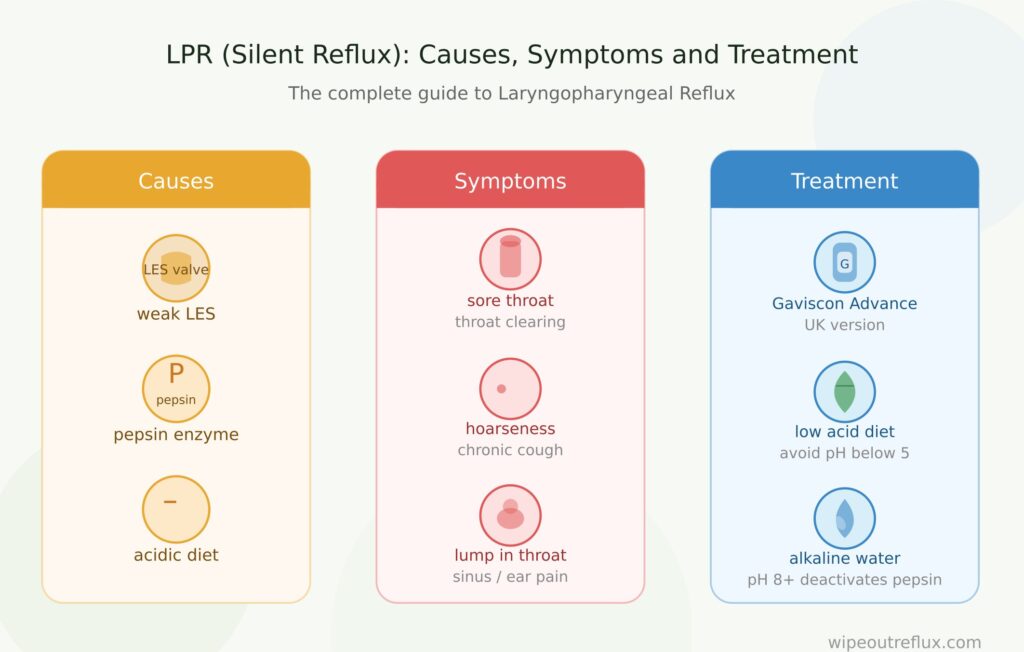
LPR which stands for Laryngopharyngeal Reflux or as it’s sometimes known as silent reflux is a condition where stomach contents come up from the stomach and damage the throat and larynx area. The main culprit behind this damage is pepsin – a digestive enzyme that causes inflammation and tissue injury when it reaches the throat, even in weakly acidic or non-acidic conditions.
Unlike regular acid reflux or GERD (Gastroesophageal reflux disease) you usually won’t have heartburn with LPR. That’s why it’s often called silent reflux – you don’t get the typical burning chest symptoms. Instead, the problems show up in your throat, sinuses and ears which makes it harder to diagnose and often leads to misdiagnosis.
I know this first-hand because it took me over 3 years of doctor visits, misdiagnoses and failed treatments before I figured out what was going on. If you are in a similar position right now, I want you to know that there are real solutions and this guide will walk you through everything you need to know.
Key Takeaways:
- Pepsin is the main driver of LPR symptoms, not acid alone – and recent research continues to confirm this
- PPIs (proton pump inhibitors) have been shown in clinical trials to be no better than placebo for LPR
- A low acid diet combined with mucosal protectors like alginates is the most evidence-based approach
- SIBO (Small Intestinal Bacterial Overgrowth) may be a hidden underlying cause – studies show up to 60% of reflux patients test positive
- Treating the root cause rather than just suppressing acid is key to lasting improvement
LPR Causes
There are a selection of different things that can cause LPR. Because of this there are also different ways to solve the problem depending on the root cause. Though it tends to be some causes are much more common than others.
Doctors and physicians alike will often assume reflux and prescribe anti-acid tablets like PPIs (proton pump inhibitors). This can help certain people and for others may not help at all and in fact make things worse. Below I am going to cover each of the different causes of LPR with advice on how to tackle each problem along with silent reflux treatment advice.
#1 Pepsin – The Real Problem Behind LPR
Pepsin is the main problem that is causing most if not all of your LPR symptoms. Not the acidity like a lot of doctors believe. Therefore treating or stopping pepsin is essential if you want to stop your LPR symptoms.
Pepsin is one of the digestive enzymes that the stomach produces and is used primarily to help break down proteins. Research has shown that people with LPR have pepsin present in the throat area whereas in a typical person this pepsin is not present. The problem with this is that pepsin is designed to digest proteins – so when it comes in contact with the throat tissues it basically tries to digest them. This is where you get most of the problematic symptoms from.
What Recent Research Tells Us About Pepsin (2024–2026)
Research into pepsin’s role in LPR has advanced significantly in recent years and continues to reinforce that pepsin is the primary villain:
Pepsin causes inflammation through specific pathways. A 2024 study published in Cytokine (Tan et al., 2024) found that pepsin triggers inflammation in the larynx through what’s called the ROS/NLRP3/IL-1β signaling pathway. In simple terms, pepsin activates an inflammatory cascade that damages throat tissue even in conditions that aren’t strongly acidic. This helps explain why PPIs often don’t help – they reduce acid but don’t stop pepsin from doing damage.
Even weak acid with pepsin causes real damage. A 2025 study in PLOS ONE (Hou et al., 2025) used animal models to demonstrate that even weakly acidic reflux combined with pepsin causes significant injury to the laryngeal mucosal barrier. The researchers found that pepsin breaks down E-cadherin – a protein that holds your throat cells together – which compromises the protective barrier of the throat lining. This is why you can still have symptoms even when your acid levels are well controlled.
The 2024 IFOS Consensus on LPR – a landmark international consensus published in The Laryngoscope (Lechien et al., 2024) – formally recognized that reflux damage is caused not just by acid but also by pepsin, bile salts and trypsin. The consensus stated that acid suppression should not be considered first-line therapy for patients with isolated throat symptoms and no typical GERD symptoms like heartburn. This is a major shift from how most doctors still practice.
Pepsin testing is becoming more useful. A 2024 review in Journal of Voice (Liu et al., 2024) found that patients who test positive for pepsin in their laryngeal mucosa respond significantly better to treatment. This supports the use of tests like Peptest for diagnosing LPR. Alongside pepsin testing, an ENT will usually grade the visible inflammation in your larynx during laryngoscopy using the Reflux Finding Score (RFS).
Diet combined with mucosal protectors works. A 2025 multicenter randomized trial published in Frontiers in Medicine (Gelardi et al., 2025) tested dietary modifications and mucosal protectors (like alginates) in LPR patients. The group that combined both approaches saw the greatest reduction in symptoms and measurable reduction in pepsin concentrations in the throat. This directly supports the approach I’ve been recommending on this site for years.
New treatments targeting pepsin directly. Researchers at the Medical College of Wisconsin led by Dr. Nikki Johnston are developing an inhaled version of fosamprenavir – a drug that directly inhibits pepsin activity. Their animal studies published in 2023 showed it reversed pepsin-induced damage in the larynx, and a Phase II clinical trial is planned for late 2026. While this isn’t available yet, it shows that the medical community is increasingly recognizing pepsin as the target, not acid.
How Pepsin Actually Works
The thing with pepsin is that it only becomes activated when in contact with something acidic. This is because it’s meant to be in the stomach and when acid is produced to help with digestion it becomes activated which is exactly its purpose.
When it is in contact with something of a pH of 6 or above it starts to become inactivated. On a pH scale 7 is neutral with everything below being acidic and everything above being alkaline.
At a pH of 6 the pepsin is only about 10% active and shouldn’t bother you much if at all. At about a pH of 5 is when it really starts to become problematic – it’s about 40% activated at pH 5 and progressively gets more active as things get more acidic.
With somewhat limited but growing research it has been shown that pepsin can lay dormant in cells for 1-2 days. So if you refluxed the day before then ate something acidic, the acidity of the food merely passing over the dormant pepsin in the throat would reactivate it and give you LPR symptoms even if you never refluxed again.
How to Treat Pepsin Through Diet
The best way to treat pepsin is to simply lower the acidity of the foods and drinks you consume. Foods that are lower in acidity activate the pepsin less if not at all which then will lower and help your symptoms. Working out which foods are low enough in acidity is the awkward part, so I put together the Wipeout Food Reference Guide — it lists everyday foods and drinks with their pH values and marks each one as reflux-safe or a common trigger.
It’s clear that pepsin reactivates mostly from foods and drinks with a pH of 5 or less. If you lower the intake of foods and drinks like this, it will also stop the pepsin becoming reactivated and will therefore help your healing process. It also helps with direct reflux because of the lower acid intake so it’s a 2-in-1 benefit if you follow this approach.
Some quick tips about food choice –
- Drink only water (most other drinks such as soft drinks and alcohol are highly acidic)
- Eat a diet with as little processed food as possible
- Avoid acidic fruits (bananas and melon are exceptions and can be eaten)
- Avoid spicy food
- Avoid most condiments (high in preservatives and things like vinegar which will irritate the throat further)
- Avoid tomatoes and raw onions
- Avoid fatty foods and foods that are deep fried
- Avoid chocolate
For more advice check out my LPR Diet article, my article on the best food choices for LPR and my article on foods to avoid with LPR. For a complete tailored diet plan check out the Wipeout Diet Plan.
Alkaline Water for Pepsin
Water that you usually drink would typically be around a pH of 7 or about neutral on the pH scale. Alkaline water is water with a pH higher than 7. Water with a pH of 8 or above has been shown in studies to deactivate pepsin, so when you drink it, it should help deactivate pepsin in the throat.
There are a few ways to get alkaline water with a pH of 8 or higher. The best way is to get water that comes from the source and naturally has a higher pH. If doing this step alone without following the diet you will still likely be reactivating the pepsin through food so I would advise to combine it with the diet for the biggest benefit.
For more detailed information check out my article – Alkaline Water for LPR.
#2 Weak Sphincters
The number one structural cause of LPR is because of a weak or malfunctioning sphincter. There are a few sphincters that can have an effect.
Lower Esophageal Sphincter (LES)
The sphincter that most likely will be causing you the problem is called the Lower Esophageal Sphincter or LES for short. This sphincter is directly above the stomach and opens and closes as food passes through from the esophagus. The problem occurs when the LES is weak or relaxed when it should be closed and tight.
This causes the stomach contents to reflux up into the esophagus which then ends up reaching the throat where the main problems of LPR arise.
Unlike most muscles in the body the LES doesn’t get stronger with more usage but in fact gets weaker. Things like overeating and eating shortly before bedtime put more pressure on the LES and this can cause the problem over years of constant overworking.
How to Fix a Malfunctioning LES
Diet – The best way to treat a malfunctioning LES is by changing your diet. There are a host of foods which are known to make the LES weaker. The common foods you should avoid are drinks with caffeine particularly coffee and soft drinks, chocolate, fatty foods (fried foods, cream, ice cream, bacon etc). Coffee and chocolate both contain methylxanthine which makes muscles relax more and this in turn can affect the LES. Also foods that are high in fat take longer to digest which means more acid in the stomach for longer which makes the LES work harder. For more information – stomach sphincters important role in acid reflux.
Eating smaller sized meals with about the amount of food the size of your fist is more appropriate. You can still eat as much as you normally would but split it amongst more smaller meals instead of few larger ones.
Surgery – Surgery should only be considered by people who have tried all other options. The 3 most notable options are Nissen fundoplication, Linx and Stretta. Each works differently to tighten the LES area. For complete information check here – LPR Surgery.
Medication – Baclofen can reduce the number of times the LES relaxes, though it comes with side effects like drowsiness. Melatonin has been shown in studies to increase LES pressure and reduce reflux which makes it worth considering.
Upper Esophageal Sphincter (UES)
The UES is the sphincter between the throat and the esophagus. When it comes to reflux it is the last barrier before the acid and pepsin gets to the throat. The problem with the UES is that it really isn’t designed to be a strong barrier against acid reflux. The best way to help the UES is by following a lower acid diet which will allow it to heal and recover.
Pyloric Sphincter
The Pyloric sphincter sits between the stomach and the intestines. When it doesn’t function correctly, bile from the small intestine can pass up through the stomach and give you reflux symptoms. This is called bile reflux and it’s important to know about because PPIs do absolutely nothing for bile reflux.
#3 Too Much Acid – Why PPIs Usually Don’t Work for LPR
If you have been to your doctor about your LPR you will likely have been prescribed PPIs (proton pump inhibitors) like omeprazole, lansoprazole or esomeprazole. Or perhaps H2 blockers like famotidine or ranitidine.
These tablets are used to lower the acidity in the stomach. For some people they may get some benefit but often this effect is limited. For most people with LPR they won’t get much benefit at all.
The reason is that these tablets don’t tackle the actual problem. They don’t stop the LES from opening and they don’t stop pepsin from being reactivated by even weakly acidic reflux. While the acidity in the stomach may be lower from taking these tablets, pepsin can still cause damage in weakly acidic conditions as confirmed by the 2025 Hou et al. study.
There have been multiple studies showing PPIs offer little to no benefit for LPR. A key study demonstrated this, and the landmark 2021 TOPPITS randomised controlled trial published in the BMJ – the largest of its kind with 346 participants – confirmed that PPIs are no better than placebo for treating LPR symptoms specifically. The 2024 IFOS consensus now formally states that acid suppression should not be considered first-line therapy for patients with isolated LPR symptoms.
Be wary of a doctor that prescribes PPIs for LPR
This is something I want to personally highlight because I myself took doctors’ advice for taking PPIs for LPR. I took them for 2-3 years with little to no benefit. Almost all doctors and even so-called specialists in the gastro area would prescribe PPIs, and if that didn’t work they would try another variant or up the dosage. I am sure plenty of you have a similar experience.
The reason I’m pointing this out is that most medical experts simply don’t have the knowledge about LPR specifically and they treat it as if it were GERD. The 2024 IFOS consensus and 2025 European CEORL-HNS guideline are starting to change this, but the majority of GPs and even many gastroenterologists are still behind on this.
Rebound Effect of PPIs
If you are currently taking PPIs with no success, you must taper off them slowly. I myself learned the hard way going from 40mg per day to 0mg which gave me tremendous reflux.
This happens because of rebound acid hypersecretion. The stomach adapts to the PPIs by trying to produce more acid and when you suddenly stop, this excess acid production continues temporarily. Studies have shown this rebound effect happens even in healthy people who never had reflux – once they stop PPI tablets they develop reflux symptoms they never had before. Here is the study.
It’s also important to know that long-term PPI use has been linked to an increased risk of SIBO (more on this below) which can actually make your LPR worse over time.
For a step-by-step tapering guide check my article – Acid Rebound and Getting Off PPIs.
#4 SIBO – The Hidden Cause Many People Are Missing
This section is something I feel strongly about because I have personally experienced this and the research in recent years has made the connection between SIBO and LPR much clearer.
SIBO stands for Small Intestinal Bacterial Overgrowth. When you have SIBO, there is an overgrowth of bacteria in the small intestine that produces excess gas through fermentation. This gas builds up pressure in the abdomen and can push stomach contents – including pepsin – back up through the LES and into the throat, giving you LPR symptoms.
What the Research Says
The connection between SIBO and reflux is no longer just a theory – there is now solid clinical research backing it up:
60% of reflux patients test positive for SIBO. A study published in Surgical Endoscopy in 2021 by researchers at RefluxUK found that 60% of patients referred for reflux surgery tested positive for SIBO on breath testing. That is a staggering number and suggests that for many people, their reflux may be driven or worsened by bacterial overgrowth in the gut rather than a problem with the stomach itself.
SIBO is specifically linked to worse LPR symptoms. A study published in the Gastrointestinal Tract journal (Haworth et al., 2023) directly examined the relationship between SIBO and LPR. They found that patients with SIBO had significantly greater LPR symptom severity on the Reflux Symptom Index (RSI) – particularly for throat clearing, cough and globus (lump in throat feeling). These are exactly the symptoms that LPR sufferers deal with daily.
Treating SIBO can eliminate the need for PPIs. A 2025 study published in Diseases of the Esophagus (Chidambaram et al., 2025) found that after treating SIBO with antibiotics in reflux patients, 95% of patients were able to stop taking PPIs completely and all patients avoided potential surgical interventions. Both GERD and LPR symptom scores improved significantly.
The mechanism makes sense. The gas produced by bacterial fermentation in SIBO distends the small bowel which increases abdominal pressure. This pressure causes increased transient lower esophageal sphincter relaxations (TLOSRs) – essentially the LES opens when it shouldn’t. The belching that results is like spraying an aerosol of stomach contents including pepsin up into the throat. This aerosol may be primarily non-acidic which explains why PPIs don’t help – the pepsin is still getting up there even without strong acid.
My Personal Experience with SIBO
Because I had a lot of gas and burping alongside my LPR symptoms I decided to test myself for SIBO by doing a hydrogen lactulose breath test which can be done quite easily at home and then sent back to the lab for results. My own result came back positive for hydrogen SIBO.
I followed the recommended course of antibiotics called rifaximin. Along with that I started following a low FODMAP diet which has been shown to help reduce SIBO symptoms. After the course of antibiotics and while following the diet I noticed a clear improvement in my LPR symptoms and noticeably about 50% less burping which proved that lessening the SIBO had helped.
What to Do if You Suspect SIBO
If you find yourself with any of the following alongside your LPR symptoms then I’d highly recommend getting tested for SIBO:
- Excessive burping or belching
- Bloating especially after meals
- IBS-type symptoms (diarrhoea, constipation or alternating between both)
- Abdominal discomfort or cramping
- Symptoms that don’t improve with PPIs or diet alone
- A history of long-term PPI use (which is a known risk factor for developing SIBO)
The test is a simple hydrogen and methane breath test that you can do at home. If positive, treatment typically involves a course of rifaximin antibiotics and dietary changes – usually a low FODMAP diet. I’d recommend Monash University’s FODMAP guide for this.
For some people SIBO might only be part of the problem but if it helps symptoms then it’s absolutely worth addressing. And importantly – if you’ve been on PPIs long-term, know that PPI use has been shown to increase the risk of SIBO as backed up by medical studies. This can create a vicious cycle where the medication meant to help your reflux is actually contributing to an underlying cause.
#5 Too Little Acid
There is a theory based around the stomach having too little acid. This may seem confusing as most people are treated for having too much acid. As someone gets older the body produces less acid and this theory suggests that low acid leads to poor digestion, fermentation and ultimately reflux.
The idea has some logic to it – if your stomach acid is too low, food sits in the stomach longer, bacteria can overgrow (connecting to the SIBO point above) and gas buildup can force the LES open. Author Jonathan Wright covered this in his book “Why Stomach Acid is Good for You“.
There is a test called the Heidelberg stomach acid test that can measure your acid levels. Some people have found benefit from supplementing with betaine hydrochloric acid (HCL).
Though keep in mind for most people with LPR this won’t be the primary cause, but I wanted to make you aware of it as it may be relevant for some.
LPR Symptoms
Sore throat – probably the most common symptom. Generally what most people with LPR will have.
Need to clear throat – if you feel the need to constantly clear the throat, try to stop doing it. When you do it constantly throughout the day it can irritate the throat further. Instead try to take a sip of water. Once you start to do it less often you will slowly stop doing it over time.
Excess mucus in throat – this is often because the throat is trying to protect and heal itself and is totally natural. Sip water when needed to keep the throat clear.
Chronic cough – just like with throat clearing, try not to cough as much as it can further irritate the throat.
Lump in throat feeling – try not to be concerned with this feeling. It is almost never an actual lump but irritation caused by the pepsin. The 2023 SIBO study specifically found globus pharyngeus was significantly associated with SIBO-positive patients.
Hard to swallow
Sore to talk
Post nasal drip
Breathing problems / Sinus Congestion – the pepsin can enter the sinuses and cause irritation, inflammation or dryness. The 2025 Gelardi et al. multicenter study confirmed that pepsin is measurable in nasal secretions of LPR patients and that treatment reduces nasal pepsin concentrations.
Hoarseness – research estimates that up to 50% of patients with chronic hoarseness have LPR as the underlying cause.
Dry throat
Ear pain – pepsin and acid can cause irritation in your ears via the eustachian tube.
Dry lips – when pepsin gets into the mouth it can dry out the lips and cause irritation. Avoid licking your lips as this makes it worse. Apply regular vaseline twice per day.
Dental erosion – a lesser-known symptom but pepsin and acid reaching the mouth can erode tooth enamel over time.
Check out my article on LPR Symptoms for detailed information on each.
Advice for Throat Relief
As I have mentioned, drinking water and in particular alkaline water is best. A couple more options I would recommend are chamomile tea which will soothe the throat thanks to having anti-inflammatory properties, and marshmallow root tea which can coat and help heal the throat and digestive tract.
Also sometimes eating something cooling is a good idea. Foods like celery, cucumber and watermelon offer a cooling effect to the throat and won’t worsen acid reflux symptoms. For more options check out natural remedies for LPR.
LPR Treatment
As I mentioned above, PPIs have been shown to NOT help with LPR in clinical trials. The 2024 IFOS consensus and the 2025 European guideline both now state that acid suppression alone is not appropriate as first-line therapy for LPR. Luckily there are other options that actually work.
When it comes to treating LPR naturally it is definitely possible for a lot of people and usually the natural path is the best and fastest option. The following are what I recommend you get started with as soon as possible.
Gaviscon Advance (UK version)
Gaviscon Advance is one of the most effective things you can take for LPR. While it won’t fix the root cause, it will help give you relief while you work on solving the underlying problem.
The important thing to note is that you buy the UK version. Unlike the US version the UK version contains sodium alginate as the main ingredient. Alginate is extracted from seaweed and produces a foam raft on top of your stomach contents which helps create a barrier against reflux. This foam also filters pepsin and bile which are the main causes of LPR damage.
A study showed that Gaviscon Advance (UK version) had a significant positive effect on LPR symptoms. And the 2025 Gelardi et al. study confirmed that mucosal protectors like alginates combined with dietary changes provide the best results.
The best way to take Gaviscon Advance is 15-30 minutes after meals when stomach enzymes and digestion are most active. You can also take it before bedtime if needed.
To purchase the UK version in the US – it is available on Amazon here. An alternative with similar ingredients is Reflux Gourmet available here.
LPR Diet
The other essential thing I recommend is changing your diet. I recommend avoiding foods with a pH of 5 or below. As I explained in the pepsin section, pepsin becomes significantly reactivated at pH 5 and below. If you avoid these foods and drinks you aren’t reactivating the pepsin in your throat which directly helps your symptoms and healing.
For more advice check out my LPR Diet article and my article on the best food choices for LPR. I also have an article on what you can drink with acid reflux.
For a complete diet plan tailored to LPR check out my Wipeout Diet Plan.
Consider SIBO Testing
If you haven’t improved with diet and Gaviscon alone, or if you have bloating, excessive gas or IBS symptoms alongside your LPR, I strongly recommend getting tested for SIBO as covered in the section above. For many people this turns out to be the missing piece of the puzzle.
Also if you want tailored advice and guidance on how to treat your LPR consider a private consultation here.
General Tips to Help LPR
Losing Weight – someone who is overweight is more prone to LPR. More body fat around the stomach area causes more pressure on the LES which means more likelihood of reflux.
Use a Wedge Pillow When Sleeping – when sleeping you are more prone to reflux because you don’t have gravity helping keep contents in the stomach. I would recommend this wedge pillow. Also worth reading – advice on nighttime acid reflux.
Lowering Stress – someone who has lots of stress or anxiety in their life is more prone to reflux symptoms. A 2026 review in European Archives of Oto-Rhino-Laryngology confirmed that anxiety and stress are significantly higher in LPR patients compared with healthy controls and directly impact symptom severity. Meditation, chamomile tea and mindset work can help. For more information check out LPR and Anxiety.
Eat Smaller Meals – eating about the size of your fist per meal reduces pressure on the LES. Split your food across more frequent smaller meals.
Don’t Eat Close to Bedtime – leave at least 3 hours between your last meal and lying down.
Conclusion
I hope this guide has given you the insight and guidance you need to get started with properly treating your LPR. The research has moved forward significantly in recent years and the evidence is clear – pepsin is the primary driver, PPIs are not the answer for most LPR patients, and underlying causes like SIBO are worth investigating.
The approach I recommend is: start with a low acid diet alongside Gaviscon Advance (UK version), consider testing for SIBO if you have gut symptoms, and taper off PPIs if you’re on them without benefit. If you stay consistent with these changes most people will see meaningful improvement within a few weeks.
If you have any questions or concerns feel free to leave a comment below or contact me using the contact page. Best of luck on your healing journey and remember to stay positive!
Some more additional resources:
- Acid Reflux Sore Throat Healing Time
- GERD vs LPR – The differences between the 2
- Neutralize Pepsin in the Throat
- RSI Test – Check Your Reflux Symptom Index
References
- Tan JJ et al. (2024) “Pepsin-mediated inflammation in laryngopharyngeal reflux via the ROS/NLRP3/IL-1β signaling pathway.” Cytokine, 178:156568. PubMed
- Hou C et al. (2025) “Weak acid and pepsin reflux induce laryngopharyngeal mucosal barrier injury.” PLOS ONE, 20(1):e0315083. PLOS ONE
- Lechien JR et al. (2024) “The Dubai definition and diagnostic criteria of laryngopharyngeal reflux: the IFOS consensus.” The Laryngoscope, 134(4):1614-1624. PubMed
- Gelardi M et al. (2025) “Efficacy of dietary modifications and mucosal protectors in the treatment of laryngopharyngeal reflux: a multicenter study.” Frontiers in Medicine, 12:1488323. PMC
- Liu CP et al. (2024) “Predictive Value of Laryngeal Mucosa Pepsin in Therapeutic Response of Laryngopharyngeal Reflux.” Journal of Voice, 38(6):1412-1418. PubMed
- Haworth JJ et al. (2023) “Small intestinal bacterial overgrowth is associated with laryngopharyngeal reflux symptom severity and impaired esophageal mucosal integrity.” Gastrointestinal Tract. Full text
- Steven S, Sherwood P, Boyle N. (2021) “SIBO in reflux patients.” Surgical Endoscopy, 35(12). PubMed
- Chidambaram S et al. (2025) “Treatment of oesophageal and laryngo-pharyngeal symptoms of reflux in patients diagnosed with SIBO and IMO with antibiotics.” Diseases of the Esophagus, 38(2):doaf001. PubMed
- O’Hara J et al. (2021) “Use of proton pump inhibitors to treat persistent throat symptoms: multicentre, double blind, randomised, placebo-controlled trial.” BMJ, 372:m4903. BMJ
- Lechien JR et al. (2025) “European clinical practice guideline: managing and treating laryngopharyngeal reflux disease.” European Archives of Oto-Rhino-Laryngology. PubMed
- Johnston N, Samuels TL et al. (2023) “Oral and inhaled fosamprenavir reverses pepsin-induced damage in a laryngopharyngeal reflux mouse model.” Laryngoscope. PMC

David Gray
12 years living with LPR · Consultant & researcher
I've lived with LPR for twelve years — the misdiagnoses, the PPI courses that did nothing, the slow work of figuring out what actually helps. Wipeout Reflux is where I translate the research into plain terms for people stuck in the same place. Every claim here is sourced to peer-reviewed work, and I consult one-to-one with LPR sufferers.
Hi David,
Thank you for the thoughtful information. I just began suffering from some of the symptoms of LPR. However, I do have stomach pain, upper abdominal pain and chest/back pains at different times. My doctor has said that I have GERDS with possible LPR symptoms. ENT told me that I may have LPR but inconclusive. I suppose my question, will following your diet plan assist with both? Would using a PPI and following the diet be an issue?
Your feedback would be appreciated.
Gino
Hi Gino,
To answer your questions yes my diet plan with absolutely help with both GERD and LPR. If you have both GERD and LPR symptoms I think taking a PPI and following the diet plan should be absolutely fine. PPI’s don’t usually help with LPR though they are effective for GERD symptoms so I think for you that is a good choice. Hope this helps Gino.
Hi David,
I’ve just stumbled upon your page, it’s really great – thank you for all this information.
I have been suffering with sore throat, horse voice, and sometimes the taste of acid coming up. My doctor put me on PPIs and I took 40mg for three weeks, I felt my throat was better but still experienced the acid coming up. I think I may have LPR as food seems to come up even though I am following the acid watcher diet. It seems to come up when I eat my main meal and also when I have porridge.
I’m finding it really hard to make the lifestyle changes though, I don’t have the time to make lots of small meals and just want to get my dinner with my family and have a normal sized portion!
The biggest one for me is wine, I miss socialising with friends. Do you think it can be managed to have wine every so often if you follow a fairly strict diet the majority of the time? Everything I have read says avoid alcohol and chocolate, but I feel for most, this is unrealistic to never have these things.
Many thanks
Yeah if your symptoms are still affecting you quite a lot I would personally advice from drinking any alcohol because it’s one of the worst things for reflux. I think once you have healed somewhat then maybe you can try to introduce some alcohol in. As far as chocolate goes I would advise basically the same though it’s much less reflux inducing when compared with alcohol for example so taking a litle of that maybe is something you could try sooner than alcohol. I know plenty of people who follow the diet and vastly improve their symptoms and they can take these things with little to no negative effect – that is typically after healing though. Hope this helps Steph 🙂
Hi David! Thanks for this comprehensive guide. Very informative. I was recently diagnosed with LPR. I first tried to tackle the problem with Zantac and that did nothing for me. Then the ENT started me on a PPI 2x a day. I’ve been on the PPI for one month AND doing the AWD diet noted above. I’ve seen some improvements and believe the diet is a big reason while the PPI is giving my throat time to heal. My goal is to get off the PPI and follow the diet. Many docs have told me that the healing is at least a 6-12 month journey and diet is a must for long term management. I am remaining positive but this has certainly been a roller coaster ride.
My question to you – have you experienced sinus issues with your reflux? I’ve noticed that if I have a flare up, it immediately triggers my nose to gets stuffy and I experience clicking in the ears. I have also experienced headaches. Any tips to manage this?
You are most welcome Dawn. I think you are already on the right track with the diet. As you said, I would advise getting of the PPI’s and instead you could replace it with Gaviscon Advance as I mentioned which will be more effective at helping your symptoms. As for your sinus issues yes I have experienced it myself and with my ears also. The best thing you can do is the diet and take the Gaviscon advance that is what I would advise and this in turn should lessen if not completely stop your symptoms. Best of luck!
P.S.
I forgot to ask what does Chamomile and Marshmallow Root Tea taste like?
Do you drink them as is or mix anything in with them?
Both of them are quite subtle and smooth tasting. I personally mostly drink them on their own though I occasionally add a half spoonful of honey into chamomile for a little sweetness.
Thank you so much. I have researched LPR for a year now. This is the most comprehensive and informative information that I have seen thus far. I love a cup of coffee and a glass of wine daily but I am giving up the coffee and will do wine weekend only. Not sure what I will do for my wake up drink in the mornings since caffeine is a no go lol. In regard to foods are you saying anything with pH of 5 or above best?
I can’t afford to buy the wipeout diet. I will have to try the basic alkaline diet etc. Are bananas and melons the only fruit? I understand all I have read just not sure I will have the knowledge to put meals together best for me. My main symptoms are burning throat and lots of little burps. That being said which one of the three sphincters do you think is my problem. Thank you for your research and this very informative guide. Blessings to you!
Yeah ideally you want to only eat/drink things above a pH of 5. In terms of fruits there are a selection that meet that criteria just like melons and bananas as you mentioned, a couple others that comes to mind are papaya and dragon fruit though there are more yes.
As for the root cause of why is it happening – it is quite impossible to say without more information and tests though the most likely cause is the LES I would guess.
You are most welcome for the guide and the information I hope it can help you on your journey to healing 🙂
David, first let me wish you on behalf of most readers here a Happy New Year and an LPR free one.
Second, thank you for taking the time to research and share with us GERD/LPR sufferers.
Most people don’t realize that a medication free cure to any disease is what medicine should be about. I studied medicine for 2 years and then dropped out: kids are never patient 🙂
This is my first 2 weeks with what looks like LPR (had intermittent bursts of AR since 2008). I have been taking omeprazole 20 mg once in the morning for 14 days now. I will reduce and let you know.
It all started after a virus induced bronchitis and coughing a month ago. I also suffered a couple of horrible episodes of laryngospasms.
Maybe this could help some of the readers. An upper respiratory infection is correlated with a flare of GERD/LPR. I am guessing the excessive coughing would add strain to the whole mouth/stomach tract causing a lot of the sphincters you mentioned to weaken. It could also trigger a hiatal hernia.
Maybe you (and the readers) can share what triggered the initial symptoms.
If you accept donations or contributions please let me know.
Will keep on reading.
Thanks again for being a kind and generous human,
Bassam
Hi Bassam thank you and happy new year to you also!
In terms of LPR I always recommend healing it naturally through diet if possible. It is generally the most effective way to heal it.
Typically PPI’s are prescribed and for me also I too took them for 1-2 years with little to no benefit. Generally speaking stopping PPI’s will do more good than harm especially in the long run.
Also as you mentioned yes there are some possible correlations and ways people have mentioned to me of how LPR can come about in the first place and it seems there is no common cause but a host of potential causes for different people.
For me personally I believe it was because of taking anti-inflammatories and anti-biotics which started my stomach problems but later down the line when I developed LPR symptoms I believe it was due to stress. My point being that there are a host of potential causes just like the one you mentioned with a respiratory infection.
Yes I do accept contributions just send me an email to david@wipeoutreflux.com
I’m glad you appreciate the information, I’m happy to know I can help people like yourself learn more about LPR and how to help it.
David.
Wow, this is such a thorough description of LPR and measures to resolve it. You never think about LPR until it rears it’s ugly head again and then it’s all you can think about.
Thank you so much for your help, as I clear my throat:( Looking into your suggestions now and yes, stress triggers it without doubt
Thank you Priscilla. I hope some of my advice can help you improve your own symptoms. If you have any questions feel free to send me an email – david@wipeoutreflux.com
Thank you so much for sharing your journey. Today is my fist day of tapering off Prilosec & I happened to find your article, I immediately purchased the Gaviscon Advance (UK) from Amazon. I had the scope done from my ENT & he told me my LPR has burned my vocal cords. 🙁
You are most welcome Maggie. I am glad I could help. I hope it works well for you.
Is there a connection between issues of the tongue, such as burning and terrible taste and LPR?
Yeah there is most likely a connection. It’s most likely acid if it’s due to acid reflux as I presume. If that is your only symptom though it could be something else possibly. Read my article about burning mouth syndrome here for more information.
Thanks for the great article David. I went to the doctors because I was experiencing burning mouth symptoms. Somehow she figured I was dealing with intestinal issues and it turned out to be gall bladder issues. Specifically, roaming sludge (cholesterol crystals). I’m experienced at natural healing and healed myself within weeks of that. (Numbers went back to normal and all discomforts went away.) And have been well for months. (But then a chronic cough that I thought was allergies has led me to realize that I most likely have LPR.) But of the 3 doctors that I saw for my gall bladder issue, none could make a connection between the gall bladder and burning mouth syndrome. In fact, most pretty much ignored it even though I mentioned it in detail each time I met them. But then, once I healed myself, such symptoms haven’t returned. So I’m also sure there was a connection. But it’s disappointing that no one thought it relevant.
Hi Irene,
Thank you I am glad you found it helpful. Yes unfortunately it seems like LPR isn’t something a lot of doctors are well informed on so perhaps that’s why they didn’t see the connection. Fortunately you did your own research and didn’t leave it solely up to them.
How did you heal your self? I’ve been suffering for a year with no prevail.. I’ve tried everything under the sun and nothing is working. I have the constant cough, burning throat I’ve been diagnosed with lot. I can not tolerate ppis. I do smoke, I know that is a factor and I have bad anxiety because im so frustrated that I can’t stop these symptoms. Any information would be greatly appreciated. Thank you
Diet is the most important one I would say myself. I would also suggest trying to stop smoking, that will likely be making it all worse.
Hello Irene, I couldn’t help but notice your remark especially on natural healing. What and how does it work as I am interested in applying it to my daily lifestyle. Thanks
Ezinne
Thank you for this extensive guide concerning LPR. I have a lot to think about.
You are most welcome. I wish you the best of luck and happy healing 🙂
Hi David,
Great advice and knowledge around this subject. Much appreciated for sharing.
Will you ever be able to go back to normal after LPR with food and alcohol?
Thank you Stephen, yeah some people can whereas others may need to stick to a adjusted diet.